A practical starting order is to contribute enough to a 401(k) to receive any available employer match, then compare a Roth IRA’s eligibility and flexibility with the 401(k)’s higher contribution capacity. You can use both accounts. The better order depends on the match, tax treatment, plan costs, investment choices, and how much access you want before retirement.
Roth IRA vs. 401(k): A Detailed Comparison
A practical starting order is to contribute enough to a 401(k) to receive any available employer match, then compare a Roth IRA’s eligibility and flexibility with the 401(k)’s higher contribution capacity. You can use…
12 min read
Practice trading with Finelo
Practice in a simulator, learn with bite-sized lessons, and build confidence before risking real money.
Want to learn more?
Practice in a simulator, learn with bite-sized lessons, and build confidence before risking real money.
Explore FineloExplore Finelo's 28-day challenges
Turn learning into a daily habit with guided challenge paths.
This comparison is for readers who understand retirement-account basics but want an evidence-based decision process. Unless stated otherwise, “401(k)” means a traditional, pre-tax 401(k). Some plans also offer a Roth 401(k), which changes the tax comparison. Finelo provides education, not individualized investment or tax advice.
Roth IRA vs. 401(k) at a Glance
| Decision point | Roth IRA | Traditional 401(k) |
|---|---|---|
| Who provides it? | You open the individual account with a financial institution. | Your employer sponsors the plan and determines its features. |
| How contributions are taxed | Contributions are made with after-tax money and are not deductible. | Employee contributions are generally made before federal income tax. |
| How qualified withdrawals are taxed | Qualified distributions are excluded from federal gross income. | Withdrawals of pre-tax contributions and earnings are generally taxable. |
| 2026 employee contribution limit | $7,500 across all traditional and Roth IRAs, or $8,600 if age 50 or older. | $24,500, plus an $8,000 catch-up if eligible. The 2026 catch-up is $11,250 for eligible participants ages 60 through 63. |
| Income restriction | Direct contributions phase out at higher modified adjusted gross income levels. | No Roth IRA-style income phaseout for employee deferrals, although plan-specific restrictions can apply. |
| Employer contribution | None. | A plan may offer matching or other employer contributions. |
| Investment menu | You choose the IRA provider and select from its available investments. | Limited to choices offered by the plan. |
| Early access | Regular contributions come out before conversions and earnings under the Roth IRA ordering rules. | Access depends on plan distribution, hardship, and loan provisions. |
| Required minimum distributions | None while the original owner is alive. | Traditional 401(k) balances are generally subject to required distributions; designated Roth 401(k) balances are not while the owner is alive. |
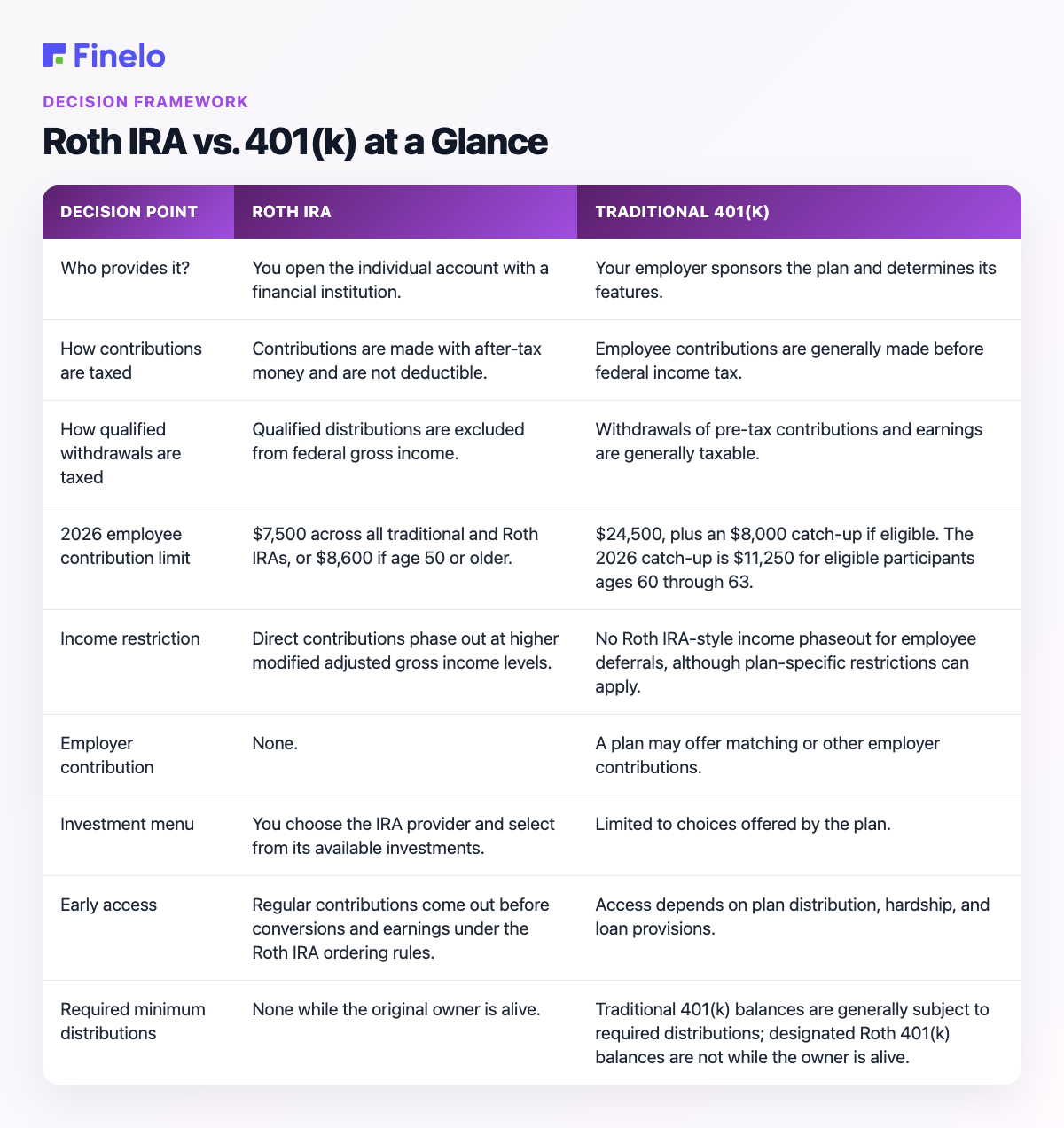
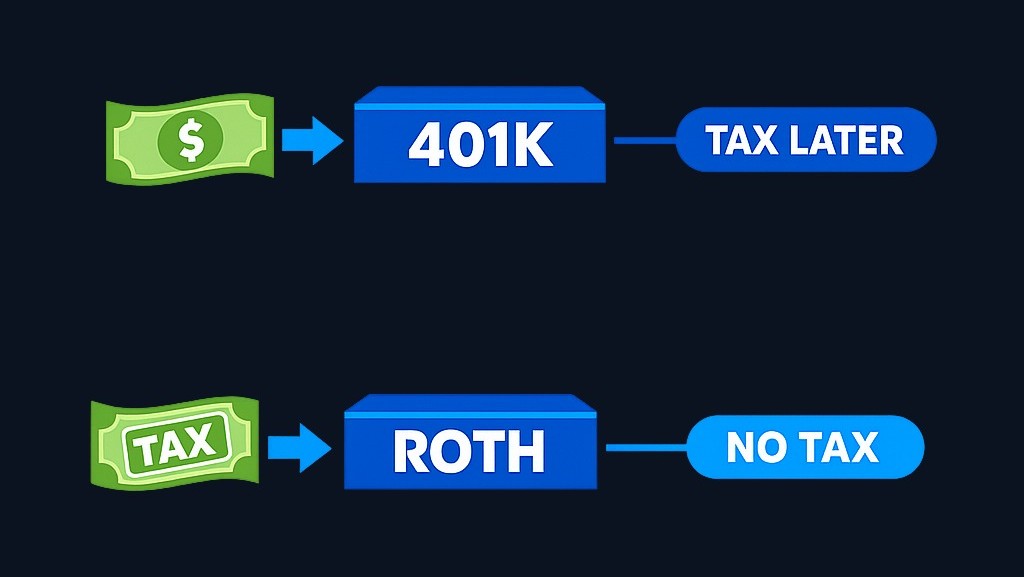
The comparison is not simply “tax-free versus taxable.” A traditional 401(k) can reduce federal taxable income now, while a Roth IRA can make qualified retirement withdrawals tax-free. The decision is partly about when you pay tax and partly about account access, savings capacity, costs, and control.
How the Two Accounts Work
What is a Roth IRA?
A Roth IRA is an individual retirement arrangement set up for you and your beneficiaries. You contribute money that has already been included in taxable income. Contributions are not deductible, but qualified distributions are excluded from federal gross income.
For 2026, your combined regular contributions to all traditional and Roth IRAs cannot exceed $7,500, or $8,600 if you are 50 or older. The limit is also capped by your taxable compensation if that amount is lower.
Eligibility depends on modified adjusted gross income, or MAGI. This is an IRS income calculation used for certain tax rules. For 2026, the Roth IRA contribution phaseout is $153,000 to $168,000 for single filers and heads of household and $242,000 to $252,000 for married couples filing jointly. A phaseout means your permitted contribution shrinks across the range and reaches zero at its upper end. Different rules apply to married people filing separately.
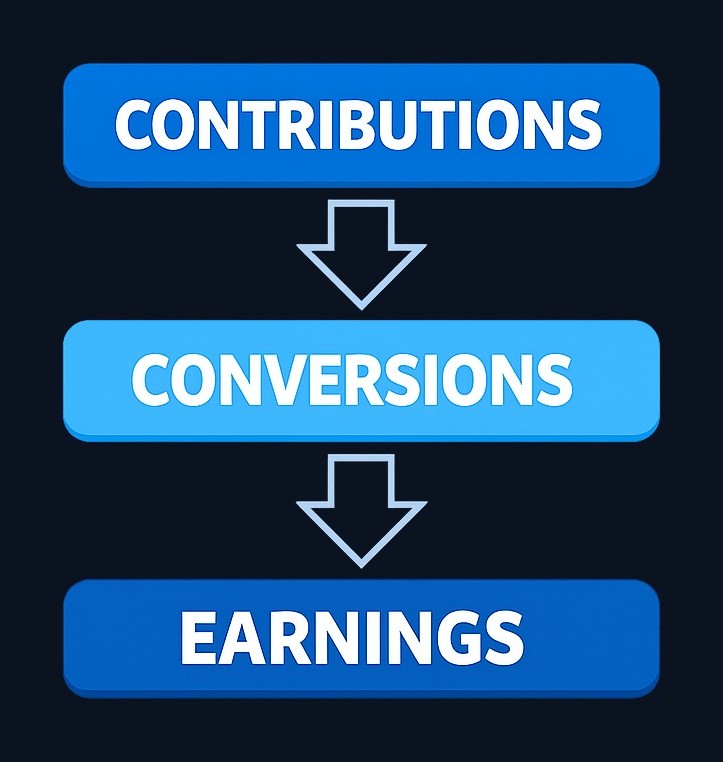
A Roth IRA is also more flexible than a 401(k) when taking back regular contributions. IRS ordering rules treat regular contributions as distributed before conversions and earnings. That does not make every Roth IRA withdrawal tax- and penalty-free. Conversions and earnings have separate rules.
What is a 401(k)?
A 401(k) allows eligible employees to contribute part of their wages to individual accounts inside an employer-sponsored plan. Contributions normally move through payroll. The employer chooses the plan’s eligibility rules, investment menu, fees, matching formula, and optional features.
In a traditional 401(k), employee deferrals are generally made before federal income tax. The deferred contributions and their earnings are usually taxed when withdrawn. A plan may instead offer a designated Roth account. Those employee contributions are taxed now, while qualified Roth 401(k) distributions are generally tax-free. The IRS explains how pre-tax and designated Roth contributions differ.
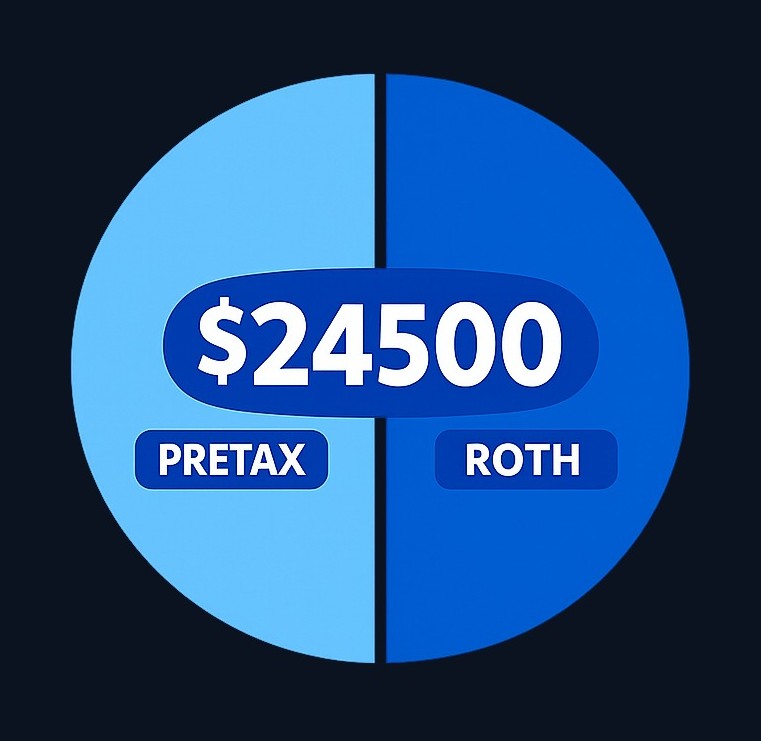
For 2026, an employee can defer $24,500 to traditional and Roth 401(k) accounts combined. Eligible participants age 50 or older may contribute an additional $8,000. The higher catch-up for eligible participants ages 60 through 63 is $11,250.
One 2026 rule deserves attention: participants whose prior-year wages from the plan sponsor exceeded $150,000 must generally make catch-up contributions on a Roth basis when the plan offers catch-ups and has a Roth feature. Ask the plan administrator how the rule applies to your plan.
Key Differences That Affect the Decision
Current tax deduction versus future qualified withdrawals
A traditional 401(k) moves federal income tax on employee deferrals into the future. That can help someone who values reducing taxable income today. A Roth IRA offers no current deduction, but qualified distributions are tax-free.
A Roth IRA distribution is generally qualified after the five-year requirement is met and the distribution occurs after age 59½, because of disability, after death, or for a qualifying first-home distribution. IRS Publication 590-B lists the complete qualified-distribution conditions.
The useful question is not “Which tax benefit is bigger?” It is “When is the tax benefit more useful?” A reader who expects a lower marginal tax rate today than later may value Roth treatment. Someone who values a deduction during higher-income years may prefer pre-tax 401(k) contributions. Future tax rates cannot be known, so many savers use both tax treatments rather than making one forecast carry the entire decision.
Contribution room and eligibility
The 401(k) allows substantially more employee contribution room in 2026. It can therefore be the practical account for someone who wants to save beyond the IRA limit.
The limits are separate. If eligible, you may contribute to both a workplace plan and a Roth IRA in the same year. The IRS confirms that retirement-plan contributions and Roth IRA contributions can coexist, subject to their respective limits and Roth IRA income rules.
Do not confuse the traditional and Roth sides of one 401(k) with separate limits. Pre-tax and designated Roth employee deferrals share the same annual 401(k) employee limit.
Employer match and vesting
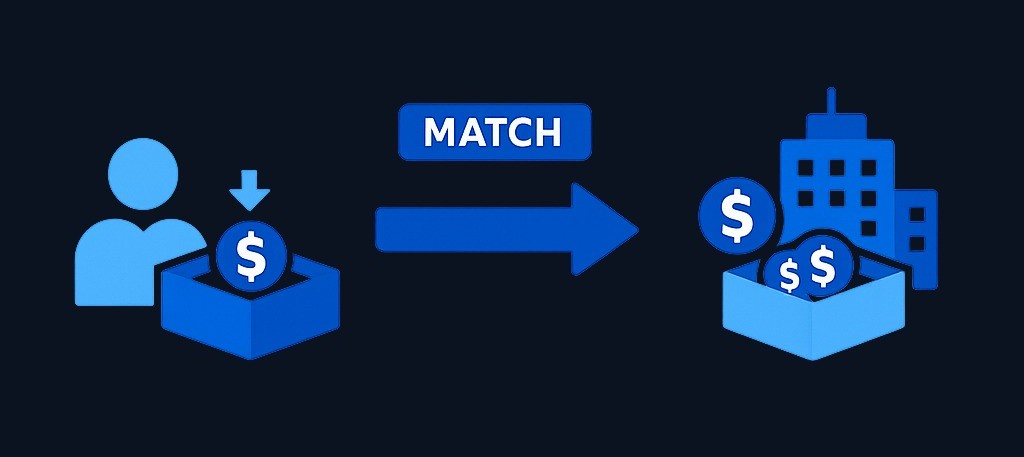
Some employers match part of an employee’s contribution. The plan materials state the formula, how much you must contribute to receive the full match, and any service requirement. The IRS recommends checking the plan information for the matching formula and vesting conditions.
This is why the match often comes first in a decision framework. A Roth IRA cannot provide an employer contribution. Do not assume your plan has a match or that every employer dollar is immediately yours. Read the summary plan description.
Investment control, fees, and administration
A 401(k) restricts you to the plan’s investment menu and service providers. That can simplify decisions, but the menu may not include the fund or fee level you prefer. A Roth IRA lets you choose the provider and available investments, which gives you more control and more responsibility.
Compare actual choices rather than account labels. Review fund expense ratios, plan or account charges, advice fees, diversification, and service. A strong low-cost 401(k) menu can be more attractive than a poorly chosen IRA portfolio. More investment choice is only useful when you use it deliberately.
Withdrawals and required distributions
A Roth IRA allows distributions, but tax treatment depends on what the withdrawal contains. Regular contributions are distributed first, followed by conversions and then earnings. Qualified distributions and returns of regular contributions are not included in gross income. Early distributions involving conversions or earnings can trigger tax or an additional tax.
A 401(k) is less accessible while you work. The plan document states whether it allows hardship distributions or loans. The IRS notes that 401(k) plans may offer loans and that early distributions can create income tax and an additional 10% tax unless an exception applies.
For original owners, Roth IRAs and designated Roth 401(k) accounts do not require lifetime minimum distributions. Traditional 401(k) accounts generally do.
Practice trading with Finelo
Practice in a simulator, learn with bite-sized lessons, and build confidence before risking real money.
When a Roth IRA May Fit Better
A Roth IRA may be a useful next account when:
- You already contribute enough to capture the available 401(k) match. The Roth IRA can add a different tax treatment and separate contribution limit.
- Your current income allows a direct contribution. Check MAGI before contributing, especially if income changes during the year.
- You want more control over the provider and investments. Compare that freedom with the cost and quality of the workplace plan.
- You value access to regular contributions. Treat that flexibility as an emergency backstop, not a reason to spend retirement money casually.
- You want retirement assets without lifetime RMDs. This applies to the original Roth IRA owner, not necessarily to beneficiaries.
Consider a worker early in a career whose employer matches contributions up to the plan’s stated threshold. After contributing enough to receive that match, the worker chooses a Roth IRA because current cash flow supports after-tax contributions and the IRA offers suitable investments. The choice reflects taxes, control, and account design—not a prediction that the Roth IRA will earn more.

A common mistake is funding a Roth IRA first while overlooking an available match. Another is contributing the maximum before checking MAGI. Build the account order only after verifying both.
When a 401(k) May Fit Better
A 401(k) may deserve priority when:
- An employer match is available. Start with the plan’s formula rather than a rule of thumb.
- You need more contribution room. The 2026 employee limit is much higher than the IRA limit.
- A current tax deduction matters. Traditional deferrals may reduce current federal taxable income.
- Payroll automation helps you save consistently. Contributions move from pay into the plan under your election.
- The plan has competitive investments and costs. A well-designed plan can make the restricted menu a benefit rather than a drawback.
- Your income prevents a direct Roth IRA contribution. A traditional 401(k) has no comparable Roth IRA MAGI phaseout. A Roth 401(k), if offered, also has no Roth IRA-style income restriction.
Imagine a mid-career employee who wants to save more than the IRA limit and whose plan offers a suitable diversified investment menu. The employee uses the 401(k)’s larger limit and pre-tax treatment. That does not make a Roth IRA inappropriate; it means the 401(k) better addresses the immediate savings-capacity and tax goals.
Common mistakes include choosing a contribution percentage without checking the match formula, overlooking plan fees, and assuming every 401(k) contribution is pre-tax. Review whether your election goes to the traditional or Roth side of the plan.
A Decision Framework, Including Job Changes
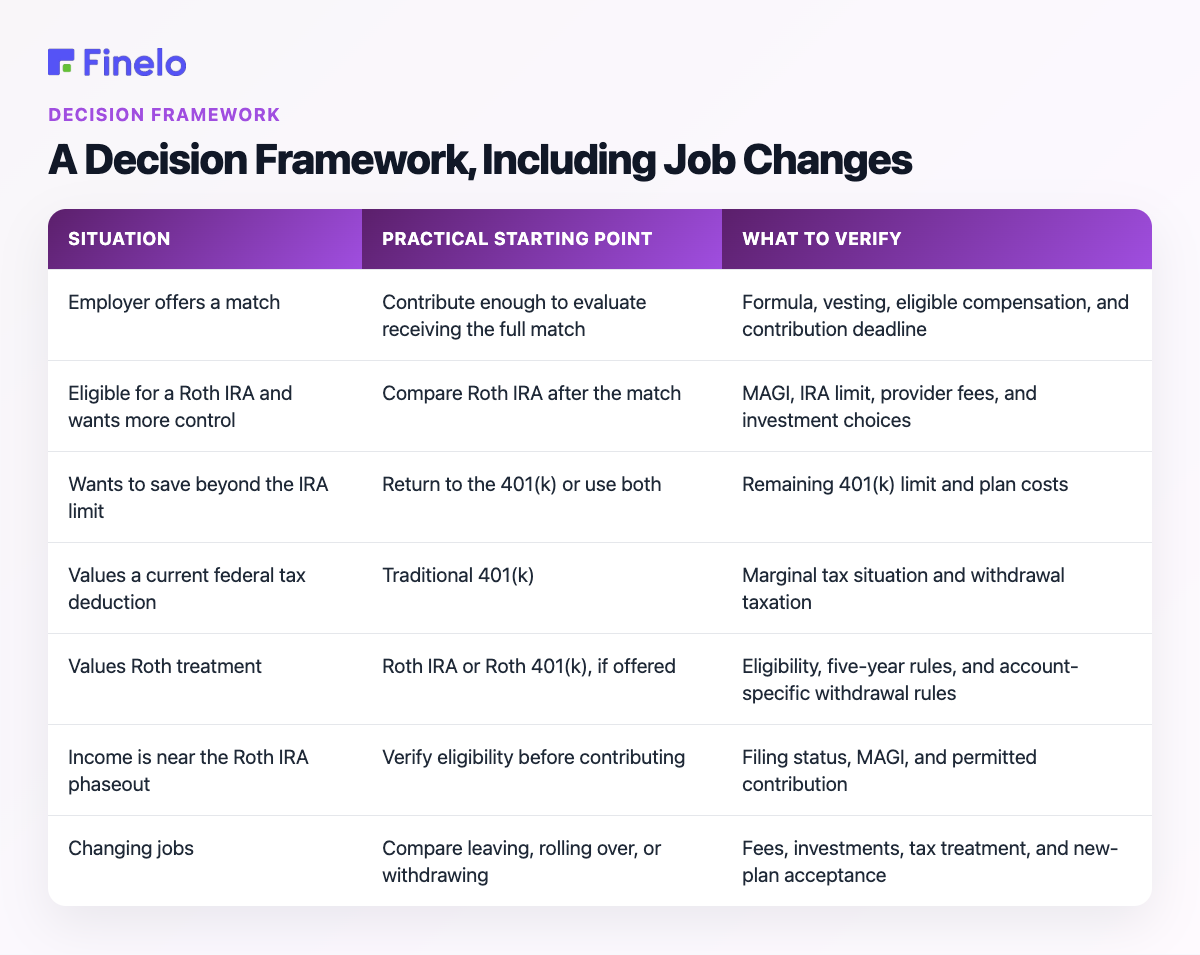
Use this order as a comparison tool, not personalized advice:
| Situation | Practical starting point | What to verify |
|---|---|---|
| Employer offers a match | Contribute enough to evaluate receiving the full match | Formula, vesting, eligible compensation, and contribution deadline |
| Eligible for a Roth IRA and wants more control | Compare Roth IRA after the match | MAGI, IRA limit, provider fees, and investment choices |
| Wants to save beyond the IRA limit | Return to the 401(k) or use both | Remaining 401(k) limit and plan costs |
| Values a current federal tax deduction | Traditional 401(k) | Marginal tax situation and withdrawal taxation |
| Values Roth treatment | Roth IRA or Roth 401(k), if offered | Eligibility, five-year rules, and account-specific withdrawal rules |
| Income is near the Roth IRA phaseout | Verify eligibility before contributing | Filing status, MAGI, and permitted contribution |
| Changing jobs | Compare leaving, rolling over, or withdrawing | Fees, investments, tax treatment, and new-plan acceptance |
When you leave a job, pause before moving the account. Ask the old and new plan administrators which choices are available, which fees and investments apply, and whether the receiving plan accepts transfers.
Do not assume a rollover or Roth conversion will be tax-free. The result depends on the source account, destination account, transaction method, and your circumstances. Compare investment choices, fees, withdrawal features, and administrative convenience. Consider professional tax advice before moving pre-tax money to a Roth account.
Next Steps
Start with your employer’s current plan documents. Record the match formula, vesting rules, traditional and Roth options, investment menu, and fees. Then estimate your 2026 Roth IRA eligibility using your filing status and MAGI.
Choose an initial contribution order and test it against three questions: Does it capture the match? Does the tax treatment fit your current objective? Can you maintain the contribution without relying on retirement withdrawals?
Recheck the plan after a raise, marriage, job change, or major income shift. Contribution limits and tax rules change, so verify current IRS guidance before acting.
Frequently asked questions
Can I have both a Roth IRA and a 401(k)?
Yes. The limits are separate, so eligible savers may contribute to both during the same year. Roth IRA income limits still apply, and traditional and Roth deferrals inside the 401(k) share one employee [limit](https://www.irs.gov/retirement-plans/retirement-plans-faqs-on-designated-roth-accounts).
What is the difference between a Roth IRA and a traditional IRA?
Roth IRA contributions are not deductible, while qualified distributions are excluded from income. Traditional IRA contributions may be deductible, depending on the rules, and taxable amounts are generally taxed when withdrawn. The IRS summarizes the Roth IRA tax [treatment](https://www.irs.gov/taxtopics/tc309).
How do I withdraw money from a Roth IRA?
Request the distribution from the financial institution holding the account, then keep the tax records it provides. The tax result depends on whether the withdrawal consists of regular contributions, conversions, or earnings and whether it is qualified. IRS Publication 590-B explains the ordering and qualification [rules](https://www.irs.gov/publications/p590b).
What happens if I exceed a contribution limit?
An excess IRA contribution can face a 6% annual tax while it remains in the [account](https://www.irs.gov/retirement-plans/plan-participant-employee/retirement-topics-ira-contribution-limits). For an excess 401(k) deferral, notify the plan administrator and request a corrective distribution by the IRS [deadline](https://www.irs.gov/retirement-plans/plan-participant-employee/retirement-topics-401k-and-profit-sharing-plan-contribution-limits). Contact the account provider, plan administrator, or a tax professional promptly.
Financial LiteracyBeginnerRetirementPersonal Finance
Practice trading with Finelo
Practice in a simulator, learn with bite-sized lessons, and build confidence before risking real money.
About the author
Finelo Team
The Finelo Team creates practical investing and trading education designed to help beginners learn faster with structured challenges, simulator practice, and bite-sized lessons.
Keep reading — Related articles

Financial Literacy
Mercury Books Review 2026: Is It Worth It for Startups?
Mercury Books brings double-entry accounting into Mercury. Review its $35 pricing, reports, AI features, integrations, and migration limits.
Finelo Team

Financial Literacy
Why is My FICO Score Lower Than My Credit Score?
Example takeaway: seeing a higher score in a bank app doesn’t guarantee lenders will see the same FICO number at application time; lenders often pull a specific FICO version from a specific bureau.
Finelo Team
Financial Literacy
Why Is My FICO Score Higher Than My Credit Score?
Brief educational note: this article is educational, not financial or investment advice; investing and credit decisions involve risk and possible loss.
Finelo Team