The core difference is when you pay taxes. A traditional IRA can give you a tax deduction now, with withdrawals taxed in retirement. A Roth IRA does the reverse: you contribute after-tax money, and qualified withdrawals come out tax-free. Both accounts share the same $7,500 contribution limit for 2026 — $8,600 if you're over 50.
Traditional IRA vs Roth IRA: Understanding the Differences
The core difference is when you pay taxes. A traditional IRA can give you a tax deduction now, with withdrawals taxed in retirement. A Roth IRA does the reverse: you contribute after-tax money, and qualified…
8 min read
Practice trading with Finelo
Practice in a simulator, learn with bite-sized lessons, and build confidence before risking real money.
Want to learn more?
Practice in a simulator, learn with bite-sized lessons, and build confidence before risking real money.
Explore FineloExplore Finelo's 28-day challenges
Turn learning into a daily habit with guided challenge paths.
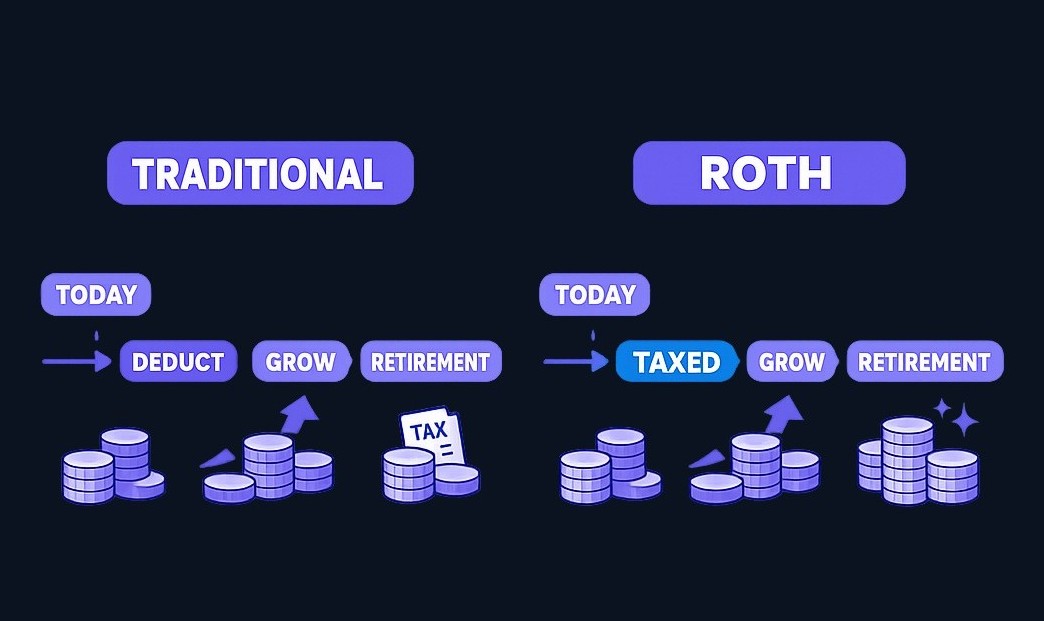
The decision hinges mostly on one question: will your tax bracket in retirement be higher or lower than it is today? Schwab's framing is the standard one — a Roth suits people expecting a higher bracket at withdrawal time, while a traditional IRA suits those expecting the same or a lower bracket. Below: how each account works, the full difference-by-difference comparison, and a decision table for your situation.
What is a Traditional IRA?
A traditional IRA is a retirement account funded with money that may be deductible from this year's taxable income. Its tax logic runs "save now, pay later":
- Contributions may be tax-deductible if you meet income requirements, which lowers today's tax bill.
- Growth is tax-deferred — no annual taxes on dividends or gains inside the account.
- Withdrawals are taxed as income when you take money out, and penalty-free after age 59½.
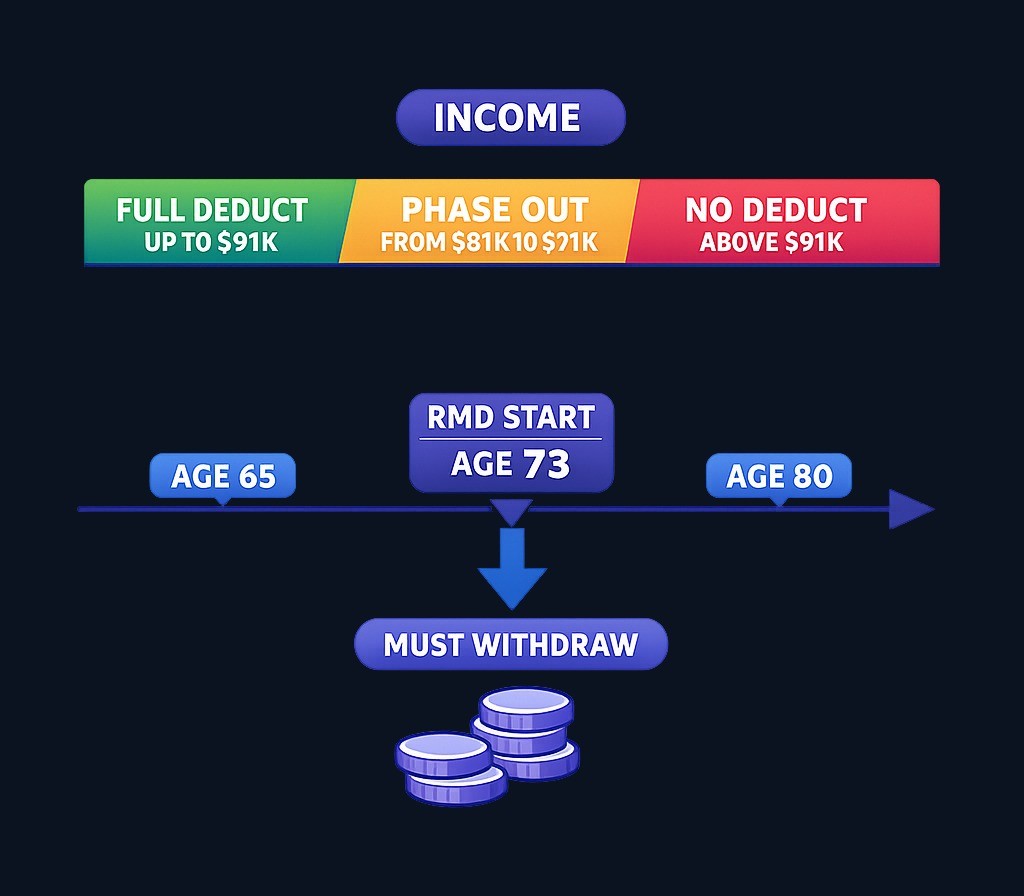
Two catches matter. First, deductibility can shrink if you have a workplace retirement plan: for 2026, the deduction phases out between $81,000 and $91,000 of income for single filers, and between $129,000 and $149,000 for joint filers. No workplace plan? You can deduct in full regardless of income. Second, the tax bill eventually comes due on a schedule: required minimum distributions (RMDs) generally start at age 73, whether you need the money or not.
Anyone with earned income can contribute to a traditional IRA — the income rules affect only the deduction.
What is a Roth IRA?
A Roth IRA flips the tax timing. You contribute after-tax dollars — contributions are not deductible — and in exchange, the account's tax logic runs "pay now, free later":
- Growth is tax-free, not just deferred.
- Qualified withdrawals are penalty- and tax-free after five years and age 59½.
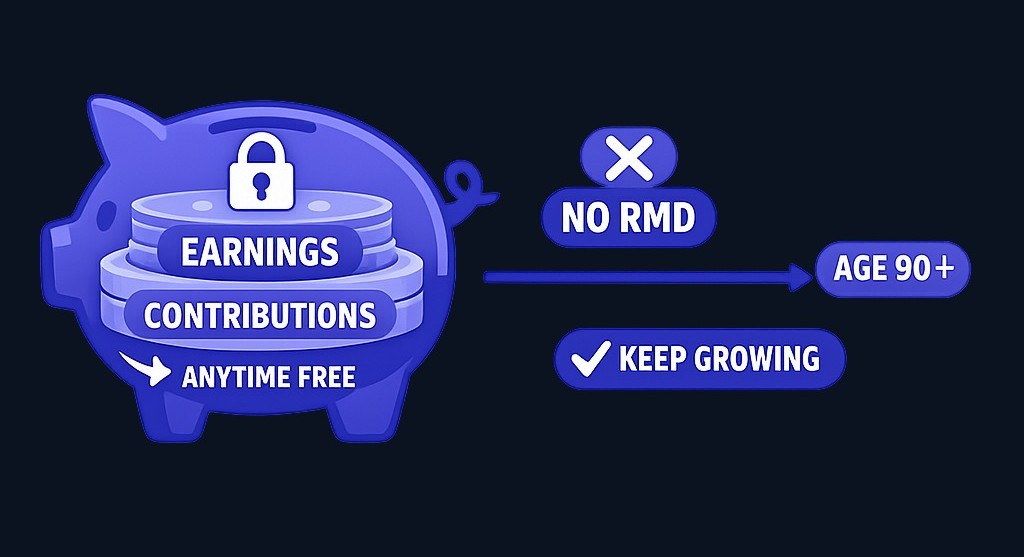
- Contributions (the money you put in, not the earnings) can be withdrawn any time, for any reason, without tax or penalty — a flexibility no traditional IRA offers.
- No RMDs. Roth IRAs never force withdrawals, so money can keep compounding untouched for life.
The catch is eligibility. Direct Roth contributions are limited to people with earned income below certain thresholds. For 2026, eligibility phases out between $153,000 and $168,000 of income for single filers, and between $242,000 and $252,000 for joint filers. Above those ranges, direct contributions close off.
Key Differences Between Traditional and Roth IRAs
| Factor | Traditional IRA | Roth IRA |
|---|---|---|
| Tax break timing | Now — deductible contributions if eligible | Later — tax-free qualified withdrawals |
| 2026 contribution limit | $7,500; $8,600 if over 50 | Same — $7,500; $8,600 if over 50 |
| Who can contribute | Anyone with earned income | Income limits apply |
| Withdrawals in retirement | Taxed as income, penalty-free after 59½ | Tax-free after 5 years and age 59½ |
| Early access | 10% penalty may apply before 59½ | Contributions withdrawable anytime; early earnings may face taxes plus 10% penalty |
| RMDs | Yes, generally from age 73 | None |
| Best suited for | Same or lower tax bracket in retirement | Higher tax bracket in retirement |
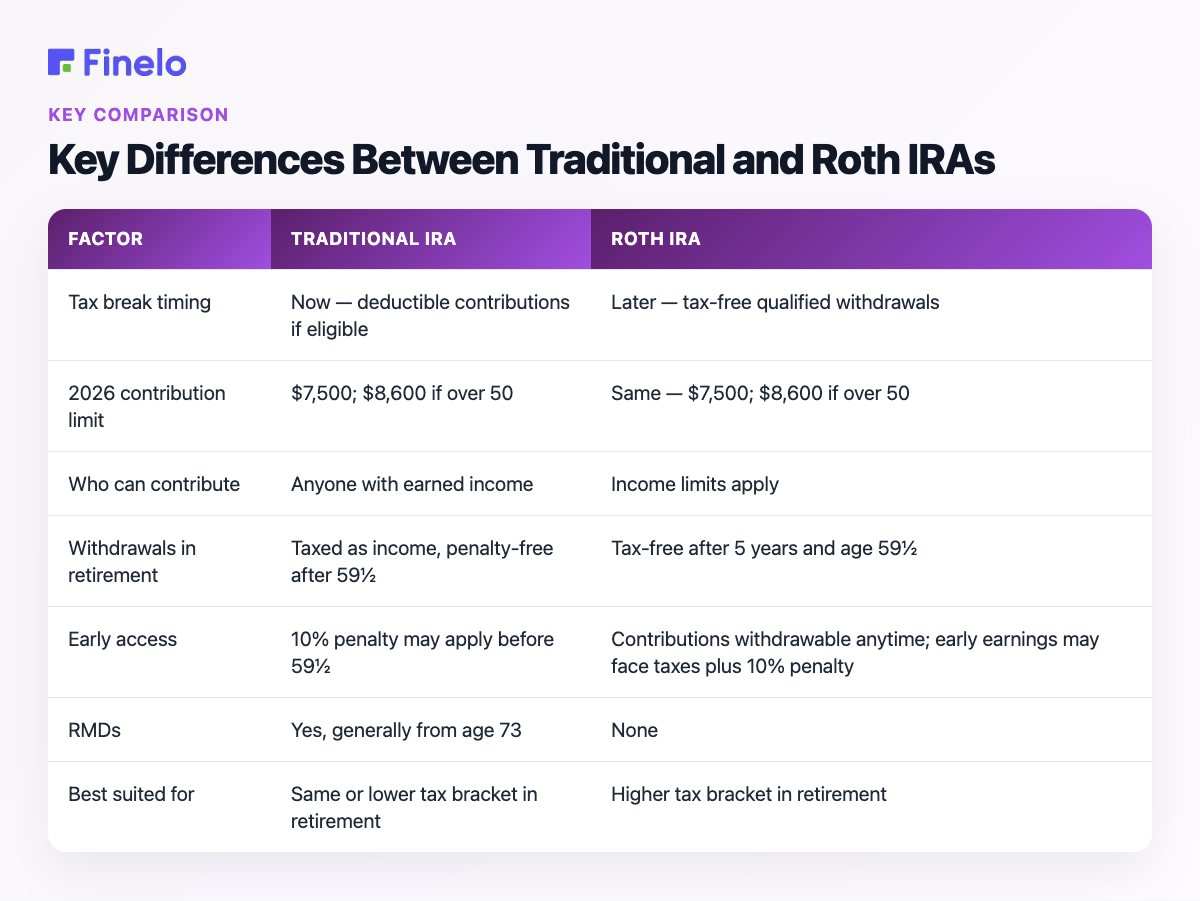
The table's shape tells the story: the accounts are twins on limits and investment freedom, opposites on tax timing and flexibility. The traditional IRA wins the today battle — a deduction you can feel this April. The Roth wins the tomorrow battle — no taxes on decades of growth, no forced withdrawals, and emergency access to contributions.
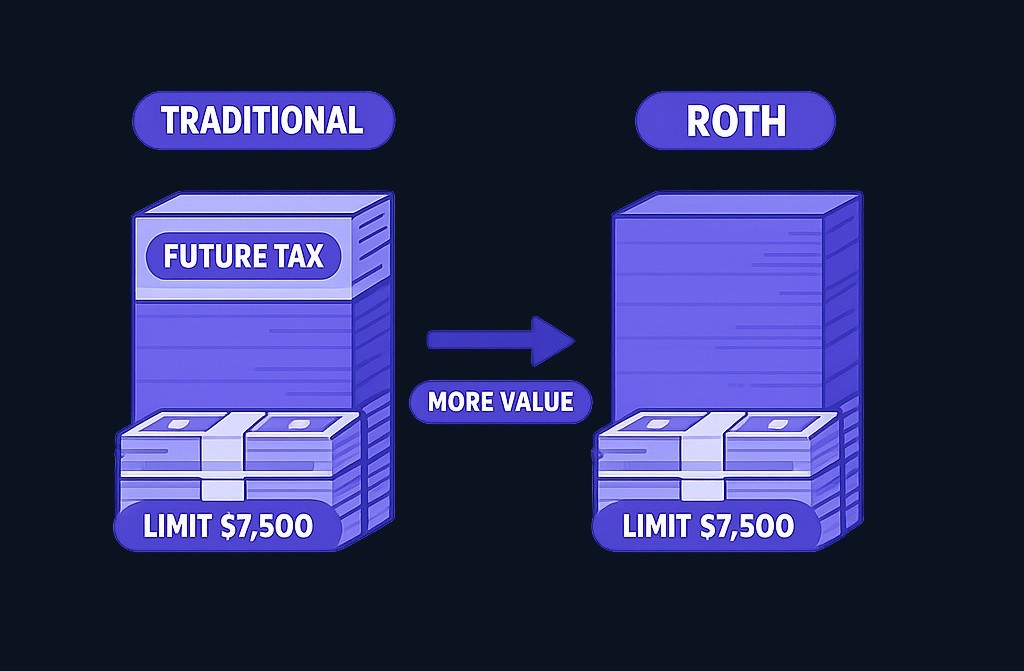
One number worth internalizing: because the $7,500 limit is the same for both, a Roth contribution is effectively bigger. Filling a Roth with $7,500 of after-tax money shelters more real purchasing power than $7,500 of pre-tax money that still owes taxes on the way out.
Practice trading with Finelo
Practice in a simulator, learn with bite-sized lessons, and build confidence before risking real money.
When to Choose a Traditional IRA
The traditional IRA tends to fit when today's tax rate is the problem:
- You're in your peak earning years. If you expect the same or a lower bracket in retirement, deducting now and paying later at a lower rate is the winning trade.
- You qualify for the full deduction. Below the 2026 phase-out ranges — or with no workplace plan at all — the upfront break is guaranteed value.
- You earn too much for a Roth. Above the Roth income limits, the traditional IRA remains open to anyone with earned income.
- You need the deduction to free up cash. The tax savings can fund other priorities — including more investing.
A worked example: someone earning $95,000 contributes $7,500 to a deductible traditional IRA. In the 22% federal bracket, that's roughly $1,650 shaved off this year's taxes. If they later withdraw that money in retirement at a 12% effective rate, they've kept the 10-point spread. That spread — bracket now versus bracket later — is the entire economic engine of the traditional choice.
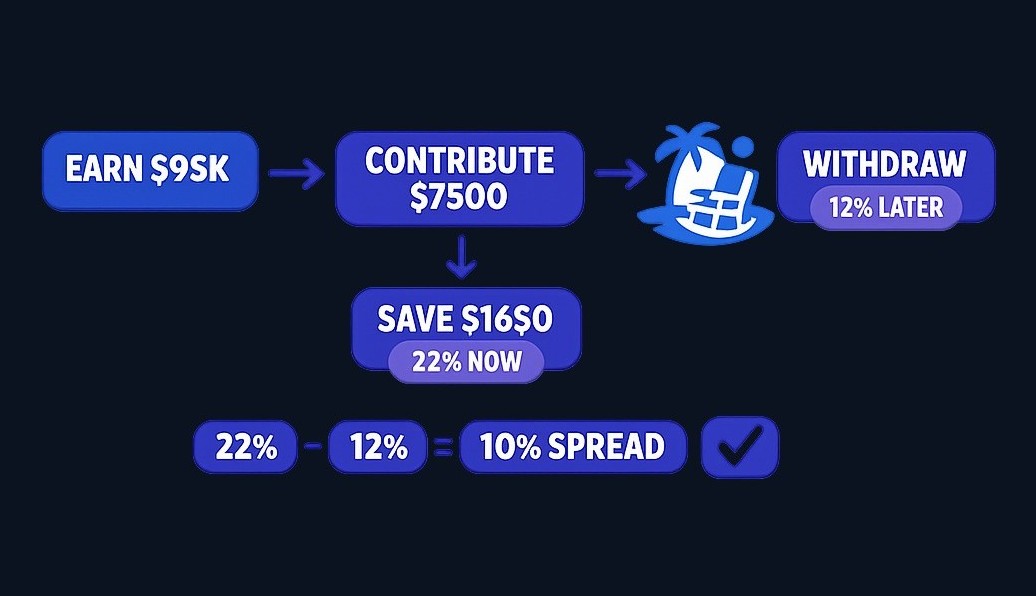
The trade-offs to accept: taxes on every withdrawal, and RMDs from age 73 that force taxable income onto your schedule, not yours.
When to Choose a Roth IRA
The Roth tends to fit when tomorrow's tax rate — or flexibility — is the priority:
- You're early in your career. Income and tax brackets usually climb over time. Paying tax now at a low rate, then withdrawing tax-free later, is the classic young-saver play.
- You expect higher taxes in retirement — from a growing career, other income sources, or a belief that rates in general will rise.
- You value escape hatches. Contributions come back out anytime, tax- and penalty-free — not a reason to raid retirement savings, but real peace of mind.
- You want to leave money compounding. With no RMDs, a Roth can grow untouched into your 80s or pass to heirs.
A mirror-image example: a 27-year-old earning $52,000 sits in a modest bracket today. The deduction a traditional IRA offers is worth relatively little now — but decades of growth on a $7,500 annual Roth contribution could all come out tax-free. The lower your current bracket, the cheaper it is to "prepay" the tax.
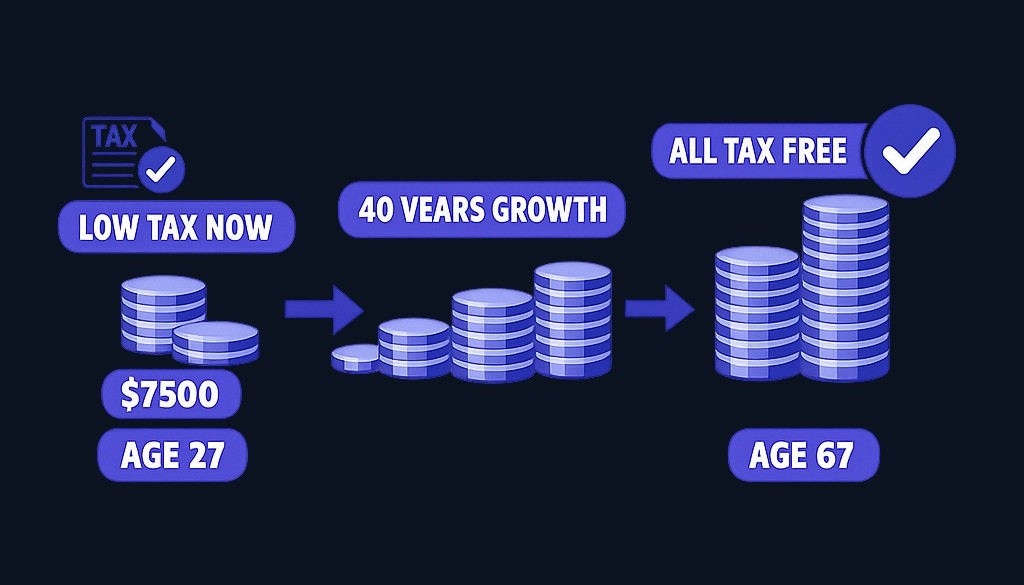
The trade-offs: no deduction today, and the income limits that can phase you out of direct contributions as your salary grows — one reason many savers prioritize Roth contributions in their lower-earning years while they still qualify.
Comparative Analysis: Decision Table
Match your situation to a next step:
| Your situation | Leans toward |
|---|---|
| Expect a lower tax bracket in retirement | Traditional |
| Expect a higher tax bracket in retirement | Roth |
| Early career, modest income today | Roth — prepay tax while it's cheap |
| Peak earnings, want a deduction now | Traditional — if you're within the deduction limits |
| Income above Roth limits | Traditional — it stays open at any income |
| Want emergency access to what you've contributed | Roth — contributions exit tax- and penalty-free |
| Hate the idea of forced withdrawals at 73 | Roth — no RMDs |
| Genuinely can't predict your future bracket | Split contributions between both |
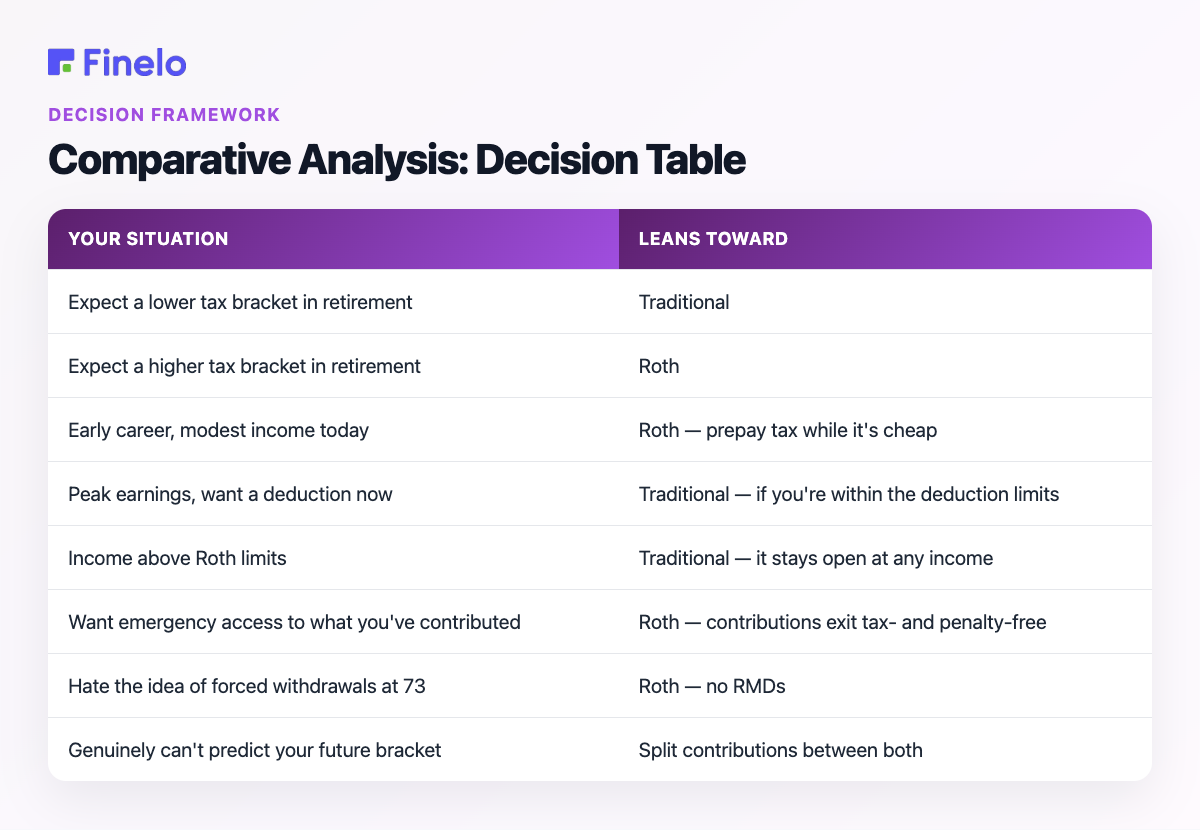
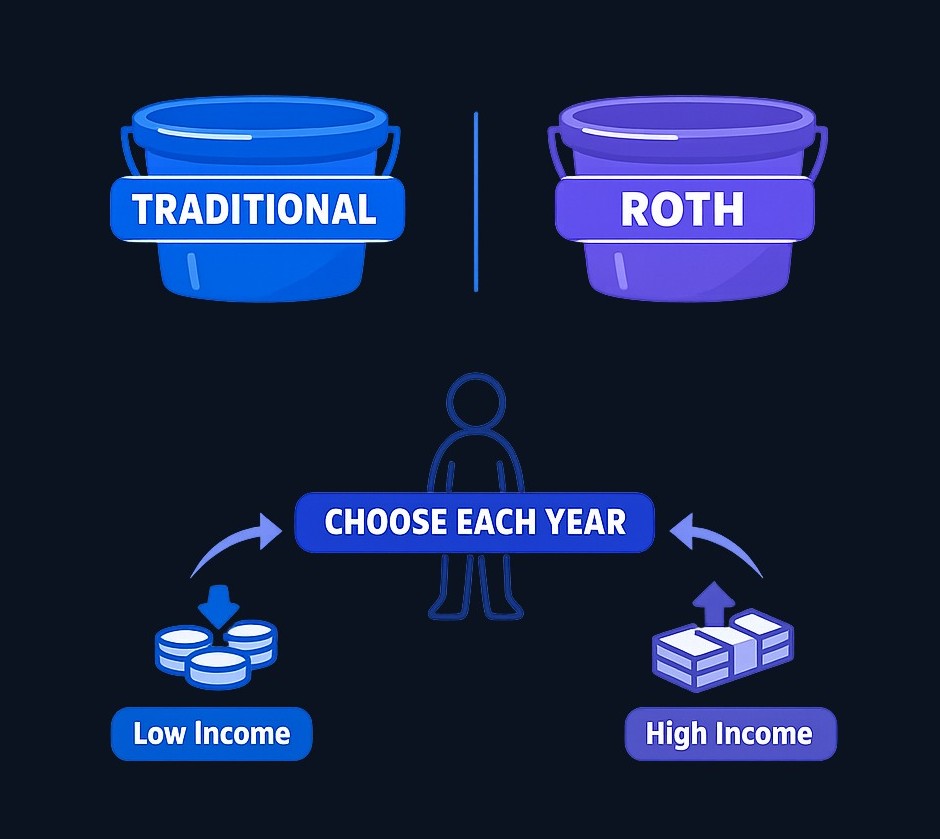
That last row deserves emphasis. Your future tax bracket is a forecast, and forecasts miss. Holding both account types — "tax diversification" — means that in any retirement year, you can choose which bucket to draw from based on that year's tax situation. You can also use a calculator that compares the two based on your income and future-tax assumptions to pressure-test your choice, since the right answer varies person to person with income, current taxes, and long-term goals.
Conclusion and Next Steps
Traditional versus Roth comes down to a tax-timing bet: deduct now and pay later, or pay now and never again. Expect a lower bracket in retirement — lean traditional. Expect higher — lean Roth. Unsure — split. Before contributing, check the current limits and income thresholds, since they adjust over time.
This comparison is educational, not personalized tax or financial advice — your situation may involve factors these general rules don't capture, so verify with a tax professional.
Want to strengthen the financial foundations behind decisions like this? Finelo's Wealth Growth Quiz can point you to a learning path that fits your starting level.
Frequently asked questions
Can I have both a traditional and a Roth IRA?
Yes — many savers hold both for tax diversification. Just note the $7,500 annual limit ($8,600 if over [50)](https://www.schwab.com/ira/roth-vs-traditional-ira) is your total across IRA contributions for the year, not per account.
What are the penalties for early withdrawal?
Generally, taking money out before 59½ risks a 10% federal penalty plus applicable [taxes](https://www.fidelity.com/retirement-ira/ira-comparison), with certain exceptions. The Roth's carve-out: your own contributions come out anytime without tax or [penalty](https://www.fidelity.com/retirement-ira/ira-comparison) — the rule applies to earnings.
Can I convert a traditional IRA to a Roth IRA?
Conversions are allowed and have no income limit, but converted pre-tax money is treated as taxable income in the year you convert. That upfront tax bill is the price of moving money into the tax-free bucket, so many people convert gradually in lower-income years. Check current IRS rules or a tax professional before converting.
How does my income affect these accounts?
Income never blocks traditional IRA *contributions* — only the deduction, which phases out if you have a workplace [plan](https://www.fidelity.com/retirement-ira/ira-comparison). For Roths, income limits restrict [contributions themselves](https://www.fidelity.com/retirement-ira/ira-comparison).
Financial LiteracyBeginnerRetirementPersonal Finance
Practice trading with Finelo
Practice in a simulator, learn with bite-sized lessons, and build confidence before risking real money.
About the author
Finelo Team
The Finelo Team creates practical investing and trading education designed to help beginners learn faster with structured challenges, simulator practice, and bite-sized lessons.
Keep reading — Related articles

Financial Literacy
Mercury Books Review 2026: Is It Worth It for Startups?
Mercury Books brings double-entry accounting into Mercury. Review its $35 pricing, reports, AI features, integrations, and migration limits.
Finelo Team

Financial Literacy
Why is My FICO Score Lower Than My Credit Score?
Example takeaway: seeing a higher score in a bank app doesn’t guarantee lenders will see the same FICO number at application time; lenders often pull a specific FICO version from a specific bureau.
Finelo Team

Financial Literacy
Why Is My FICO Score Higher Than My Credit Score?
Brief educational note: this article is educational, not financial or investment advice; investing and credit decisions involve risk and possible loss.
Finelo Team


