For U.S. readers: This article discusses U.S. rules and financial products. State rules and individual eligibility may differ.
S Corporation Self-Employment Tax: Wages, Distributions, and Reasonable Compensation
An S corporation shareholder’s pass-through share of ordinary business income is generally not subject to self-employment tax.
8 min read
Practice trading with Finelo
Practice in a simulator, learn with bite-sized lessons, and build confidence before risking real money.
Want to learn more?
Practice in a simulator, learn with bite-sized lessons, and build confidence before risking real money.
Explore FineloExplore Finelo's 28-day challenges
Turn learning into a daily habit with guided challenge paths.
Quick answer
An S corporation shareholder’s pass-through share of ordinary business income is generally not subject to self-employment tax. But a shareholder who performs more than minor services for the corporation is generally an employee, and payments for those services must be treated as reasonable wages subject to employment taxes before non-wage distributions are used.
An S election does not make business profit tax-free. Shareholders generally report their allocated S corporation income for federal income-tax purposes whether or not the corporation distributes cash.
Finelo provides general financial education, not tax, legal, investment, or individualized financial advice. Entity choice, reasonable compensation, basis, state tax, payroll, and benefit rules require fact-specific analysis.
Self-employment tax and employment tax are different
Self-employment tax generally refers to Social Security and Medicare tax calculated on net earnings from self-employment. Sole proprietors and many partners use Schedule SE to calculate it.
An S corporation shareholder-employee is different:
- W-2 wages are generally subject to Social Security and Medicare employment taxes, with employee withholding and employer contributions.
- The shareholder’s pass-through share of S corporation net income is generally not subject to self-employment tax.
- Non-wage distributions are not a substitute for required reasonable compensation.
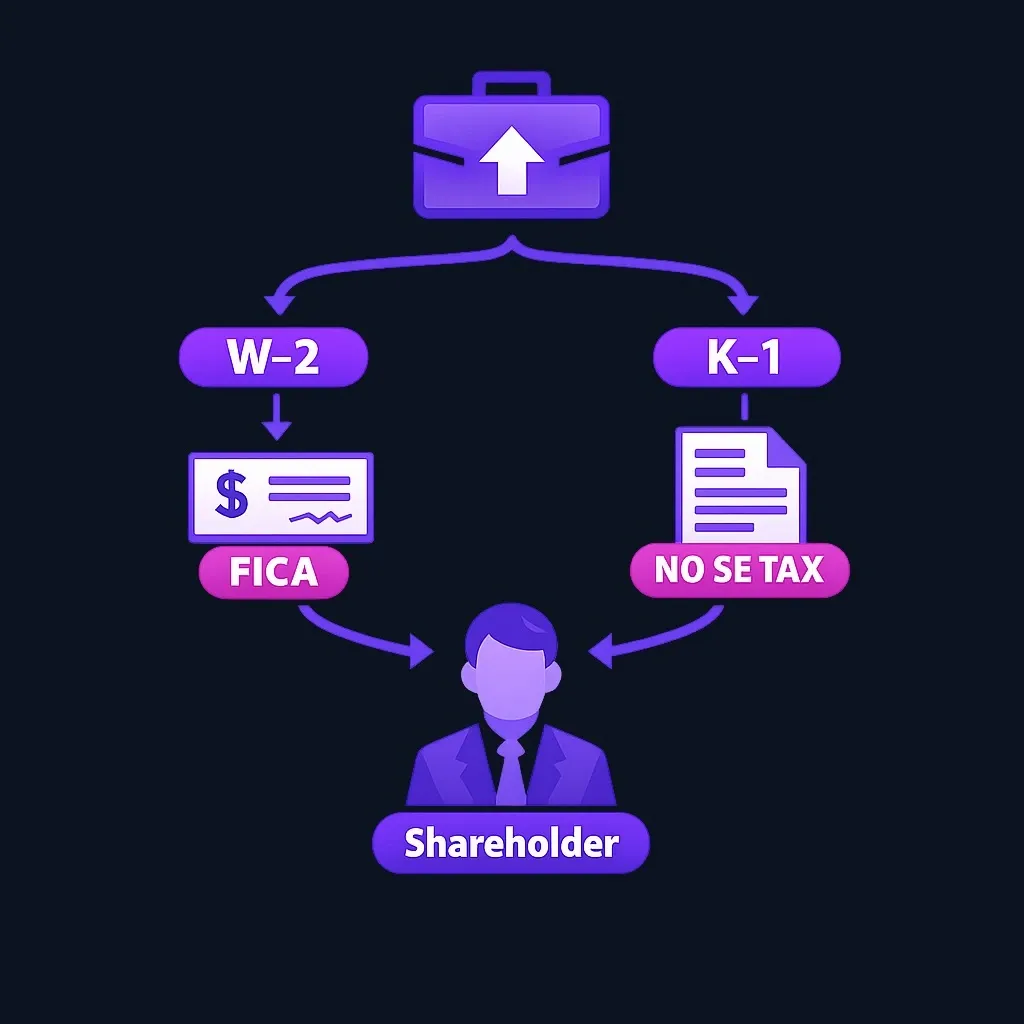
The IRS confirms that an S corporation’s pass-through net income is not self-employment income in the Instructions for Schedule E. The corporation must still run payroll correctly for shareholder-employees.
Why reasonable compensation is central
The IRS states that an S corporation must pay reasonable compensation to a shareholder-employee for services before making non-wage distributions to that shareholder-employee. It may reclassify distributions or other payments as wages when they represent compensation for services.
There is no universal percentage split between wages and distributions. A “60/40 rule,” fixed profit percentage, or industry shortcut is not an IRS safe harbor.
The IRS lists factors such as:
- training and experience;
- duties and responsibilities;
- time and effort devoted to the business;
- payments to non-shareholder employees;
- comparable compensation for similar work;
- compensation agreements;
- dividend history; and
- how the company’s gross receipts are generated.
When receipts primarily come from the shareholder’s personal services, a larger portion of payments may need wage treatment. When receipts depend more on non-shareholder labor, capital, or equipment, that may support a different result.
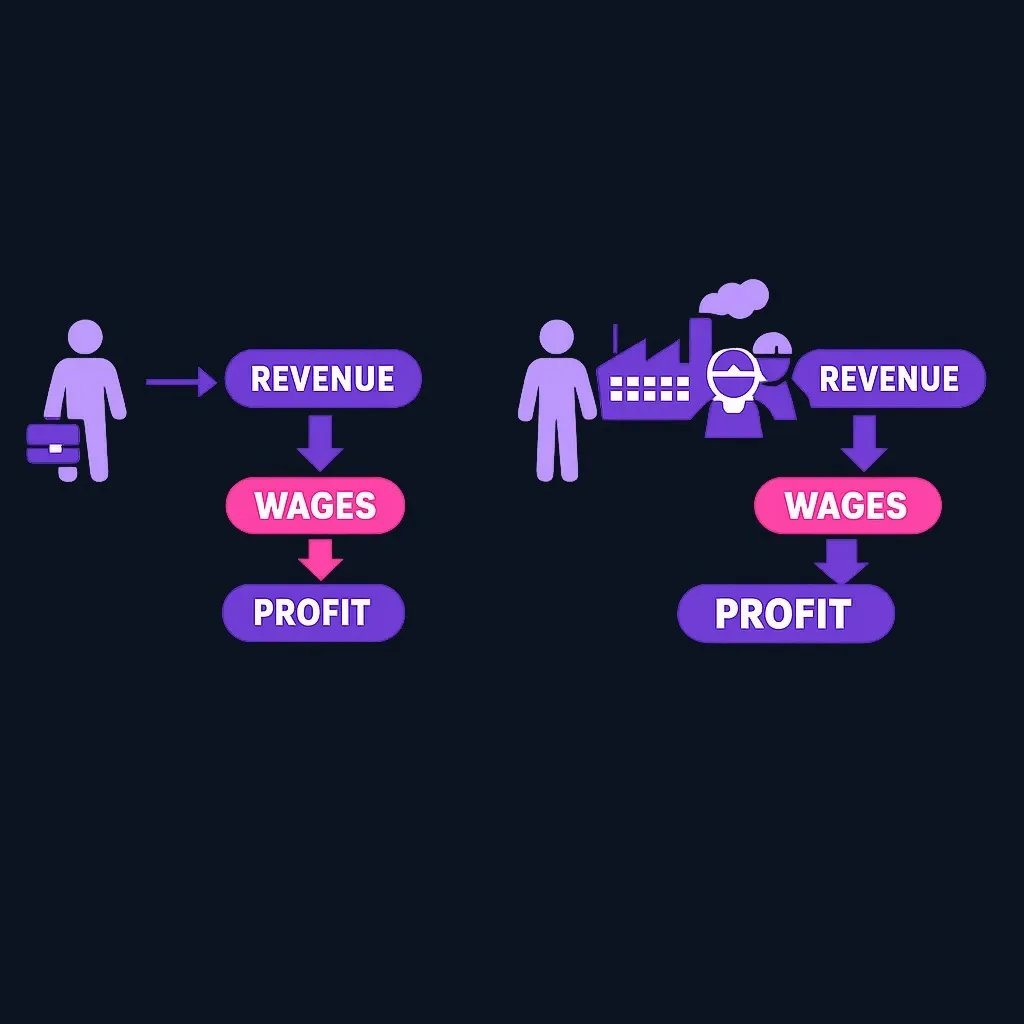
Official source: S Corporation Compensation and Medical Insurance Issues — IRS.
Wages, pass-through income, and distributions
These terms should not be used interchangeably.
| Item | Federal income-tax treatment | Social Security and Medicare treatment |
|---|---|---|
| W-2 wages | Included in employee income; generally deductible by the corporation if otherwise allowable | Generally subject to employment taxes |
| Pass-through S corporation income | Reported by the shareholder whether or not cash is distributed | Generally not subject to self-employment tax |
| Cash distribution within stock basis | Generally reduces basis and is often not taxed again when distributed | Generally not subject to employment taxes, but cannot replace reasonable wages |
| Distribution exceeding basis | May create taxable gain | Requires basis and distribution analysis |
The taxability of a distribution depends on basis and other corporate history. “Distribution” does not mean “tax-free money.” See IRS Publication 550 for general S corporation distribution and basis concepts.
A hypothetical comparison
Assume a business owner expects $120,000 of business income before owner compensation and related employer payroll costs. The result is not found by arbitrarily labeling $40,000 as wages and $80,000 as a distribution.
A defensible analysis would first evaluate the market value of the owner’s services, the hours and duties performed, how revenue is produced, and what comparable businesses pay. If reasonable compensation is determined to be $85,000, the corporation would process that amount through payroll. Remaining pass-through income and any later cash distribution would follow separate income-tax, basis, and corporate-law rules.
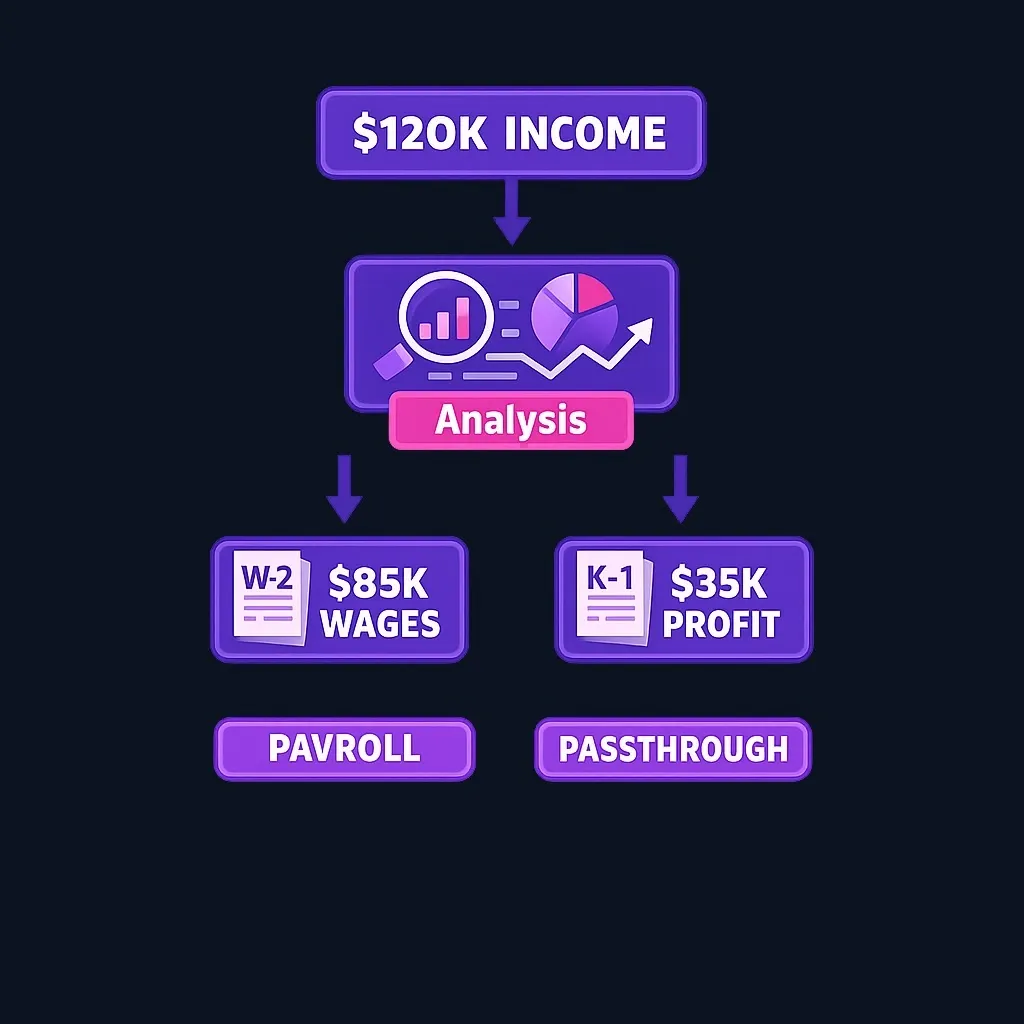
The numbers are hypothetical and do not establish reasonable compensation for any occupation or business.
Practice trading with Finelo
Practice in a simulator, learn with bite-sized lessons, and build confidence before risking real money.
Costs that can offset an employment-tax difference
An S election can add:
- payroll service and tax-deposit administration;
- Form W-2 and employment-tax filings;
- Form 1120-S preparation;
- bookkeeping and basis tracking;
- state franchise, minimum, or entity-level taxes;
- legal and corporate compliance costs; and
- professional fees for compensation and benefit issues.
The comparison should use the net annual effect, not only an estimate of Social Security and Medicare taxes.
Other tax issues an S corporation does not eliminate
Federal and state income tax
Shareholders generally owe income tax on allocated S corporation income even when the corporation retains the cash. States may not fully follow the federal S election or may impose separate taxes.
Estimated tax
Payroll withholding may not cover tax on pass-through income. A shareholder may need additional withholding or estimated payments.
Additional Medicare Tax and Net Investment Income Tax
High-income taxpayers may face additional federal taxes depending on the character of income and participation. The treatment is not captured by a simple wage-versus-distribution comparison.
Retirement-plan contributions
The IRS states that shareholder distributions are not earned income for retirement-plan contribution purposes. Employee salary deferrals and employer contributions generally depend on eligible W-2 compensation. See Retirement Plan FAQs Regarding Contributions — S Corporation.
Health-insurance reporting
Special reporting applies to health premiums paid or reimbursed for a shareholder who owns more than 2% of the S corporation. Correct handling can affect both the corporation’s Form W-2 reporting and the shareholder’s potential deduction.
A neutral decision framework
1. Confirm entity eligibility
An eligible entity makes the federal election on Form 2553 and must satisfy shareholder and stock requirements. State elections may be separate. See About Form 2553.
2. Model the current structure
Record net business income, self-employment tax, income tax, retirement contributions, health-insurance treatment, and current compliance costs.
3. Estimate reasonable compensation
Document the owner’s role, hours, experience, responsibilities, comparable pay, and sources of revenue. Avoid a percentage-only shortcut.
4. Model the S corporation
Include W-2 wages, employer payroll taxes, pass-through income, payroll fees, tax preparation, state taxes, benefit effects, and basis tracking.
5. Stress-test the result
Lower profit can leave too little cash for payroll and compliance. Higher profit can increase income-tax and estimated-payment needs even when cash remains in the corporation.
6. Revisit compensation annually
Reasonable compensation can change as duties, hours, staff, profitability, and market pay change.
Common mistakes
Using a fixed 60/40 or 50/50 split
The IRS uses facts and circumstances, not a universal percentage.
Paying no wages to an active owner
Corporate officers who perform more than minor services and receive or are entitled to payments are generally employees. Reclassification can create back taxes, interest, and penalties.
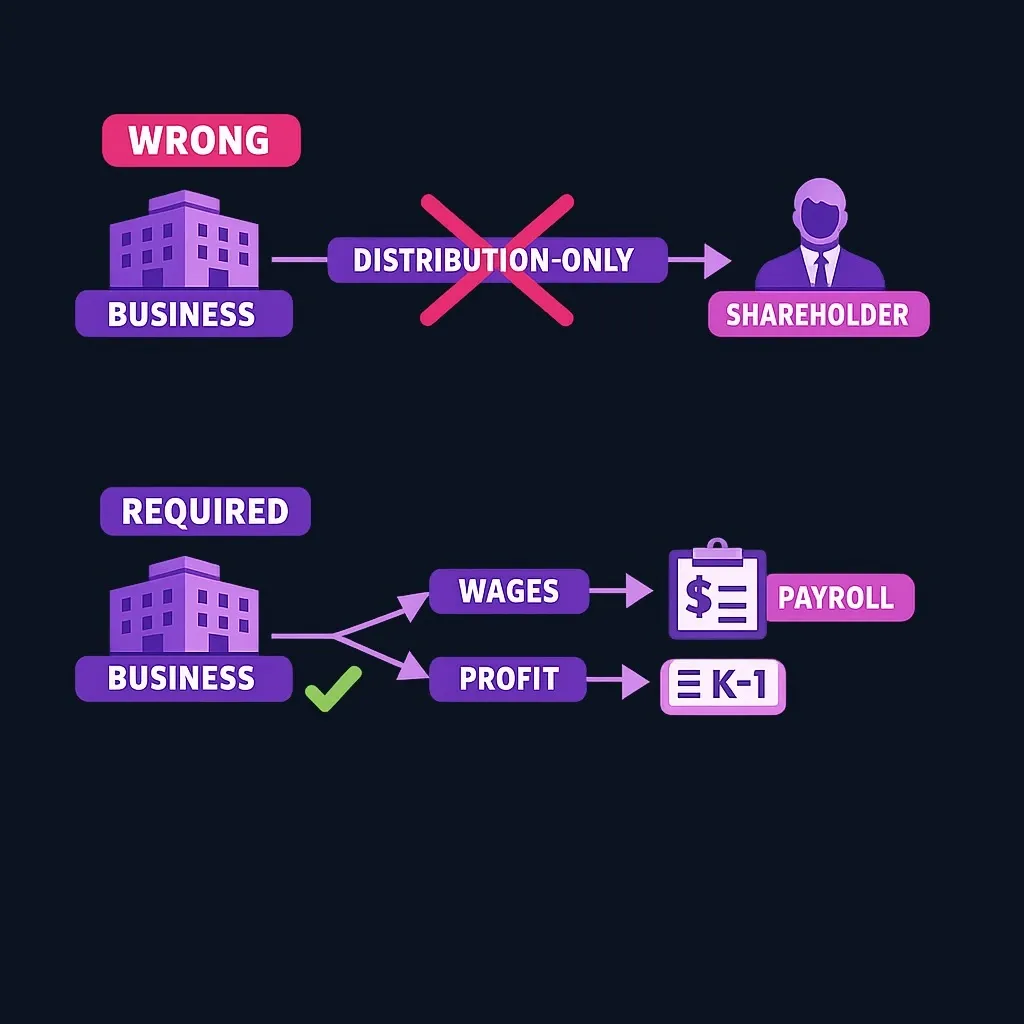
Confusing distributions with pass-through income
Taxable income is allocated on Schedule K-1; cash distributions are separate transactions that affect basis.
Ignoring basis
Distributions exceeding stock basis may produce taxable gain. Loss deductions also depend on basis and other limitations.
Assuming distributions support retirement contributions
S corporation distributions are not compensation for qualified-plan contribution purposes.
Ignoring state rules
State taxes, fees, elections, and payroll obligations can eliminate or reduce an apparent federal benefit.
Frequently asked questions
Is S corporation profit subject to self-employment tax?
The shareholder’s pass-through share of S corporation net income is generally not subject to self-employment tax. Wages paid for the shareholder’s services are generally subject to employment taxes.
Can an owner take only distributions?
An owner who performs more than minor services generally cannot avoid reasonable wages by labeling all payments as distributions. The IRS can reclassify payments.
How is a reasonable salary calculated?
There is no single formula. The analysis considers duties, hours, experience, comparable pay, business size, revenue sources, and other facts documented for the year.
Does an S corporation always reduce taxes?
No. The result depends on reasonable wages, profit, payroll costs, state taxes, professional fees, benefits, and the owner’s wider tax situation.
Is an LLC automatically an S corporation?
No. “LLC” is a state-law entity form. An eligible LLC may elect S corporation tax treatment, but the legal entity and federal tax classification are separate concepts.
Bottom line
The potential S corporation difference comes from treating an active owner as an employee for reasonable wages while pass-through business income is generally excluded from self-employment tax. It is not created by choosing an arbitrary salary or calling compensation a distribution.
Compare the full after-tax and administrative result, document reasonable compensation, and verify federal and state requirements before making or relying on an S election.
For more plain-language small-business tax education, visit the Finelo Blog.
Financial LiteracyFinancial Education
Practice trading with Finelo
Practice in a simulator, learn with bite-sized lessons, and build confidence before risking real money.
About the author
Finelo Team
The Finelo Team creates practical investing and trading education designed to help beginners learn faster with structured challenges, simulator practice, and bite-sized lessons.
Keep reading — Related articles
Financial Literacy
Mercury Books Review 2026: Is It Worth It for Startups?
Mercury Books brings double-entry accounting into Mercury. Review its $35 pricing, reports, AI features, integrations, and migration limits.
Finelo Team

Financial Literacy
Why is My FICO Score Lower Than My Credit Score?
Example takeaway: seeing a higher score in a bank app doesn’t guarantee lenders will see the same FICO number at application time; lenders often pull a specific FICO version from a specific bureau.
Finelo Team
Financial Literacy
Why Is My FICO Score Higher Than My Credit Score?
Brief educational note: this article is educational, not financial or investment advice; investing and credit decisions involve risk and possible loss.
Finelo Team


