For U.S. readers: This article discusses U.S. rules and financial products. State rules and individual eligibility may differ.
Self-Employed and Employed Tax Estimation Worksheet
Finelo provides financial education, not tax, financial, or investment advice.
6 min read
Practice trading with Finelo
Practice in a simulator, learn with bite-sized lessons, and build confidence before risking real money.
Want to learn more?
Practice in a simulator, learn with bite-sized lessons, and build confidence before risking real money.
Explore FineloExplore Finelo's 28-day challenges
Turn learning into a daily habit with guided challenge paths.
Quick answer
If you receive both W-2 wages and self-employment income, your tax planning needs to account for payroll withholding, net business profit, self-employment tax, and any estimated payments already made. This page is a manual worksheet—not an interactive calculator—and it does not generate a tax return or payment amount automatically. Use current IRS forms or tax software for the calculation you will actually file.
Finelo provides financial education, not tax, financial, or investment advice. Tax treatment depends on your complete facts, filing status, deductions, credits, and state rules.
What this worksheet helps you organize
The worksheet brings the main inputs into one place so you can prepare a more informed estimate or a focused conversation with a tax professional:
- W-2 wages and federal income tax withheld
- Gross business or freelance receipts
- Documented business expenses
- Estimated payments already made
- Other income, deductions, and credits that may affect the return
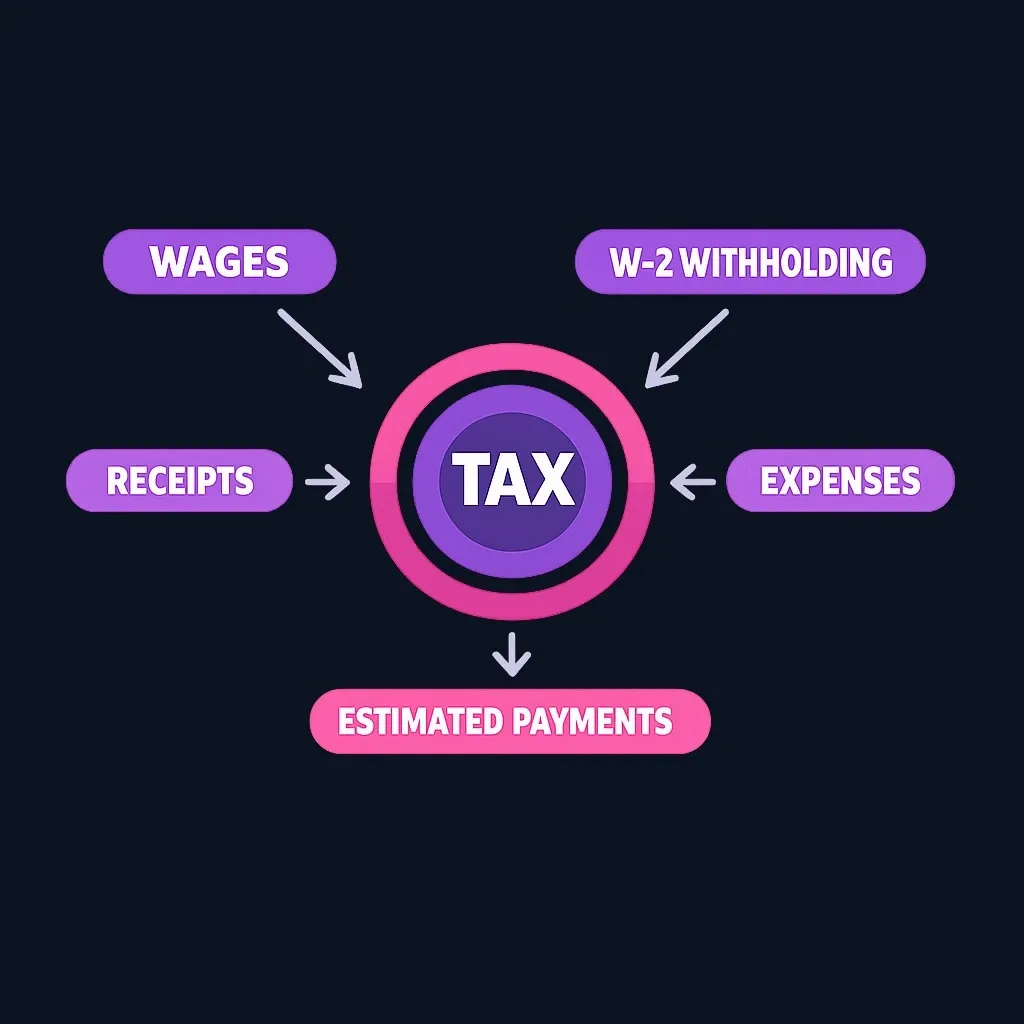
The IRS explains that self-employed people generally file an annual return and may need to make estimated tax payments during the year. Start with the IRS Self-Employed Individuals Tax Center and the current Form 1040-ES instructions.
Before you begin
Gather current year-to-date records rather than relying only on last year's return:
- Recent pay stubs showing federal withholding
- W-2 wage estimates for the full year
- Invoices, payment-platform records, and bank deposits for business receipts
- Receipts and bookkeeping records for possible business expenses
- Confirmation numbers for estimated tax payments
- Records of retirement contributions, health coverage, and other adjustments you plan to discuss with a preparer
Do not treat every cash outflow as a deductible business expense. Eligibility and documentation requirements vary by expense type.
Manual worksheet
| Input | Your amount | Where to verify it |
|---|---|---|
| Expected W-2 wages | $_____ | Pay stubs or employer payroll portal |
| Federal income tax withheld | $_____ | Pay stubs; do not combine with Social Security or Medicare withholding |
| Gross business receipts | $_____ | Invoices, 1099s, platforms, bank records |
| Documented eligible business expenses | $_____ | Bookkeeping records and receipts |
| Estimated payments already made | $_____ | IRS Online Account and payment confirmations |
| Other taxable income | $_____ | Applicable statements and records |
| Adjustments, deductions, and credits | $_____ | Current IRS instructions or tax professional |
Step 1: calculate preliminary business profit
Use a simple starting calculation:
Gross business receipts − eligible business expenses = preliminary net business profit
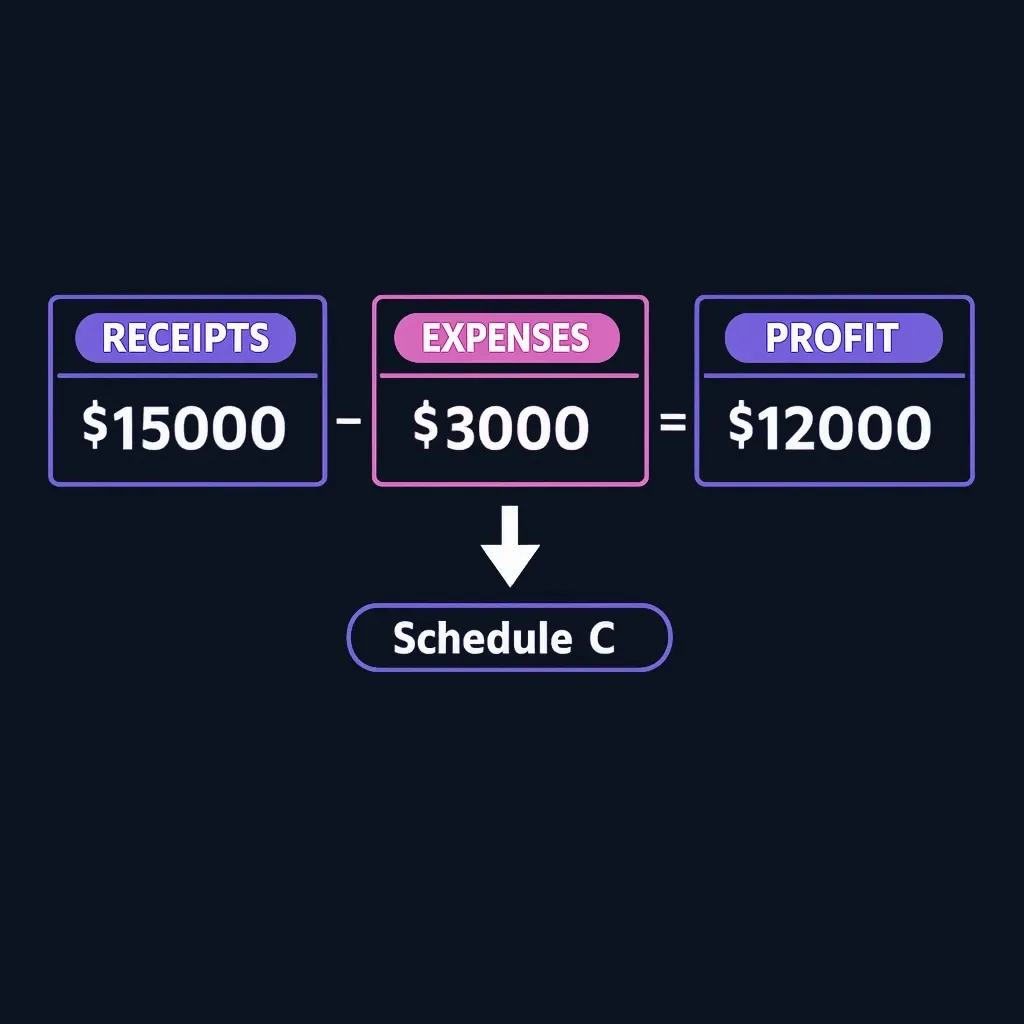
This is an organizing step, not a completed Schedule C. Classification rules, inventory, depreciation, home-office expenses, vehicle expenses, and other items can change the filed result.
Step 2: identify self-employment tax inputs
Self-employment tax generally covers Social Security and Medicare taxes for people who work for themselves. The calculation is completed on Schedule SE and is not simply a flat percentage applied to every dollar of gross receipts. Use the current IRS Schedule SE instructions for the applicable year.
Step 3: combine the annual picture
Form 1040-ES walks through expected adjusted gross income, taxable income, income tax, self-employment tax, credits, withholding, and prior payments. Use the current form rather than copying a rate or threshold from an older article, because tax-year amounts can change.
Step 4: subtract withholding and payments
W-2 withholding may cover part of the tax associated with your combined income. Compare the annual estimate with:
- Expected federal income tax withholding from wages
- Estimated tax payments already made
- Any additional withholding you arrange through payroll
The remaining amount is not automatically your next payment. Form 1040-ES includes rules and worksheets for determining whether estimated payments may be required and how to calculate them.
Worked organizing example
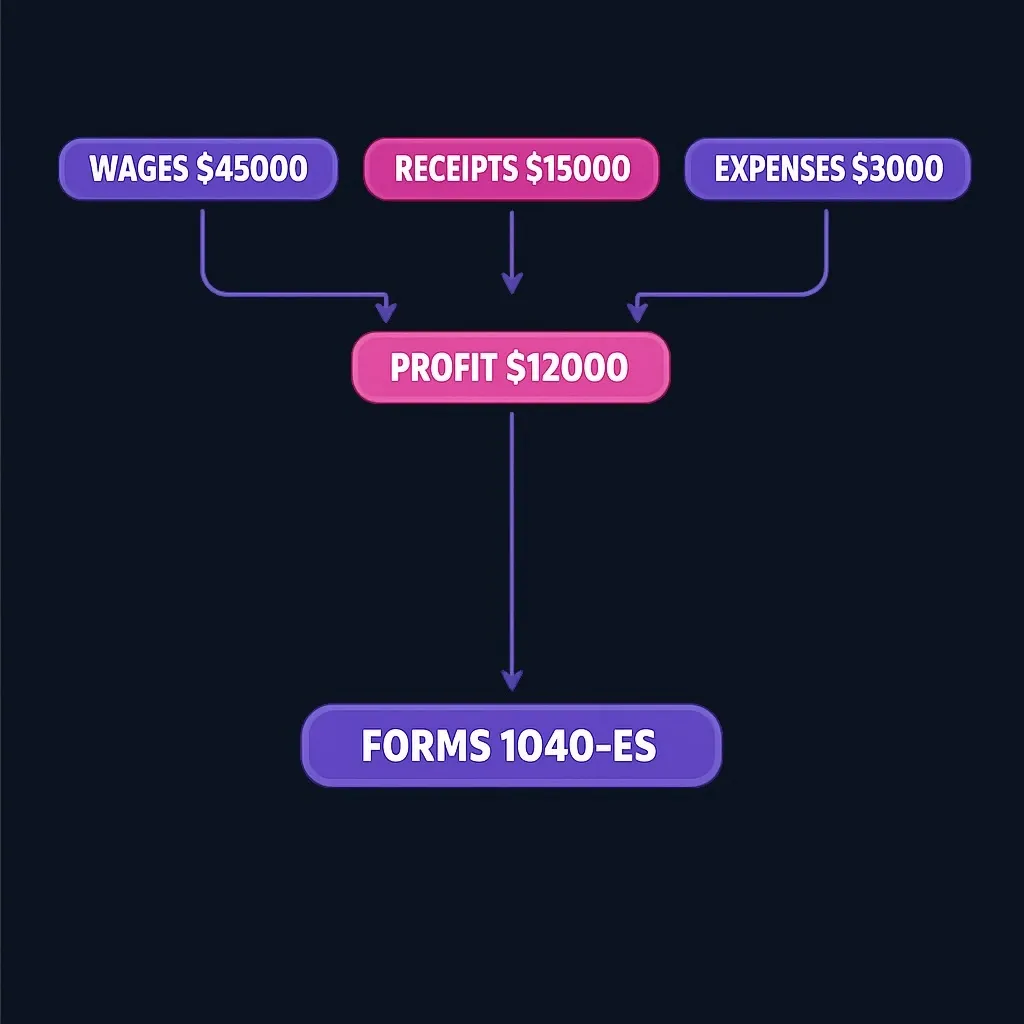
Assume someone expects:
- $45,000 of W-2 wages
- $15,000 of gross freelance receipts
- $3,000 of documented eligible business expenses
The preliminary business-profit input would be $12,000. That figure would then flow into the applicable Schedule C, Schedule SE, and Form 1040-ES calculations alongside wages, withholding, filing status, deductions, credits, and other income. This example intentionally does not state a final tax or quarterly payment because those missing facts can materially change the result.
Practice trading with Finelo
Practice in a simulator, learn with bite-sized lessons, and build confidence before risking real money.
Three ways to manage a projected shortfall
If the official worksheet indicates that current withholding may be insufficient, common administrative options include:
- Reviewing whether estimated payments are appropriate under Form 1040-ES.
- Asking an employer to adjust wage withholding through a new Form W-4.
- Setting aside cash in a separate account while you verify the calculation.
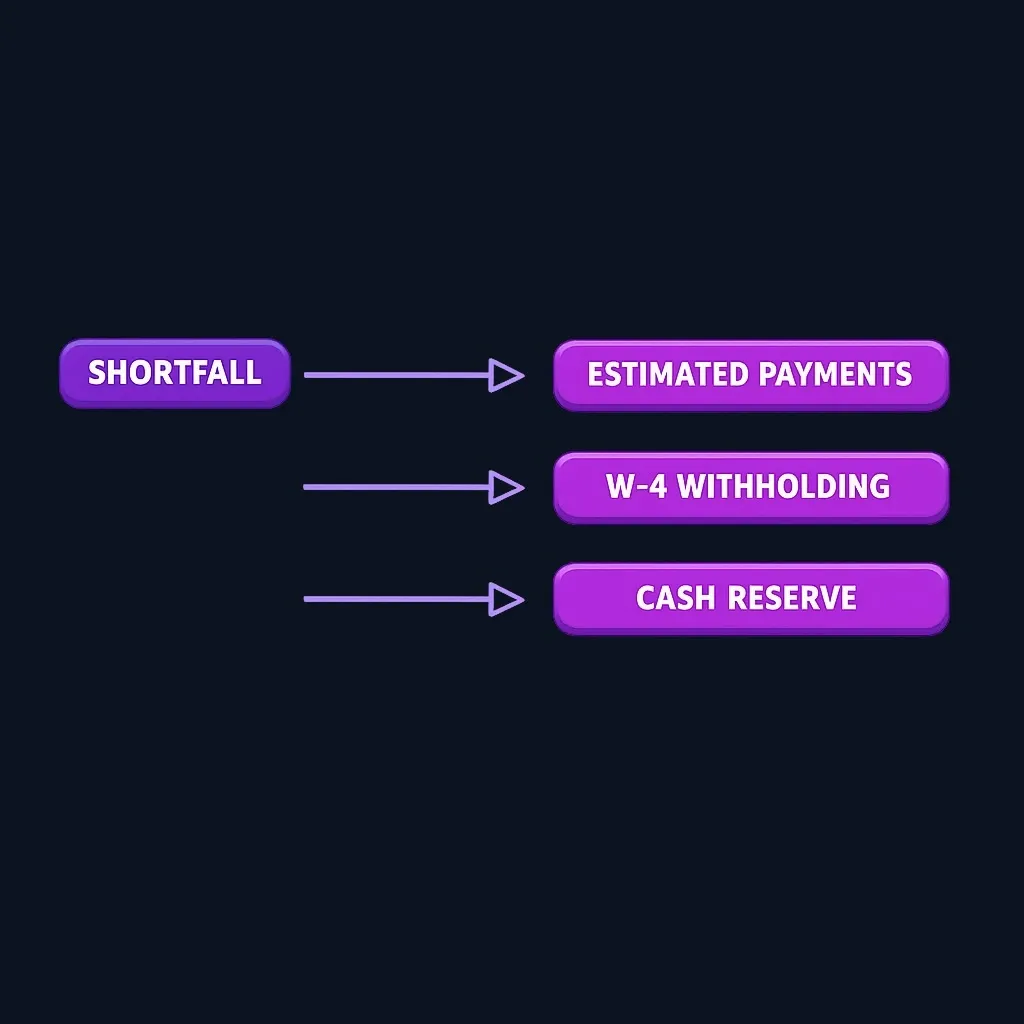
These are planning options, not recommendations about which approach is best for you. Payment timing and safe-harbor rules can be complex, especially when income is seasonal or changes substantially during the year.
Common mistakes
- Using gross receipts as profit: business expenses may reduce net profit, but only when they are eligible and properly documented.
- Counting all payroll deductions as federal income tax withholding: pay stubs usually separate federal income tax from Social Security, Medicare, state tax, and benefits.
- Using last year's thresholds without checking: forms, limits, and tax-year amounts can change.
- Ignoring state and local obligations: the federal worksheet does not calculate every state or city requirement.
- Assuming four equal payments always fit: taxpayers with uneven income may need to review the annualized-income method in the official instructions.
- Treating this worksheet as a filed calculation: it organizes inputs; it does not replace forms, software, or professional review.
When professional help may be useful
Consider qualified tax assistance when the situation includes multiple states, employees, partnerships, an S corporation, inventory, major asset purchases, prior underpayment penalties, or uncertainty about whether an expense is deductible. Bring the completed input table and supporting records so the preparer can verify rather than reconstruct the numbers.
FAQ
Is this an interactive tax calculator?
No. It is an on-page planning worksheet. It does not accept data, apply current tax tables, save results, export a PDF, or transmit figures to the IRS.
Does having a W-2 eliminate estimated taxes on freelance income?
Not necessarily. Wage withholding counts toward the total annual obligation, but whether it is sufficient depends on the complete return. Review Form 1040-ES or consult a tax professional.
Should I transfer the worksheet's result directly to the IRS?
No automatic payment amount is produced here. Verify any payment using current IRS forms, tax software, or professional guidance before submitting it.
Can I save this worksheet?
You can print this page or save it as a PDF using your browser. The page does not create a personalized downloadable report.
Next steps
Complete the input table, reconcile it to your records, and then use the current Form 1040-ES and Schedule SE instructions. Keep calculations and payment confirmations with your tax records, and revisit the estimate when income or withholding changes materially.
Financial LiteracyFinancial Education
Practice trading with Finelo
Practice in a simulator, learn with bite-sized lessons, and build confidence before risking real money.
About the author
Finelo Team
The Finelo Team creates practical investing and trading education designed to help beginners learn faster with structured challenges, simulator practice, and bite-sized lessons.
Keep reading — Related articles

Financial Literacy
Mercury Books Review 2026: Is It Worth It for Startups?
Mercury Books brings double-entry accounting into Mercury. Review its $35 pricing, reports, AI features, integrations, and migration limits.
Finelo Team

Financial Literacy
Why is My FICO Score Lower Than My Credit Score?
Example takeaway: seeing a higher score in a bank app doesn’t guarantee lenders will see the same FICO number at application time; lenders often pull a specific FICO version from a specific bureau.
Finelo Team

Financial Literacy
Why Is My FICO Score Higher Than My Credit Score?
Brief educational note: this article is educational, not financial or investment advice; investing and credit decisions involve risk and possible loss.
Finelo Team