For U.S. readers: This article discusses U.S. rules and financial products. State rules and individual eligibility may differ.
A Complete Guide to Self-Employment Tax Deductions
Educational note: this article is educational, not financial or investment advice.
10 min read
Practice trading with Finelo
Practice in a simulator, learn with bite-sized lessons, and build confidence before risking real money.
Want to learn more?
Practice in a simulator, learn with bite-sized lessons, and build confidence before risking real money.
Explore FineloExplore Finelo's 28-day challenges
Turn learning into a daily habit with guided challenge paths.
Quick answer
You can reduce your taxable income by deducting the employer‑equivalent portion of your self‑employment tax and by claiming ordinary, necessary business expenses plus qualifying self‑employed health insurance premiums; compute these items on Schedule SE and report them per the Form 1040 instructions IRS: Self‑employment tax. Finelo provides financial education, not financial or investment advice.
What to know before deciding
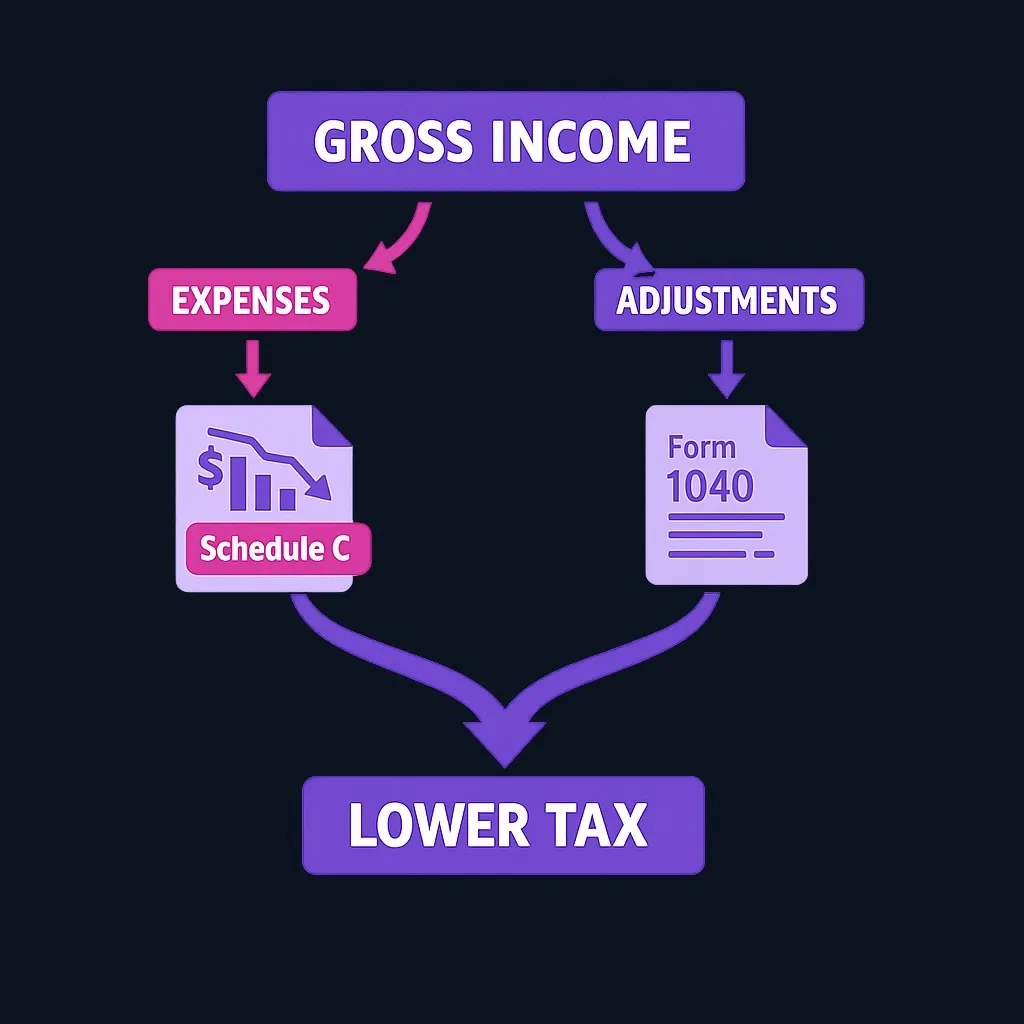
Self‑employment tax deductions fall into two practical groups: above‑the‑line adjustments (for example, the employer‑equivalent portion of self‑employment tax and certain health insurance premiums) and ordinary business expense deductions that reduce the net profit reported on Schedule C. These items change the net earnings used to compute self‑employment tax and can also lower your adjusted gross income on Form 1040.
Educational note: this article is educational, not financial or investment advice. Tax choices can have financial consequences and may increase audit risk. Confirm filing decisions with the IRS instructions or a tax professional.
Who Can Benefit from Self‑Employment Tax Deductions?
Self‑employment tax deductions are most relevant if you operate a trade or business and report the results on your individual return.
Typical filers who benefit
- Sole proprietors and single‑member LLC owners who report profit or loss on Schedule C and compute self‑employment tax on Schedule SE.
- Independent contractors, freelancers, gig workers, and others with net earnings from self‑employment who must use Schedule SE to calculate their self‑employment tax.
What you’ll be able to evaluate after reading
- Whether your earnings normally trigger Schedule SE reporting.
- Which expense categories to track to reduce net profit.
- Whether you may qualify for the self‑employed health insurance deduction or the employer‑equivalent adjustment on Form 1040.
Decision caveat: eligibility for some deductions depends on other return items such as household income, filing status, and retirement‑plan participation. Check IRS form instructions before claiming specific benefits.
Key Self‑Employment Tax Deductions You Should Know
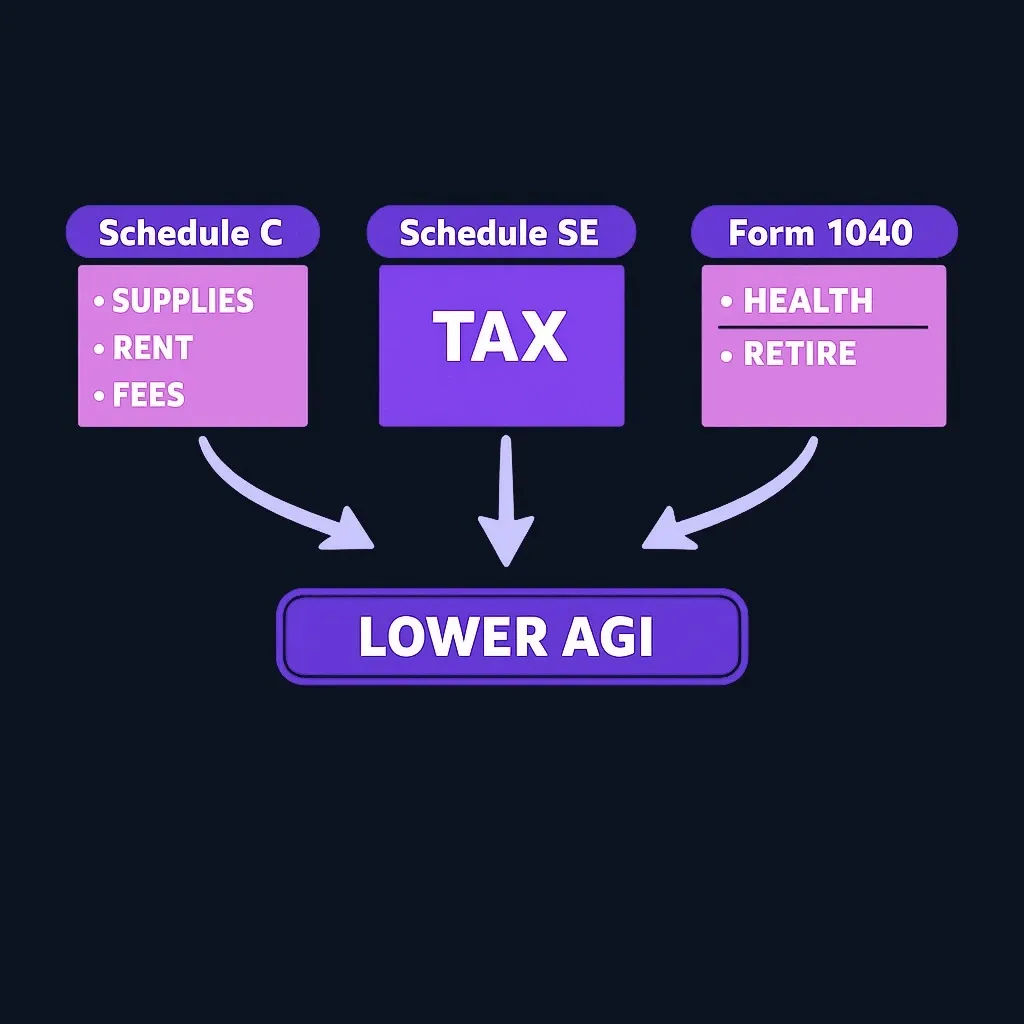
Use the table below as a practical checklist when you sort receipts and entries for your return. Each category ties into Schedule C, Schedule SE, or Form 1040 as noted by the IRS.
| Deduction category | What it is | Action or caveat |
|---|---|---|
| Employer‑equivalent portion of self‑employment tax | An above‑the‑line adjustment equal to the employer share of self‑employment tax; it reduces adjusted gross income. | Compute on Schedule SE and transfer the adjustment to Form 1040 per IRS instructions. |
| Self‑employed health insurance premiums | A deduction for qualifying health insurance premiums taken into account when calculating net earnings from self‑employment. | Follow the IRS eligibility rules and the examples in the Form 1040/Schedule instructions. |
| Ordinary and necessary business expenses | Deductible costs such as supplies, advertising, professional fees, software, and other ordinary costs of your trade. | Track receipts and business purpose; subtract these expenses from gross receipts to determine net profit (Schedule C). |
| Retirement plan contributions | Pretax contributions to plans available to self‑employed taxpayers (for example, SEP or solo 401(k)) that lower taxable income. | Plan limits and rules differ by plan; follow plan documents and IRS reporting requirements. |
| Vehicle and mileage costs | Deduct either actual vehicle expenses or the standard mileage method when the vehicle is used for business. | Keep contemporaneous mileage logs and supporting receipts; allocate personal vs. business use. |
Practical tip: treat this table as a filing checklist — place receipts into the matching category and note where each deduction appears on Schedule C, Schedule SE, or Form 1040.
How to Calculate Your Self‑Employment Tax Deductions
Follow this stepwise workflow to move from gross receipts to the lines you enter on your return. The IRS provides Schedule SE and Form 1040 instructions that show precise line entries and computation steps.
Calculation workflow
- Record gross receipts for the tax year with invoices, bank deposits, and summaries.
- Subtract ordinary and necessary business expenses to determine net profit (reported on Schedule C). Keep receipts by category.
- Apply above‑the‑line adjustments that apply (for example, qualifying self‑employed health insurance premiums) before finalizing net earnings.
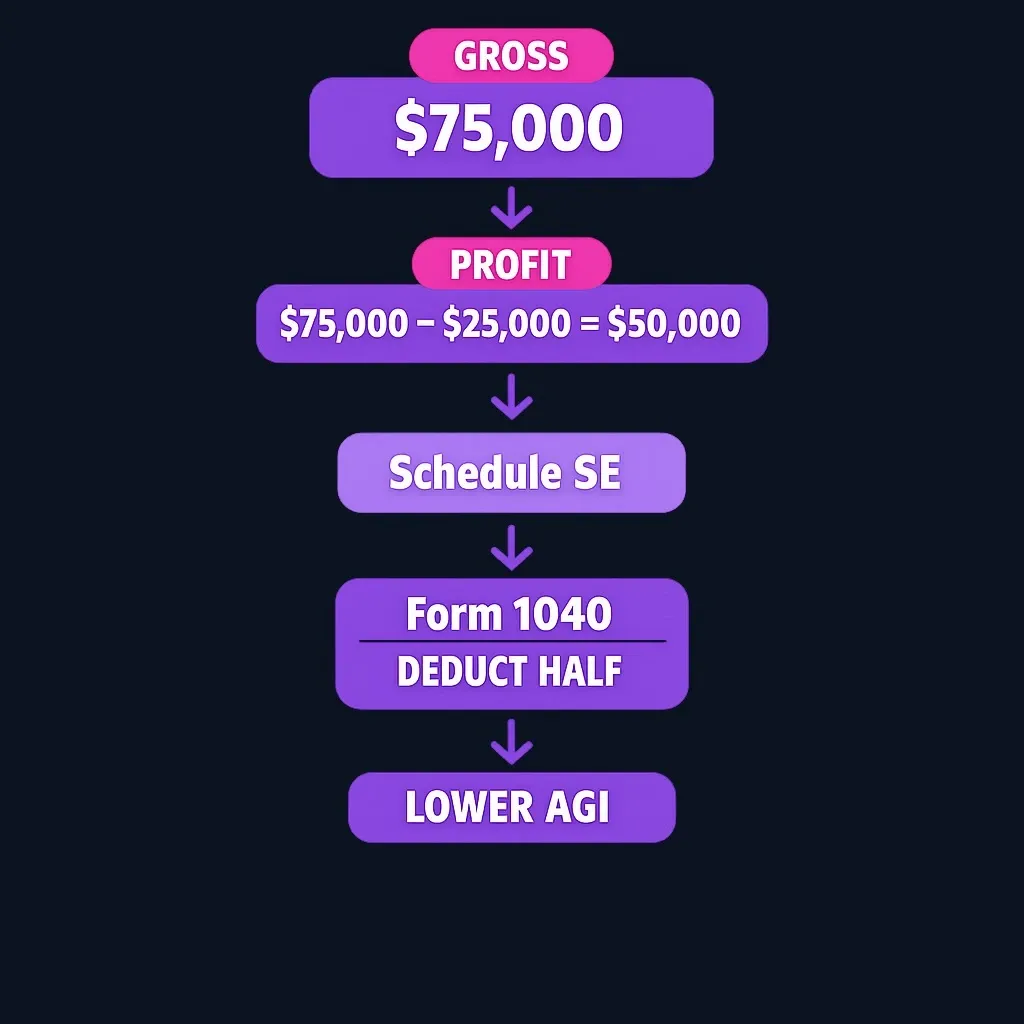
- Complete Schedule SE to compute self‑employment tax and to identify the employer‑equivalent portion deductible on Form 1040. Transfer the indicated deduction per the Form 1040 instructions.
- Enter retirement contributions, vehicle deductions, home‑office allocations (if applicable), and other business deductions on the correct forms; these reduce taxable income and sometimes affect net self‑employment earnings.
Worked examples (illustrative)
- Example A — single deduction workflow: net business profit = $40,000 on Schedule C. Use Schedule SE with that net profit to compute self‑employment tax and to determine the employer‑equivalent deduction to enter on Form 1040.
- Example B — combined deductions: gross receipts $75,000 minus $25,000 business expenses = $50,000 net profit. Subtract eligible self‑employed health insurance premiums as allowed, then compute Schedule SE to find the self‑employment tax and the deductible employer‑equivalent portion to move to Form 1040.
Practical tip: use current tax software to automate Schedule SE math, but review the form lines and keep printed worksheets or supporting export files as documentation.
Practice trading with Finelo
Practice in a simulator, learn with bite-sized lessons, and build confidence before risking real money.
Filing Requirements for Self‑Employment Taxes
These filing steps follow the IRS guidance for individual filers who operate a business.
Core forms and actions
- Use Schedule SE (Form 1040) to compute self‑employment tax and the employer‑equivalent deduction; the IRS posts the form and instructions online.
- Report business income and expenses on Schedule C so Schedule SE can use your net profit figure.
- If you expect to owe tax, you will likely need to make estimated tax payments; the IRS describes estimated payment procedures and due dates in its forms and instructions — check current deadlines on the IRS site.
Action step: download Schedule SE and the Form 1040 instructions from the IRS web page and follow those documents when preparing and filing your return.
Common Mistakes to Avoid When Claiming Deductions
Below are frequent errors and fixes to reduce audit risk and preserve deductions.
- Poor recordkeeping
- Mistake: Mixing personal and business transactions or failing to retain receipts.
- Fix: Use a dedicated business account, scan receipts promptly, and tag expenses by category.
- Errors on Schedule SE
- Mistake: Omitting the employer‑equivalent deduction or misreporting net earnings.
- Fix: Complete Schedule SE carefully and transfer the deduction to Form 1040 exactly as the IRS instructions indicate.
- Overclaiming mixed‑use expenses
- Mistake: Claiming full deductions for items with personal use (for example, vehicle or home expenses) without proper allocation.
- Fix: Keep contemporaneous logs (mileage, schedules) and allocate expenses between business and personal use; claim only the business portion.
- Assuming health premiums automatically qualify
- Mistake: Deducting premiums without confirming eligibility rules or alternative coverage options.
- Fix: Verify the self‑employed health insurance deduction rules in the IRS guidance before claiming the deduction.
- Failing to plan for estimated taxes
- Mistake: Underpaying quarterly estimated taxes and incurring penalties.
- Fix: Project taxable income early, use estimated tax worksheets or software, and make timely payments per IRS guidance.
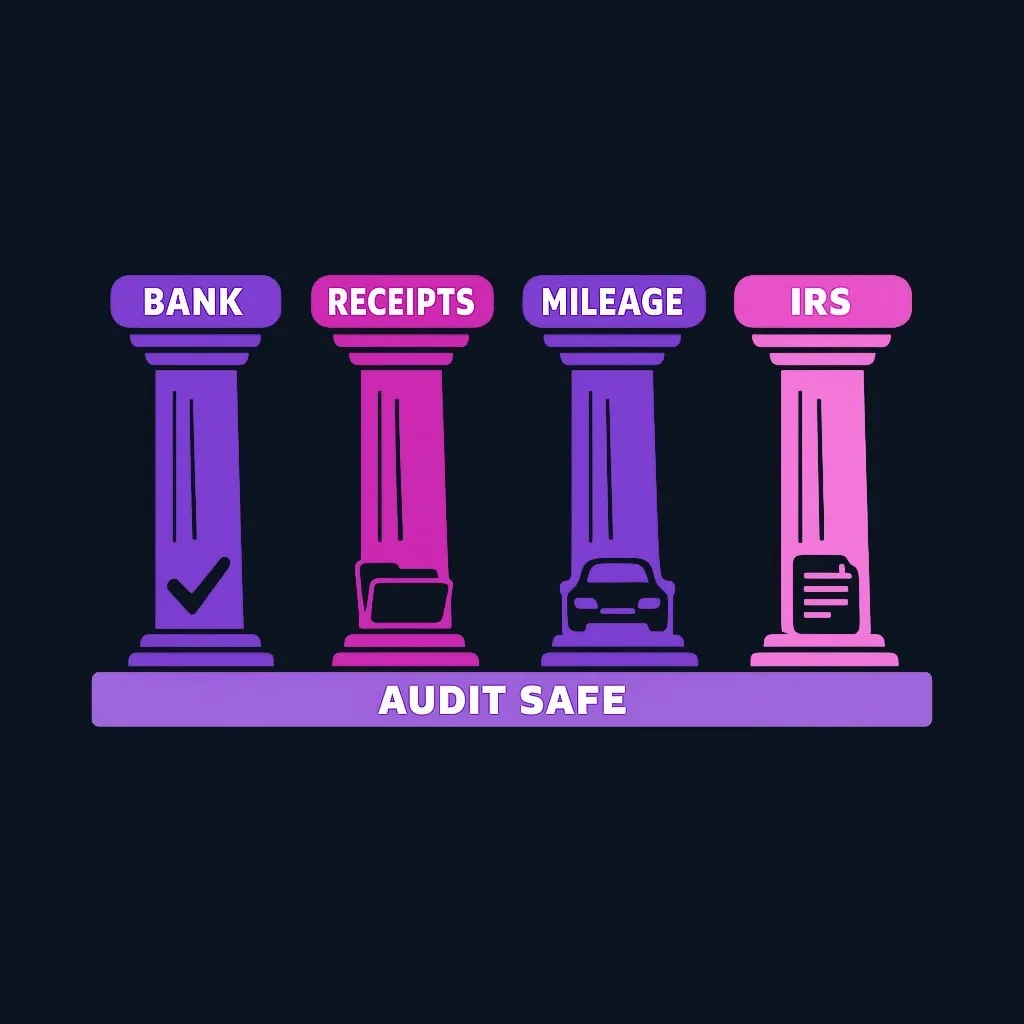
Quick checklist to reduce risk
- Reconcile bank statements monthly.
- Archive receipts with date, amount, and business purpose.
- Keep a separate, contemporaneous mileage log.
- Review Schedule SE and Form 1040 instructions before filing.
Decision framework
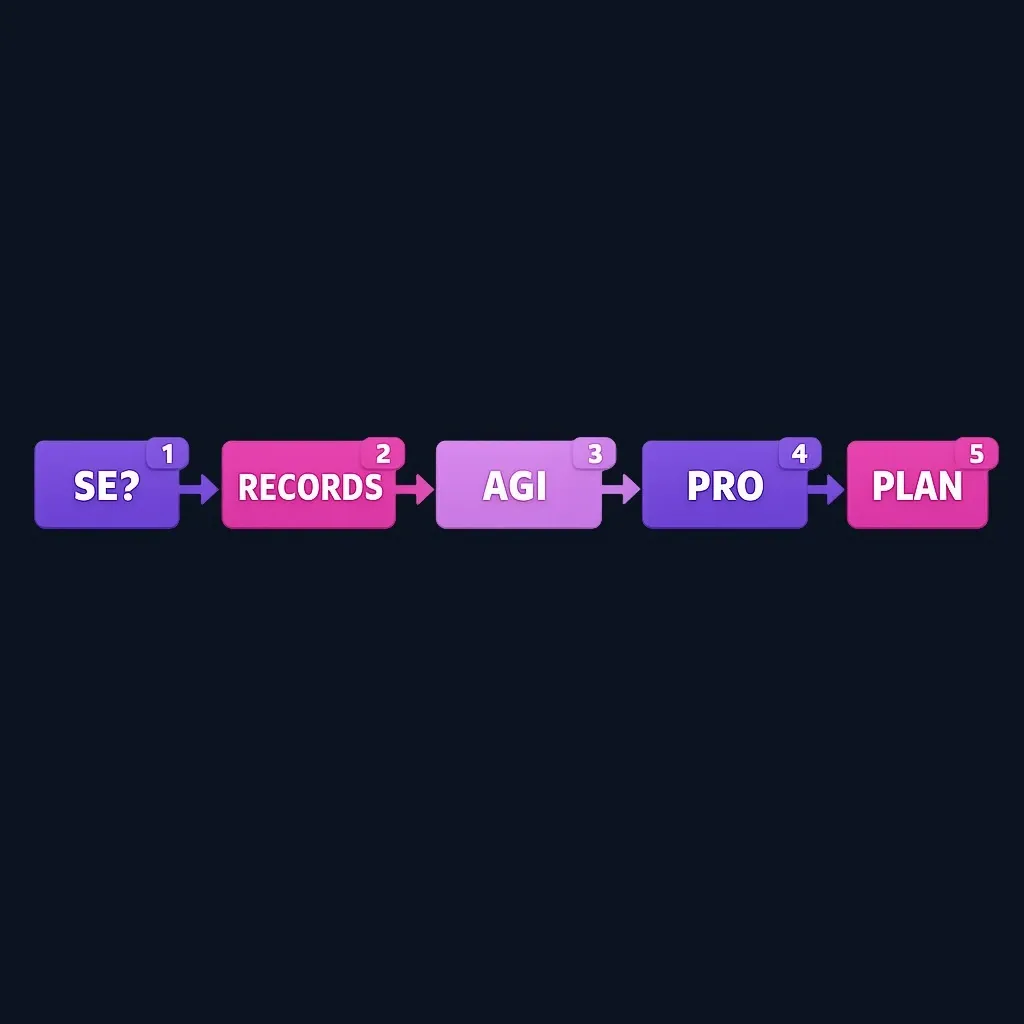
Use this short framework to decide which deductions to claim and when to consult help.
Step 1 — Confirm your filing path If you report business profit on Schedule C, you will normally need Schedule SE to compute self‑employment tax and the employer‑equivalent deduction.
Step 2 — Separate recordkeeping from strategy Good records tell you what to claim. Use a dedicated business account and categorize expenses monthly. If an expense is mixed use, document the allocation method (e.g., mileage log or square footage) and apply it consistently.
Step 3 — Prioritize above‑the‑line adjustments that directly reduce AGI Above‑the‑line items such as the employer‑equivalent portion of self‑employment tax and qualifying self‑employed health insurance premiums affect your AGI and can change eligibility for other credits. Confirm eligibility rules in the IRS instructions before claiming them.
Step 4 — Evaluate larger‑impact choices with a professional If you have substantial income, hire employees, or are choosing a business entity (for example, converting to an S corporation), consult a tax professional. Entity changes can affect how self‑employment tax and deductions apply; these choices have tradeoffs in payroll, benefits, and tax reporting.
Step 5 — Revisit estimated taxes and retirement planning If deductions substantially lower current taxable income, reproject estimated payments to avoid underpayment penalties. Consider retirement plans available to self‑employed taxpayers to defer income and lower taxable income (follow plan rules and IRS reporting).
When to consult help
- You have complex mixed‑use allocations, W‑2 employees, or plan to change entity type.
- You face unusual transactions (like large asset sales, significant business losses, or foreign income).
- You want a formal audit‑ready recordkeeping and reporting workflow.
FAQs About Self‑Employment Tax Deductions
What is self‑employment tax?
Self‑employment tax covers Social Security and Medicare taxes for people who work for themselves. Use Schedule SE to compute the tax and to determine the employer‑equivalent portion that you may deduct on Form 1040.
How do I know if I need to pay self‑employment tax?
If you have net earnings from self‑employment and report them on Schedule C (or another business schedule) you will generally use Schedule SE to compute self‑employment tax; check the IRS page and Schedule SE instructions to confirm thresholds and calculation steps.
What forms do I need to file for self‑employment tax?
Report business income and expenses on Schedule C (or the appropriate business schedule). Compute self‑employment tax on Schedule SE and carry the deductible employer‑equivalent portion to Form 1040 per the IRS instructions.
Can I deduct my health insurance premiums if I'm self‑employed?
A deduction for qualifying self‑employed health insurance premiums is allowed for income tax purposes and is taken into account when calculating net earnings from self‑employment; review the IRS rules and the Form 1040/Schedule instructions for eligibility details.
Conclusion and Next Steps
Summary: track income, separate business and personal expenses, claim ordinary business deductions on Schedule C, compute self‑employment tax on Schedule SE, and take the employer‑equivalent portion and qualifying health insurance premiums as adjustments on Form 1040 where allowed.
Actionable next steps
- Download Schedule C, Schedule SE, and the Form 1040 instructions from the IRS and review the lines you will complete.
- Start a simple bookkeeping routine today: separate accounts, monthly reconciliations, and scanned receipts.
- If you have complex questions or large tax exposures, consult a tax professional.
Explore more clear tax and small‑business guidance in the Finelo Blog: Finelo Blog (one place to find educational resources).
Financial LiteracyFinancial Education
Practice trading with Finelo
Practice in a simulator, learn with bite-sized lessons, and build confidence before risking real money.
About the author
Finelo Team
The Finelo Team creates practical investing and trading education designed to help beginners learn faster with structured challenges, simulator practice, and bite-sized lessons.
Keep reading — Related articles

Financial Literacy
Mercury Books Review 2026: Is It Worth It for Startups?
Mercury Books brings double-entry accounting into Mercury. Review its $35 pricing, reports, AI features, integrations, and migration limits.
Finelo Team

Financial Literacy
Why is My FICO Score Lower Than My Credit Score?
Example takeaway: seeing a higher score in a bank app doesn’t guarantee lenders will see the same FICO number at application time; lenders often pull a specific FICO version from a specific bureau.
Finelo Team

Financial Literacy
Why Is My FICO Score Higher Than My Credit Score?
Brief educational note: this article is educational, not financial or investment advice; investing and credit decisions involve risk and possible loss.
Finelo Team