For U.S. readers: This article discusses U.S. rules and financial products. State rules and individual eligibility may differ.
Self-Employment Tax vs Income Tax: What Each One Covers
Self-employment tax and income tax overlap for many people who work for themselves, but they serve different purposes: self-employment tax covers Social Security and Medicare contributions tied to self-employment earnings, while federal income tax is a progressive levy on…
9 min read
Practice trading with Finelo
Practice in a simulator, learn with bite-sized lessons, and build confidence before risking real money.
Want to learn more?
Practice in a simulator, learn with bite-sized lessons, and build confidence before risking real money.
Explore FineloExplore Finelo's 28-day challenges
Turn learning into a daily habit with guided challenge paths.
Self-employment tax and income tax overlap for many people who work for themselves, but they serve different purposes: self-employment tax covers Social Security and Medicare contributions tied to self-employment earnings, while federal income tax is a progressive levy on taxable income from all sources. This page gives a concise head‑to‑head answer, a compact comparison table, a decision framework for common situations, practical calculation steps without unsupported numeric claims, filing notes, tradeoffs, and short FAQs. Finelo provides financial education, not financial or investment advice. For authoritative definitions about self‑employment tax, see the IRS tax tutorial on self‑employment and payroll taxes IRS tax tutorial. Small‑business coverage of the self‑employment tax burden is summarized by the SBA Office of Advocacy SBA PDF.
Quick comparison answer
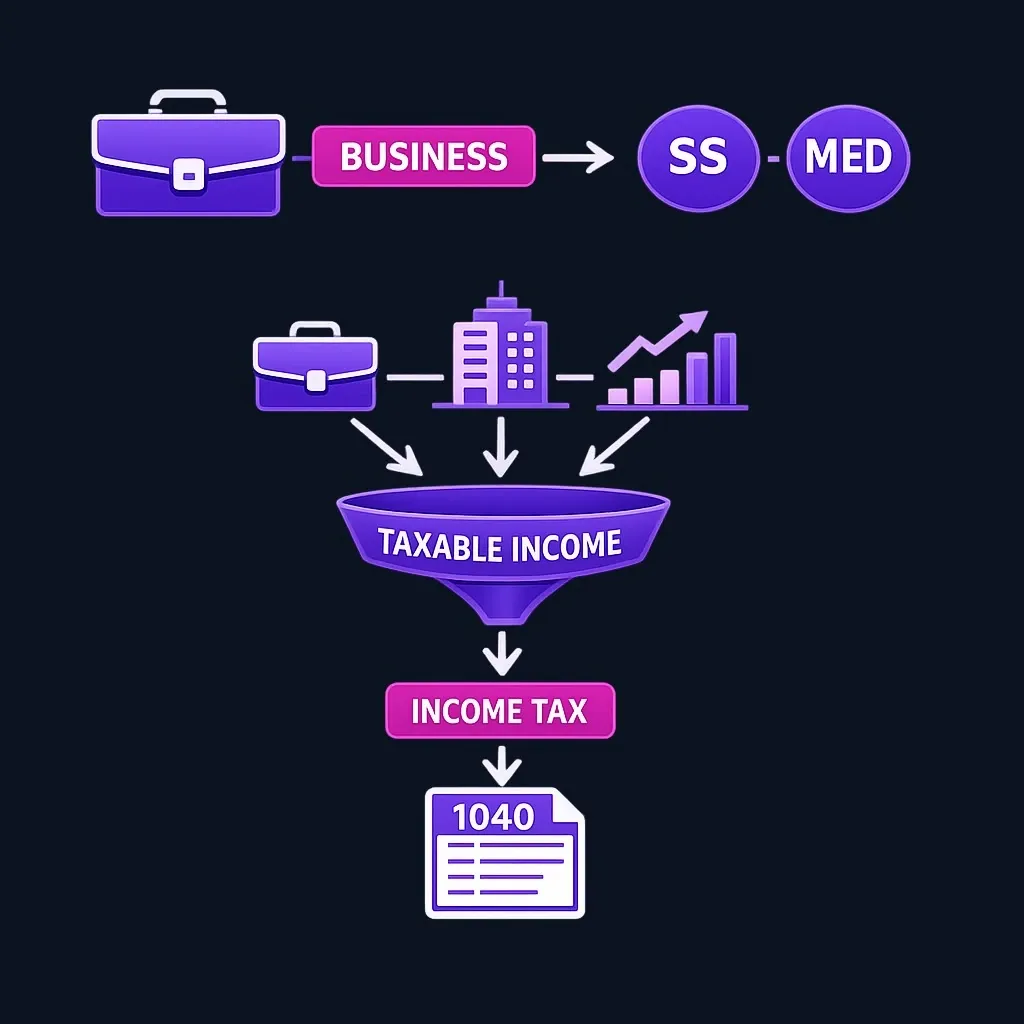
Self‑employment tax is a dedicated contribution system for Social Security and Medicare that applies to earnings from self‑employment; income tax is the general federal tax on taxable income from wages, self‑employment, investments and other sources. A self‑employed person will typically face both kinds of tax: self‑employment tax on business earnings and income tax on taxable income after deductions. For an official primer on how self‑employment income is treated, consult the IRS tutorial. The U.S. Small Business Administration reports that small business owners bear a large share of the overall self‑employment tax burden.
Side-by-side comparison table
| Topic | Self‑Employment Tax | Income Tax |
|---|---|---|
| Primary purpose | Funds Social Security & Medicare contributions tied to self‑employment earnings — described in IRS guidance on payroll/self‑employment taxes. | Funds federal government programs via a progressive tax on taxable income from many sources (wages, self‑employment, investments). |
| Who pays | Individuals with net earnings from self‑employment (self‑employed persons). See the IRS self‑employment tutorial for scope. | Taxpayers whose gross income exceeds filing thresholds; applies to individuals regardless of employment status. |
| Tax base | Tied to net earnings from self‑employment (business profit after allowable business expenses). | Taxable income after adjustments, deductions, and credits. |
| Calculation concept | Computed from self‑employment net earnings and intended to cover the worker and employer portions of payroll taxes. | Computed from taxable income using progressive tax brackets and affected by deductions and credits. |
| Timing/collection | Typically paid as you go via estimated payments or withheld when applicable; IRS sources explain payroll and self‑employment treatment. | Collected via withholding, estimated payments, and payment with annual return; timing depends on overall tax liability. |
| Typical overlap | Self‑employed individuals often pay both; SBA analysis highlights how self‑employment taxes concentrate on small business owners. | All taxpayers may owe income tax depending on total taxable income and filing status. |
Note: This table summarizes categories and concepts. For line‑by‑line computation rules and current numeric parameters consult the IRS directly.
Decision criteria
When deciding how self‑employment tax and income tax affect you, evaluate these criteria:
- Income source and amount: Are earnings from wages, business profit, dividends, or retirement distributions? Self‑employment tax applies specifically to net earnings from self‑employment; income tax applies to taxable income from almost any source.
- Business structure and payroll: If you run a business that pays yourself wages, payroll treatment changes how contributions are split between employer and employee. Consider whether you are treated as a sole proprietor, an employee of your own company, or as an owner receiving distributions — each has tax implications.
- Cash flow and timing: Self‑employed people often must make estimated payments through the year to cover both self‑employment and income tax liabilities; plan for quarterly cash needs to avoid surprises.
- Administrative capacity and cost: Running payroll, filing employer returns, or electing corporate structures increases filing complexity and costs but can shift how employment taxes are assessed.
Practical decision point: if most of your earnings come from running your own business, assume you will face both obligations and plan for both when you set aside money for taxes. For authoritative scope and basic rules on self‑employment income, see the IRS tutorial.
When to choose each option
This heading answers the likely reader question: "When does self‑employment tax matter more than income tax, and vice versa?"
- When self‑employment tax is the main concern: If your primary earnings come from solo professional services or a business you personally operate (no employer withholding), self‑employment tax will materially affect payroll‑type contributions and should be planned for each pay period or quarter. The IRS explains how self‑employment income triggers payroll‑tax obligations.
- When income tax is the dominant planning lever: If you have a mix of wage income, investment income, or large deductible items, income tax planning (deductions, credits, retirement contributions that affect taxable income) will generally produce larger swings in annual tax owed.
- Hybrid situations: Most self‑employed people have both concerns. Use the decision criteria above to prioritize: immediate cash‑flow (set aside for both), structural choices (payroll vs. distributions), and long‑term planning (retirement contributions, business deductions).
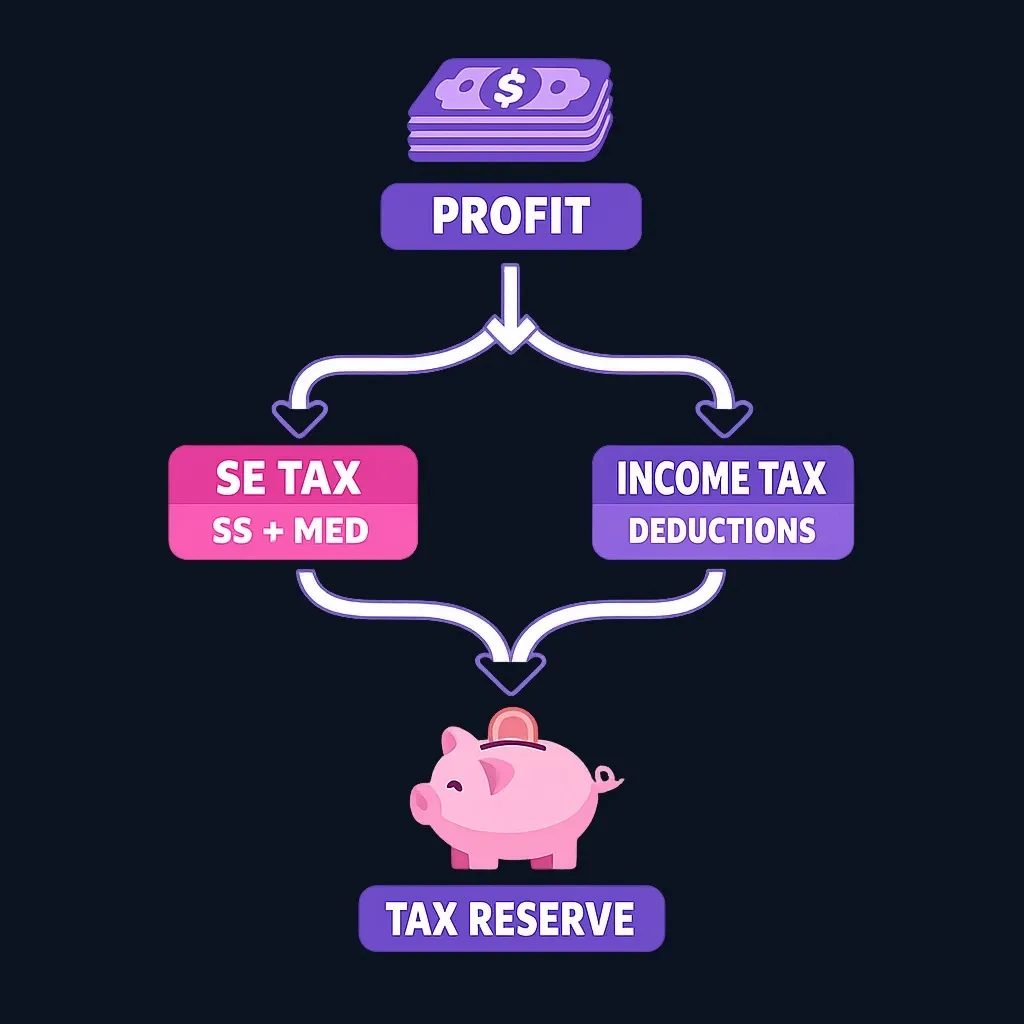
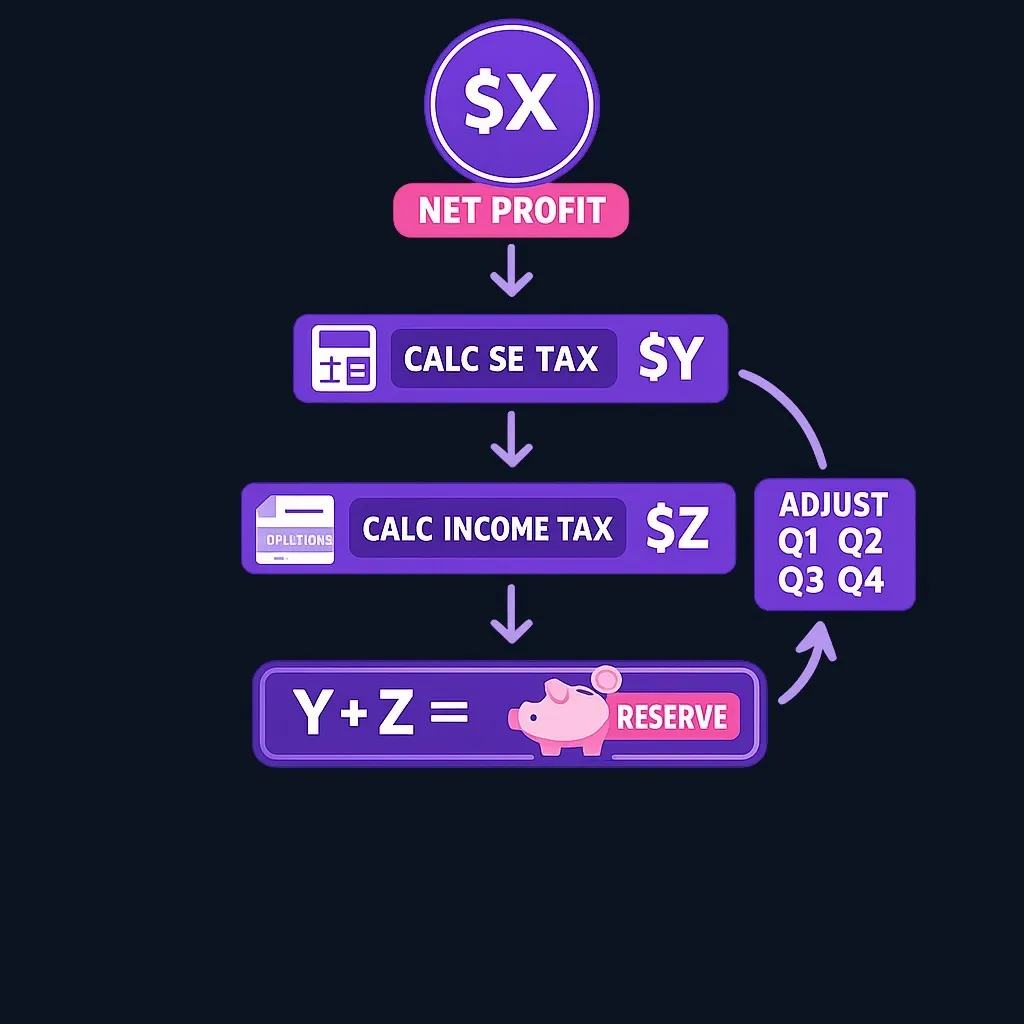
Concrete scenario (worked example without numeric policy claims): imagine you expect X dollars of net business profit this year. First, reserve a percentage of X to cover the payroll‑equivalent obligation represented by self‑employment tax. Second, compute taxable income after expected deductions to estimate income tax and set aside additional funds. Adjust reserves each quarter as income changes. For authoritative definitions of what counts as self‑employment income, see IRS materials.
Practice trading with Finelo
Practice in a simulator, learn with bite-sized lessons, and build confidence before risking real money.
Tradeoffs and caveats
- Double considerations: Self‑employed taxpayers effectively carry both worker and employer portions of payroll taxes; that affects overall tax burden and cash flow — the SBA explores how this burden concentrates on small business owners.
- Deductions and adjustments: Income tax is heavily affected by deductions, credits and retirement contributions. Self‑employment tax focuses on earnings from business activity and is less flexible—plan deductions that reduce taxable income and separate planning for payroll obligations.
- Business structure changes can shift tax outcomes: Moving from sole proprietorship to an entity that pays wages can change how payroll taxes are assessed and who is treated as employer versus employee. Such changes also bring administrative costs and compliance tradeoffs.
- State and local interaction: State or local tax systems may add separate income or payroll obligations; coordinate federal planning with state rules.
- Evidence and limits: This page is educational and summarizes conceptual differences using official IRS and SBA sources. For specific numeric rates, deduction rules, or filing forms, consult the IRS and your tax advisor because precise parameters change over time.
How to calculate self-employment tax
This section gives a step‑by‑step conceptual method you can apply with current numeric values from official sources.
- Determine net earnings from self‑employment: total business receipts minus allowable business expenses. Use your bookkeeping or profit/loss summary.
- Apply the self‑employment tax base rule: the tax is computed from most of your net earnings from self‑employment. (Refer to IRS guidance for the exact base and any adjustment factors.) See the IRS self‑employment tutorial for scope and explanations.
- Break the combined self‑employment contribution into its program components (payroll equivalents for Social Security and Medicare) and sum them to get total self‑employment tax owed.
- Combine this amount with your projected income tax liability (taxable income after deductions and credits) to determine total federal tax for the year.
- Make estimated payments or adjust withholding to cover combined liability and avoid underpayment.
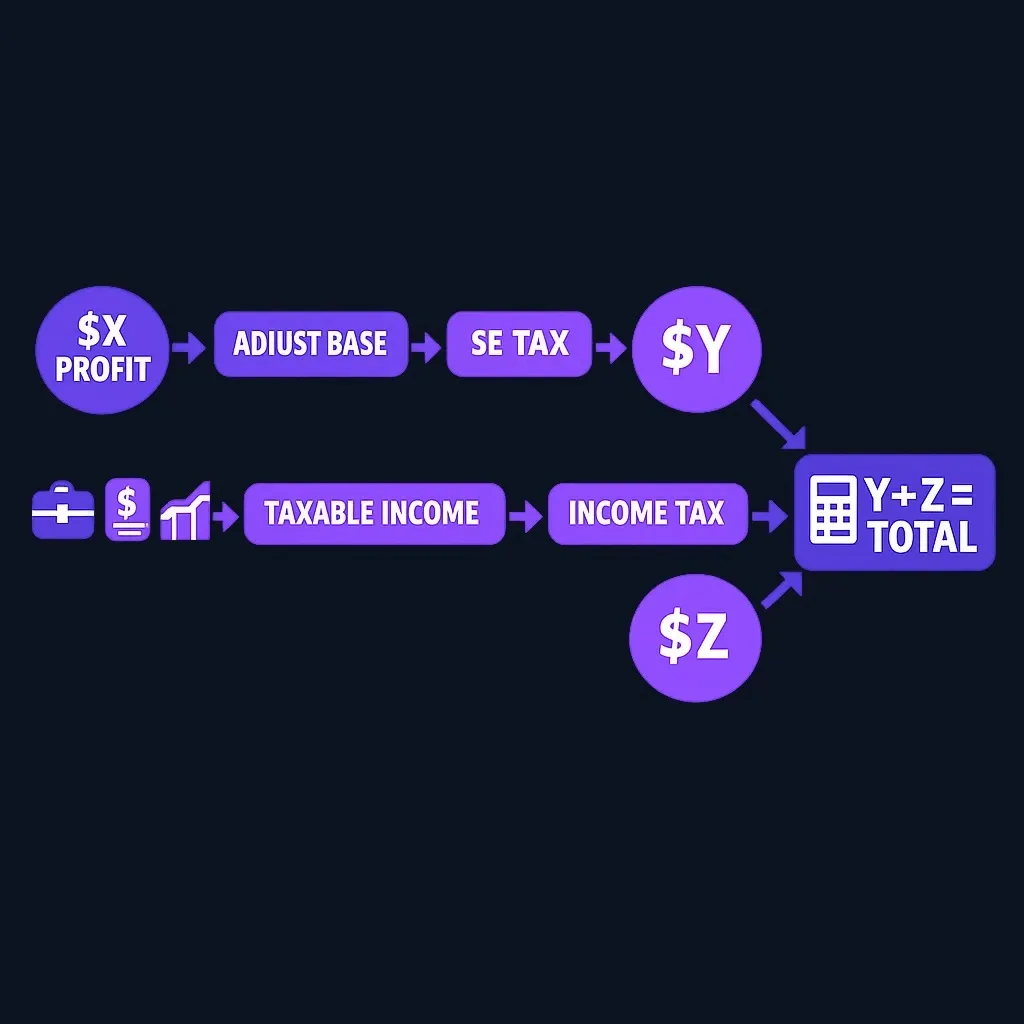
Worked example (symbolic): If your net business profit is X, compute the tax base from X (apply any adjustment allowed), then compute the payroll‑equivalent obligations to get amount Y. Separately, compute taxable income from all sources to get tax Z. Total federal tax reserve = Y + Z. For exact multipliers, current thresholds, and how to report these amounts on tax forms, consult the IRS materials. Caveat: This method explains the workflow and decision points; verify specific numeric formulas and current parameters on the IRS website before filing.
Filing requirements
This combined section summarizes filing responsibilities conceptually; check IRS official pages for exact forms, thresholds, and deadlines.
- Reporting: Self‑employment tax arises when you report net earnings from self‑employment on your federal return; income tax is reported on your annual individual return. The IRS provides tutorials covering self‑employment and payroll tax concepts.
- Payment timing: Self‑employed taxpayers commonly make periodic (e.g., quarterly) estimated tax payments to cover both income and self‑employment tax obligations, while employees typically have amounts withheld from wages. For guidance on withholding vs. estimated payments see IRS resources.
- Keep records: Maintain invoices, receipts, expense logs, and records of estimated payments to support business income and deductions; good records simplify filings and reduce audit risk.
Practical checklist before filing (conceptual):
- Reconcile bookkeeping to confirm net business profit.
- Project combined self‑employment + income tax liability and set aside funds.
- Schedule estimated payments or adjust withholding if you expect tax due.
- Retain documentation for business deductions and credits.
For authoritative, up‑to‑date rules and forms, consult IRS guidance on self‑employment and payroll taxes.
FAQ
What is self‑employment tax?
Self‑employment tax is the federal tax mechanism that collects Social Security and Medicare contributions from people who work for themselves. The IRS offers a tutorial that explains how self‑employment income is treated for payroll‑tax purposes.
Who must pay self‑employment tax?
Individuals with net earnings from self‑employment typically trigger self‑employment tax obligations; see IRS guidance for definitions of self‑employment income and thresholds.
How is self‑employment tax different from income tax?
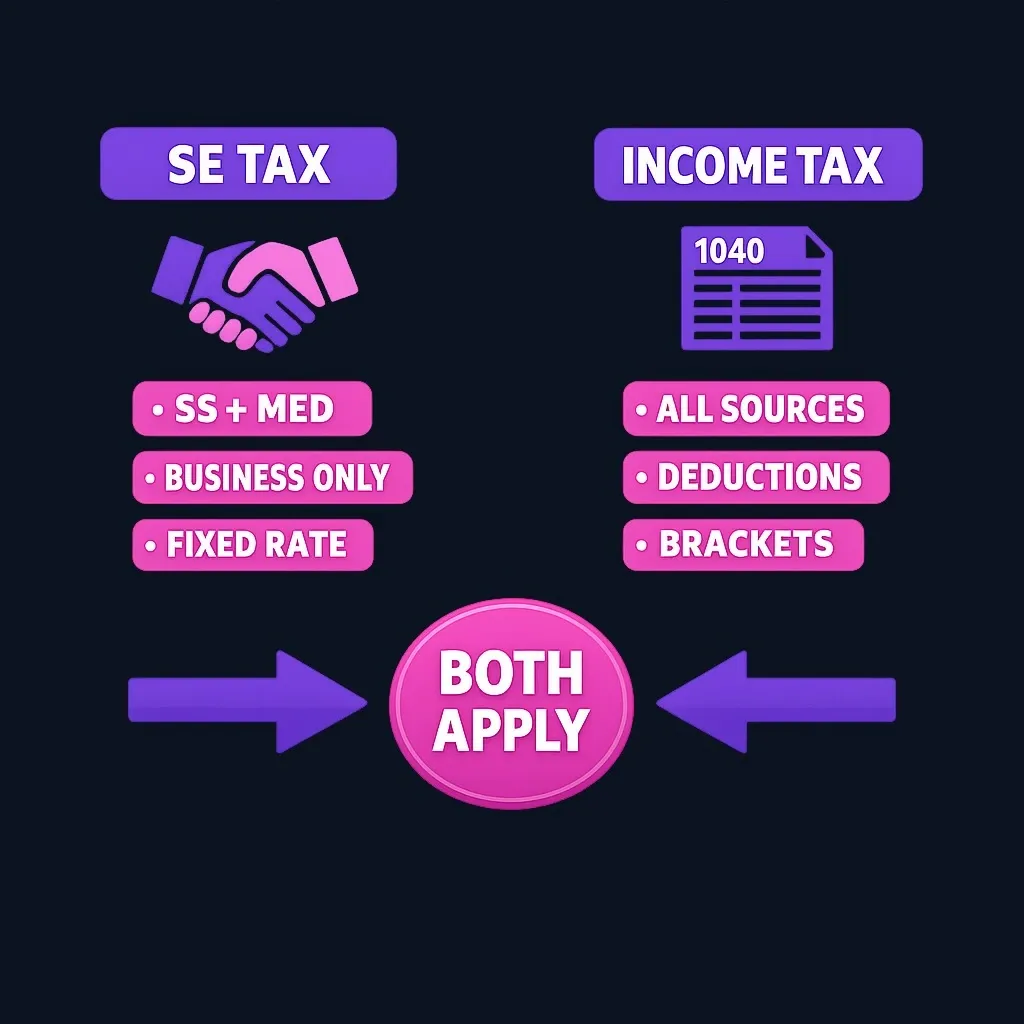
Self‑employment tax finances payroll‑type benefits (Social Security and Medicare) tied to self‑employment earnings, while income tax is assessed on taxable income across many sources after deductions and credits. Both can apply to the same person and should be planned together.
When should I consult a tax professional?
Consider professional advice when your business structure, mix of wages and distributions, or income level create complex filing choices, or when you need current numeric parameters used to compute taxes and estimated payments. The SBA materials discuss how small business tax burdens can be concentrated, which is one reason owners often seek professional help.
Finelo provides educational material to help you compare options; for filing forms, exact rates, and official calculation rules, consult the IRS and, when appropriate, a qualified tax professional. Learn more about Finelo's financial education resources at Finelo Blog.
Financial LiteracyFinancial Education
Practice trading with Finelo
Practice in a simulator, learn with bite-sized lessons, and build confidence before risking real money.
About the author
Finelo Team
The Finelo Team creates practical investing and trading education designed to help beginners learn faster with structured challenges, simulator practice, and bite-sized lessons.
Keep reading — Related articles

Financial Literacy
Mercury Books Review 2026: Is It Worth It for Startups?
Mercury Books brings double-entry accounting into Mercury. Review its $35 pricing, reports, AI features, integrations, and migration limits.
Finelo Team

Financial Literacy
Why is My FICO Score Lower Than My Credit Score?
Example takeaway: seeing a higher score in a bank app doesn’t guarantee lenders will see the same FICO number at application time; lenders often pull a specific FICO version from a specific bureau.
Finelo Team
Financial Literacy
Why Is My FICO Score Higher Than My Credit Score?
Brief educational note: this article is educational, not financial or investment advice; investing and credit decisions involve risk and possible loss.
Finelo Team