This article is about tangible book value per share (TBVPS), not another basic BVPS definition. A common starting point is common shareholders' equity minus goodwill, identifiable intangible assets, and preferred equity claims, divided by diluted common shares. The exact adjustments depend on the purpose and must be reconciled to the filing.
Tangible Book Value Per Share: Adjustments and Bank Analysis

This article is about tangible book value per share (TBVPS), not another basic BVPS definition. A common starting point is common shareholders' equity minus goodwill, identifiable intangible assets, and preferred equity…
8 min read
Practice investing with Finelo
Build practical investing skills with guided lessons, simulator practice, and structured challenges.
Want to learn more?
Build practical investing skills with guided lessons, simulator practice, and structured challenges.
Explore FineloExplore Finelo's 28-day challenges
Turn learning into a daily habit with guided challenge paths.
A reproducible TBVPS worksheet
- Start with total equity and subtract noncontrolling interests and preferred equity to reach common equity.
- Subtract goodwill and separately recognized intangible assets; consider related deferred-tax effects only with a documented rationale.
- Review accumulated other comprehensive income, credit-loss allowances, held-to-maturity marks, pension items, and acquisition accounting rather than adjusting them automatically.
- Use a share count consistent with the valuation question: period-end basic shares for a point-in-time balance or a clearly defined diluted count for potential dilution.
- Reconcile every adjustment and compare the same definition across periods and peers.
TBVPS can be informative for banks and other balance-sheet businesses, but it does not reveal asset quality, deposit stability, duration risk, funding cost, profitability, or franchise value. Price-to-tangible-book comparisons require those factors as well as consistent accounting.
Book value per share starts with common equity divided by common shares. Tangible BVPS then removes defined intangible balances and other claims. It is an accounting measure, not liquidation value, and the usefulness of its adjustments depends on the business and analysis purpose.
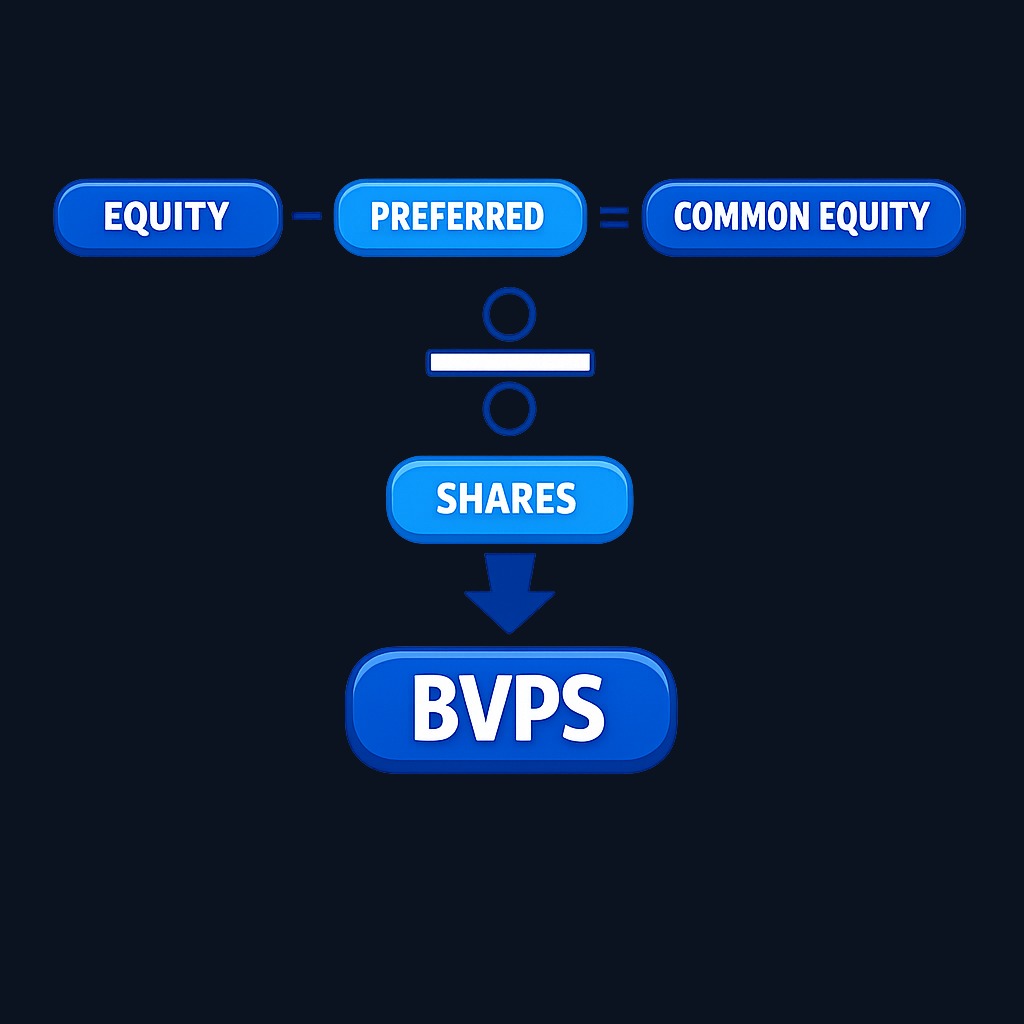
How to calculate book value per share
The formula is straightforward:
BVPS = (Total shareholders' equity - Preferred equity) / Common shares outstanding
You subtract preferred equity because preferred shareholders sit ahead of common shareholders in the capital structure. What remains is the equity that belongs to common stockholders.
A hypothetical worked example
Suppose Ridgeline Tools Inc. reports the following on its balance sheet:
| Line item | Amount |
|---|---|
| Total assets | $840 million |
| Total liabilities | $510 million |
| Total shareholders' equity | $330 million |
| Preferred equity | $30 million |
| Common shares outstanding | 60 million |
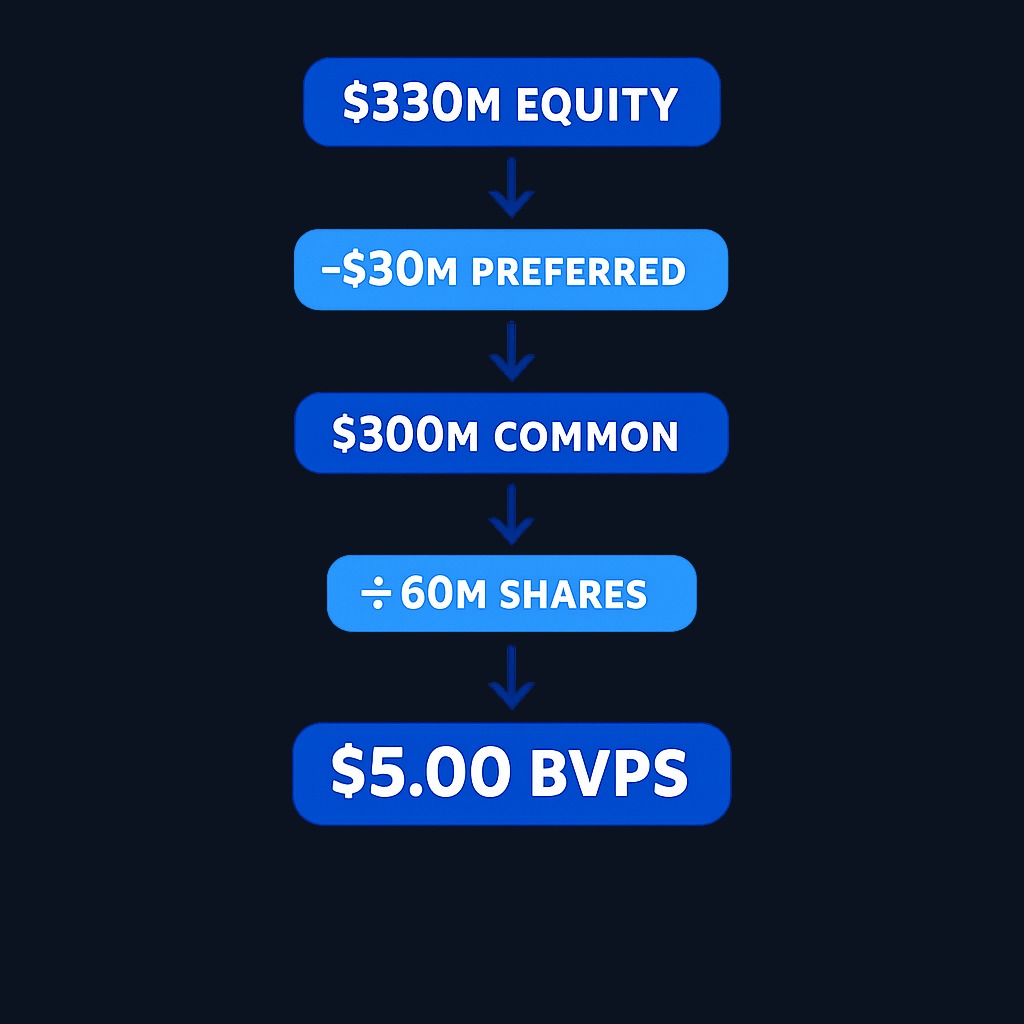
Common equity is $330 million minus $30 million, or $300 million. Divide by 60 million shares and BVPS equals $5.00. If Ridgeline's stock trades at $12.50, the market prices the business at 2.5 times its book value. If it trades at $4.20, the shares sit 16% below book, and value-oriented investors would start asking why.
Where to find the inputs
Every figure comes from the balance sheet in a company's annual or quarterly report. You can pull these filings for free from the SEC's EDGAR database. Share counts appear on the cover page of the 10-K or 10-Q; use the most recent count, not an average, since BVPS is a point-in-time snapshot.
Why book value per share matters for investors
BVPS anchors several practical judgments:
- Valuation floor context. When a stock trades below book value, the market is saying the company's assets are worth less deployed in that business than their accounting cost. Sometimes that signals a bargain; often it signals real problems with asset quality or profitability.
- Price-to-book ratio input. Dividing the share price by BVPS gives the P/B ratio, a staple screen for banks, insurers, and other asset-heavy businesses whose balance sheets are mostly financial instruments carried near market value.
- Tracking value creation. A company that compounds BVPS year after year, through retained earnings, is building measurable net worth per share. Watching the trend over five or ten years tells you more than any single reading.
- Dilution check. If equity grows but BVPS stalls, new share issuance is absorbing the gains. The per-share lens catches dilution that headline equity growth hides.
Factors that change book value per share
Several events move BVPS up or down, and not all of them involve operating performance:
- Retained profits increase equity and lift BVPS when the share count holds steady.
- Losses and dividends reduce retained earnings, pulling BVPS down.
- Share buybacks cut the share count. Repurchases below book value raise BVPS for remaining holders; buybacks above book value lower it, even though they can still make sense for other reasons.
- New share issuance dilutes BVPS whenever shares are sold below the current book value.
- Write-downs and impairments of goodwill, inventory, or equipment reduce assets and equity in one stroke.
- Accounting conventions matter: assets sit at historical cost less depreciation, so land bought decades ago or a strong brand name may be dramatically understated relative to what a buyer would pay today.
Practice investing with Finelo
Build practical investing skills with guided lessons, simulator practice, and structured challenges.
Book value vs market value: what the gap means
Market value per share is simply the stock price, set by supply and demand. Book value per share is an accounting figure. The gap between them reflects everything the balance sheet cannot capture: expected future earnings, brand strength, patents, network effects, and management quality.
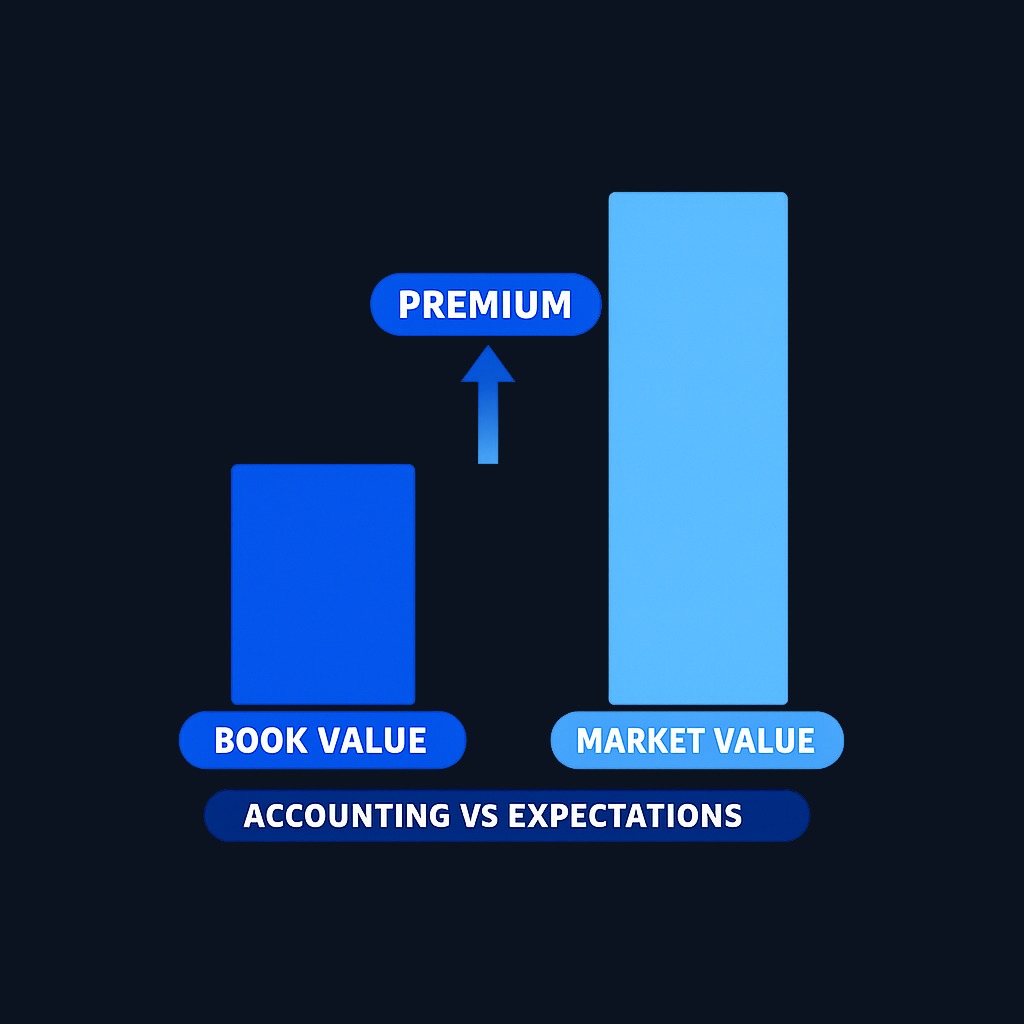
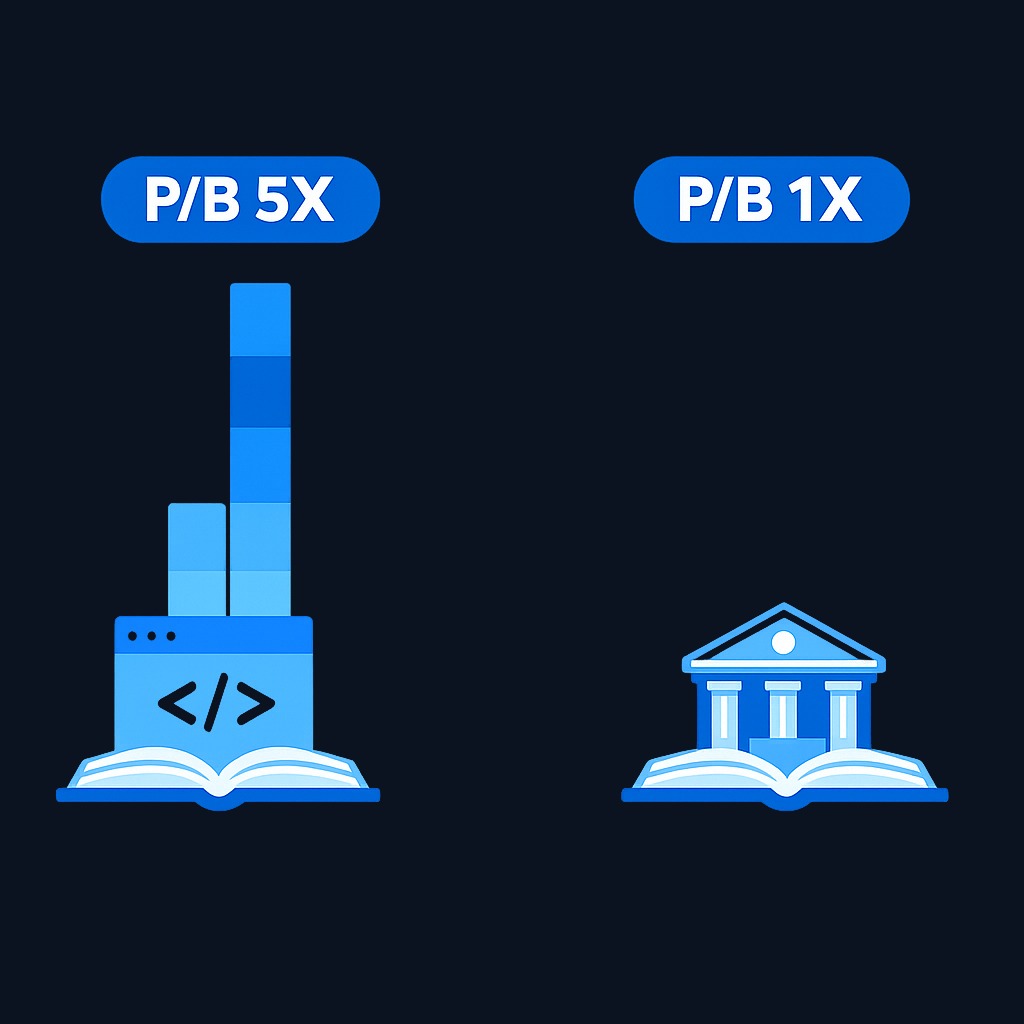
Software and services companies routinely trade at many multiples of book because their most productive assets, code and people, barely register on the balance sheet. Banks and insurers cluster near book value because their assets are mostly loans and securities already carried close to market. Comparing P/B ratios across industries is therefore close to meaningless; compare a company against its own history and its direct peers instead.
What to know before deciding
Common misconceptions are worth clearing up before you act on BVPS:
- "Below book means cheap." Not necessarily. A retailer full of obsolete inventory or a bank holding shaky loans can trade below book and still be expensive relative to what the assets would fetch.
- "Book value equals liquidation value." Liquidation sales usually recover far less than carrying amounts, and they trigger costs the balance sheet never shows.
- "BVPS works for every company." For asset-light businesses, BVPS is nearly irrelevant to valuation; earnings power and cash flow tell the story.
- "Tangible and total book value are the same." Tangible book value strips out goodwill and intangibles, and it is the stricter, more conservative measure many analysts prefer after acquisitions inflate goodwill.
Decision framework: when to lean on BVPS
Use this quick mapping to decide how much weight the metric deserves:
| Your situation | How to use BVPS |
|---|---|
| Screening banks or insurers | Core valuation metric; pair P/B with return on equity |
| Evaluating an industrial with heavy fixed assets | Useful reference; check asset age and impairment history |
| Analyzing a software or consumer-brand business | Low weight; prioritize earnings and cash flow metrics |
| Watching a long-term holding | Track BVPS growth plus dividends as a value-creation gauge |
| Spotting a stock trading under book | Investigate asset quality first, not price alone |
FAQ
What is book value per share in simple terms?
It is the amount of company net worth assigned to each common share on the balance sheet. Take everything the company owns, subtract everything it owes and the preferred shareholders' claim, and divide by the common share count.
How is book value per share different from earnings per share?
BVPS measures accumulated net assets at a point in time; earnings per share measures profit generated over a period. One is a snapshot of the balance sheet, the other a flow from the income statement, and healthy companies typically grow both.
Is a higher book value per share always better?
Not by itself. A high BVPS with weak returns on that equity means capital is sitting idle. Investors generally prefer a company that earns strong returns on a growing book value rather than one that merely accumulates assets.
Can book value per share be negative?
Yes. Companies that have sustained heavy losses or borrowed aggressively to fund buybacks can report negative equity, which makes BVPS negative. It is a signal to examine the debt load and the path back to positive net worth carefully.
Conclusion and next steps
Book value per share gives you a grounded, balance-sheet-based reference point: the formula takes total common equity and divides it by shares outstanding, and the result is most meaningful for asset-heavy businesses and least meaningful for asset-light ones. Pull a real 10-K from EDGAR, compute BVPS yourself, and compare it with the current stock price to see the premium or discount the market assigns. If you want structured practice turning metrics like this into actual investing skill, the Finelo app builds these concepts into bite-size lessons, with plan details on the pricing page and help available through support.
InvestingFundamental AnalysisFinancial StatementsBeginner
Practice investing with Finelo
Build practical investing skills with guided lessons, simulator practice, and structured challenges.
About the author
Finelo Team
The Finelo Team creates practical investing and trading education designed to help beginners learn faster with structured challenges, simulator practice, and bite-sized lessons.
Keep reading — Related articles

Investing
Tax-gain harvesting vs. tax-loss harvesting
Compare realizing investment gains with realizing losses, including holding periods, wash sales, offsets, and portfolio tradeoffs.
Finelo Team

Investing
Stable value fund vs. money market fund
Compare investment structure, contract protections, transfer restrictions, net yields, and access inside a retirement account.
Finelo Team

Investing
Single-life vs. joint-life annuity
Compare income for one lifetime with continued payments to a survivor, using equal premiums and matching guarantee terms.
Finelo Team