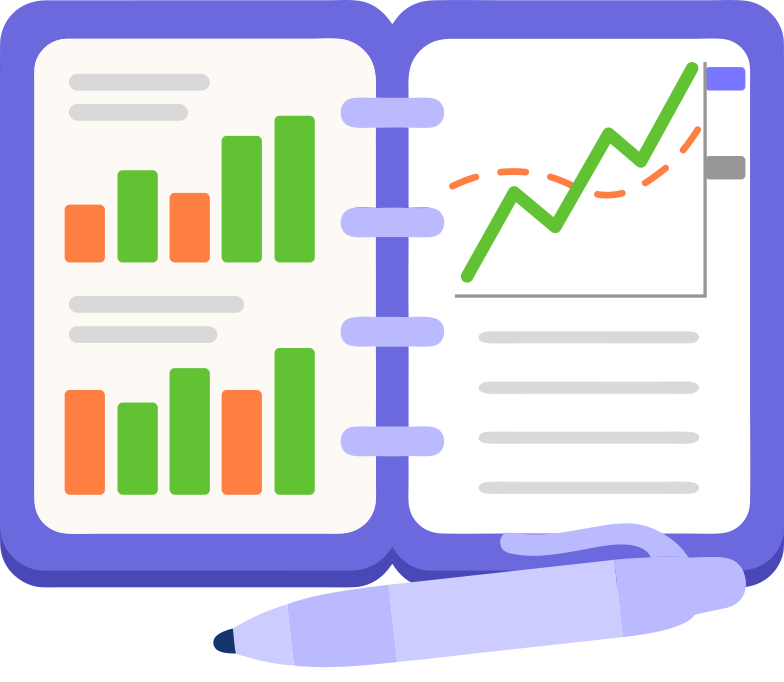
A target date fund is an investment fund built around a future year, often a retirement year, that automatically shifts its mix of investments over time. According to Investor.gov, target date funds are often mutual funds or ETFs and are designed for long-term goals such as retirement or college savings. The date in the name is a guide, not a guarantee: a “2055” fund is generally intended for someone with a goal near 2055, but the fund’s cost, risk level, holdings, and assumptions still matter.
Investing guide
Target Date Fund: Allocation, Costs & Risks
investing10 min read
A target date fund is an investment fund built around a future year, often a retirement year, that automatically shifts its mix of investments over time.
10 min read
Practice investing with Finelo
Build practical investing skills with guided lessons, simulator practice, and structured challenges.
Want to learn more?
Build practical investing skills with guided lessons, simulator practice, and structured challenges.
Explore FineloExplore Finelo's 28-day challenges
Turn learning into a daily habit with guided challenge paths.
How a Target Date Fund Works
A target date fund is usually a diversified, all-in-one investment option. Instead of choosing separate stock funds, bond funds, and other holdings yourself, you choose one fund tied to an approximate future date. That fund then manages the mix internally.
A portfolio is the collection of investments an investor owns. In a target date fund, the fund company builds and manages a portfolio inside the fund. Many target date funds are “funds of funds,” meaning they hold other funds rather than individual securities directly. FINRA describes target-date funds as funds that change their investments over time to meet goals planned for a specific time, such as retirement.
The central feature is the glide path: the planned shift in the fund’s investment mix as the target date approaches. Early on, a target date fund may hold more stocks because the investor is assumed to have more time before needing the money. As the target year gets closer, the fund may gradually shift toward bonds, cash-like holdings, or income-producing investments.
For example, a hypothetical 2055 target date fund might start with a stock-heavy mix decades before 2055, then slowly reduce stock exposure over time. The fund does this automatically according to its stated strategy. That convenience is the main appeal, but it also means the investor is accepting the fund provider’s assumptions about timing, risk, and asset mix.
This article is for educational purposes only and does not constitute financial or investment advice. Finelo does not recommend any security, strategy, or transaction. Investing involves risk, including possible loss of principal.
What the Target Year Does—and Does Not—Tell You
The year in a target date fund name is useful, but it is not enough to evaluate the fund.
A “2045” or “2050” label usually suggests the approximate year when an investor expects to retire or begin using the money. If a person expects to retire around 2050, a 2050 target date fund may appear to line up with that goal. But the label does not tell you everything important.
The target year does not automatically tell you:
- How much the fund holds in stocks today
- How quickly it becomes more conservative
- What it will hold at the target date
- Whether it keeps changing after the target date
- How expensive it is
- Whether it overlaps with other investments you already own
- Whether its risk level matches your comfort with market declines
Two funds with the same target year can be meaningfully different. One 2055 fund may hold more stocks than another 2055 fund. One may use low-cost index funds; another may use actively managed underlying funds with higher expenses. One may continue changing for years after the target date, while another may largely stop at or near the target year.
That is why the target date should be treated as a starting filter, not a final decision. It helps narrow the list, but the fund’s documents, expense ratio, holdings, and risk profile provide the substance.
A common misinterpretation is that the target year is the year when the investment becomes “safe.” It is not. A target date fund can lose value before, during, or after the target year. Even a more conservative fund may hold bonds or other assets that can decline in price.
Costs, Holdings, and Risk Factors to Compare
When comparing target date funds, three areas deserve special attention: cost, holdings, and risk.
Cost usually starts with the expense ratio, which is the annual fund operating cost expressed as a percentage of assets. A lower expense ratio does not guarantee better results, and a higher expense ratio does not guarantee worse results. But costs reduce investor returns, so they are worth comparing carefully.
Holdings show what the fund actually owns. Many target date funds hold underlying stock funds, bond funds, and sometimes additional asset classes. The fund’s prospectus or plan materials should show its target percentages, underlying funds, and investment approach.
Risk depends largely on the asset mix. A fund with a larger stock allocation may have greater long-term growth potential but may also experience larger short-term declines. A fund with more bonds or cash-like holdings may feel less volatile at times, but it may also have lower growth potential or face risks such as inflation and interest-rate changes.
Here are practical questions a reader could use when comparing options:
| Question | Why it matters |
|---|---|
| What is the target date? | It should roughly match the timing of the goal, but it is only a starting point. |
| What is the current stock/bond mix? | This helps estimate how aggressive or conservative the fund may be today. |
| What does the glide path look like? | The pace of change affects future risk exposure. |
| What is the expense ratio? | Small percentage differences can become meaningful as balances grow. |
| What underlying funds does it hold? | The fund may be index-based, actively managed, or a mix. |
| Does it overlap with other holdings? | Overlap can make a broader account more concentrated than intended. |
| What happens after the target date? | Some funds keep adjusting after the date; others level off sooner. |
If you are learning how individual pieces fit together, Finelo’s guide on how to build a diversified portfolio can be useful related education. A target date fund is one way to package diversification, but it is not the only way.
Practice investing with Finelo
Build practical investing skills with guided lessons, simulator practice, and structured challenges.
Worked Example: Comparing Two Hypothetical 2055 Funds
Assume an investor is comparing two hypothetical target date funds available in the same retirement account. The investor expects to retire around 2055 and is reviewing two options labeled “2055.”
These are simplified assumptions for education only:
| Feature | Fund A: 2055 Index-Based Fund | Fund B: 2055 Active Blend Fund |
|---|---|---|
| Current balance to invest | $20,000 | $20,000 |
| Expense ratio | 0.10% per year | 0.55% per year |
| Current stock allocation | 90% | 85% |
| Current bond/cash allocation | 10% | 15% |
| Glide path | Gradually becomes more conservative through retirement | Gradually becomes more conservative near and after 2055 |
| Underlying funds | Broad index funds | Mix of active and index funds |
First, compare annual fund costs using simple arithmetic:
-
Fund A cost estimate: $20,000 × 0.10%
-
Convert 0.10% to decimal: 0.001
-
$20,000 × 0.001 = $20 per year
-
Fund B cost estimate: $20,000 × 0.55%
-
Convert 0.55% to decimal: 0.0055
-
$20,000 × 0.0055 = $110 per year
Simple estimated annual cost difference:
- $110 − $20 = $90 per year
That $90 is not a prediction of future performance. It is a simplified cost comparison based on the starting balance and stated expense ratios. Actual dollar costs may change as the account balance changes.
Next, compare the investment mix:
-
Fund A: $20,000 × 90% stocks = $18,000 in stock exposure
-
Fund A: $20,000 × 10% bonds/cash = $2,000 in bond/cash exposure
-
Fund B: $20,000 × 85% stocks = $17,000 in stock exposure
-
Fund B: $20,000 × 15% bonds/cash = $3,000 in bond/cash exposure
Even though both funds have the same 2055 target year, Fund A is slightly more stock-heavy in this simplified example. Fund B is slightly more conservative today but costs more. Whether either structure is appropriate would depend on the investor’s broader account, risk tolerance, plan rules, and goals.
A concrete reading workflow could look like this:
- Confirm the target year and whether it broadly matches the expected goal date.
- Find the expense ratio and convert it into dollars using the balance you expect to invest.
- Read the current asset allocation: stocks, bonds, cash, and any other categories.
- Review the glide path to see how the fund expects to change over time.
- Check whether the fund continues changing after the target date.
- Compare the underlying funds and whether they are index-based, active, or mixed.
- Look at how the fund would fit with other investments in the same account or household.
This process does not identify a “best” fund. It helps make the tradeoffs visible.
When a Target Date Fund May Be Useful
A target date fund may be useful when an investor wants a simplified way to invest for a long-term goal. It can reduce the number of separate decisions: instead of selecting several funds and rebalancing them manually, the investor evaluates one fund with a built-in allocation strategy.
This structure may be especially appealing in workplace retirement plans, where target date funds are often included as menu options. For someone who might otherwise leave cash uninvested or make random fund choices, a diversified date-based option may be easier to understand than a long list of separate funds.
Potential advantages include:
- Simplicity: One fund can provide exposure to multiple asset classes.
- Automatic adjustments: The glide path changes the investment mix over time.
- Built-in rebalancing: The fund generally manages its own internal target allocation.
- Goal-based labeling: The target year can help connect the fund to a future need.
- Behavioral support: A single fund may reduce the temptation to constantly tinker.
However, “simple” does not mean “risk-free” or “maintenance-free.” A target date fund still requires review. Life events, retirement timing, plan changes, or a shift in risk tolerance can all make it worth rechecking whether the fund still fits the intended role.
For readers who want to understand the maintenance side of investing, Finelo’s article on how to rebalance a portfolio offers related education. A target date fund often handles rebalancing internally, but understanding the concept can help you evaluate what the fund is doing on your behalf.
Limitations, Failure Modes, and Common Misinterpretations
Target date funds are designed to simplify investing, but several problems can arise when they are misunderstood.
Misinterpretation 1: “The date makes the fund safe.”
The target date is not a maturity date, insurance feature, or promise that the money will be preserved. A 2030 fund can lose value in 2030. A 2055 fund can experience large declines decades before retirement.
Misinterpretation 2: “All funds with the same year are basically identical.”
They are not. Same-year funds can differ in stock exposure, bond exposure, international allocation, underlying funds, fees, and glide path. Comparing only the fund name can lead to a mismatch.
Misinterpretation 3: “I never need to look at it again.”
The fund changes automatically, but your life may change too. Retirement timing, income needs, other accounts, and comfort with volatility may shift. A periodic review can help identify whether the fund still matches the goal.
Misinterpretation 4: “One target date fund plus many other funds always means more diversification.”
Adding investments does not always improve diversification. If the target date fund already owns broad stock and bond funds, adding similar funds may create overlap. The account might become more stock-heavy or concentrated than intended.
Misinterpretation 5: “The default option must be the best option.”
A workplace plan may use a target date fund as a default because it is broadly designed for long-term retirement saving. That does not mean it is the best fit for every individual situation. Costs, alternatives, and personal circumstances still matter.
Common failure modes include:
- Choosing a fund only because the year matches the expected retirement date
- Ignoring the expense ratio because it looks small
- Holding multiple target date funds with different years without understanding the combined allocation
- Adding a target date fund to an already diversified account without checking overlap
- Assuming the fund will produce enough retirement income
- Selling during a market decline without understanding the fund’s long-term design
- Forgetting to review the fund after major life changes
Another important limitation is that target date funds rely on assumptions about a typical investor. Real people do not always fit those assumptions. Two people retiring in the same year may have very different savings levels, pensions, Social Security expectations, health needs, family responsibilities, debt, and risk tolerance. A single date cannot capture all of that.
How to Review a Target Date Fund Before Using One
A careful review does not need to be complicated. The goal is to understand what the fund is designed to do, what it costs, and where it might fit within a broader plan.
Use this checklist as an educational review process:
-
Identify the goal.
Is the money intended for retirement, education, or another long-term purpose? A target date fund is usually designed for a long horizon, not short-term spending needs. -
Match the approximate date.
Compare the target year with when you may begin using the money. Treat the date as approximate, not exact. -
Read the asset allocation.
Look for the current mix of stocks, bonds, cash, and other holdings. Ask whether the level of potential volatility would be emotionally and financially manageable. -
Study the glide path.
Determine how the fund expects to change over time. Check whether it becomes more conservative at the target date or continues evolving afterward. -
Calculate the cost in dollars.
Multiply the expected investment amount by the expense ratio. This can make percentage costs easier to compare. -
Check for overlap.
If you already own other investments, compare them with the target date fund’s underlying holdings. -
Consider account rules and taxes.
In a workplace retirement plan, available options and transaction rules may be set by the plan. In a taxable account, selling or switching funds could have tax consequences. When unsure, it may be appropriate to consult a qualified professional. -
Set a review habit.
A target date fund is not meant for daily trading, but it can still be reviewed periodically or after major life changes.
A target date fund can be a practical educational example of goal-based investing: one fund, one target year, and a built-in plan for changing risk over time. Its value depends on the specific fund and the specific context. The most important step is not finding a perfect label—it is understanding what the fund owns, what it costs, how it can fail to meet expectations, and whether its assumptions align with the goal it is meant to serve.
InvestingPortfolio ManagementBeginner
Practice investing with Finelo
Build practical investing skills with guided lessons, simulator practice, and structured challenges.
About the author
Finelo Team
The Finelo Team creates practical investing and trading education designed to help beginners learn faster with structured challenges, simulator practice, and bite-sized lessons.
Keep reading — Related articles
Investing
Tax-gain harvesting vs. tax-loss harvesting
Compare realizing investment gains with realizing losses, including holding periods, wash sales, offsets, and portfolio tradeoffs.
Finelo Team
Investing
Stable value fund vs. money market fund
Compare investment structure, contract protections, transfer restrictions, net yields, and access inside a retirement account.
Finelo Team
Investing
Single-life vs. joint-life annuity
Compare income for one lifetime with continued payments to a survivor, using equal premiums and matching guarantee terms.
Finelo Team