Methodology note: TWR breaks performance into subperiods at external cash-flow dates, values the portfolio immediately before the cash flow, and geometrically links subperiod returns. MWR is an IRR/XIRR based on the amount and timing of investor cash flows. The 2026 CFA Institute GIPS overview explains when GIPS generally requires TWR and when MWR may be used. Do not annualize a period shorter than one year, and state fees, dates, and valuation conventions.
Time-Weighted vs Money-Weighted Returns: What Each One Measures

Time-weighted return (TWR) measures how well the investments themselves performed, stripping out the effect of deposits and withdrawals. Money-weighted return (MWR) measures how well your actual dollars did, including…
7 min read
Practice investing with Finelo
Build practical investing skills with guided lessons, simulator practice, and structured challenges.
Want to learn more?
Build practical investing skills with guided lessons, simulator practice, and structured challenges.
Explore FineloExplore Finelo's 28-day challenges
Turn learning into a daily habit with guided challenge paths.
Time-weighted return (TWR) measures how well the investments themselves performed, stripping out the effect of deposits and withdrawals. Money-weighted return (MWR) measures how well your actual dollars did, including the timing of every contribution and withdrawal. Same account, two honest numbers that can differ sharply. This page is for investors comparing their broker's performance figures, evaluating a fund or advisor, or wondering why their personal return does not match the fund's published one. Below you will find both calculations with worked numbers, a side-by-side comparison, and a simple rule for which number to use when. Check which method your own platform reports before comparing anything.
Searches for time weighted return vs money weighted return usually come from exactly that confusion, so let's resolve it first with a direct comparison.
Key differences at a glance
| Feature | Time-weighted return | Money-weighted return |
|---|---|---|
| What it judges | The investment strategy or manager | Your personal dollar experience |
| Cash flow timing | Removed from the result | Central to the result |
| Also known as | Geometric linked return | Internal rate of return (IRR) |
| Best for | Comparing funds and managers | Judging your own outcomes and behavior |
| Standard use | Fund industry performance reporting | Personal accounts with frequent deposits |
| Same for every investor in a fund? | Yes | No; depends on each investor's flows |
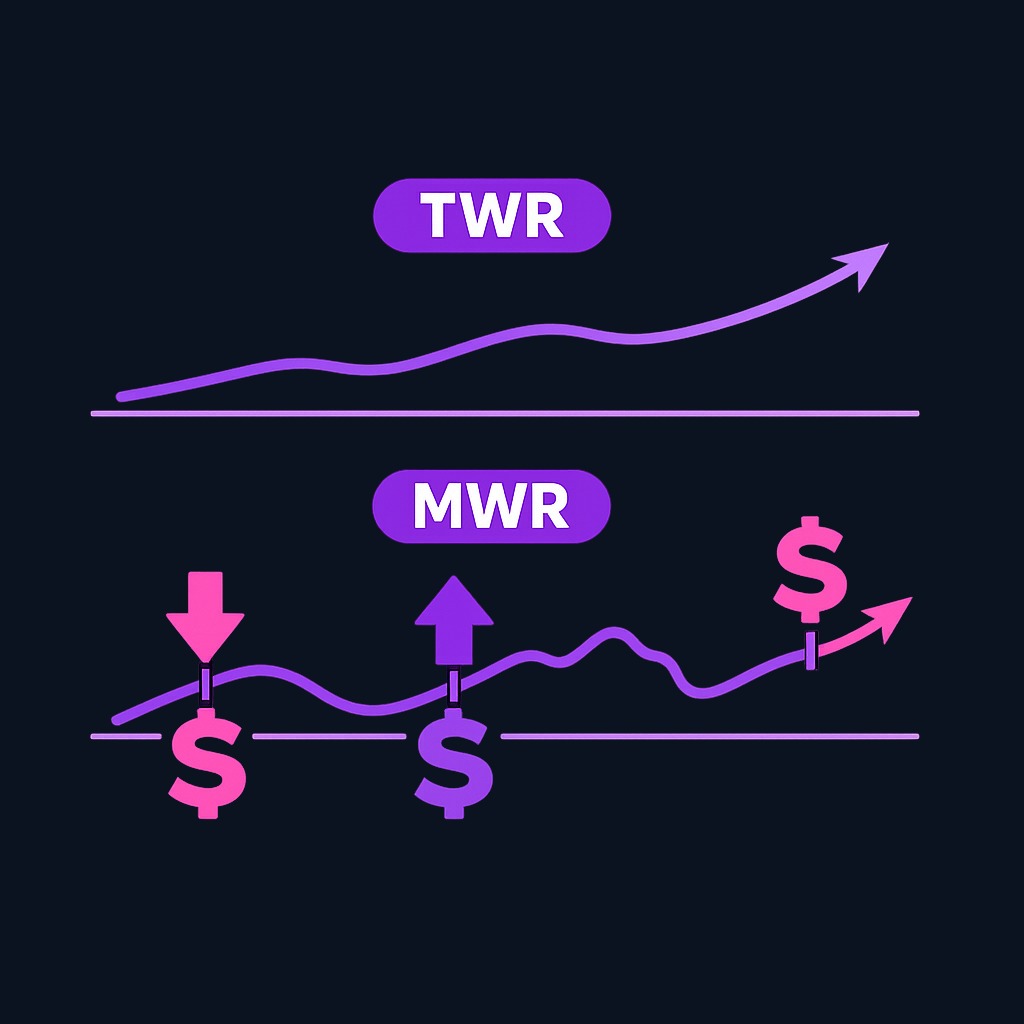
The core distinction: TWR asks "how did each invested dollar grow while it was invested?" MWR asks "how did my money do, given when I added and removed it?"
How to calculate time-weighted return
TWR breaks the measurement window into sub-periods at every cash flow, computes the simple return of each sub-period, then links them:
- Each time money enters or leaves, close a sub-period and note the account value just before the flow.
- Compute each sub-period's return: (ending value − beginning value) / beginning value.
- Link them: TWR = (1 + r1) × (1 + r2) × ... − 1.
Example. An account starts at $10,000 and grows to $11,000 (+10%). You then deposit $9,000, bringing it to $20,000. The market slips, and the account ends at $19,000 (−5%). TWR = 1.10 × 0.95 − 1 = +4.5%. The deposit's unlucky timing does not touch the number; it grades only the underlying portfolio performance.
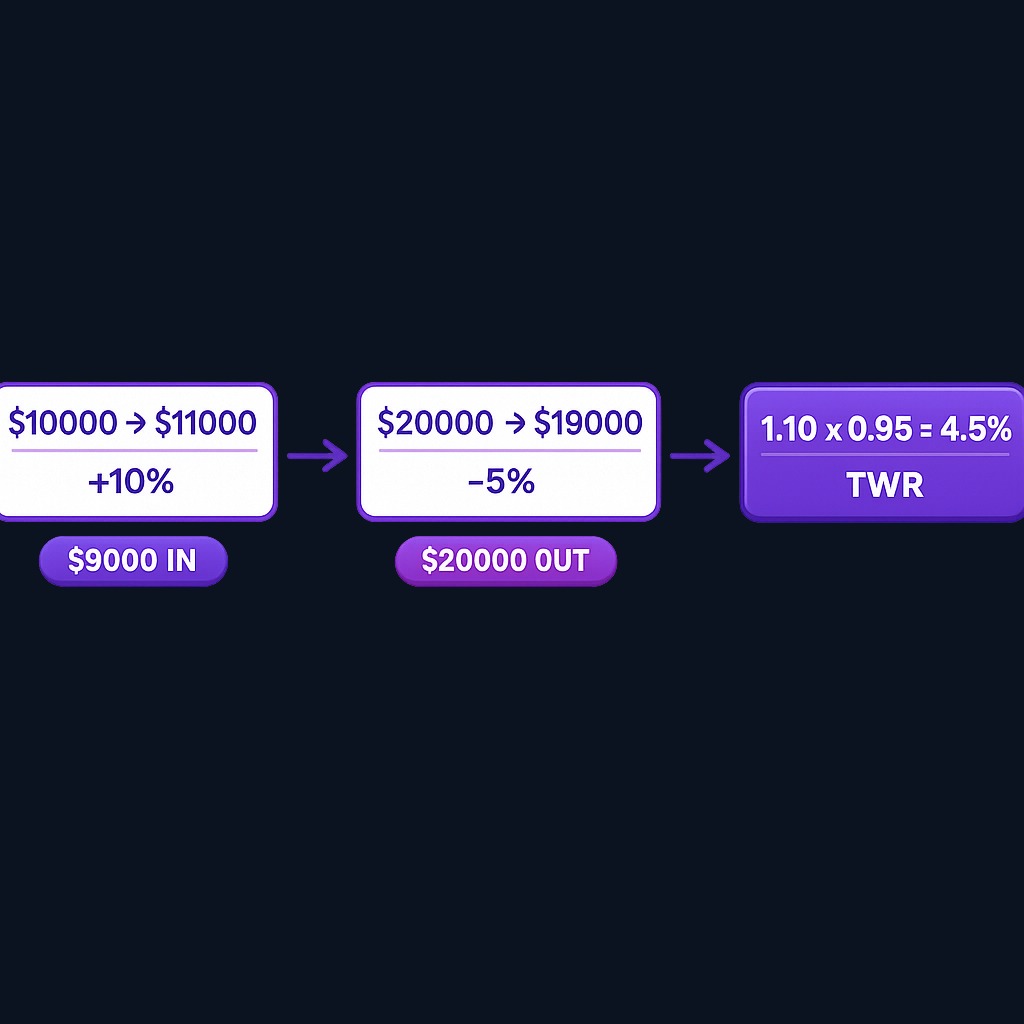
That neutrality is why fund performance is reported this way: a fund manager controls the strategy, not the timing of thousands of investors' deposits. Performance figures in fund prospectuses and reports, which U.S. investors can verify through the SEC's EDGAR filing system, follow this logic.
How to calculate money-weighted return
MWR is the internal rate of return: the single annualized rate that makes all your cash flows (deposits negative, withdrawals and ending value positive) sum to zero when discounted. Nobody solves it by hand; spreadsheets do it with the XIRR function.
Run the same example. You invested $10,000 at the start and $9,000 mid-period, and ended with $19,000. You put in $19,000 total and ended with $19,000: your dollars went nowhere. The MWR lands near 0%, far below the +4.5% TWR, because the big deposit arrived right before the decline and most of your money experienced only the losing stretch.
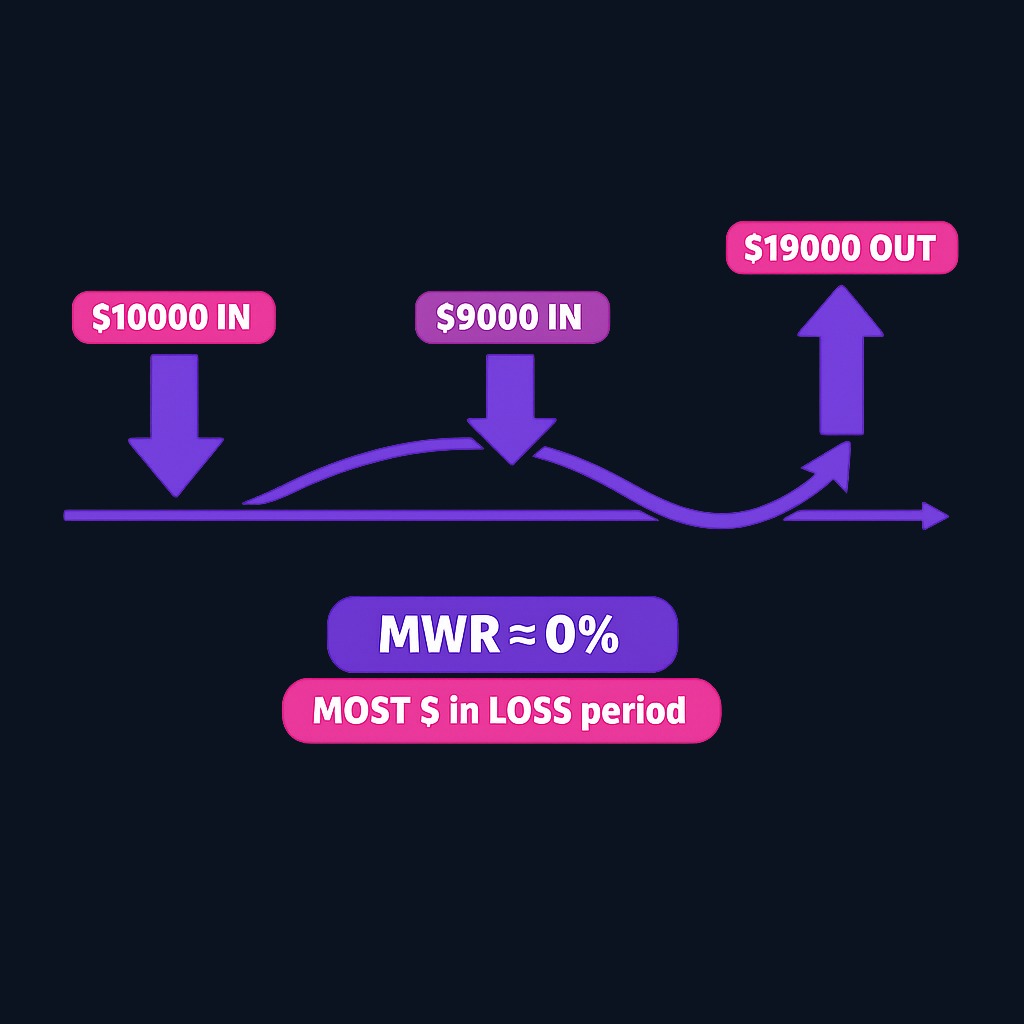
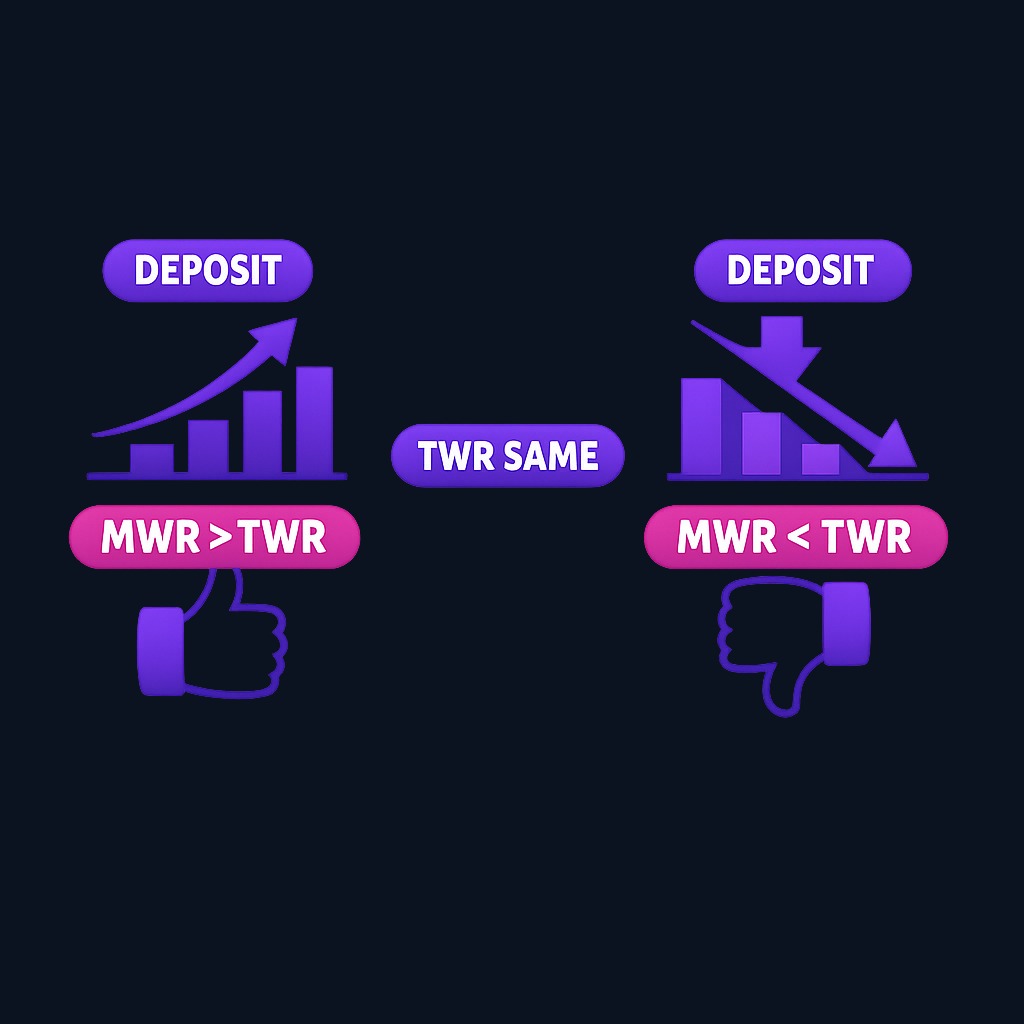
Flip the timing and the gap reverses: deposit before the gains and withdraw before the losses, and your MWR beats the TWR. Timing, luck, and behavior all show up in this number, which is exactly what makes it personal.
When to use each measure
Use time-weighted return when judging someone else's skill. Comparing two funds, benchmarking an advisor against an index, or evaluating a strategy requires removing investor cash-flow noise. TWR is the fair exam.
Use money-weighted return when judging your own outcome. Whether you are on track for a goal depends on what your actual dollars earned. MWR captures the combined effect of the market and your timing.
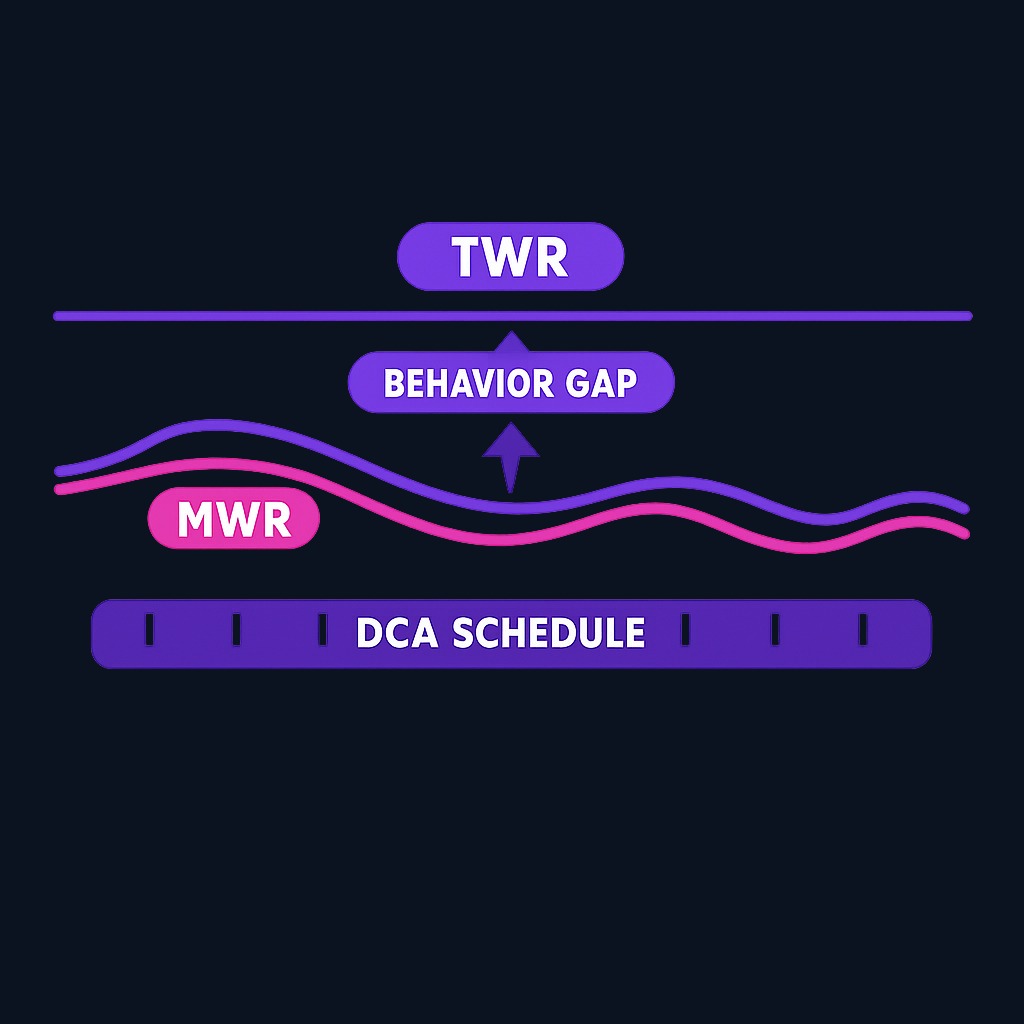
Use both to diagnose behavior. A persistent gap between your MWR and the same portfolio's TWR is a behavior report. If your MWR chronically lags, your deposits tend to chase rallies or your withdrawals cluster in panics. Steady schedules such as dollar-cost averaging shrink the gap by making timing mechanical rather than emotional.
A quick scenario table:
| Situation | Better measure |
|---|---|
| Choosing between two index funds | TWR |
| Checking progress toward retirement | MWR |
| Evaluating an advisor's decisions | TWR |
| Reviewing the cost of your own market timing | Both, compared |
| Account with no deposits or withdrawals | Identical either way |
Practice investing with Finelo
Build practical investing skills with guided lessons, simulator practice, and structured challenges.
What to know before deciding
Neither number is "the true return"; they answer different questions, and both are needed for a full picture. Platforms differ in what they display, and some label the method vaguely, so confirm whether your dashboard shows TWR, MWR, or a simple cumulative gain before drawing conclusions. Short measurement windows exaggerate the difference between the two, and annualizing either number from a few months of data produces impressive-looking nonsense.
Also remember that returns are only comparable after fees and over matching periods. A fund's published TWR is calculated after its expenses, while your personal MWR also absorbs trading costs, account fees, and taxes. None of this is personalized advice; it is the vocabulary you need to read performance claims skeptically.
Decision framework: which return should you check?
- "Is this fund better than that one?" Compare their TWRs over identical periods, after fees.
- "Am I on track for my goal?" Check your MWR against the return your plan assumes.
- "Is my advisor adding value?" TWR versus an appropriate benchmark.
- "Is my own timing costing me money?" Compare your MWR with the portfolio's TWR over the same window.
- "My account has no cash flows." Relax; the two numbers converge.
FAQ
Why is my personal return lower than the fund's published return?
The fund publishes a time-weighted return, while your dollars earned a money-weighted return shaped by when you bought and sold. Deposits before declines or withdrawals before rallies pull your MWR below the fund's TWR.
Which is more accurate, TWR or MWR?
Both are accurate answers to different questions. TWR accurately grades the investment; MWR accurately grades your dollars' experience. Use the one that matches the question you are asking.
What is the money-weighted return also called?
It is the internal rate of return (IRR) applied to your account's cash flows. Spreadsheet functions like XIRR compute it from dated flows and the ending balance.
Do deposits and withdrawals affect time-weighted return?
No. TWR is specifically constructed to neutralize cash-flow timing by breaking the period at each flow and linking the sub-period returns.
Conclusion and next steps
Time-weighted and money-weighted returns split performance into its two honest halves: what the strategy did, and what your behavior did with it. Judge funds and managers by TWR, judge your own progress by MWR, and treat a persistent gap between them as feedback on your timing habits. Find out which figure your platform reports, run XIRR on your own account once a year, and let the comparison teach you where your real returns come from.
InvestingFundamental AnalysisBeginner
Practice investing with Finelo
Build practical investing skills with guided lessons, simulator practice, and structured challenges.
About the author
Finelo Team
The Finelo Team creates practical investing and trading education designed to help beginners learn faster with structured challenges, simulator practice, and bite-sized lessons.
Keep reading — Related articles

Investing
Tax-gain harvesting vs. tax-loss harvesting
Compare realizing investment gains with realizing losses, including holding periods, wash sales, offsets, and portfolio tradeoffs.
Finelo Team

Investing
Stable value fund vs. money market fund
Compare investment structure, contract protections, transfer restrictions, net yields, and access inside a retirement account.
Finelo Team

Investing
Single-life vs. joint-life annuity
Compare income for one lifetime with continued payments to a survivor, using equal premiums and matching guarantee terms.
Finelo Team


