When a stock is delisted, it is removed from an exchange such as the NYSE or Nasdaq. Delisting alone does not cancel your shares, but continued trading is not guaranteed: the security may move to an over-the-counter market, become restricted at some brokers, be converted under a merger, or ultimately be canceled in a bankruptcy or other corporate action. This guide explains how to identify which outcome applies.
What Happens When a Stock is Delisted?

When a stock is delisted, it is removed from an exchange such as the NYSE or Nasdaq. Delisting alone does not cancel your shares, but continued trading is not guaranteed: the security may move to an over-the-counter…
7 min read
Practice investing with Finelo
Build practical investing skills with guided lessons, simulator practice, and structured challenges.
Want to learn more?
Build practical investing skills with guided lessons, simulator practice, and structured challenges.
Explore FineloExplore Finelo's 28-day challenges
Turn learning into a daily habit with guided challenge paths.
Who this is for and what delisting means
This explainer is for three kinds of readers: shareholders who just received a delisting notice in a company they own, bargain hunters eyeing a stock trading below exchange minimums, and learners who want to understand exchange mechanics before the situation ever touches their portfolio.
Listing on a major exchange is a privilege with conditions, not a permanent status. Exchanges set standards a company must keep meeting: timely financial reporting, minimum share price, minimum market value, and governance rules. Delisting is the removal of the company's shares from that exchange, either at the company's request or by the exchange's decision.
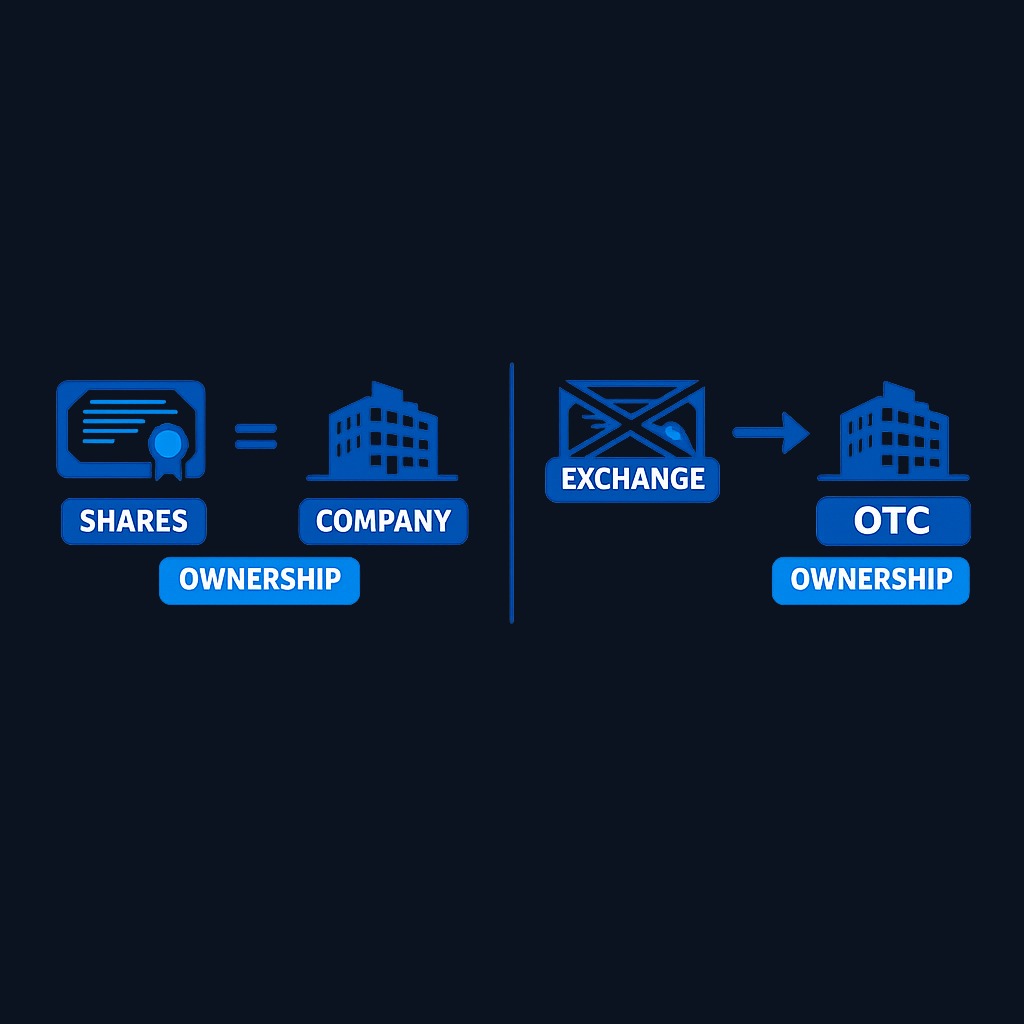
Delisting is not the same as bankruptcy, and it is not a seizure of your property. Shares represent ownership in the company, and that ownership survives the loss of a listing. What changes is where and how easily those shares trade.
How it works: from deficiency notice to removal
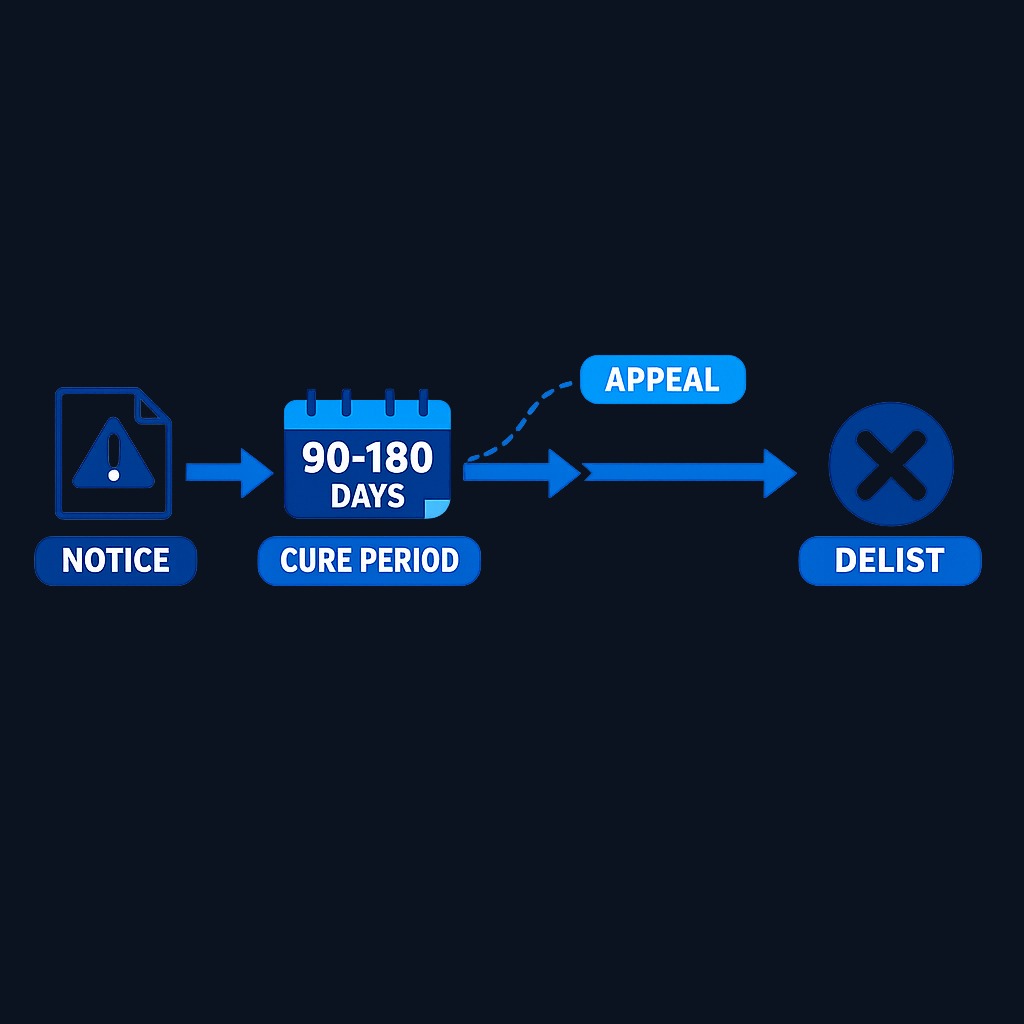
Involuntary delisting is a process, not an ambush. Exchanges move against companies that stop meeting listing standards, and common triggers include a share price below the exchange minimum for an extended period, late or missing financial reports, market-value or shareholder-count shortfalls, bankruptcy filings, and governance violations.
The sequence often includes a deficiency notice, a compliance period, and possible review or appeal, but timing depends on the exchange rule and reason for removal. An exchange can also suspend trading before the delisting process ends, so do not assume there will always be months of liquid trading.
Voluntary delisting works differently. A private-equity acquirer may buy all outstanding shares, a founder may take the business private, or a foreign issuer may consolidate to one home-market listing to cut compliance costs. In an acquisition, shareholders are typically cashed out or receive acquirer stock, so the delisting is a technicality at the end of the deal rather than a warning sign.
Key benefits of knowing the delisting playbook
Understanding the mechanics pays off in three concrete ways. First, you can act early: deficiency notices and cure periods give informed holders months of lead time to decide while liquidity is still good. Second, you avoid panic mistakes, such as dumping shares of a healthy company being taken private at a premium. Third, you can judge the aftermath rationally, because you know what changes for the shares themselves:
| Situation | What typically happens to your shares |
|---|---|
| Buyout or going-private deal | Converted to cash or acquirer stock at deal terms |
| Involuntary delisting, company still operating | May become quoted OTC if regulatory, broker-dealer, and market requirements are met; trading is not assured |
| Delisting during bankruptcy | May trade OTC temporarily, be restricted, or be canceled; common stock is last in priority |
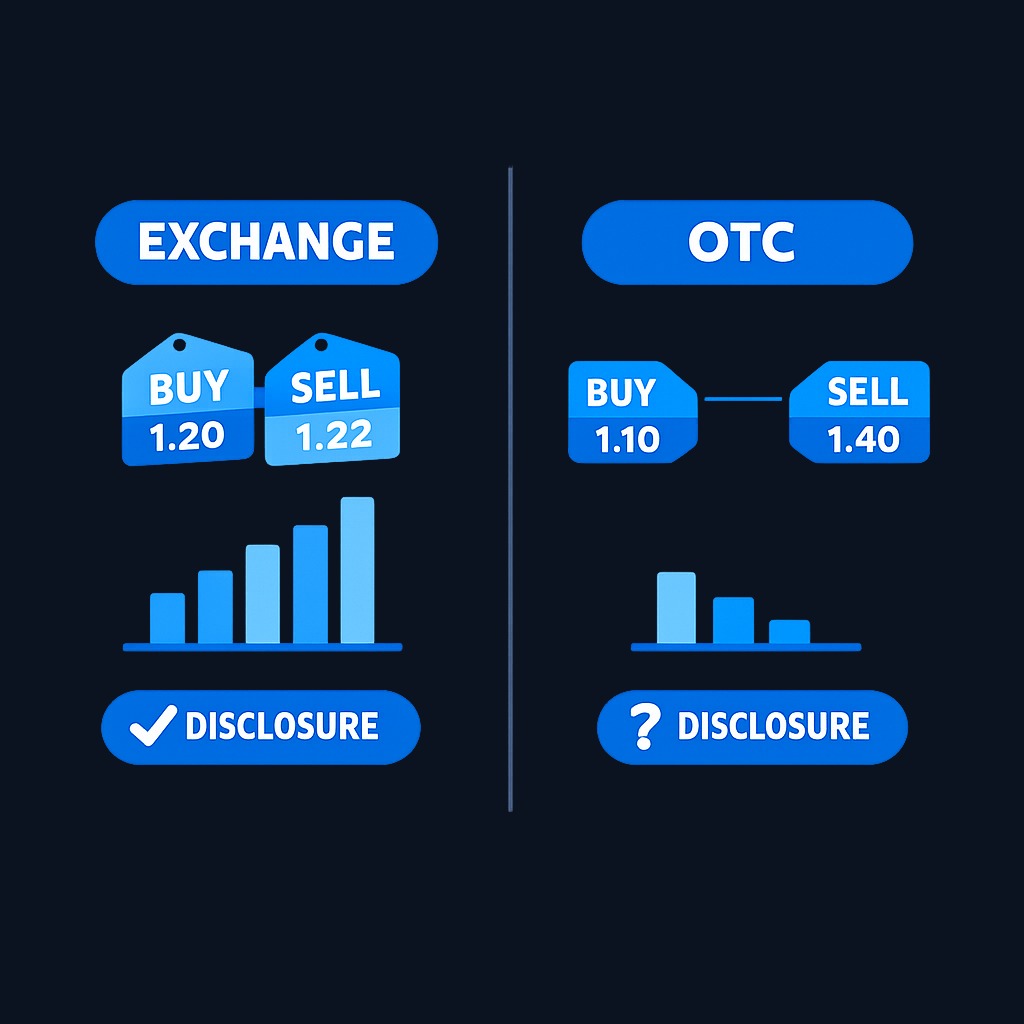
If shares become available OTC, liquidity may be thinner, spreads wider, and disclosure more limited, especially if the company stops filing with regulators. FINRA's overview of over-the-counter trading explains that OTC securities do not trade on a national securities exchange and that risks vary substantially across issuers and markets.
Proof, examples, and objections
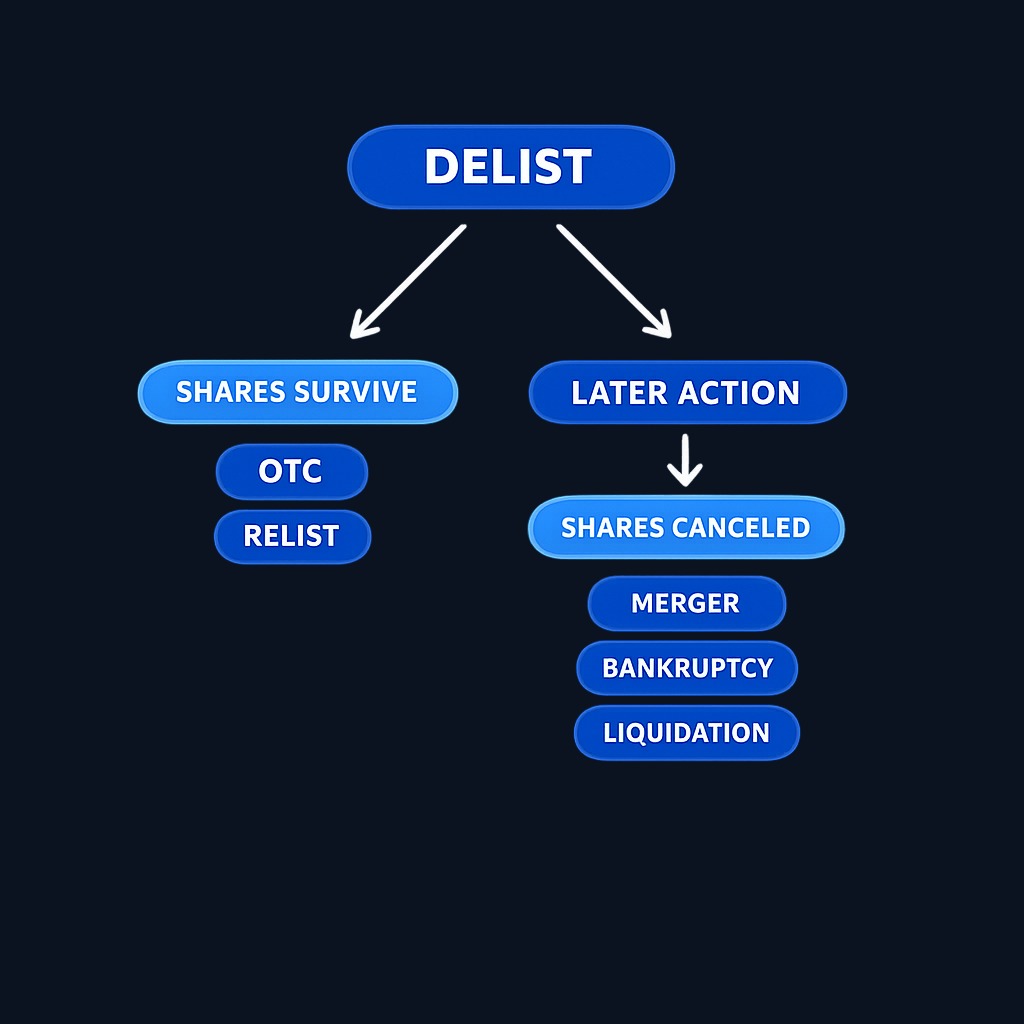
Outcomes depend on the cause and the governing documents. A completed cash merger may pay the stated consideration, while financial distress can leave common shareholders with little or nothing after senior claims. Some companies cure deficiencies or later qualify to relist, but investors should not assume that either OTC trading or relisting will occur.
Two common objections deserve answers. "If the stock is delisted, my money is automatically gone"—not necessarily; exchange removal and cancellation are separate events. But ownership can later be converted or canceled under a merger, bankruptcy plan, liquidation, or other corporate action. "Delisting is always a scandal"—also no; going-private transactions are routine corporate finance. OTC securities can nevertheless be harder to trade and research.
Practice investing with Finelo
Build practical investing skills with guided lessons, simulator practice, and structured challenges.
What to do if your stock is delisted
- Identify the reason. Read the company's announcement and the exchange notice. A merger cash-out and a compliance failure call for opposite responses.
- Check whether the company still files reports. You can verify continued disclosures for free through the SEC's EDGAR database. A company that keeps filing is far easier to evaluate than one that goes dark.
- Confirm where the shares now trade. Your broker can tell you whether the stock trades over the counter and whether they support trading it. Some brokers restrict OTC purchases but still allow selling existing positions.
- Reassess the investment case. Ask whether you would buy this business today at this price. If not, holding out of inertia is a decision too.
- Use limit orders if you trade. Thin OTC liquidity makes market orders risky; a limit order controls your execution price.
- Keep records for taxes. Sales, worthless-security claims, and buyout proceeds each carry tax consequences worth documenting.
Decision framework: hold, sell, or reassess
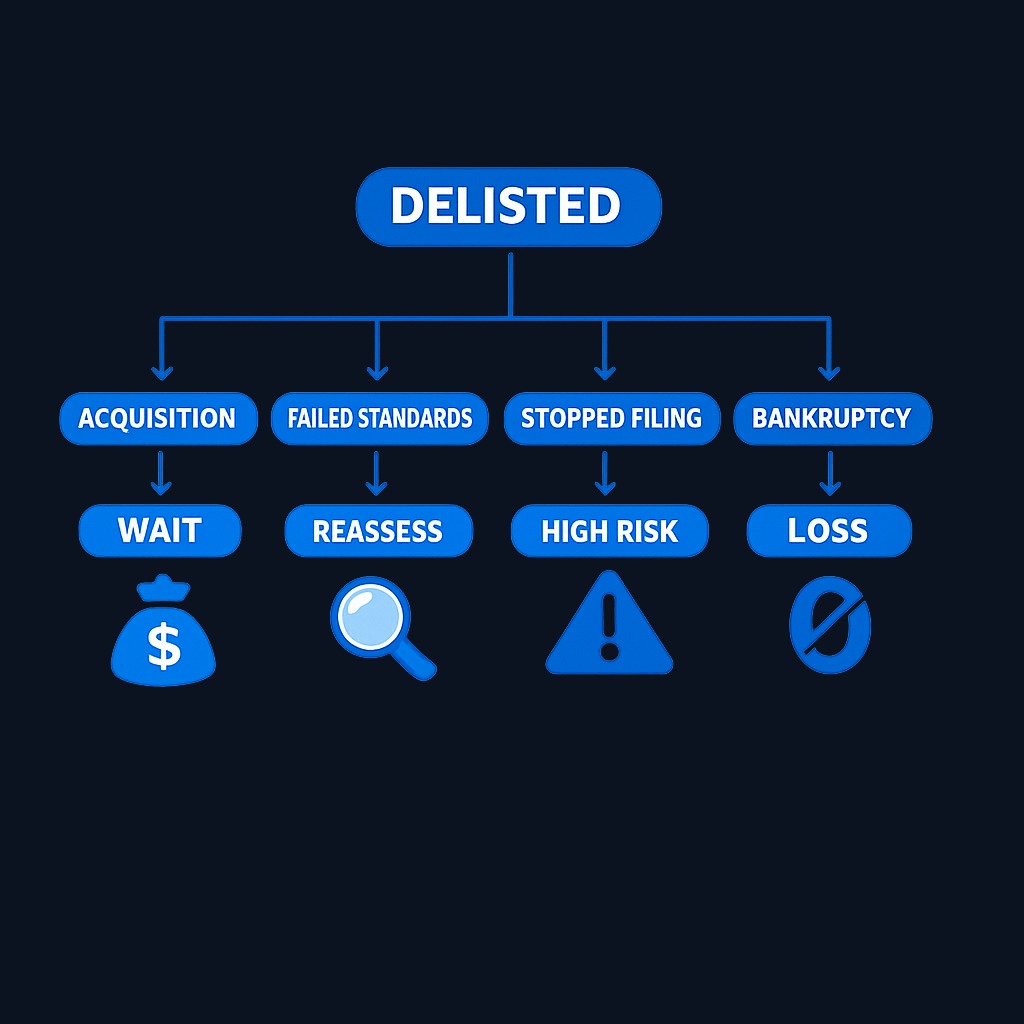
A delisting forces a fresh decision, and the worst response is to look away because the position is embarrassing. Selling into an illiquid market costs more per share, but waiting rarely fixes the fundamentals behind an involuntary removal. In a bankruptcy, common shareholders stand behind creditors and preferred holders, so recoveries are often minimal. Use the cause as your guide:
- Acquisition or going-private deal: usually nothing to do; deal terms dictate your payout. Verify the timeline with your broker.
- Failed standards, still operating and filing: re-underwrite on fundamentals; if you keep it, accept OTC liquidity costs knowingly.
- Stopped filing entirely: treat the position as high-risk speculation; without current information, valuation is guesswork.
- Bankruptcy: assume common equity may be wiped out, and weigh any remaining bid against the tax value of realizing the loss.
FAQ
Do I lose my shares when a stock is delisted?
Not solely because of the delisting. Exchange removal does not itself cancel ownership, but a separate merger, bankruptcy plan, liquidation, or other corporate action can convert or cancel the shares. Continued OTC quotation is not guaranteed.
Can I still sell a delisted stock?
Possibly. First confirm that the security is quoted, that your broker permits transactions, and that a buyer exists. Some brokers allow only closing transactions or no transactions at all. If trading is available, spreads and price gaps can be large.
Can a delisted stock come back to an exchange?
A company can apply once it meets the exchange's applicable initial or relisting standards. Approval is not automatic, and investors should not base a decision on an assumed return to an exchange.
Is delisting always bad news?
No. Voluntary delistings tied to buyouts or going-private deals are routine corporate events. Involuntary delistings for failed standards usually confirm problems the market already suspected.
Conclusion and next steps
Delisting changes—or may eliminate—the market in which shares can trade. It does not by itself erase ownership, but later corporate actions can convert or cancel the security. Check the exchange notice, issuer filings, broker restrictions, and governing deal or bankruptcy documents before deciding what to do.
InvestingFundamental AnalysisBeginner
Practice investing with Finelo
Build practical investing skills with guided lessons, simulator practice, and structured challenges.
About the author
Finelo Team
The Finelo Team creates practical investing and trading education designed to help beginners learn faster with structured challenges, simulator practice, and bite-sized lessons.
Keep reading — Related articles
Investing
Tax-gain harvesting vs. tax-loss harvesting
Compare realizing investment gains with realizing losses, including holding periods, wash sales, offsets, and portfolio tradeoffs.
Finelo Team

Investing
Stable value fund vs. money market fund
Compare investment structure, contract protections, transfer restrictions, net yields, and access inside a retirement account.
Finelo Team

Investing
Single-life vs. joint-life annuity
Compare income for one lifetime with continued payments to a survivor, using equal premiums and matching guarantee terms.
Finelo Team