A black swan event is an extreme event that falls outside ordinary expectations, has a major impact, and appears easier to explain after it has happened. The idea matters in finance because investors, businesses, and…
•8 min read
Practice investing with Finelo
Build practical investing skills with guided lessons, simulator practice, and structured challenges.
A black swan event is an extreme event that falls outside ordinary expectations, has a major impact, and appears easier to explain after it has happened. The idea matters in finance because investors, businesses, and institutions often build plans around familiar risks—not shocks their models have never encountered.
Explore Finelo's 28-day challenges
Turn learning into a daily habit with guided challenge paths.
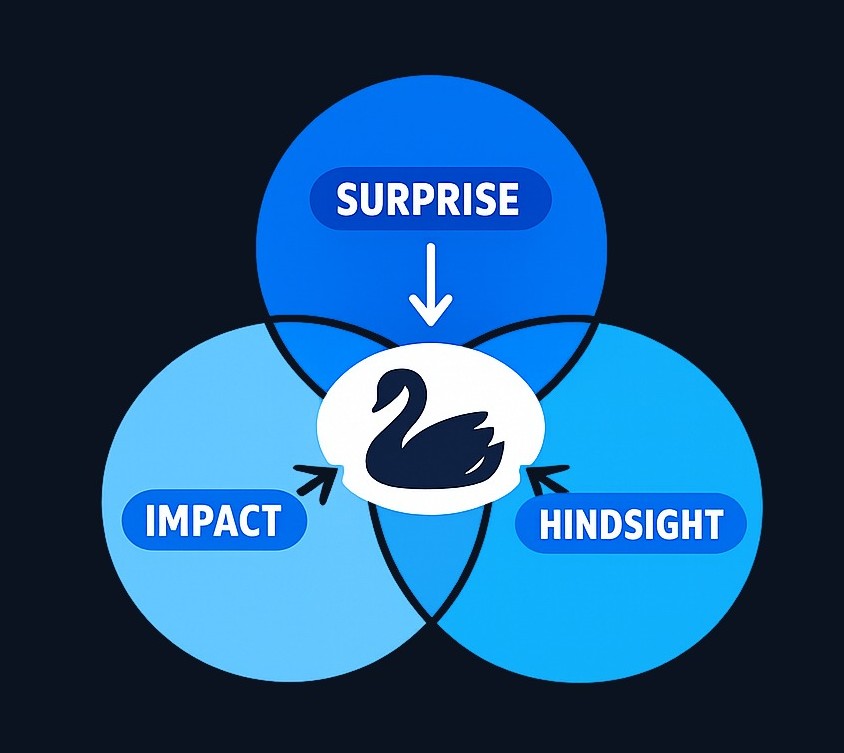
A black swan event combines three traits: it falls outside normal expectations, creates major impact, and appears predictable only in hindsight. All three must be present.
The practical lesson is not to predict the exact next surprise. It is to become less fragile when forecasts fail. That means maintaining financial flexibility, avoiding dependence on one scenario, and deciding in advance how to respond when markets or operations move far beyond normal ranges.
The Federal Reserve describes black swans as “unknown unknowns” and argues that new ones cannot be prevented. Its practical conclusion is to build resilience to crises that cannot be foreseen (Federal Reserve).
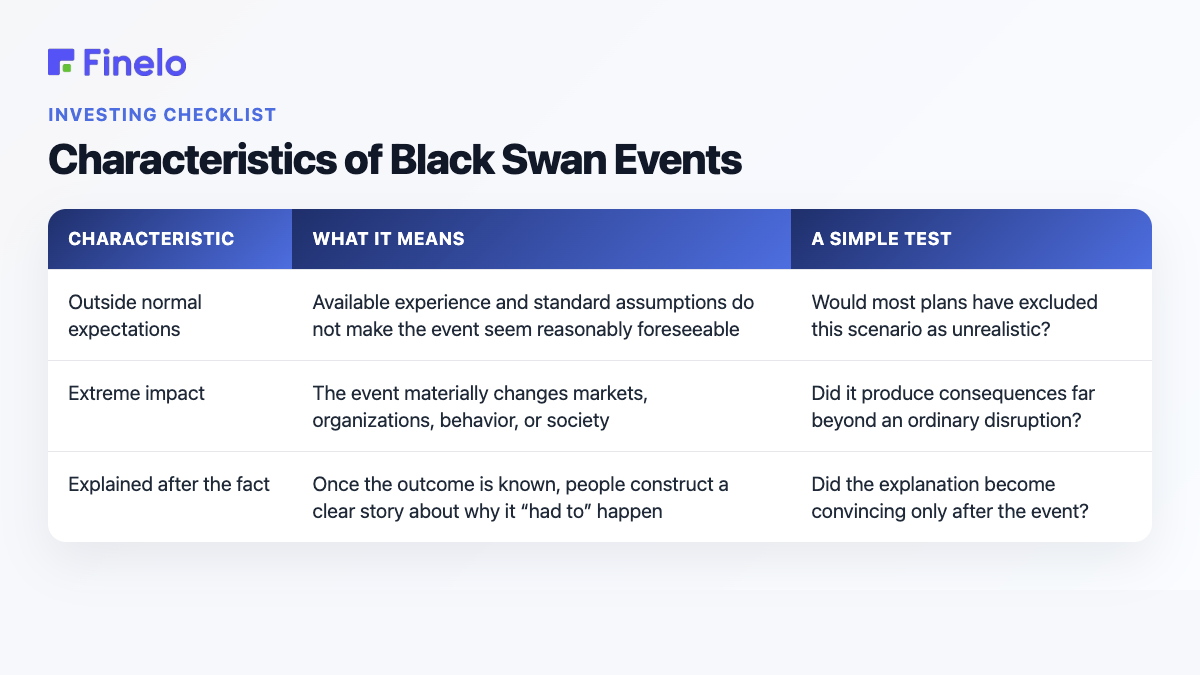
Characteristics of Black Swan Events
The term is often used loosely for any dramatic surprise, but a true black swan has a more demanding profile.
Characteristic
What it means
A simple test
Outside normal expectations
Available experience and standard assumptions do not make the event seem reasonably foreseeable
Would most plans have excluded this scenario as unrealistic?
Extreme impact
The event materially changes markets, organizations, behavior, or society
Did it produce consequences far beyond an ordinary disruption?
Explained after the fact
Once the outcome is known, people construct a clear story about why it “had to” happen
Did the explanation become convincing only after the event?
Reference table from this guide — Characteristics of Black Swan Events.
All three characteristics matter. A predictable recession may be severe without being a black swan. A bizarre one-day incident may be surprising without having lasting impact. A black swan combines deep surprise with outsized consequences and powerful hindsight narratives.
This also explains why the label is subjective. An event can be unimaginable to one person but recognized as a possibility by someone with different information. A company that never considered the failure of a single critical supplier may experience that failure as a black swan, while another company may already treat it as a standard continuity risk.
Black swans, regular crises, and “grey swans”
Not every crisis is a black swan. The distinction depends less on how frightening an event feels and more on whether the underlying risk was understood beforehand.
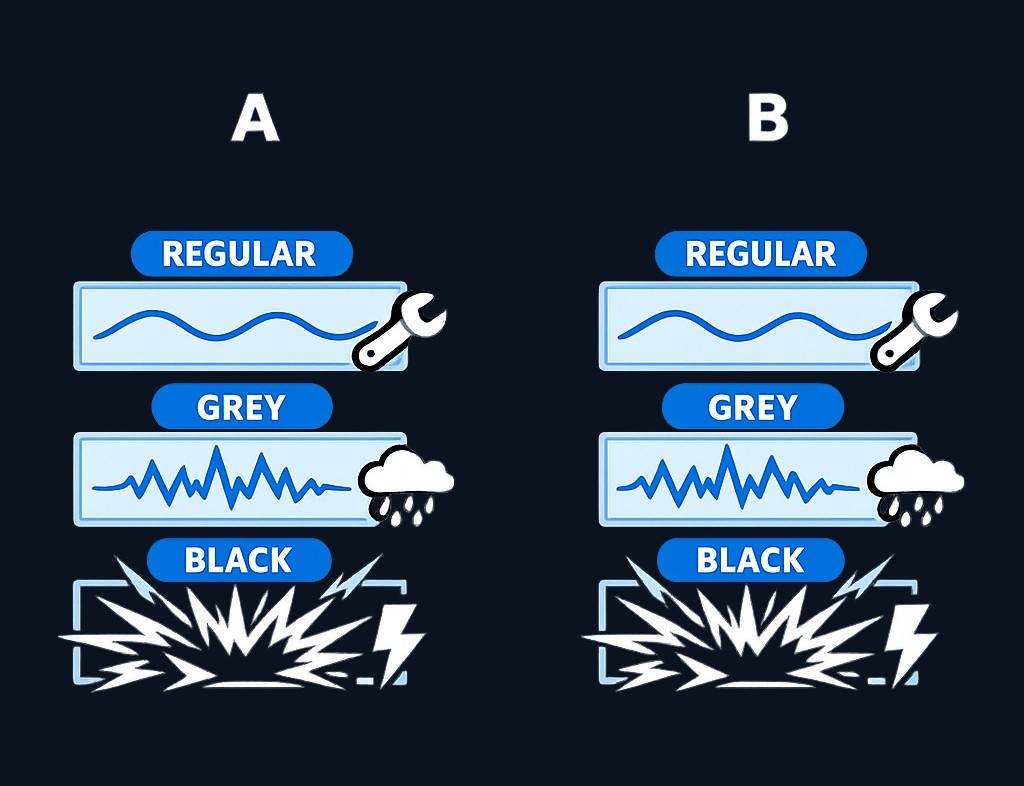
A regular crisis is a known type of problem. Organizations may not know exactly when it will occur, but they can estimate its likelihood, monitor warning signs, and create specific procedures. Examples include ordinary equipment failures, seasonal demand changes, or familiar market downturns.
A “grey swan” is an extreme scenario that is difficult to time but possible to imagine. A severe cyberattack, disruption at a major supplier, sudden loss of liquidity, or prolonged infrastructure outage may fit this category for an organization that has already identified the risk. The event may still be devastating, yet it is not wholly outside the planning horizon.
A black swan is more disruptive to the planning process itself. Existing models may not contain the right variables, historical comparisons may fail, and relationships that appeared stable can break down. The event does not merely produce a worse-than-expected result; it exposes weaknesses in how expectations were formed.
Regular crises are known risks you can plan for. Grey swans are extreme scenarios you can imagine. Black swans break your planning
That distinction changes the response. Known crises call for targeted controls. Black-swan exposure calls for broad resilience: spare capacity, flexible decisions, diverse resources, and limits on losses that do not depend on correctly naming the threat.
Historical Examples of Black Swan Events
People often ask for a definitive list of historical or recent black swan events. Such lists should be treated carefully. If analysts had described a scenario in advance, was it truly outside expectations? If specialists anticipated it but the public did not, whose perspective determines the label?
Instead of treating the category as a fixed hall of fame, it is more useful to examine event patterns:
A previously unmodeled market shock causes assets that normally move independently to fall together.
A new form of operational failure interrupts many connected businesses at once.
A geopolitical development suddenly changes access to markets, materials, payments, or transportation.
A public-health emergency changes consumer behavior, workplace operations, and financial expectations across sectors.
A technological breakthrough rapidly undermines established business assumptions.
Each pattern could be a black swan, a grey swan, or a conventional crisis depending on the observer’s knowledge and preparation. The label should therefore follow analysis, not replace it.
COVID-19 shows why classification can remain disputed even when the shock is clear. In a shareholder letter filed with the SEC in March 2020, an investment company explicitly called the global outbreak a black swan and said it could not have predicted the details, although it had prepared its portfolio for that kind of disruption (SEC filing). That is one organization’s documented assessment, not a universal ruling. Critics can argue that pandemics were imaginable even if the timing, scale, and chain of effects were not.
The effects can also extend well beyond the first shock. Businesses may redesign supply chains, households may change saving behavior, regulators may revisit safeguards, and investors may reassess what counts as diversification. In that sense, a black swan can alter the assumptions used to interpret later events.
In finance, uncertainty is not merely an abstract concern. Federal Reserve research notes that surges in economic uncertainty can contribute to business cycles, bank runs, and asset-price fluctuations, and examines how belief formation can produce large changes in perceived black-swan risk (Federal Reserve).
Practice investing with Finelo
Build practical investing skills with guided lessons, simulator practice, and structured challenges.
Human beings are skilled at building coherent stories from known outcomes. Once an event has occurred, relevant warning signs become easier to see, while the many signals that led nowhere fade from attention. This is hindsight bias: knowledge of the result changes how predictable the past appears.
Several habits reinforce the effect:
Outcome bias: judging an earlier decision mainly by what eventually happened rather than by the information available at the time.
Narrative bias: preferring a clean chain of cause and effect over a messier explanation involving uncertainty and coincidence.
Availability bias: giving greater weight to vivid recent events because they are easier to recall.
Confirmation bias: selecting evidence that supports the explanation we now believe.
Suppose a market drops after several unusual signals. Later, commentators may connect those signals into an apparently obvious warning. Before the decline, however, the same signals may have competed with many plausible interpretations. A convincing retrospective story is not proof that the outcome was forecastable.
Before an event, many signals compete for attention and most lead nowhere. After the event, we naturally connect only the signals that
Technology can improve monitoring, scenario analysis, and response speed, but it cannot remove this problem. Models learn from selected data and assumptions. They can identify known patterns and simulate severe variations; they cannot guarantee discovery of a genuinely unprecedented event. More computing power does not turn an unknowable future into a knowable one.
Preparing for Black Swan Events
Preparation begins by replacing “How do we predict the next black swan?” with “What would help us survive being wrong?”
A resilience checklist
Identify concentrations. Map dependence on a single income source, customer, supplier, market, funding channel, system, or decision-maker.
Protect liquidity. Estimate which obligations must still be met if revenue falls, financing tightens, or assets become difficult to sell.
Use severe scenarios. Test combinations of problems, not only one variable at a time. A supply interruption may coincide with weaker demand and higher financing needs.
Set decision triggers. Define who can act, what information is required, and when emergency procedures begin.
Create alternatives. Develop backup suppliers, communication methods, operating locations, data access, and delegated authority where practical.
Limit irreversible exposure. Be cautious with commitments that leave no room to adjust when assumptions change.
Review near misses. Study incidents that almost caused major damage; they can expose hidden connections before a larger shock does.
Communicate uncertainty clearly. Separate what is known, what is estimated, and what remains unknown.
For an individual investor, the same principles translate into avoiding a plan that succeeds only under one market path. Consider emergency liquidity, time horizon, diversification, debt obligations, and the possibility that several assets may decline together under stress. Diversification can reduce some concentration risks, but it cannot guarantee against loss.
For a business, resilience should include both a continuity plan and the ability to improvise when the plan does not match reality. A checklist for a familiar outage is useful; so are flexible teams, accessible records, clear authority, and cash-flow visibility when the disruption is unfamiliar.
Liquidity deserves special attention because a sound long-term plan can still fail if an organization cannot meet immediate obligations. FINRA’s liquidity-risk guidance explicitly asks firms to consider access to liquidity during ordinary stress and “black swan” events (FINRA). The broader lesson applies beyond broker-dealers: identify where cash may be needed, which funding sources might disappear, and who can authorize action.
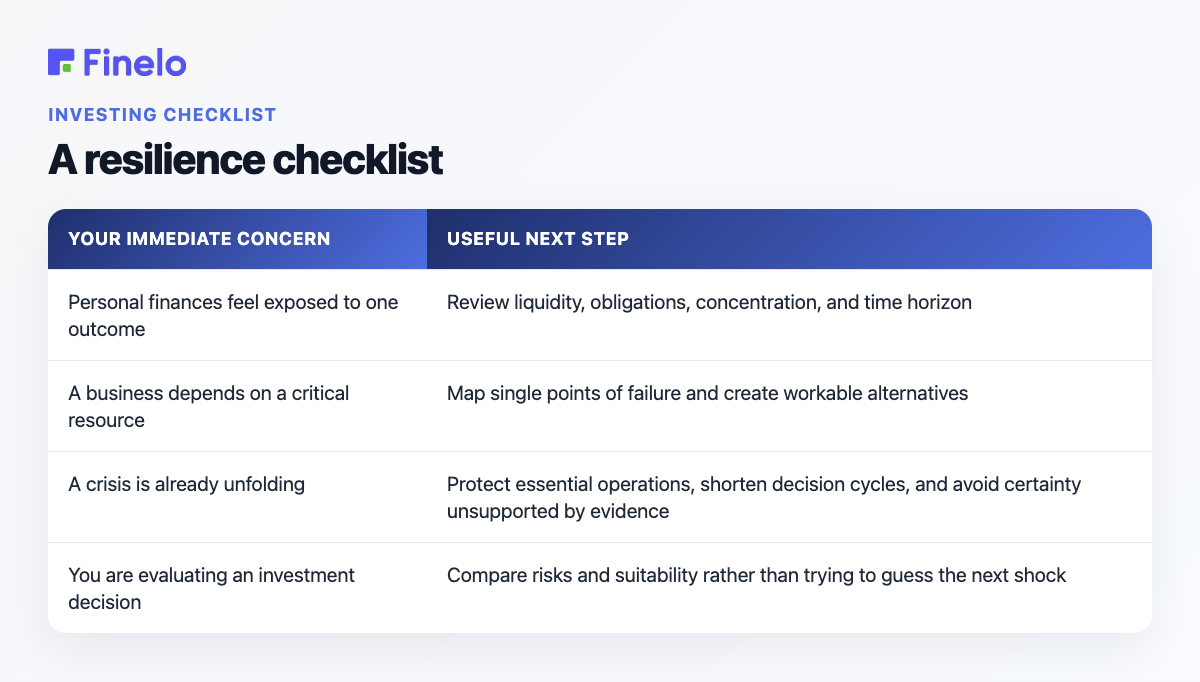
Your immediate concern
Useful next step
Personal finances feel exposed to one outcome
Review liquidity, obligations, concentration, and time horizon
A business depends on a critical resource
Map single points of failure and create workable alternatives
A crisis is already unfolding
Protect essential operations, shorten decision cycles, and avoid certainty unsupported by evidence
You are evaluating an investment decision
Compare risks and suitability rather than trying to guess the next shock
Reference table from this guide — A resilience checklist.
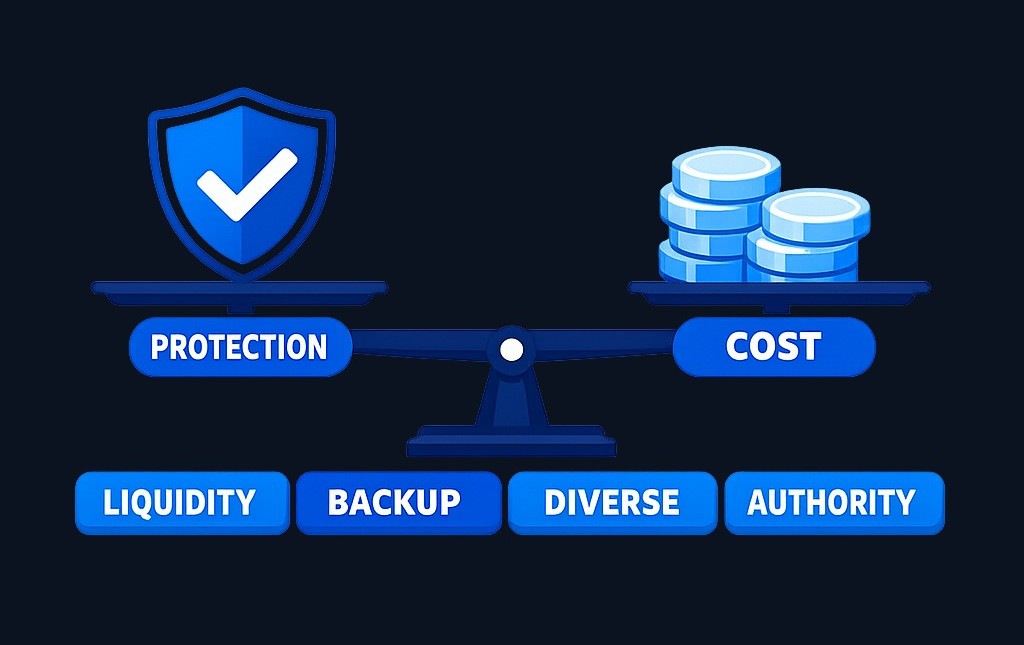
The goal is not maximum defensiveness at any cost. Excess cash, duplicated systems, insurance, and backup capacity can all carry trade-offs. Resilience is the deliberate choice of which failures would be unacceptable and which safeguards are proportionate.
Building resilience means balancing protection against costs. Identify unacceptable failures, then choose proportionate safeguards:
Conclusion and Next Steps
A black swan event is not simply bad news or a large market move. It is an event outside normal expectations that creates extreme consequences and then attracts an after-the-fact explanation that makes it look more predictable than it was.
The most useful response is humility. Forecasts remain necessary, but plans should acknowledge their limits. Investors can examine concentration and liquidity; businesses can test continuity, authority, and fallback options; everyone can resist treating hindsight as foresight.
For readers building their financial knowledge, Finelo provides an education-focused starting point. Use educational material to sharpen your questions, then verify risk, costs, and suitability before making financial decisions.
Frequently asked questions
What is the simplest definition of a black swan event?
It is a highly consequential event that sits outside normal expectations and seems easier to explain after it occurs. The definition involves surprise, impact, and hindsight—not rarity alone.
How do black swan events affect the stock market?
They can rapidly change expectations about earnings, liquidity, risk, or economic activity. Prices may move sharply, relationships between assets may change, and uncertainty may make valuation more difficult. The exact direction and duration cannot be assumed in advance.
Can black swan events be predicted?
A genuinely unforeseeable event cannot be predicted in detail by definition. People can still monitor vulnerabilities, imagine severe scenarios, and prepare for broad categories of disruption. That improves resilience without pretending to know the precise trigger.
Is a black swan always negative?
No. An unexpected event can create positive as well as negative consequences. The term is often associated with disasters because harmful shocks receive more attention, but the underlying idea concerns extreme impact rather than a required direction.
The Finelo Team creates practical investing and trading education designed to help beginners learn faster with structured challenges, simulator practice, and bite-sized lessons.