A penny stock is a very low-priced share, usually issued by a small company. The label does not mean the stock literally costs one cent. It describes a speculative corner of the stock market where companies may be small, lightly followed, and difficult to evaluate. Investor.gov notes that the lowest-priced stocks are known as penny stocks and that the companies behind them may have little or no earnings, making the shares highly speculative (Investor.gov).
What is a Penny Stock? Understanding the Basics and Risks
A penny stock is a very low-priced share, usually issued by a small company. The label does not mean the stock literally costs one cent. It describes a speculative corner of the stock market where companies may be…
8 min read
Practice investing with Finelo
Build practical investing skills with guided lessons, simulator practice, and structured challenges.
Want to learn more?
Build practical investing skills with guided lessons, simulator practice, and structured challenges.
Explore FineloExplore Finelo's 28-day challenges
Turn learning into a daily habit with guided challenge paths.
That low share price can look inviting, especially to a beginner. But price alone says almost nothing about whether a company is healthy or whether its stock is fairly valued. Understanding that distinction is the first step toward evaluating penny stocks responsibly.
What defines a penny stock?
Penny stocks are commonly associated with small companies, low share prices, and limited market attention. They may overlap with the broader category of microcap stocks, which describes companies with relatively small total market values. However, “low-priced stock” and “small company” are related ideas, not interchangeable measures.
Three concepts help clarify the definition:
- Share price is the price of one share. A low price does not automatically make a stock cheap in a valuation sense.
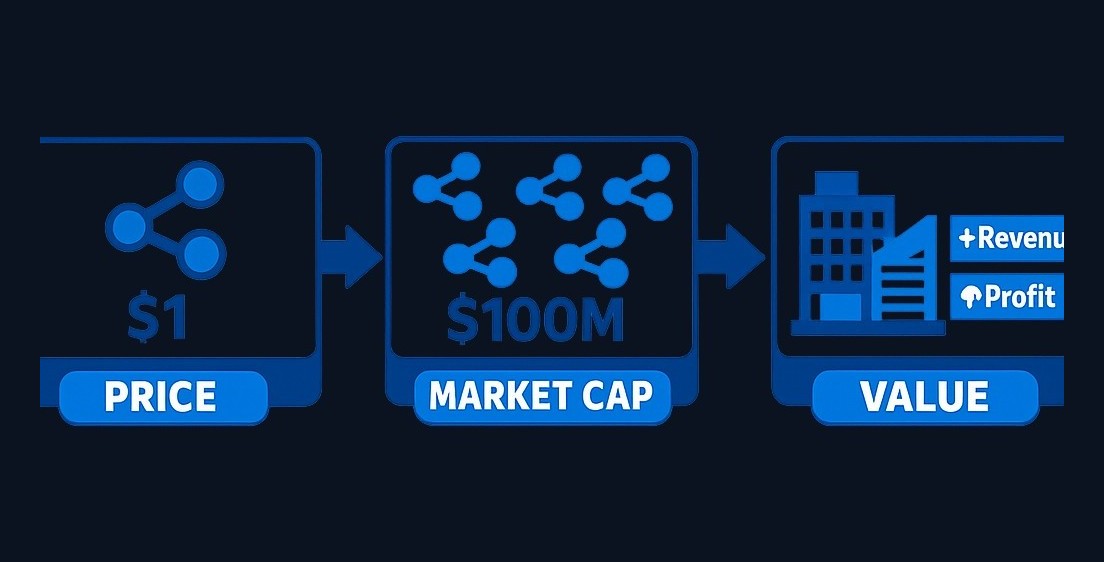
- Market capitalization is the share price multiplied by the number of shares outstanding. It reflects the market value of the whole company.
- Business value depends on factors such as assets, debt, revenue, cash flow, competitive position, and future prospects—not simply the digits in the stock quote.
Consider two imaginary companies. Company A trades at $1 per share but has issued an enormous number of shares and carries substantial debt. Company B trades at a much higher price but has stronger finances and fewer shares outstanding. The $1 quote does not prove that Company A offers better value. It only tells you the price of one small ownership unit.
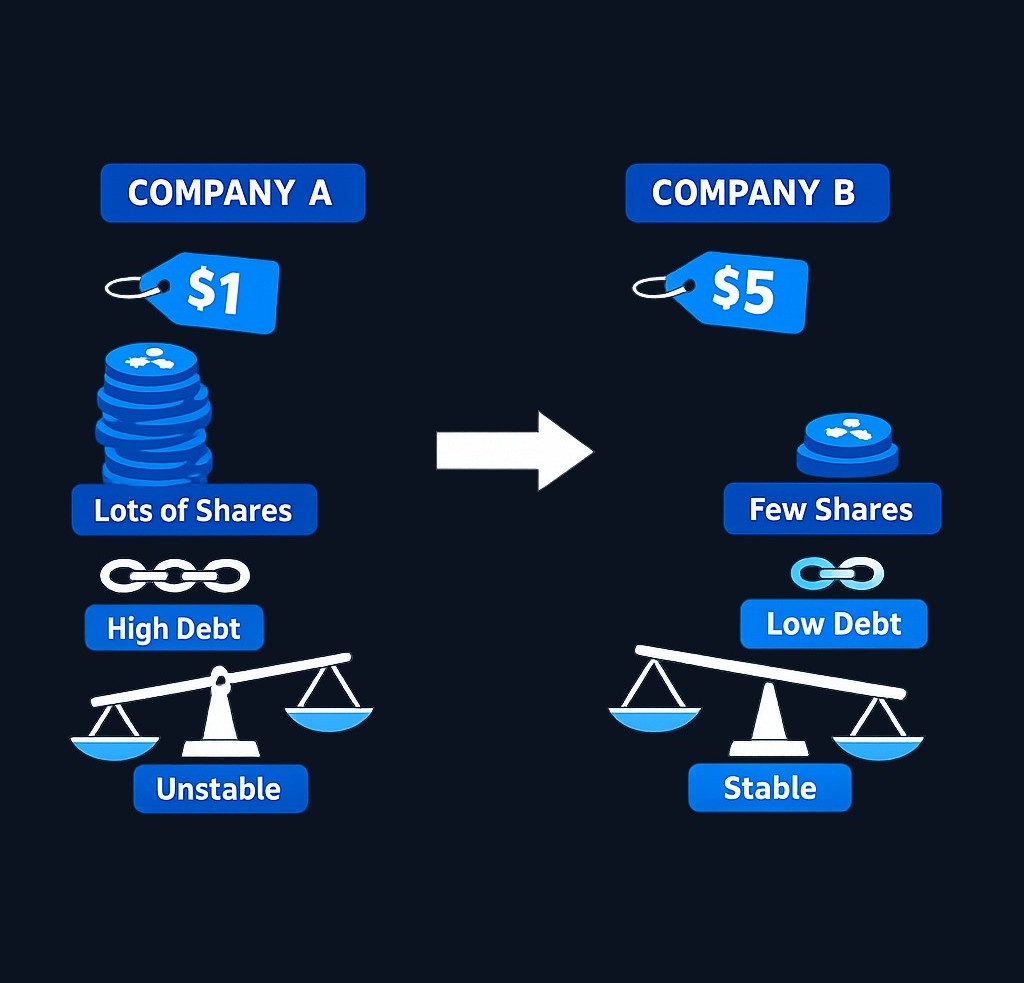
This is why a penny stock should be approached as a company analysis problem, not as a lottery ticket with a low entry price.
Why penny stocks attract attention
The appeal is easy to understand. A modest amount of money can buy many shares, and a small change in the quoted price can translate into a large percentage move. Stories about unknown companies becoming successful can also make low-priced shares feel like undiscovered opportunities.
Those impressions can be misleading:
- Owning more shares does not mean owning more economic value.
- A large percentage gain is only useful if an investor can sell at a realistic price.
- A compelling product story does not replace evidence of a sustainable business.
- A falling stock can keep falling, regardless of how inexpensive it appears.
The useful question is not “How many shares can I buy?” It is “What am I buying, what evidence supports the valuation, and how easily could I exit?”
The main risks of penny stocks
Investor.gov explicitly describes penny stocks as highly speculative (Investor.gov). Several practical risks sit behind that warning.
Limited reliable information
It may be harder to find complete, current information about a small issuer than about a widely followed public company. Sparse information makes basic questions difficult to answer: Is the business generating revenue? Is it burning cash? Has its share count changed? Who controls the company?
When information is missing, investors may rely too heavily on promotional claims, online enthusiasm, or price momentum. None of those substitutes for financial evidence.
Low liquidity
Liquidity describes how readily shares can be bought or sold without causing a major price change. If relatively few people trade a stock, the quoted price may not represent the price available for a larger order. The gap between buyers’ bids and sellers’ asking prices may also be meaningful.
This creates an important distinction between a paper gain and a realizable gain. A screen may show that a position has risen, but an investor still needs a willing buyer at an acceptable price.

Sharp price movements
Low-priced, lightly traded stocks can move abruptly. A small absolute change may equal a large percentage change, encouraging emotional decisions. Volatility can work in either direction, and losses can accumulate quickly when a position is difficult to sell.
Dilution
A company that needs capital may issue additional shares. New financing can help a business survive or grow, but it can also reduce each existing shareholder’s percentage ownership. Investors should therefore examine changes in shares outstanding rather than focusing only on the current quote.

Promotion and manipulation risk
Thin trading and limited public attention can make a stock easier to promote aggressively. Warning signs include guaranteed-return language, urgent messages, unverifiable “inside” information, unexplained price spikes, and claims that discourage independent research.
No single warning sign proves misconduct. A cluster of them is a reason to slow down, verify the source, and avoid acting under pressure.
How to evaluate a penny stock
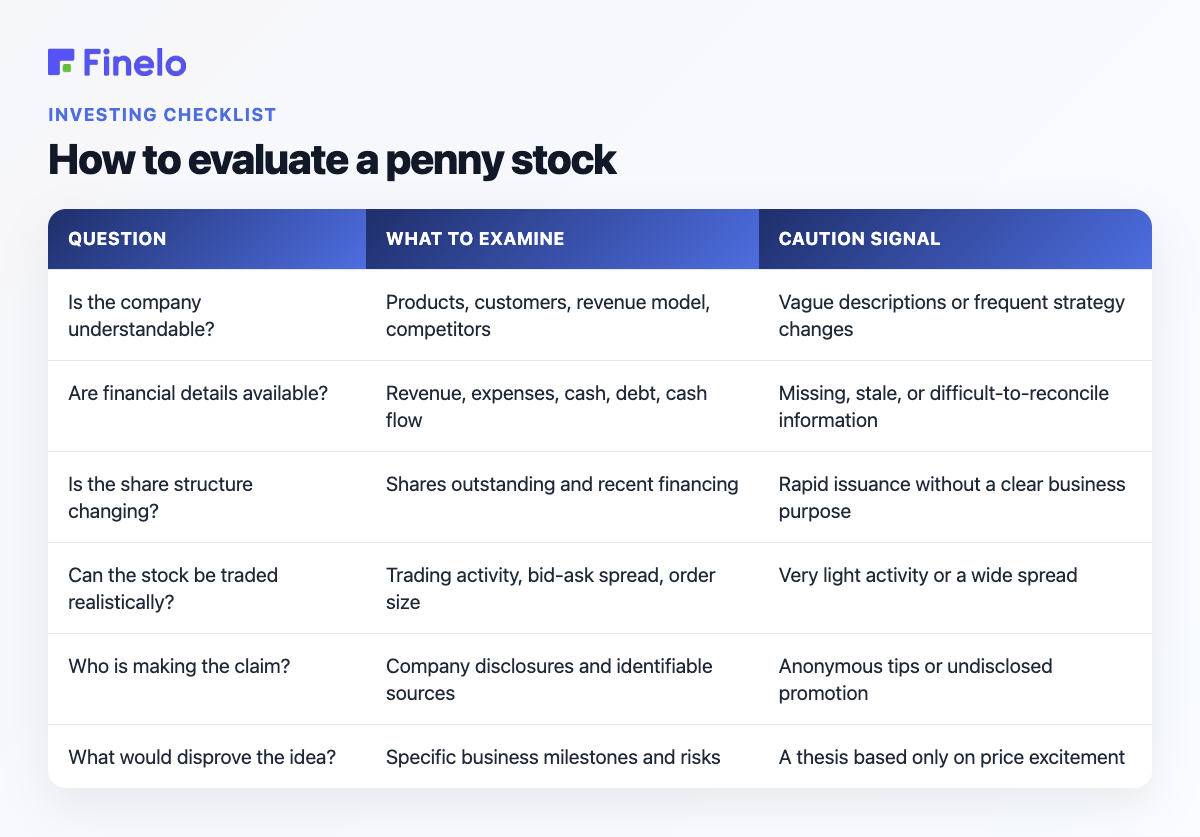
There is no checklist that can identify a guaranteed winner. A checklist can, however, expose weak evidence and help an investor decide when the uncertainty is too high.
| Question | What to examine | Caution signal |
|---|---|---|
| Is the company understandable? | Products, customers, revenue model, competitors | Vague descriptions or frequent strategy changes |
| Are financial details available? | Revenue, expenses, cash, debt, cash flow | Missing, stale, or difficult-to-reconcile information |
| Is the share structure changing? | Shares outstanding and recent financing | Rapid issuance without a clear business purpose |
| Can the stock be traded realistically? | Trading activity, bid-ask spread, order size | Very light activity or a wide spread |
| Who is making the claim? | Company disclosures and identifiable sources | Anonymous tips or undisclosed promotion |
| What would disprove the idea? | Specific business milestones and risks | A thesis based only on price excitement |
Start with the business
Write a one-sentence explanation of how the company makes money. If that cannot be done after reviewing its available information, the investment may be too difficult to assess.
Next, separate current operations from aspirations. A company may discuss a large potential market, future product, planned partnership, or expansion. Those possibilities matter only when weighed against what the business has already accomplished and what resources it has available.
Review financial health
Look beyond reported revenue alone. Ask whether expenses are rising faster than the business, whether cash appears sufficient for near-term needs, and whether debt or financing terms could pressure shareholders. Consistent operating cash generation generally tells a different story from a company repeatedly dependent on new capital.
Study the share count
A stock chart can rise while an investor’s ownership percentage is diluted. Compare shares outstanding over time and read available financing information. If the count has increased, identify why and what the company received in return.
Test the trading conditions
Before considering a trade, observe whether quoted prices are stable and whether normal-sized orders appear likely to move the market. Using a price limit can offer more control than agreeing to whatever price is available, though it cannot guarantee that an order will execute.
Practice investing with Finelo
Build practical investing skills with guided lessons, simulator practice, and structured challenges.
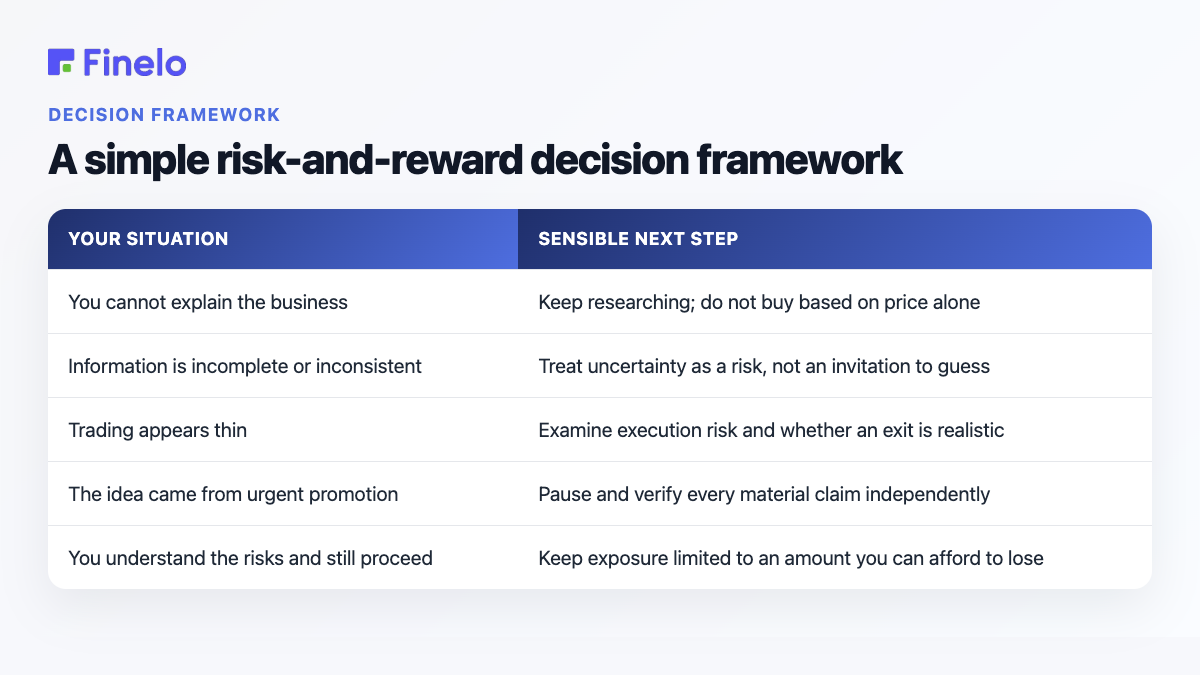
A simple risk-and-reward decision framework
Use four filters before moving from curiosity to action:
- Evidence: Can you find enough reliable information to understand the company and its finances?
- Liquidity: Is there a realistic market for entering and leaving the position?
- Downside: Could you tolerate losing the full amount committed without disrupting essential goals?
- Discipline: Have you defined what would change your view before the stock starts moving?
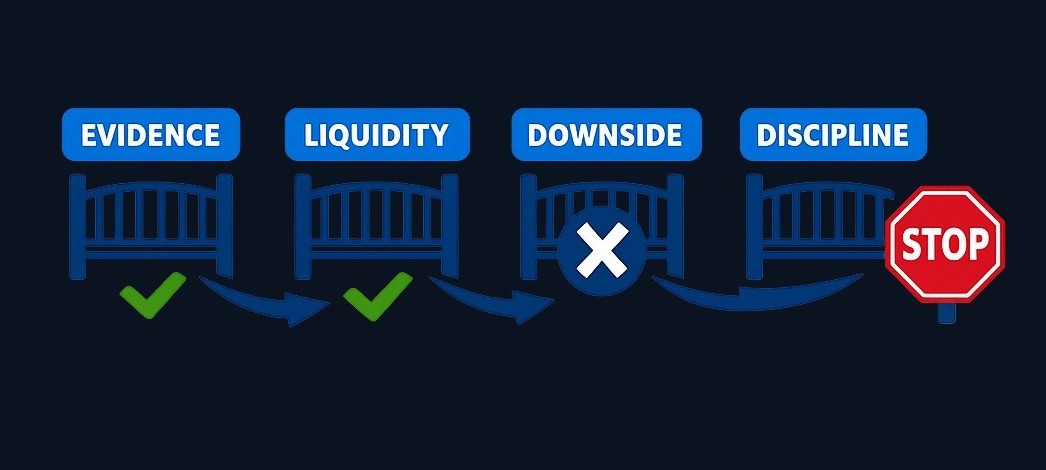
If any answer is no, the appropriate next step may be more research—or no trade. Passing all four filters does not make a penny stock safe. It only means the idea has survived a basic review.
| Your situation | Sensible next step |
|---|---|
| You cannot explain the business | Keep researching; do not buy based on price alone |
| Information is incomplete or inconsistent | Treat uncertainty as a risk, not an invitation to guess |
| Trading appears thin | Examine execution risk and whether an exit is realistic |
| The idea came from urgent promotion | Pause and verify every material claim independently |
| You understand the risks and still proceed | Keep exposure limited to an amount you can afford to lose |
Regulations and investor protections
Penny stocks exist within the securities market, but regulatory oversight should not be confused with a guarantee of quality, liquidity, or investment success. Requirements may depend on the security, the issuer, the market where it trades, and the transaction.
For an individual investor, the practical approach is to:
- confirm what security is being purchased and where it trades;
- read the broker’s disclosures, fees, and order terms;
- review available company information directly;
- understand whether trading restrictions or special procedures apply;
- avoid assuming that a ticker symbol or broker listing represents an endorsement.
Rules can reduce certain risks, but they cannot remove business failure, poor pricing, volatility, or fraud. Due diligence remains necessary.
Risk-management strategies for penny stocks
Risk management begins before an order is placed. It is not a technique for turning speculation into certainty.
Limit position size
Decide the maximum acceptable loss in advance. A small speculative position should not endanger emergency savings, essential expenses, or long-term plans. Increasing a position merely because its price has fallen can compound a weak original decision.
Define the thesis and exit conditions
Write down why the company might improve and what evidence would invalidate that view. Useful conditions relate to the business—such as deteriorating finances, missed milestones, or unexpected dilution—not just an arbitrary hope that the price will rebound.
Avoid borrowed money
Using borrowed funds adds repayment obligations to an already uncertain asset. It can force decisions at the worst time and make losses exceed the investor’s initial cash contribution.
Diversify thoughtfully
Holding several speculative stocks is not necessarily meaningful diversification if they share similar liquidity, financing, and business risks. Consider how a position fits with the rest of the portfolio rather than viewing it in isolation.
Keep records
Save the information used for the decision and revisit it when new facts emerge. This makes it easier to distinguish a changing business thesis from a changing emotion.
The bottom line
A penny stock is a low-priced, highly speculative share typically associated with a small company. Its low price may attract attention, but it does not prove that the company is undervalued or that the stock has greater upside. The central risks include incomplete information, limited liquidity, volatility, dilution, and promotion-driven decisions.
For beginners, the best next step is to practice evaluating the business, finances, share structure, and trading conditions before risking money. Finelo approaches investing as a learning process; use education to strengthen your decision-making, then verify costs, risks, and suitability for your own circumstances. This article is educational and is not personalized financial advice.
Frequently asked questions
Are penny stocks the same as cheap stocks?
Not necessarily. A low share price describes one share, while valuation considers the company as a whole. A higher-priced stock can be less expensive relative to its business fundamentals, and a penny stock can be overpriced despite its small quote.
Can you make money from penny stocks?
It is possible for a stock investment to gain value, but penny stocks are highly speculative and losses can be severe. A possible positive outcome is not evidence that a particular trade offers favorable odds.
How do beginners find reliable penny-stock information?
Start with information attributable to the company and relevant official market or regulatory sources. Compare dates, financial figures, share counts, and disclosures. Treat anonymous posts, urgent tips, and promotional claims as leads to verify—not as proof.
What is the biggest mistake to avoid?
Do not confuse a low share price with low risk or good value. Evaluate the underlying company and the ability to exit the position before deciding whether the speculation fits your risk tolerance.
InvestingBeginnerStocksMarkets
Practice investing with Finelo
Build practical investing skills with guided lessons, simulator practice, and structured challenges.
About the author
Finelo Team
The Finelo Team creates practical investing and trading education designed to help beginners learn faster with structured challenges, simulator practice, and bite-sized lessons.
Keep reading — Related articles

Investing
I Bonds vs EE Bonds in 2026: Rates, Rules, and Which to Buy for the Long Run
Series I and Series EE savings bonds are both U.S. Treasury retail savings bonds sold on TreasuryDirect. They share ownership, tax treatment, and redemption rules; the key difference is the…
Finelo Team
Investing
Coverdell ESA vs 529 Plan: Limits, Flexibility, and Which to Choose
Quick answer (one minute) Both a Coverdell Education Savings Account (Coverdell ESA) and a 529 plan let money grow tax‑free and be withdrawn tax‑free for qualified education expenses. The…
Finelo Team
Investing
CD vs High Yield Savings Account: Where to Park Your Cash in 2026
Hero answer — CD vs high yield savings account in one line A CD (certificate of deposit) and a high yield savings account are both low‑risk, federally insured homes for cash — the difference…
Finelo Team