A rights offering is a capital raise in which a company gives its existing shareholders the right, but not the obligation, to buy additional shares directly from the company, usually at a discount to the market price and in proportion to what they already own. Shareholders can typically exercise the rights, sell them if they are transferable, or let them expire.
What is a Rights Offering? A Complete Overview

A rights offering is a capital raise in which a company gives its existing shareholders the right, but not the obligation, to buy additional shares directly from the company, usually at a discount to the market price…
6 min read
Practice investing with Finelo
Build practical investing skills with guided lessons, simulator practice, and structured challenges.
Want to learn more?
Build practical investing skills with guided lessons, simulator practice, and structured challenges.
Explore FineloExplore Finelo's 28-day challenges
Turn learning into a daily habit with guided challenge paths.
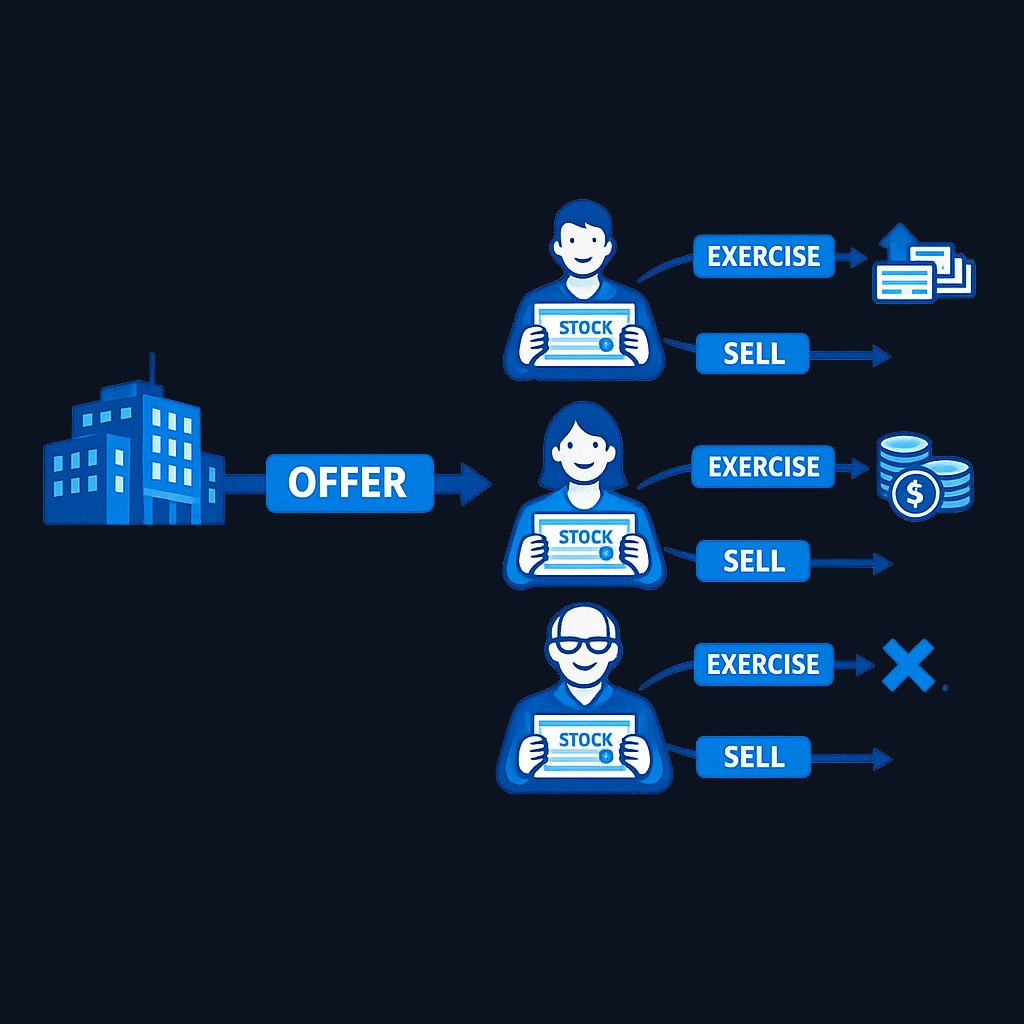
If a company you own has announced a rights offering, you have a real decision to make with a deadline attached. This page explains how these offerings work, why companies use them, the risks, the tax angle, and a framework for choosing among your options. It is educational content, not financial or tax advice.
How rights offerings work
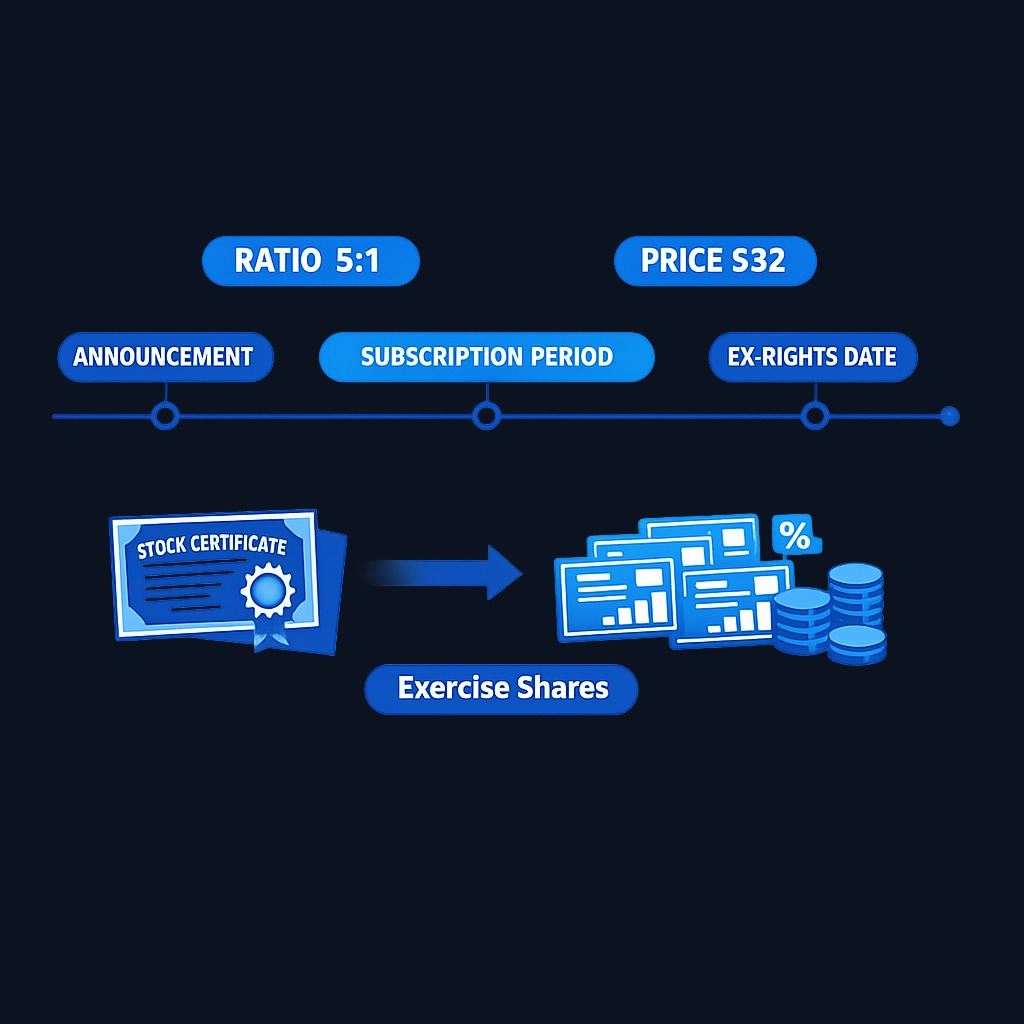
The mechanics follow a standard sequence. The company announces the offering and files the details, including the subscription price, the ratio, and the timetable. Each shareholder receives rights in proportion to their holdings, for example one right for every share owned, with a stated number of rights required to buy each new share. A typical structure might let you purchase one additional share for every five you hold at a set subscription price below the current market.
Key terms to understand:
- Subscription price: the discounted price at which rights holders can buy new shares.
- Ratio: how many rights you need to purchase one new share.
- Subscription period: the window, often a few weeks, during which rights can be exercised before they expire worthless.
- Ex-rights date: after this date, shares trade without the rights attached, and the stock price typically adjusts to reflect that.
- Oversubscription privilege: some offerings let participating shareholders request extra shares that others declined.
Every detail lives in the offering documents, which US companies file publicly; you can read them for free in the SEC's EDGAR database before deciding anything.
Transferable vs non-transferable rights
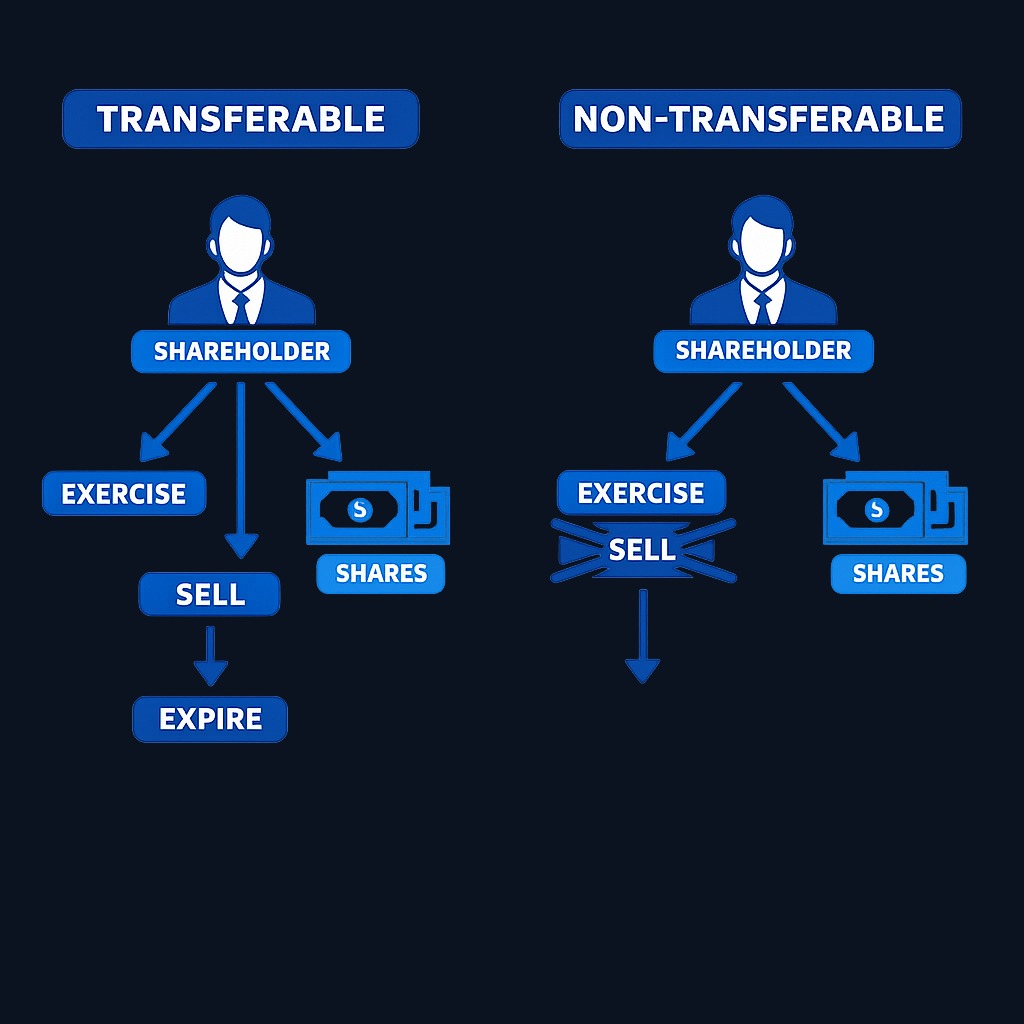
| Feature | Transferable rights | Non-transferable rights |
|---|---|---|
| Can be sold on the market? | Yes, they trade for a limited period | No |
| Your options | Exercise, sell, or let expire | Exercise or let expire |
| Value if you do nothing | Lost unless sold or exercised | Lost at expiration |
Transferable rights give you a middle path: shareholders who cannot or do not want to invest more cash can sell the rights and capture part of the discount's value. With non-transferable rights, doing nothing simply forfeits whatever value the rights carried, which makes an active decision more important.
Why companies use rights offerings
From the company's perspective, a rights offering raises equity capital while giving current owners first claim on the new shares. Common motivations include paying down debt, funding acquisitions or projects, shoring up a balance sheet under stress, and raising money when other financing routes are expensive or unavailable. Because existing shareholders get the first opportunity, the structure is often viewed as fairer than selling discounted stock to outside investors, and in some markets it is the customary way to raise follow-on equity.
For shareholders, the benefits are conditional but real: the chance to buy at a discount, protection against ownership dilution if they participate, and, with transferable rights, compensation even when they decline.
Risks and considerations
A rights offering is not free money, and several cautions apply:
- Dilution if you sit out. New shares increase the total count, so non-participants end up owning a smaller percentage of the company.
- The discount is relative. The subscription price is set below the market price at announcement, but the market price can fall during the subscription window, shrinking or erasing the advantage.
- Signal check. Companies raising emergency capital sometimes use deeply discounted rights offerings; the reason behind the raise matters more than the discount itself.
- Concentration creep. Exercising rights means adding money to a single stock, which can quietly unbalance a portfolio.
- Deadlines are hard. Rights expire on schedule; missing the window with non-transferable rights forfeits their value entirely.
Practice investing with Finelo
Build practical investing skills with guided lessons, simulator practice, and structured challenges.
A worked example
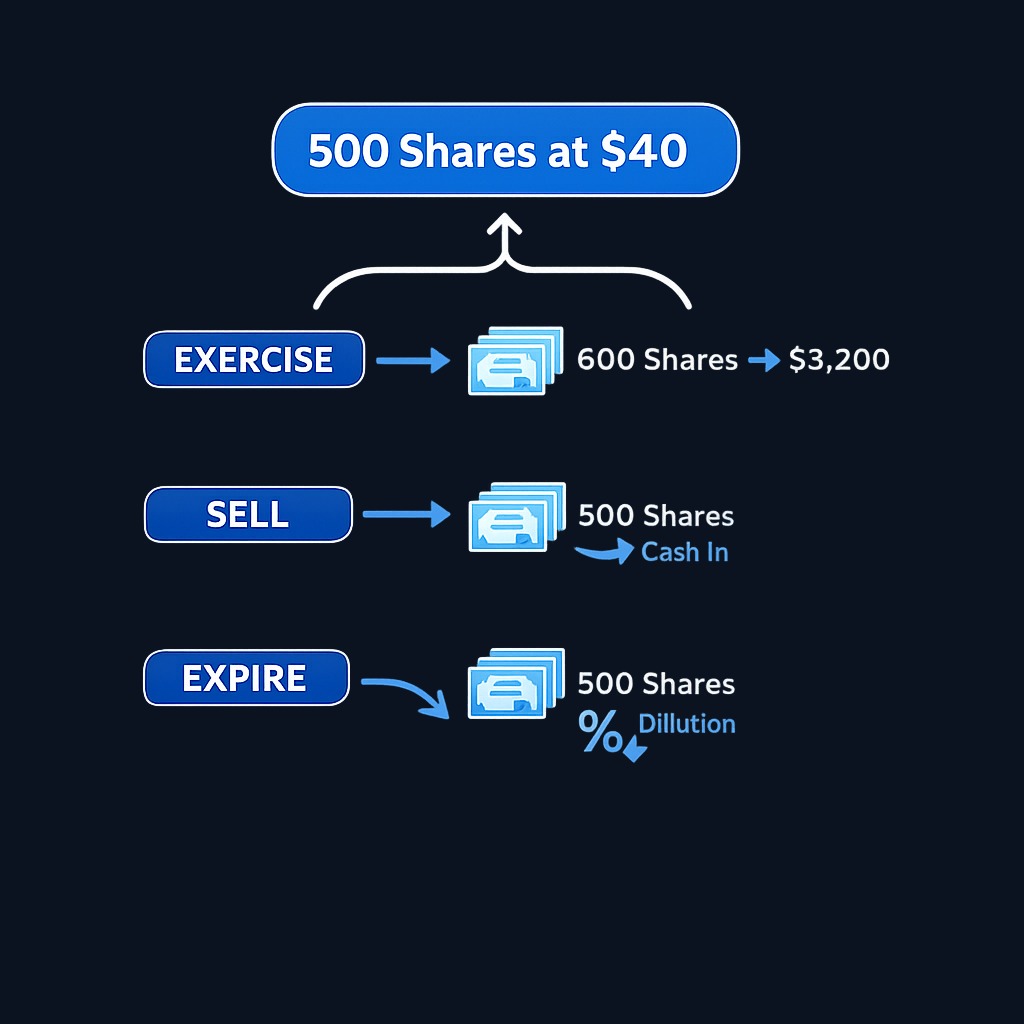
Suppose you own 500 shares of a company trading at $40, and it announces a 1-for-5 rights offering at a $32 subscription price. You receive rights to buy 100 new shares for $3,200. If you exercise, you own 600 shares at a blended cost below the pre-offer market price. If the rights are transferable and you decline, you can sell the rights, whose value roughly reflects the gap between market and subscription prices. If you do nothing and the rights lapse, your ownership percentage shrinks as other investors take up the new shares. After the offering, expect the share price to settle somewhere below the old market price, reflecting the new discounted shares, a level often called the theoretical ex-rights price.
Calculate the theoretical ex-rights price (TERP)
If a holder can buy m new shares for every n old shares at subscription price S, and the pre-rights market price is P, the simplified formula is TERP = (n × P + m × S) ÷ (n + m). In this example, TERP is (5 × $40 + 1 × $32) ÷ 6 = $38.67. The theoretical value transferred from each old share is $40 − $38.67 = $1.33. TERP is a reference calculation, not a price forecast: market movements, fees, taxes, and changes in the issuer's prospects can produce a different result.
Tax implications
Tax treatment depends on your jurisdiction and personal situation, and rights can create taxable events at several points: selling rights, exercising them, and eventually selling shares acquired through them. Cost-basis rules for rights can be technical, including how basis is allocated between old shares and rights. Because the details vary and change, review the offering documents' tax section and consult a qualified tax professional before acting, rather than relying on rules of thumb.
What to know before deciding
Three questions frame the decision. Why is the company raising money? Growth funding reads differently than crisis patching, and the prospectus states the intended use of proceeds. What happens to your position if you decline? Estimate the dilution and, for transferable rights, what selling them would recover. Can you afford the exercise without distorting your portfolio? A rights offering compresses a meaningful investment decision into a few weeks, so treat it with the same research you would give any new purchase of the stock.
Decision framework: exercise, sell, or let lapse
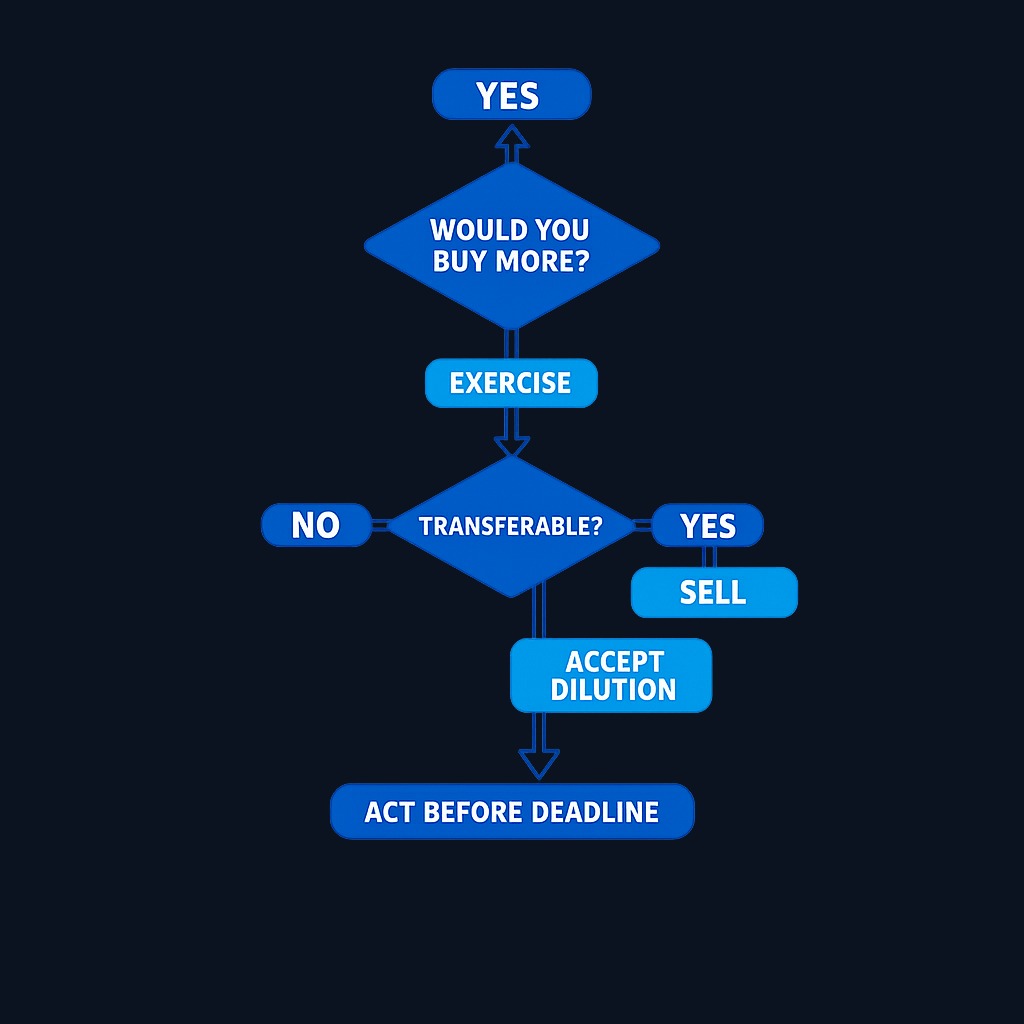
Work through this sequence before the deadline. First, re-underwrite the stock: would you buy more of this company today at the subscription price if there were no offering? If yes, exercising is coherent. Second, if you would not buy more, check transferability: selling the rights captures value without adding exposure. Third, if the rights are non-transferable and you decline to invest, accept the dilution consciously rather than by accident. Fourth, mind the calendar: set your own deadline several days before the official one to leave room for broker processing. Whatever you choose, make it a decision, not a default.
Conclusion and next steps
A rights offering hands existing shareholders a time-limited choice: buy discounted shares, sell the opportunity if it is transferable, or accept dilution by standing aside. The offer's quality depends on why the company needs capital and whether you would want more of the stock at that price anyway. Next step: if you hold a stock with an active offering, pull the prospectus from EDGAR, note the ratio, subscription price, and expiration date, and run the worked-example math on your own position before the window closes.
Frequently asked questions
What happens if I ignore a rights offering?
Your rights expire worthless, and your ownership percentage falls as new shares are issued to participants. With transferable rights, ignoring the offer also forfeits the money you could have received by selling the rights in the market.
Are the new shares from a rights offering different from regular shares?
No. Once issued, shares purchased through a rights offering are ordinary shares of the company, identical in voting rights and dividends to the shares already trading.
Why does the stock price usually drop after a rights offering?
New shares enter at a discount, so the market price adjusts toward a weighted average of old and new shares, the theoretical ex-rights price. The drop reflects arithmetic more than judgment, though sentiment about the raise can add its own pressure.
Can I buy more shares than my rights allow?
Sometimes. Offerings with an oversubscription privilege let participating shareholders request shares that other holders declined, subject to availability and allocation rules described in the prospectus.
rightsoffering
Practice investing with Finelo
Build practical investing skills with guided lessons, simulator practice, and structured challenges.
About the author
Finelo Team
The Finelo Team creates practical investing and trading education designed to help beginners learn faster with structured challenges, simulator practice, and bite-sized lessons.
Keep reading — Related articles

Investing
Tax-gain harvesting vs. tax-loss harvesting
Compare realizing investment gains with realizing losses, including holding periods, wash sales, offsets, and portfolio tradeoffs.
Finelo Team

Investing
Stable value fund vs. money market fund
Compare investment structure, contract protections, transfer restrictions, net yields, and access inside a retirement account.
Finelo Team

Investing
Single-life vs. joint-life annuity
Compare income for one lifetime with continued payments to a survivor, using equal premiums and matching guarantee terms.
Finelo Team


