A risk parity portfolio is an allocation strategy that balances how much risk each asset class contributes, rather than how many dollars each receives. Instead of putting 60% of the money in stocks and 40% in bonds, risk parity sizes positions so stocks, bonds, and other assets each drive a roughly equal share of the portfolio's overall volatility.
What is a Risk Parity Portfolio and How Does It Work?
A risk parity portfolio is an allocation strategy that balances how much risk each asset class contributes, rather than how many dollars each receives. Instead of putting 60% of the money in stocks and 40% in bonds…
14 min read
Practice investing with Finelo
Build practical investing skills with guided lessons, simulator practice, and structured challenges.
Want to learn more?
Build practical investing skills with guided lessons, simulator practice, and structured challenges.
Explore FineloExplore Finelo's 28-day challenges
Turn learning into a daily habit with guided challenge paths.
The idea sounds technical, but the motivation is simple: in a classic 60/40 portfolio, equities dominate the risk even though they only hold 60% of the capital. Risk parity tries to fix that imbalance. This article explains the principles, the construction steps, the trade-offs, and a framework for deciding whether the approach fits your goals. It is educational content, not financial advice, so verify costs, risks, and suitability before acting on anything here.
The core principles of risk parity
Traditional allocation starts with capital: how many dollars go into each asset class. Risk parity starts with risk: how much each asset class moves and how those movements interact.
Principle one: allocate risk, not dollars. Every asset class has its own volatility profile. Equities swing hard, high-quality government bonds usually swing less, and commodities sit somewhere in between depending on the period. A risk parity portfolio weights each asset so its contribution to total portfolio volatility is roughly equal. In practice, that means less money in the most volatile assets and more money in the calmer ones.
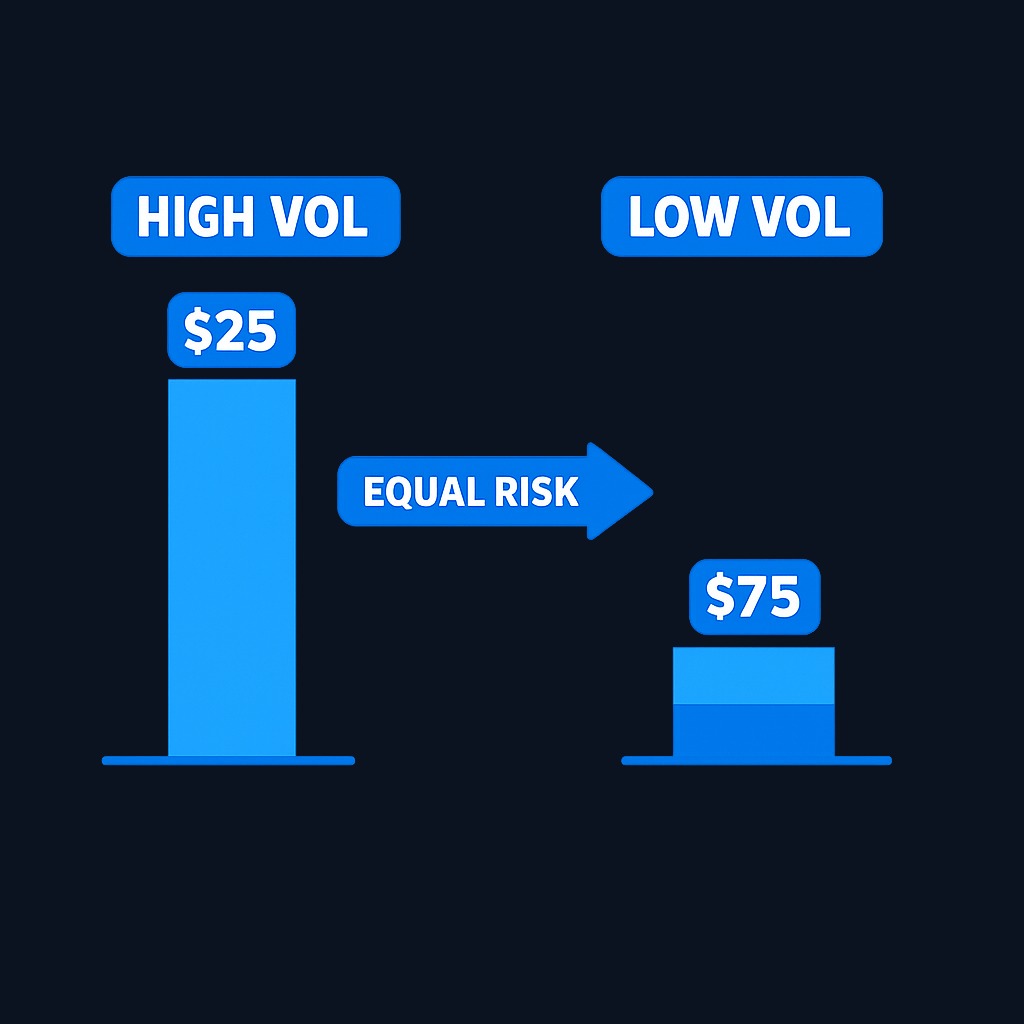
Principle two: diversification works best when no single risk dominates. The classic 60/40 stock-bond mix looks diversified on paper. Measured by risk, it is not: because equities are several times more volatile than investment-grade bonds, the stock side can account for the overwhelming majority of the portfolio's fluctuations. When equities fall sharply, the whole portfolio falls with them. Risk parity spreads the sources of pain so no single asset class decides the portfolio's fate.
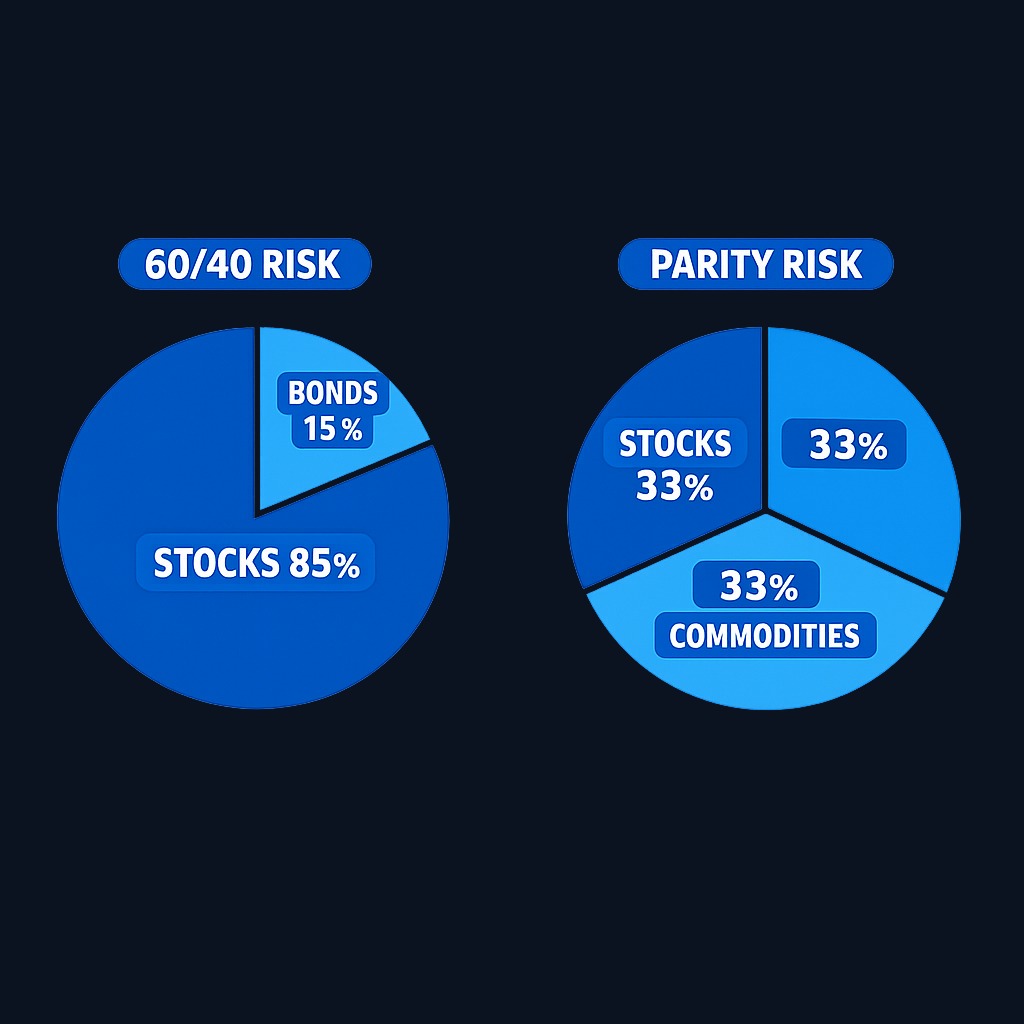
Principle three: different assets respond to different economic conditions. Equities tend to do well in growth periods, government bonds have historically helped in slowdowns, and inflation-sensitive assets such as commodities or inflation-linked bonds respond to rising prices. By balancing risk across assets tied to different economic environments, the portfolio aims to have something working in most conditions rather than betting everything on one scenario.
Principle four: leverage can substitute for concentration. A portfolio dominated by low-volatility bonds may not generate enough expected return on its own. Rather than adding return by concentrating in equities, risk parity strategies often apply modest leverage to the balanced mix, scaling total risk up to a target level while keeping the risk balance intact. This is the strategy's most debated feature, and it deserves the scrutiny it gets.
Why measuring risk changes behavior
Risk-based allocation also changes how a portfolio feels to hold. When you know each asset class contributes a similar share of the swings, a bad month for equities no longer means a bad month for everything you own. That psychological stability matters. Investors abandon strategies during drawdowns far more often than during dull periods. Abandoning a sound strategy at the bottom is one of the most expensive mistakes in investing. Balanced risk is partly a design choice. It is also a commitment device that makes staying invested easier.
How to construct a risk parity portfolio
Building a simple version takes five steps. Institutional funds use far more sophisticated models, but the logic is the same.
- Choose the asset classes. A common starting set: broad equities, long-term government bonds, and an inflation-sensitive sleeve such as commodities or inflation-protected bonds. Each should respond differently to growth and inflation surprises.
- Estimate each asset's volatility. Use a consistent measure, such as the standard deviation of monthly returns over a trailing window. The estimates do not need to be perfect; they need to be reasonable and updated on a schedule.
- Weight positions inversely to volatility. The more volatile an asset, the smaller its capital weight. In a simple two-asset example, if stocks are three times more volatile than bonds, a risk-balanced mix holds roughly three dollars of bonds for every dollar of stocks.
- Account for correlations. Volatility alone ignores how assets move together. Full risk parity models use the covariance between assets so that truly independent risks get full credit and overlapping risks do not. A simplified inverse-volatility portfolio skips this step at some cost in precision.
- Set the total risk level, with or without leverage. If the balanced mix is too tame for your return goals, the strategy either accepts the lower expected return or applies leverage to lift total volatility to a chosen target. Leverage introduces borrowing costs, margin requirements, and the possibility of forced selling, so any use of it should be deliberate and small at first.
A worked example
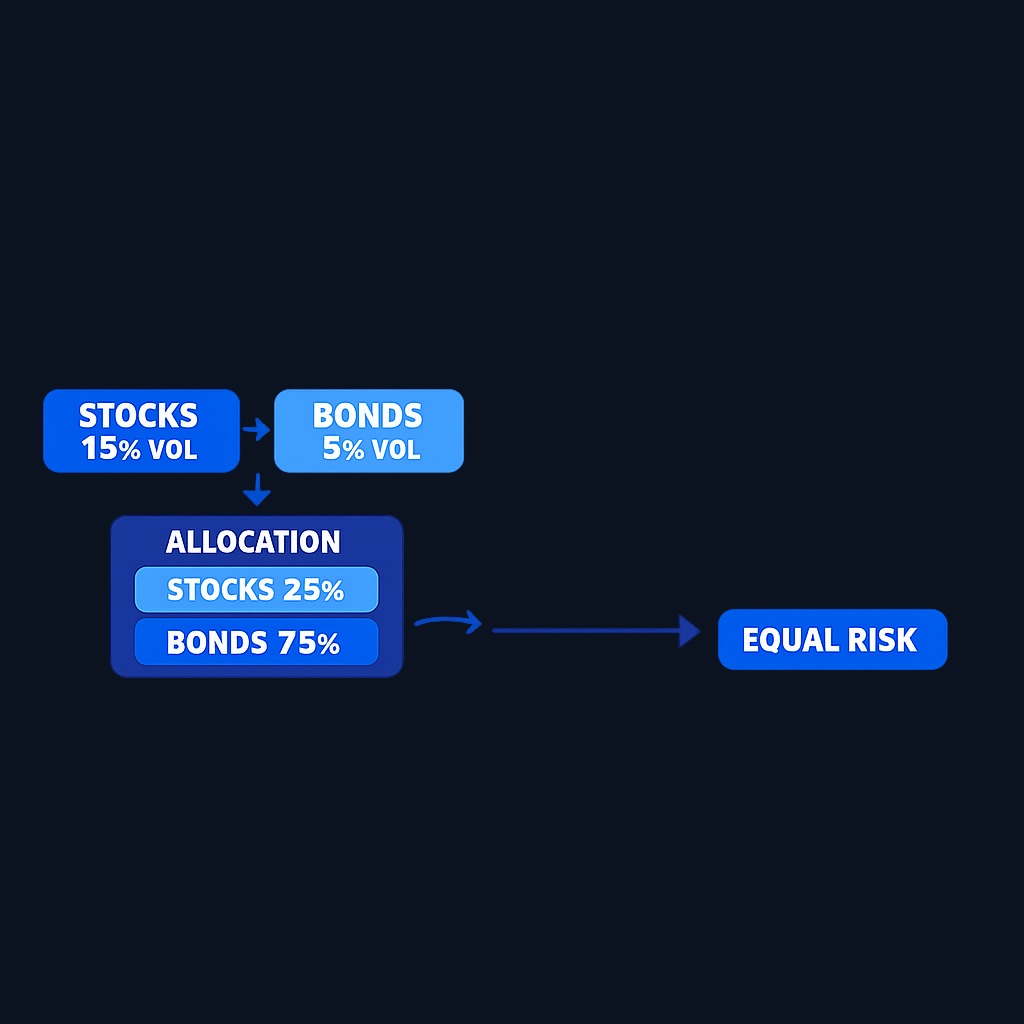
Suppose stocks show 15% annualized volatility and long-term government bonds show 5%. Dollar-balanced 50/50 investing would let stocks contribute roughly three-quarters of the risk. An inverse-volatility allocation instead puts about 25% in stocks and 75% in bonds, so each side contributes a similar share of the swings. If that mix produces less expected return than the investor needs, a risk parity manager might lever the whole package modestly rather than shifting money back toward equities. The risk stays balanced; only its overall scale changes.
Choosing instruments
The same design can be built with different tools, and the choice matters. Broad index ETFs are the simplest building blocks for a personal version. They are liquid, transparent, and cheap. An unlevered inverse-volatility mix needs nothing else. Mutual funds work similarly for investors who prefer them. Institutional versions typically use futures contracts. Futures embed leverage efficiently and trade at low cost. They also demand margin management, daily attention, and expertise most individuals do not have. Packaged risk parity mutual funds and ETFs are a middle path. You get professional execution in a single ticker. You give up some control over leverage and the asset mix, and you pay management fees. Whichever route you take, prefer instruments you fully understand. Check total costs before committing capital: expense ratios, trading spreads, and any embedded financing charges.
Maintenance: rebalancing and monitoring
Volatilities and correlations drift, so risk parity portfolios need scheduled rebalancing, quarterly or semiannually for a simple version. Rebalancing in taxable accounts can realize capital gains and losses along the way; the IRS describes how realized gains and losses offset each other in Topic 409, Capital Gains and Losses, which is worth understanding before running a high-turnover strategy outside a tax-advantaged account.
Risk parity vs traditional portfolios
The table compresses the comparison:
| Dimension | Traditional 60/40 | Risk parity |
|---|---|---|
| Allocation basis | Dollars per asset class | Risk contribution per asset class |
| Typical equity risk share | Dominant | Roughly equal with other assets |
| Bond allocation | Moderate | Often large in capital terms |
| Use of leverage | Rare | Common at institutional scale |
| Behavior in equity crashes | Tracks equities closely | Historically cushioned by other assets |
| Sensitivity to rising rates | Moderate | Higher, due to larger bond exposure |
| Complexity and monitoring | Low | Moderate to high |
| Costs | Low with index funds | Higher: rebalancing, borrowing, fund fees |
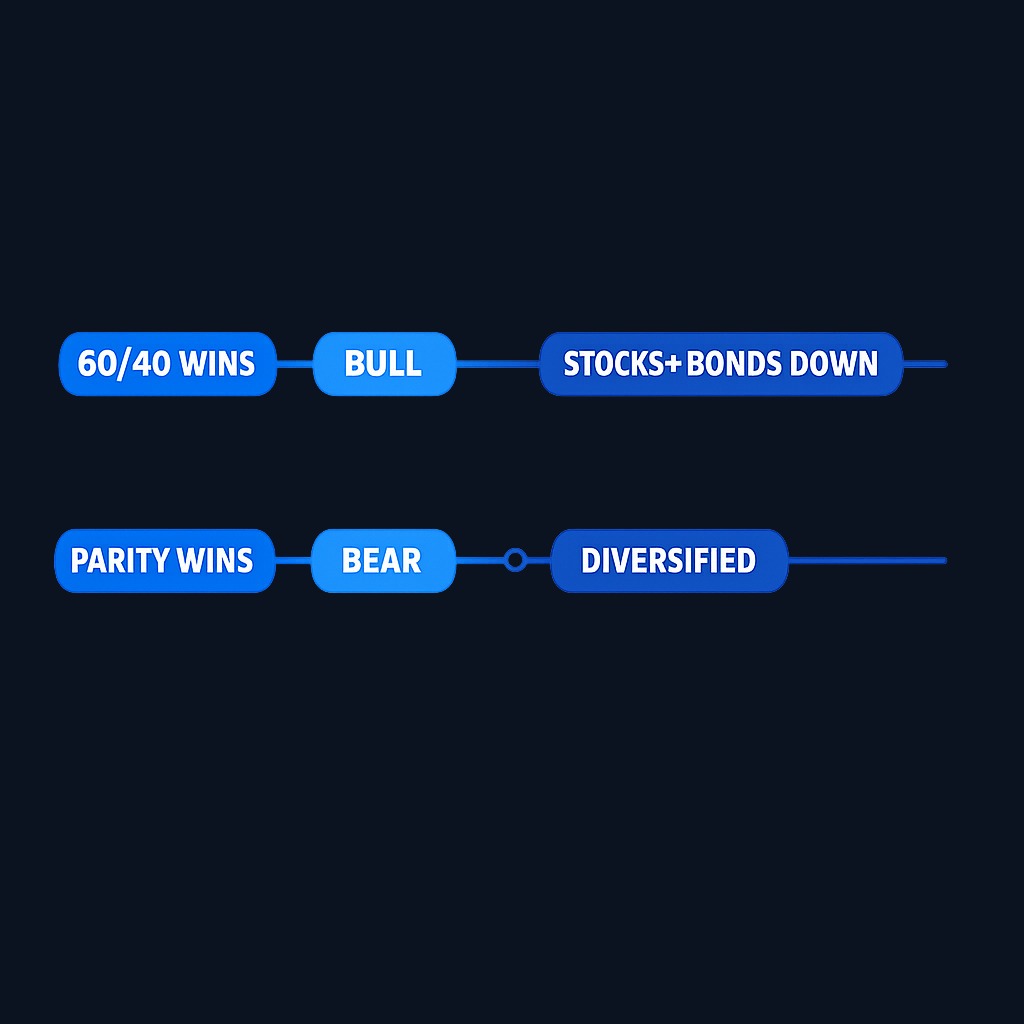
Neither column wins outright. The 60/40 is simple, cheap, and well understood, and it quietly bets that equities will do most of the work. Risk parity spreads the bet across economic environments, and it quietly bets that leverage stays cheap and that bonds keep diversifying equities. Each approach has decades with the upper hand: balanced-risk approaches tended to shine in equity bear markets, while simple equity-heavy mixes looked better in long bull runs and in periods when stocks and bonds fell together.
Reading the historical record honestly
Be careful with backtests when comparing these approaches. Much of risk parity's measured advantage came from a multi-decade stretch of falling interest rates. Falling rates flattered large bond allocations. Cheap financing later flattered the levered versions too. A backtest built on those conditions will overstate future results. It says little about periods when rates rise or financing gets expensive. The reverse caution applies to 60/40 comparisons that start at an equity market bottom. When you evaluate either approach, look at full cycles. Include at least one rising-rate period and one deep equity bear market. Treat any single decade as one draw from a wide distribution, not a verdict.
Practice investing with Finelo
Build practical investing skills with guided lessons, simulator practice, and structured challenges.
Benefits and risks of risk parity portfolios
The benefits. The strategy's appeal is smoother participation across environments. Because no single asset dominates, drawdowns driven by any one asset class tend to be shallower than in equity-concentrated portfolios. The framework is also honest about risk: it forces you to measure volatility and correlation instead of assuming that a dollar split equals diversification. And it scales: the same logic works for a simple three-fund version and for institutional portfolios spanning dozens of markets.
The risks are real and specific:
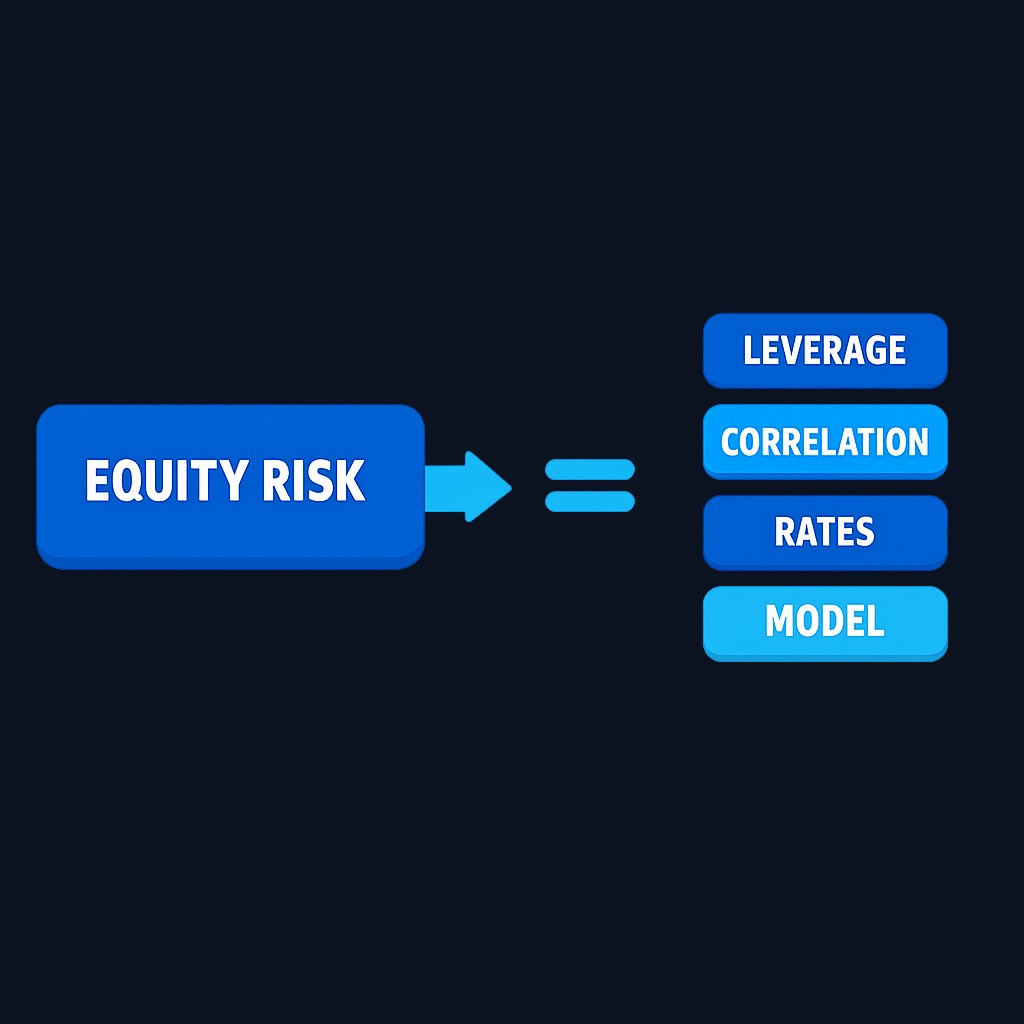
- Leverage risk. Borrowed exposure magnifies losses, adds financing costs that rise with interest rates, and can force selling at bad moments if margin requirements bite.
- Correlation risk. The strategy leans on the tendency of bonds to offset equity weakness. In inflationary shocks, stocks and bonds can fall together, which removes the cushion exactly when it is needed. Periods of simultaneous stock and bond losses are historically uncommon but far from impossible.
- Rate sensitivity. Large bond allocations mean rising yields hurt more than they would in an equity-heavy mix.
- Model risk. Volatility and correlation estimates come from the past. When market behavior shifts abruptly, yesterday's balanced portfolio can be today's unbalanced one.
- Cost drag. Borrowing, frequent rebalancing, and specialized fund fees all subtract from returns before the strategy proves anything.
A fair summary: risk parity replaces one concentrated risk, equities, with a set of smaller, more varied risks, including leverage and modeling. Whether that trade is attractive depends on execution and on the decade you happen to live through.
Stress scenarios worth rehearsing
Before investing, rehearse three specific scenarios. First, a sharp inflation shock. Rates jump, bonds fall, and equities fall together. Commodities may rise, but not enough. A levered version also faces rising financing costs at the same time. Second, a liquidity squeeze. Correlations spike toward one and margin requirements tighten. Forced deleveraging then turns paper losses into realized ones. Third, a long equity boom. Your balanced portfolio grinds out modest returns while equity-heavy neighbors celebrate double-digit years. The temptation to quit peaks right there. None of these scenarios disqualifies the strategy by itself. But if you cannot say in advance what you would do in each, you are not ready to run it. That goes double for leverage.
How institutions use risk parity
Institutional adoption explains much of the strategy's fame. Large pension funds and hedge funds began balancing risk contributions decades ago. Their motivation was practical. Equity-dominated portfolios kept failing their members in bear markets, and adding more asset classes by dollars barely changed the risk picture. Risk-balanced funds promised steadier funding ratios across economic seasons.
Institutions implement the idea with futures and swaps across dozens of markets: global equities, government bonds of several countries, credit, and commodities. They update volatility and correlation estimates frequently, sometimes daily. Many also scale total exposure to a volatility target, trimming positions when markets turn turbulent and adding when they calm. Individual investors cannot copy that machinery, and they do not need to. The lesson worth borrowing is smaller: measure where your risk actually comes from, then decide whether you accept the answer.
A simple three-fund starting point
A beginner-friendly sketch uses three broad index funds: total-market equities, long-term government bonds, and an inflation-sensitive fund. Estimate each fund's volatility from a few years of monthly returns. Weight each fund inversely to its volatility, so the calmest fund gets the most capital. Skip leverage entirely. Rebalance twice a year on fixed dates. Track the result against your old allocation for a full year before moving serious money.
This starter version is not institutional-grade risk parity. It ignores correlations and reacts slowly. But it teaches the core skill, thinking in risk contributions, at nearly zero cost, and it leaves you far better equipped to judge the packaged products that market themselves on the same idea.
What to know before deciding
Before adopting any version of risk parity, check the practical details. If you are considering a fund, read its official documents for the leverage range, the asset classes used, the fee schedule, and how the manager handled past stress periods, especially times when stocks and bonds fell together. If you are building a simplified version yourself, decide honestly whether you will maintain the rebalancing schedule and whether you are comfortable holding a portfolio that can look very different from headline market indexes for years at a time. Tracking error is psychological risk: a strategy you abandon at the worst moment is worse than a simpler one you can hold. Keep any leverage small, understand your borrowing costs, and never run a levered strategy with money you may need on short notice.
Decision framework: is risk parity right for you?
Walk through these six questions in order:
- Do you understand where the returns come from? If you cannot explain the role of each asset class and of leverage in one sentence each, study first and invest later.
- What problem are you solving? If your current portfolio's risk is dominated by equities and that worries you, risk balancing addresses a real issue. If you are chasing recent performance, pause.
- Can you tolerate being different? Risk parity can lag simple equity portfolios for long stretches, particularly in strong bull markets. Decide in advance how many years of lag you can accept.
- Will you use leverage, and how much? An unlevered balanced portfolio is the conservative entry point. Any leverage should be modest, cheap, and stress-tested against rate rises and margin calls.
- Where will the strategy live? High-turnover rebalancing fits best in tax-advantaged accounts; in taxable accounts, count the tax drag before committing.
- Simple version or fund? A do-it-yourself inverse-volatility mix is cheap and transparent but cruder; a professional fund is more precise but adds fees and opacity. Match the choice to your skill and attention.
If any answer disqualifies the strategy, a conventional diversified portfolio remains a perfectly respectable default.
Common mistakes to avoid
Three errors show up repeatedly among newcomers to risk parity. The first is treating leverage as free return. Borrowing costs compound quietly. A strategy that only works at high leverage is fragile. The second is set-and-forget construction. Volatility estimates go stale, and a portfolio balanced on last year's numbers can be unbalanced today. Put rebalancing dates on a calendar and honor them. The third is judging the strategy on short windows. Balanced-risk portfolios aim to be average in most years and useful over full cycles. Scoring them against last year's hottest asset class guarantees disappointment. A written policy prevents all three mistakes at once. Cover leverage limits, rebalancing dates, and your evaluation horizon.
Conclusion and next steps
A risk parity portfolio balances risk contributions instead of dollar amounts: less capital in volatile assets, more in stable ones, optional leverage to reach a return target, and scheduled rebalancing to keep the balance honest. The approach offers steadier participation across economic environments and a more truthful picture of diversification, in exchange for leverage, rate, correlation, model, and cost risks that deserve genuine respect.
Next steps: measure the current risk balance of your own portfolio by estimating each holding's volatility and its share of your total swings. Many investors discover their "diversified" mix is an equity portfolio wearing a costume. Whether or not you adopt risk parity, that measurement is worth an evening. If you want structured practice with allocation concepts like these, the Finelo learning app walks beginners through portfolio construction step by step.
Frequently asked questions
Does risk parity require leverage?
No. Leverage is optional and used to raise the expected return of a bond-heavy balanced mix to a chosen target. An unlevered risk parity portfolio simply accepts lower expected returns in exchange for balanced risk. Most beginner-friendly versions start unlevered.
How did risk parity strategies become popular?
Large institutional managers popularized the approach after the concept emerged from research on balancing risk contributions rather than capital, and it gained attention for holding up comparatively well in equity bear markets. Popularity then attracted debate, particularly about leverage and bond dependence.
What happens to risk parity when stocks and bonds fall together?
That is the strategy's hardest environment. Inflationary shocks that push rates up while equities fall remove the usual bond cushion, and levered versions feel it more. Inflation-sensitive sleeves such as commodities are included partly to soften exactly this scenario.
Can I build a simple risk parity portfolio myself?
Yes, a basic inverse-volatility version using broad index funds is achievable for a careful DIY investor: estimate volatilities, weight inversely, rebalance on a schedule, and skip leverage. You give up modeling precision, but you keep costs and complexity low.
riskparityportfolio
Practice investing with Finelo
Build practical investing skills with guided lessons, simulator practice, and structured challenges.
About the author
Finelo Team
The Finelo Team creates practical investing and trading education designed to help beginners learn faster with structured challenges, simulator practice, and bite-sized lessons.
Keep reading — Related articles

Investing
Tax-gain harvesting vs. tax-loss harvesting
Compare realizing investment gains with realizing losses, including holding periods, wash sales, offsets, and portfolio tradeoffs.
Finelo Team

Investing
Stable value fund vs. money market fund
Compare investment structure, contract protections, transfer restrictions, net yields, and access inside a retirement account.
Finelo Team

Investing
Single-life vs. joint-life annuity
Compare income for one lifetime with continued payments to a survivor, using equal premiums and matching guarantee terms.
Finelo Team


