Book value per share (BVPS) is a company's net worth divided across its shares. You calculate it by taking total shareholders' equity, subtracting any preferred equity, and dividing by common shares outstanding. It estimates the accounting value behind each share, giving investors a baseline to compare against the market price.
What is Book Value Per Share and Why Does It Matter?

Book value per share (BVPS) is a company's net worth divided across its shares. You calculate it by taking total shareholders' equity, subtracting any preferred equity, and dividing by common shares outstanding. It…
6 min read
Practice investing with Finelo
Build practical investing skills with guided lessons, simulator practice, and structured challenges.
Want to learn more?
Build practical investing skills with guided lessons, simulator practice, and structured challenges.
Explore FineloExplore Finelo's 28-day challenges
Turn learning into a daily habit with guided challenge paths.
This page is for investors learning to read balance sheets and judge whether a stock trades above or below the value of its recorded assets. You will learn the formula, worked examples, how BVPS relates to market price, and where the number misleads. Everything here is educational, not financial advice.
How to calculate book value per share
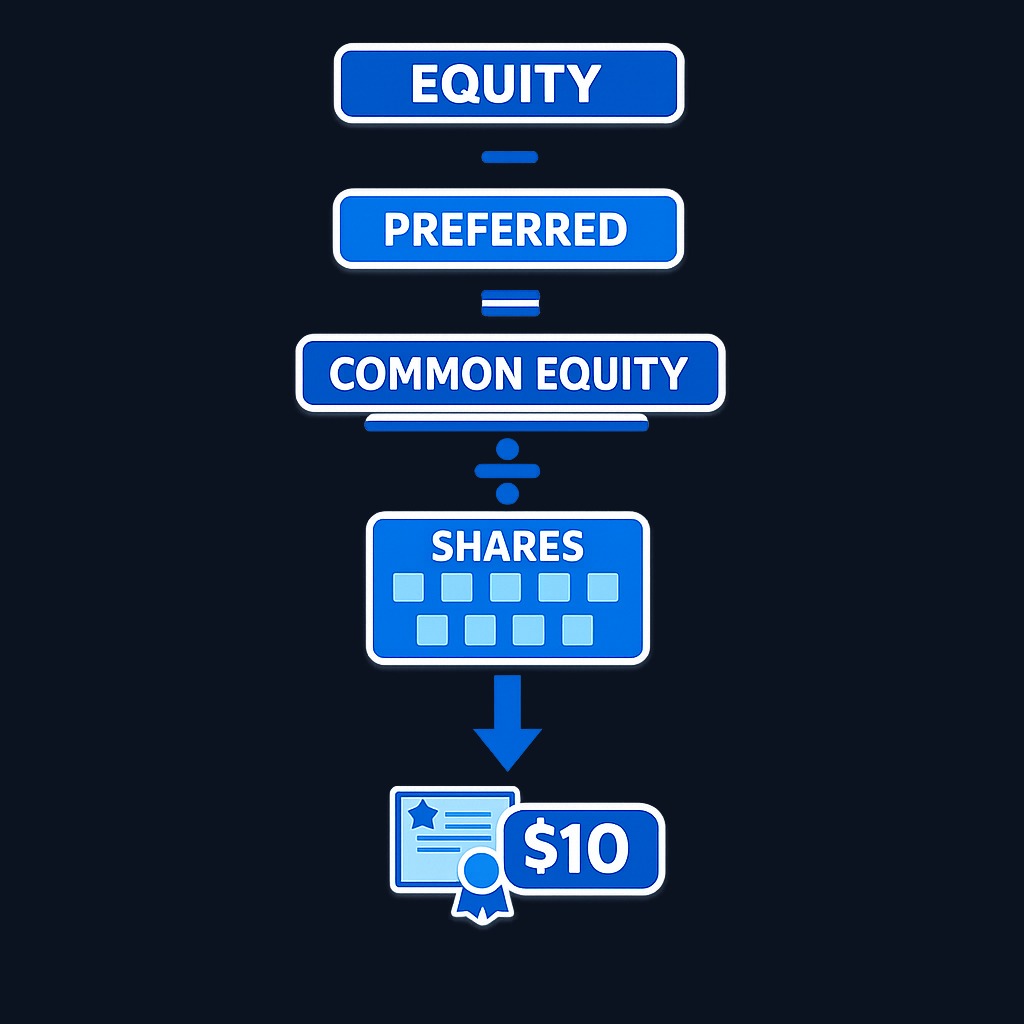
BVPS = (total shareholders' equity - preferred equity) ÷ common shares outstanding
Shareholders' equity is total assets minus total liabilities, straight from the balance sheet. Preferred equity comes out first because preferred holders stand ahead of common shareholders in a liquidation.
Worked example
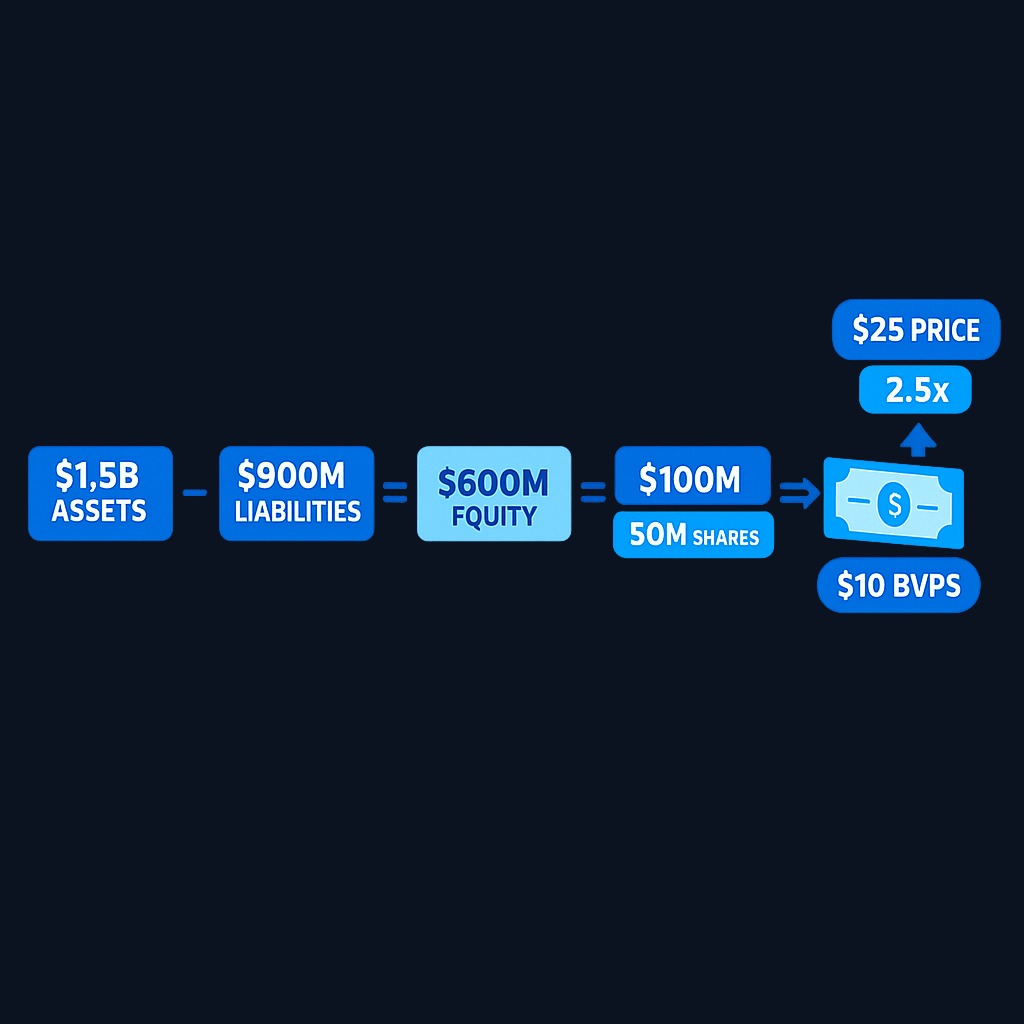
A company reports $1.5 billion in assets and $900 million in liabilities, so equity is $600 million. It has $100 million of preferred stock and 50 million common shares outstanding.
| Input | Value |
|---|---|
| Total assets | $1.5B |
| Total liabilities | $0.9B |
| Shareholders' equity | $600M |
| Preferred equity | $100M |
| Common equity | $500M |
| Shares outstanding | 50M |
| BVPS | $10.00 |
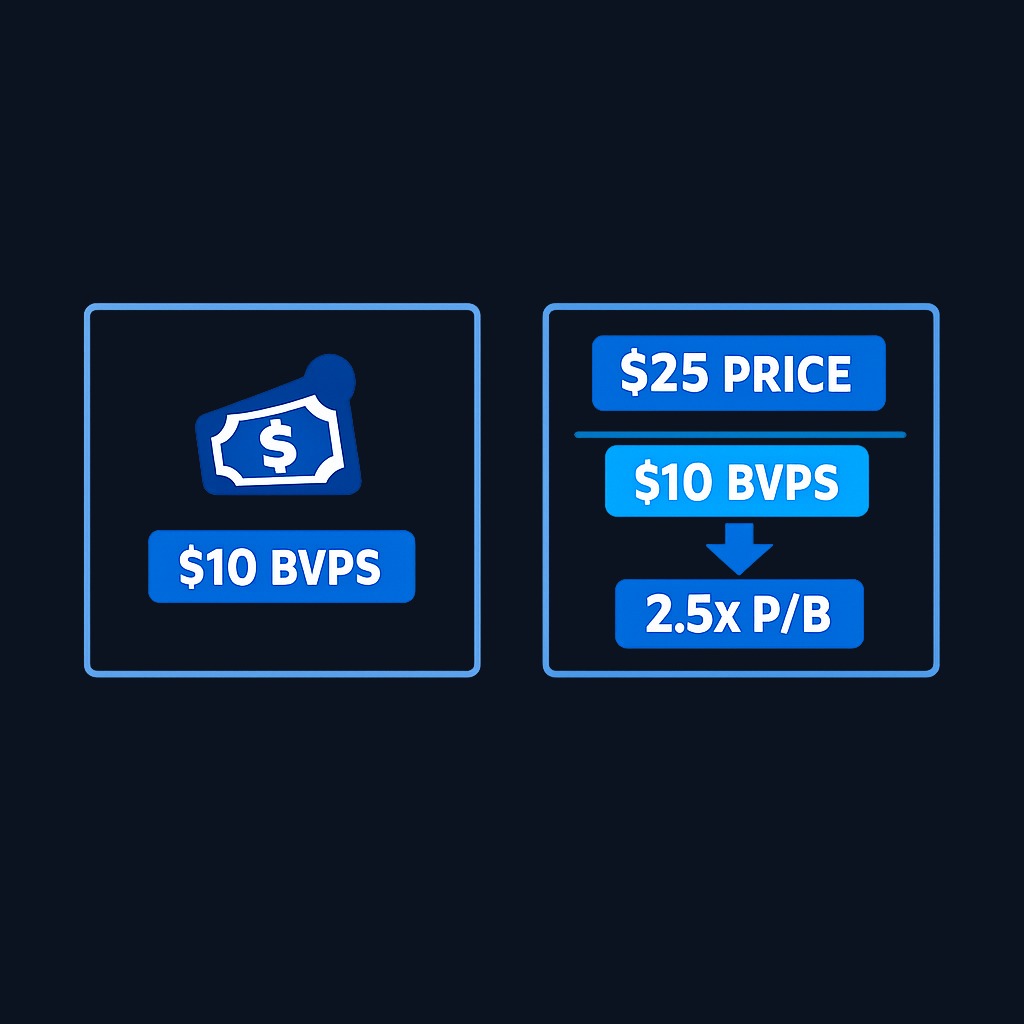
BVPS is $500M ÷ 50M = $10 per share. If the stock trades at $25, the market prices the company at 2.5 times its book value. Watch the share count: buybacks shrink it and can raise BVPS, while new issuance dilutes it, independent of how the business itself performed.
The importance of book value per share for investors
BVPS gives you three practical things. First, a valuation anchor: dividing price by BVPS produces the price-to-book ratio, one of the oldest value-investing screens. Second, a growth record: tracking BVPS over years shows whether a company is compounding shareholder capital through retained earnings, a signal long-term investors watch closely. Third, downside context: in liquidation-style analysis, book value hints at what might remain for common holders after creditors are paid, a rough floor rather than a promise.
The metric works hardest in asset-heavy sectors. For banks and insurers, whose balance sheets are mostly financial instruments carried near market value, BVPS and its growth are central performance measures. For asset-light software or brand-driven businesses, recorded book value misses most of what makes the company valuable.
Comparing book value per share with market value
Market price per share reflects what investors will pay for future earnings, growth, and intangibles. BVPS reflects what accounting rules have recorded, historical costs, minus liabilities. The gap between them is expectation.
- Price far above BVPS means the market credits the company with substantial value beyond its net assets: brands, technology, network effects, or expected growth.
- Price near BVPS is common in mature, capital-intensive, or slow-growth industries.
- Price below BVPS says the market doubts the assets can earn their keep, or doubts the recorded values themselves. It can flag a bargain, an accounting illusion, or a business in decline.

A price below book value is an invitation to investigate, not to buy. Ask what the assets really are, how they would fare if sold, and whether losses are quietly eroding equity. Return on equity ties the comparison together: companies that earn strong returns on their book value deserve, and usually get, prices far above it.
Common misconceptions about book value per share
- "BVPS is what I would get if the company liquidated." Only loosely. Liquidations often realize less than recorded values, and costs come out along the way.
- "A stock below book value is automatically cheap." The discount often exists for a reason: stale asset values, looming write-downs, or persistent losses.
- "Higher BVPS means a better company." BVPS is a per-share accounting figure, not a quality measure. A $50 BVPS company is not better than a $5 one; only the relationship to price and returns matters.
- "Book value captures all assets." Internally developed brands, software, and expertise rarely appear on the balance sheet, so BVPS understates asset-light businesses.
- "BVPS cannot be negative." Sustained losses or heavy buybacks can push equity below zero, making BVPS negative even at some well-known, operating companies.
Practice investing with Finelo
Build practical investing skills with guided lessons, simulator practice, and structured challenges.
Case studies: BVPS in action
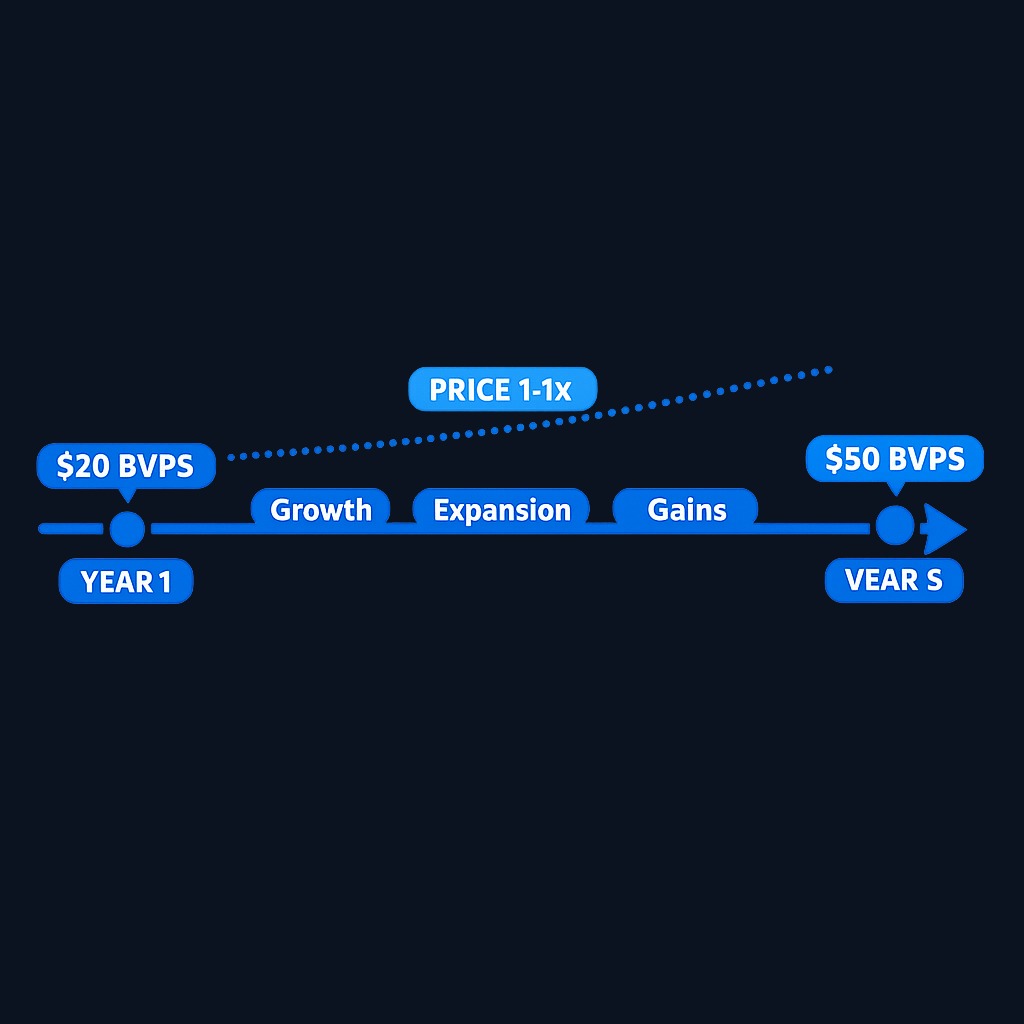
Consider a regional bank whose BVPS compounds from $20 to $30 over five years while the stock oscillates around 1.1 times book. The steady BVPS growth tells you retained profits are accumulating on the balance sheet, and the near-book pricing keeps the valuation grounded in audited numbers. Bank investors routinely track this pairing, price to book against BVPS growth, as their core scorecard.
Now consider a software company trading at 15 times book value. Its BVPS is almost irrelevant to the investment case; the value lives in code, customers, and margins that accounting barely records. Forcing a book-value lens onto it would have kept you out of some of the market's best businesses. The two cases teach the same lesson from opposite directions: BVPS is powerful where balance sheets describe the business, and nearly silent where they do not.
What to know before deciding
Before using BVPS in a decision, verify the inputs and the fit. Check the date of the balance sheet, whether goodwill from acquisitions inflates equity, whether buybacks or issuance changed the share count, and whether preferred equity was subtracted. Confirm the industry is one where book value means something. Pair BVPS with return on equity and earnings trends, since capital that earns nothing deserves no premium. If you rotate positions based on valuation screens, remember that selling triggers taxable events; the IRS overview of capital gains and losses explains how gains are treated. No single balance-sheet number should decide an investment alone.
Decision framework: putting BVPS to work
- Fit check. Asset-heavy business? BVPS is a primary tool. Asset-light? Treat it as background.
- Trend check. Is BVPS growing over five-plus years? Compounding book value signals retained profits doing their job.
- Price check. Compare price to BVPS against industry peers and the company's own history.
- Quality check. Confirm return on equity justifies the premium or explains the discount.
- Reality check. Scrutinize what the assets are: goodwill and stale valuations weaken the floor BVPS appears to offer.
Conclusion: practical steps for investors
Book value per share turns a balance sheet into a per-share anchor: equity minus preferred claims, divided by shares outstanding. It grounds valuation in audited numbers, shines for banks and asset-heavy firms, and fades for businesses built on intangibles.
Next steps: pull the latest balance sheet for a company you follow, compute BVPS yourself, and compare it with the current share price. Then repeat for two industry peers and check whose book value has grown fastest over five years.
Frequently asked questions
What is a good book value per share?
There is no universal good number. BVPS matters relative to the share price, industry norms, and its own trend over time. A growing BVPS alongside strong returns on equity is generally the healthy pattern.
Why do some companies trade far above book value per share?
Because their most valuable assets, brands, software, and expertise, are not recorded on the balance sheet. The market prices those intangibles and future earnings even though accounting does not.
Can book value per share be negative?
Yes. Accumulated losses or aggressive buybacks can push shareholders' equity below zero. A negative BVPS makes ratio analysis meaningless, but the cause deserves investigation before investing.
How is BVPS different from the price-to-book ratio?
BVPS is a dollar amount per share from the balance sheet. Price-to-book divides the market price by BVPS, turning it into a valuation multiple you can compare across companies.
bookvaluepershare
Practice investing with Finelo
Build practical investing skills with guided lessons, simulator practice, and structured challenges.
About the author
Finelo Team
The Finelo Team creates practical investing and trading education designed to help beginners learn faster with structured challenges, simulator practice, and bite-sized lessons.
Keep reading — Related articles

Investing
Tax-gain harvesting vs. tax-loss harvesting
Compare realizing investment gains with realizing losses, including holding periods, wash sales, offsets, and portfolio tradeoffs.
Finelo Team

Investing
Stable value fund vs. money market fund
Compare investment structure, contract protections, transfer restrictions, net yields, and access inside a retirement account.
Finelo Team

Investing
Single-life vs. joint-life annuity
Compare income for one lifetime with continued payments to a survivor, using equal premiums and matching guarantee terms.
Finelo Team