Evidence note: “Economic moat” is a strategy and valuation framework, not a GAAP measure or a status certified by SEC filings. Network effects, switching costs, cost advantages, intangibles, and efficient scale are hypotheses about durable excess returns. Test them against named evidence—market share, retention, pricing, unit costs, returns on capital, reinvestment runway, regulation, and credible threats—and treat company examples as illustrative rather than proof.
What Is an Economic Moat? Understanding Its Meaning and Importance

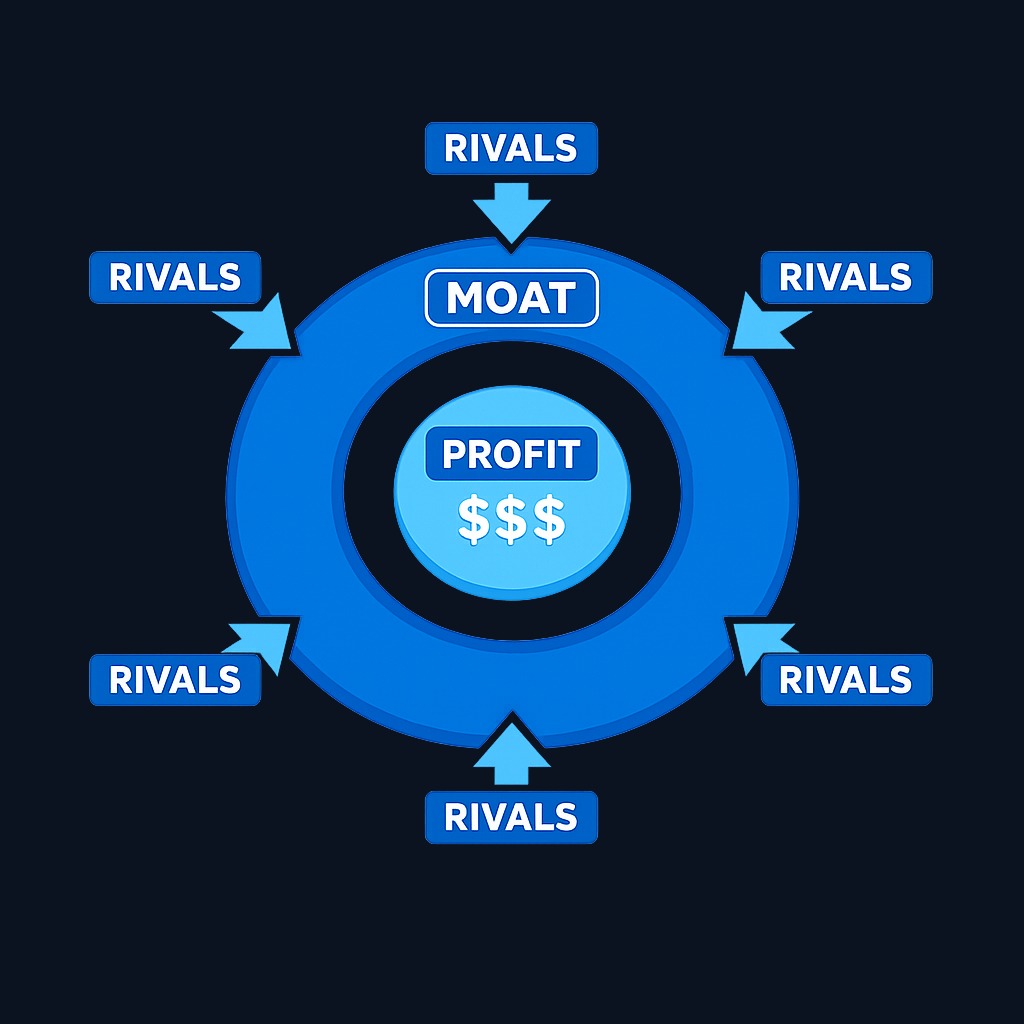
An economic moat is a long-lasting structural edge that shields a business's earnings from competitors, much as a water-filled trench once shielded a castle. The term, popularized by Warren Buffett, describes anything…
8 min read
Practice investing with Finelo
Build practical investing skills with guided lessons, simulator practice, and structured challenges.
Want to learn more?
Build practical investing skills with guided lessons, simulator practice, and structured challenges.
Explore FineloExplore Finelo's 28-day challenges
Turn learning into a daily habit with guided challenge paths.
An economic moat is a long-lasting structural edge that shields a business's earnings from competitors, much as a water-filled trench once shielded a castle. The term, popularized by Warren Buffett, describes anything that lets a business sustain high returns on capital for years: brands, network effects, switching costs, cost advantages, or regulatory barriers. This page is for investors and finance learners who want the economic moat meaning in plain terms, the main moat types, and a practical way to spot one in a real company. Read the types first, then use the identification checklist before applying the idea to any stock you own or research.
The direct answer for anyone searching "economic moat meaning": it is the set of structural reasons a company can keep earning above-average profits even while competitors try to take them away.
Why economic moats matter to investors
Capitalism attacks profit. When a business earns unusually high margins, competitors notice and copy it, and returns usually get competed back down to average. A moat is whatever slows or stops that process. For long-term investors, the moat question is central because holding a stock for a decade is a bet that its profitability will survive a decade of attack.
Moats matter for valuation too. A company that can defend high returns on invested capital deserves a higher price relative to current earnings than one whose profits are one competitor away from shrinking. Two businesses with identical earnings today can be worth very different amounts if one has a moat and the other does not. That is why analysts spend more time on competitive advantage than on any single quarter's results, and why moat analysis pairs naturally with fundamental analysis.
Types of economic moats
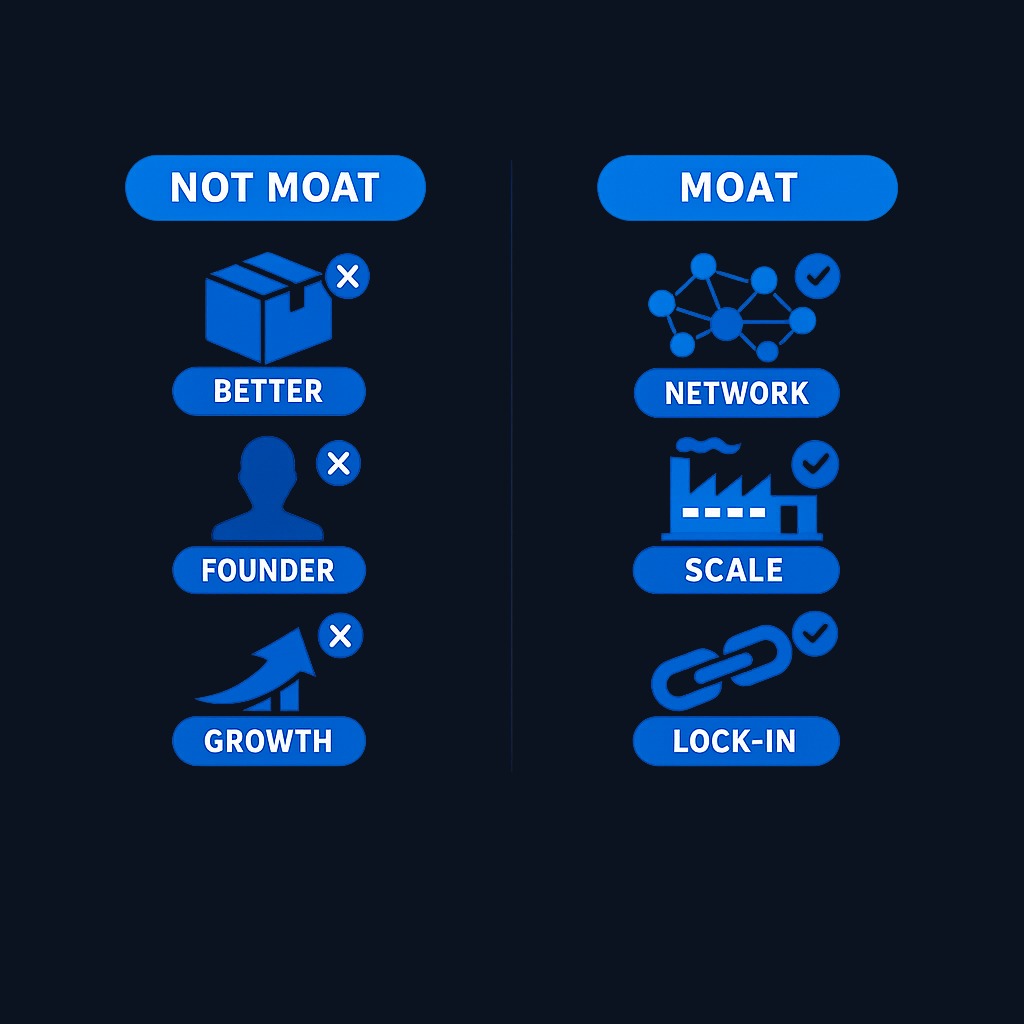
Most moats fall into five recognizable categories:
| Moat type | How it protects profits | Classic signs |
|---|---|---|
| Brand and intangible assets | Customers pay more for a trusted name; patents and licenses block copies | Premium pricing that customers accept without complaint |
| Network effects | Each new user makes the product more valuable to every other user | Winner-take-most markets, users who stay because everyone else is there |
| Switching costs | Leaving means retraining, data migration, or contract pain | High renewal rates, customers who grumble but stay |
| Cost advantage | Structurally lower costs from scale, location, or process | Ability to profit at prices where rivals lose money |
| Efficient scale | A market only big enough for a few players | Rational pricing among few competitors, little new entry |
Real companies often combine several. A payments network can enjoy network effects, a trusted brand, and scale economics at once, which is why the strongest moats are usually stacked rather than single-source.

How to identify an economic moat
A moat claim is a hypothesis you test against evidence, not a vibe. A practical checklist:
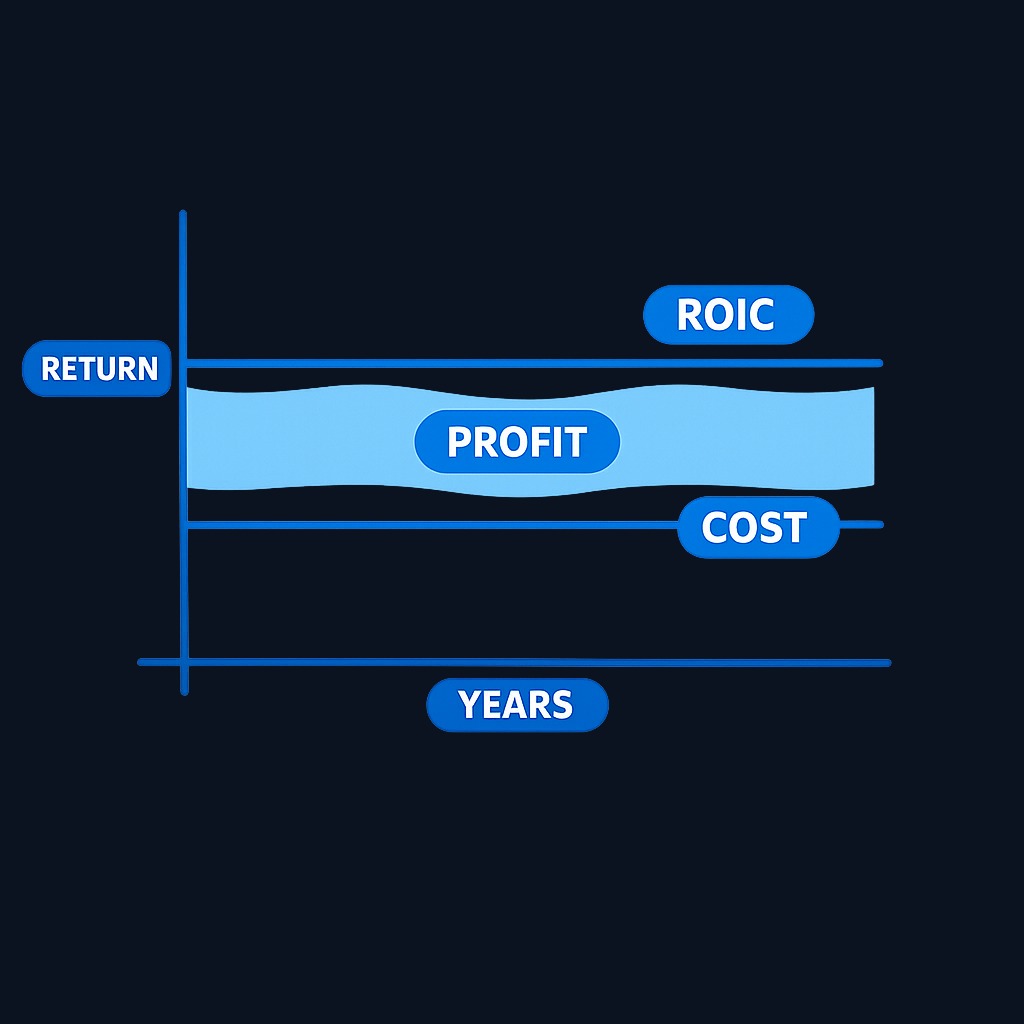
- Look for sustained high returns on capital. One great year proves nothing. Five to ten years of returns above the cost of capital suggest something structural is at work.
- Check pricing power. Can the company raise prices without losing customers? Stable or expanding gross margins through inflationary periods are a strong tell.
- Watch customer behavior. High retention, long contracts, and repeat purchases point to switching costs or brand strength.
- Study market share stability. Moaty industries show stable share over time; share that churns every few years signals weak advantages.
- Read what the company says about competition. Public companies must describe competitive conditions and risk factors in their annual reports, and those filings are available free through the SEC's EDGAR database. Management's own description of competition is often more honest in filings than in marketing.
- Ask the reverse question. If you gave a smart rival a large budget to attack this business, what exactly would stop them? If you cannot name the obstacle, there may not be one.
The number that summarizes most of this is return on invested capital versus the cost of that capital. A moat is ultimately visible in accounting: persistent spread between what the business earns and what its capital costs.
What strong moats look like in practice
Rather than naming tickers, it is more useful to recognize the patterns. A dominant search or social platform illustrates network effects: users go where other users are, and advertisers follow the users. Enterprise software with deep integrations illustrates switching costs: ripping it out costs more than the subscription. A global beverage brand illustrates intangible assets: the recipe is not the moat, the mental shelf space is. A giant discount retailer illustrates cost advantage: scale lets it sell at prices smaller rivals cannot match profitably. And a regulated utility illustrates efficient scale: one set of power lines per region is all the market supports.
In each pattern, notice what the moat is not. It is not a better product this quarter, a charismatic founder, or a hot growth rate. Those attract competition; the moat is what survives it.
Practice investing with Finelo
Build practical investing skills with guided lessons, simulator practice, and structured challenges.
Challenges to economic moats
Moats erode, and the erosion is often invisible until late:
- Technology shifts can make an advantage irrelevant, the way streaming dissolved the value of physical distribution networks.
- Changing consumer habits weaken brands that anchored to an older generation's preferences.
- Regulation can dismantle barriers, open networks to rivals, or cap the pricing power a moat once enabled.
- Management errors matter: diversifying away from the moat, underinvesting in it, or milking it with price hikes that invite entry.
- Moat mirages are common in fast-growing sectors, where early scale looks like permanent advantage until subsidized competitors arrive.
Because of this, moat investing is not a one-time classification. An annual re-check of returns, share stability, and competitive developments is the maintenance the strategy requires.

What to know before deciding
Before you act on a moat thesis, keep four things in view. First, a wide moat does not make a stock a buy at any price; overpaying for a great business is still overpaying. Second, moats are judged in years, so the evidence you need is multi-year financial history, not recent headlines. Third, your own conviction needs a specific mechanism, name the moat type and the proof, or treat the thesis as unproven. Fourth, diversification still applies, because even well-reasoned moat calls fail when industries shift; a portfolio of independent theses beats one big bet.
Decision framework: using moats in your investing process
| Your intent | Recommended next step |
|---|---|
| Learn the concept properly | Study the five moat types and match each to one real-world example you know |
| Evaluate a stock you own | Verify multi-year return on capital and margin trends; name the moat type explicitly |
| Compare two companies | Ask which one could raise prices tomorrow with less customer loss |
| Research a new idea | Read the competition and risk-factor sections of the annual report on EDGAR |
| Build long-term habits | Re-test each moat thesis yearly and write down what would disprove it |
FAQ
What does economic moat mean in simple terms?
It is a lasting structural advantage, like a strong brand, network effects, or lower costs, that protects a company's profits from competitors, letting it earn above-average returns for a long time.
What are the main types of economic moats?
Five categories cover most cases: brand and intangible assets, network effects, switching costs, cost advantages, and efficient scale. Strong companies often combine two or more.
How do I tell if a company has a real moat?
Look for years of returns on capital above the cost of capital, pricing power, stable market share, and high customer retention. Then identify the specific mechanism that would stop a well-funded competitor.
Can a company lose its economic moat?
Yes. Technology shifts, changing habits, regulation, and management mistakes all erode moats, sometimes quickly. Moat analysis is a recurring check, not a permanent label.
Next steps. Pick one company you know well, name its moat type, and try to falsify it with the checklist above; that single exercise teaches more than any definition. To build the underlying skills, the Finelo app offers short interactive lessons on competitive advantage, valuation, and reading company fundamentals at your own pace.
InvestingFundamental AnalysisBeginner
Practice investing with Finelo
Build practical investing skills with guided lessons, simulator practice, and structured challenges.
About the author
Finelo Team
The Finelo Team creates practical investing and trading education designed to help beginners learn faster with structured challenges, simulator practice, and bite-sized lessons.
Keep reading — Related articles
Investing
Tax-gain harvesting vs. tax-loss harvesting
Compare realizing investment gains with realizing losses, including holding periods, wash sales, offsets, and portfolio tradeoffs.
Finelo Team
Investing
Stable value fund vs. money market fund
Compare investment structure, contract protections, transfer restrictions, net yields, and access inside a retirement account.
Finelo Team

Investing
Single-life vs. joint-life annuity
Compare income for one lifetime with continued payments to a survivor, using equal premiums and matching guarantee terms.
Finelo Team