Gross profit is the money a business retains from sales after subtracting the direct cost of the goods or services sold. Investors use it to examine pricing power, direct-cost pressure, product mix, and whether revenue growth is translating into stronger core economics. In its simplest form:
Gross Profit: How Investors Read Margins and Business Quality
Gross profit is the money a business retains from sales after subtracting the direct cost of the goods or services sold. Investors use it to examine pricing power, direct-cost pressure, product mix, and whether revenue…
6 min read
Practice investing with Finelo
Build practical investing skills with guided lessons, simulator practice, and structured challenges.
Want to learn more?
Build practical investing skills with guided lessons, simulator practice, and structured challenges.
Explore FineloExplore Finelo's 28-day challenges
Turn learning into a daily habit with guided challenge paths.
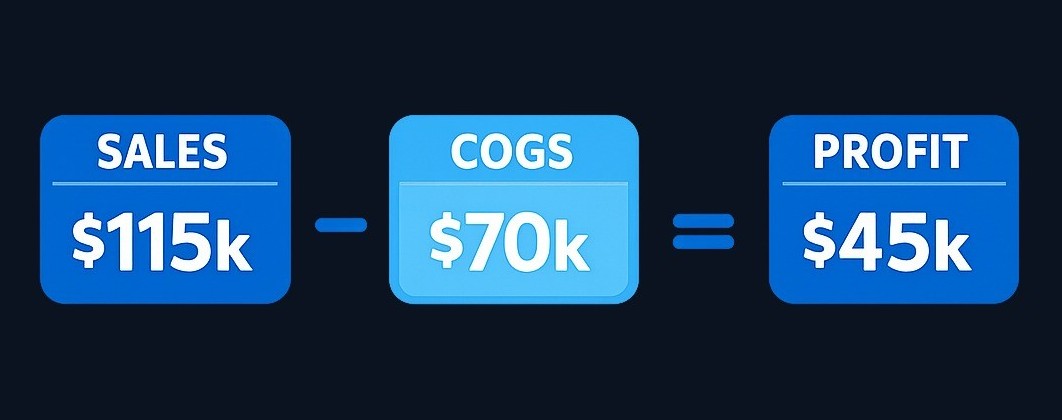
Gross profit = net sales revenue − cost of goods sold (COGS)
It shows whether the core product or service is generating enough value to cover its direct costs before expenses such as marketing, administration, interest, and taxes are considered. The IRS describes the calculation as gross receipts from sales or services, less returns and allowances, minus the cost of sales and services.
This guide helps beginner investors calculate gross profit, interpret gross margin trends, and avoid confusing a healthy core margin with overall profitability or cash generation.
How to Calculate Gross Profit
Start with net sales, not necessarily the gross amount collected from customers. Returns, refunds, rebates, or allowances may reduce gross sales before COGS is deducted.
The basic process is:
- Add the revenue earned from selling the relevant goods or services.
- Subtract returns, refunds, rebates, and sales allowances to find net sales.
- Identify the direct costs associated with delivering those sales.
- Subtract those direct costs from net sales.
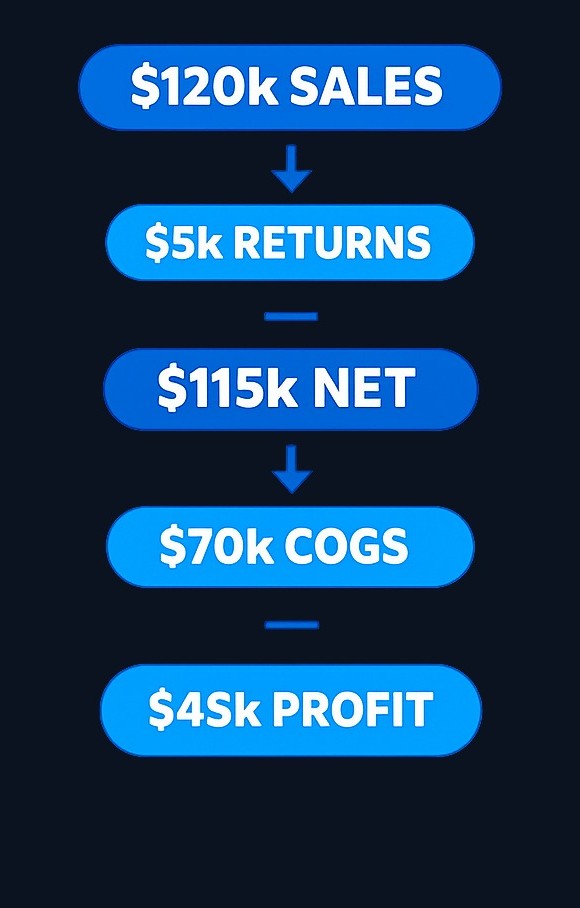
For example, suppose a retailer records $120,000 in gross sales, issues $5,000 in refunds, and has $70,000 in COGS:
- Net sales: $120,000 − $5,000 = $115,000
- Gross profit: $115,000 − $70,000 = $45,000
The business generated $45,000 from its selling activity before accounting for operating and other expenses.
What belongs in COGS?
The answer depends on the business model and accounting method. For a seller of physical products, COGS may include the purchase or production cost of the units sold. For a service business, direct labor or materials used to deliver a service may be treated as direct costs.
The key is consistency. A cost should not move in or out of COGS merely to make gross profit look better. When the classification is uncertain, an accountant can help apply the appropriate accounting rules.
Gross profit margin
Gross profit is a currency amount. Gross profit margin converts that amount into a percentage:
Gross profit margin = (gross profit ÷ net sales) × 100
Using the retailer above:
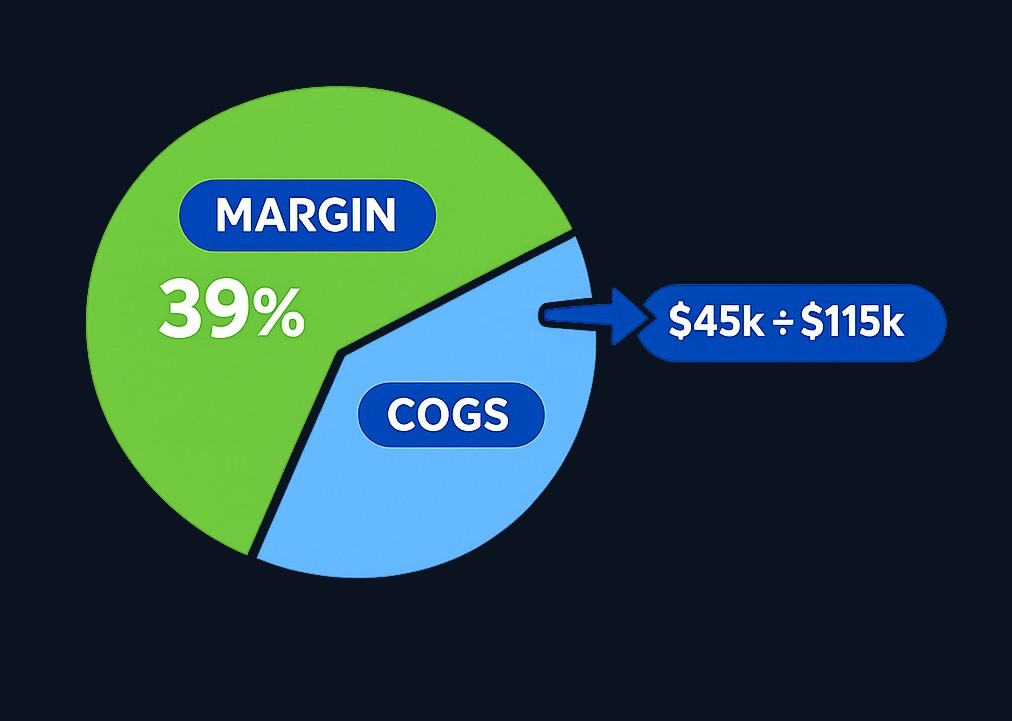
($45,000 ÷ $115,000) × 100 = 39.1%
This means about 39 cents of each net sales dollar remains after direct costs. It does not mean the business keeps 39 cents as net profit.
Gross Profit vs. Operating Profit and Net Profit
Each profit measure answers a different question.
| Metric | Simplified calculation | What it helps assess |
|---|---|---|
| Gross profit | Net sales − COGS | Economics of producing and selling |
| Operating profit | Gross profit − operating expenses | Profitability of regular operations |
| Net profit | Revenue − all recognized expenses | Overall profit after operating and other costs |
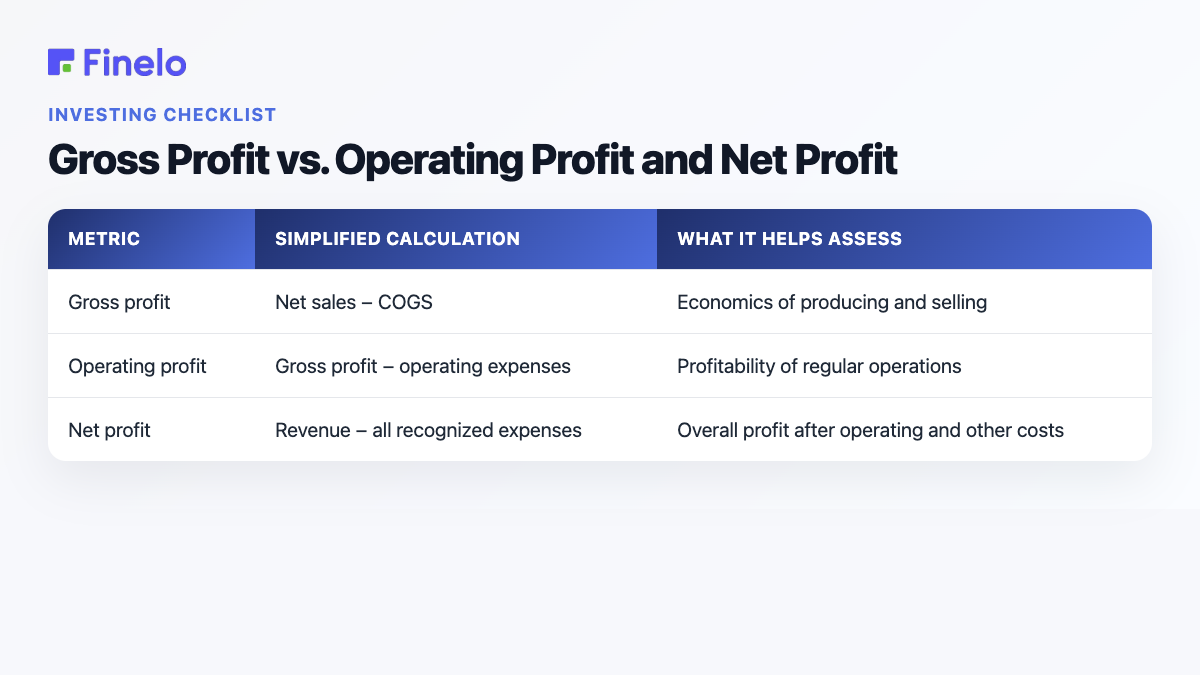
Gross profit stops before costs such as general administration and many selling expenses. Operating profit goes further by deducting operating expenses. Net profit goes further still, reflecting other recognized costs and income.
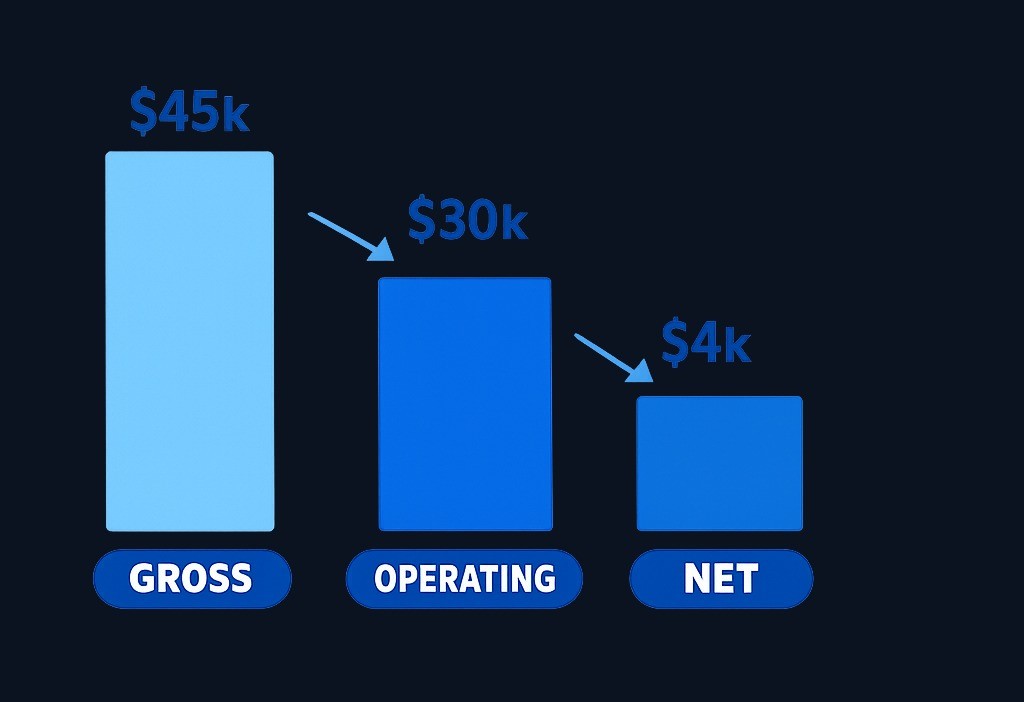
Consider a business with $45,000 in gross profit, $30,000 in operating expenses, and $4,000 in other net expenses:
- Gross profit: $45,000
- Operating profit: $15,000
- Net profit: $11,000
The company can therefore have a healthy gross profit while producing a much smaller net profit. High overhead, financing costs, or other expenses may consume much of what remains after COGS.
Why Gross Profit Matters to Investors
Gross profit isolates the relationship between sales and direct costs. Tracking it over comparable periods can help an investor investigate:
- whether prices are keeping pace with direct costs;
- whether supplier, material, or production costs are changing;
- whether the sales mix is shifting toward products with different margins;
- whether returns and allowances are reducing net sales;
- whether growth is adding gross profit or merely adding low-margin revenue.
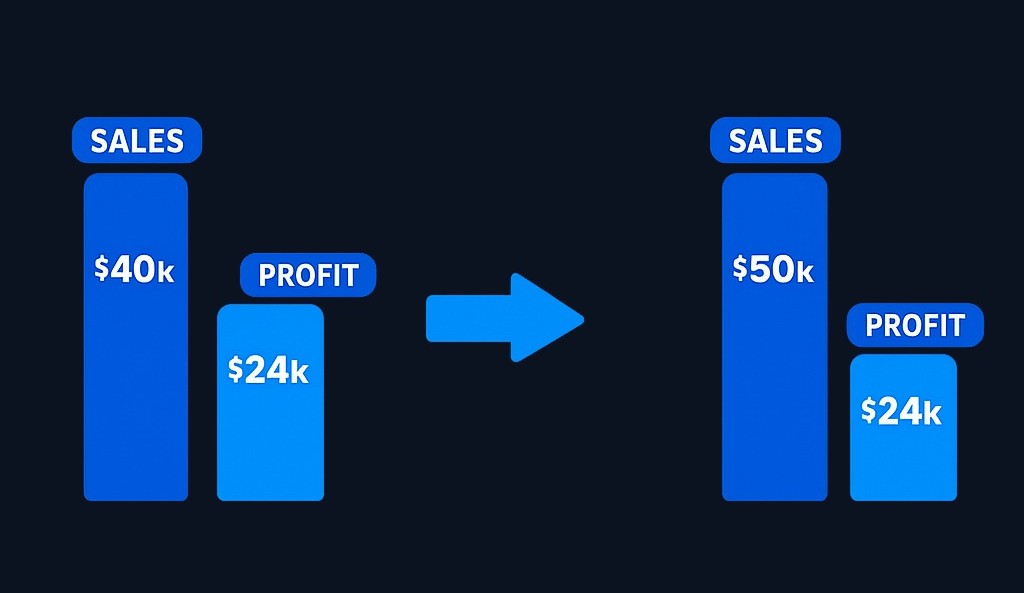
Suppose a café’s revenue rises from $40,000 to $50,000, but its gross profit remains at $24,000. Sales grew, yet the amount available to cover rent, administration, and other expenses did not. The owner might examine ingredient costs, discounting, waste, and the mix of items sold before assuming the higher revenue represents stronger performance.
Gross profit is also useful for scenario planning. If direct costs rise while prices and sales volume stay unchanged, gross profit will fall. A manager can model possible responses—such as changing the product mix, renegotiating input costs, or reviewing pricing—without assuming that any single action is automatically appropriate.
Practice investing with Finelo
Build practical investing skills with guided lessons, simulator practice, and structured challenges.
What Is a Good Gross Profit Margin for Investors?
There is no universal “good” gross profit margin. A useful comparison should account for the business model, product mix, accounting treatment, location, company maturity, and period measured.
A retailer that buys and resells physical inventory has a different direct-cost structure from a consultancy whose main input is professional time. Even two companies in the same broad industry may classify costs differently or sell through different channels.
Use this comparison framework:
- Compare like with like. Use businesses with similar products, customers, and cost structures.
- Check definitions. Confirm that revenue and COGS are calculated consistently.
- Review the trend. Compare the company with its own prior periods.
- Investigate the cause. Separate changes in price, volume, sales mix, returns, and unit costs.
- Read beyond one ratio. Consider operating and net profit as well as cash flow and the balance sheet.
Industry benchmarks can provide context, but they are not targets to copy blindly. A lower margin may accompany a high-volume model, while a higher margin does not guarantee overall profitability if operating expenses are excessive.
Practical Examples Across Business Models
Product retailer
A shop has $80,000 in net sales and $52,000 in COGS.
- Gross profit: $80,000 − $52,000 = $28,000
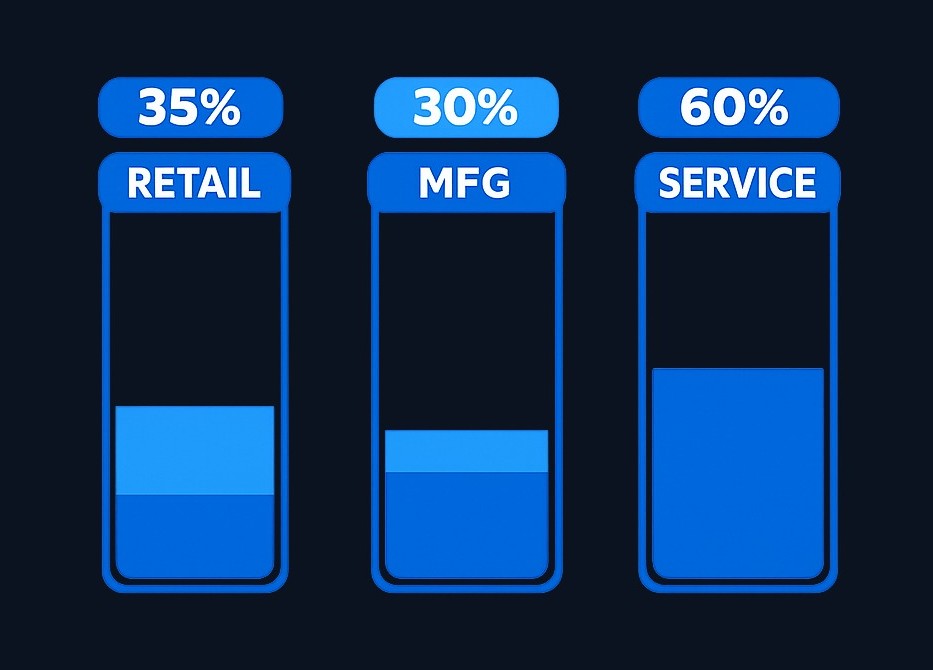
- Gross profit margin: $28,000 ÷ $80,000 = 35%
If the margin later falls while prices remain stable, the shop could inspect supplier costs, inventory loss, discounting, and its mix of products.
Manufacturer
A manufacturer records $300,000 in net sales and $210,000 in costs associated with the goods sold.
- Gross profit: $300,000 − $210,000 = $90,000
- Gross profit margin: $90,000 ÷ $300,000 = 30%
A rise in material or production costs could reduce gross profit even when the number of units sold is unchanged.
Service business
A service firm earns $100,000 in net sales and assigns $40,000 of direct delivery costs to those services.
- Gross profit: $100,000 − $40,000 = $60,000
- Gross profit margin: $60,000 ÷ $100,000 = 60%
This example depends on how direct service-delivery costs are classified. Comparing it with a firm that records similar labor under operating expenses could be misleading.
Common Gross Profit Mistakes
One common mistake is treating gross profit as cash in the bank. Gross profit is an accounting measure; customer payment timing, inventory purchases, debt payments, and capital spending can produce a different cash position.
Another is confusing gross profit with revenue. Revenue is the sales starting point, while gross profit is what remains after the relevant direct costs.
Other pitfalls include:
- using gross sales when returns and allowances should be deducted;
- subtracting every business expense in the gross profit calculation;
- comparing margins calculated with inconsistent cost classifications;
- assuming a rising gross profit amount always means a rising margin;
- judging a business from gross profit alone.
A negative gross profit results when COGS exceeds net sales. That is a strong signal to examine pricing, direct costs, returns, and sales mix, but diagnosis still requires the underlying records.
An Investor’s Gross Profit Checklist
Calculate net sales, COGS, gross profit, and gross profit margin for several comparable periods. Then identify whether any change came from pricing, sales volume, product mix, returns, acquisitions, or direct unit costs. Compare the trend with close peers only after checking that cost classifications are similar. Finally, review operating profit, net income, and cash flow so a strong gross margin is not mistaken for a strong investment on its own.
Finelo presents financial concepts for investor education. Gross profit is a useful analytical starting point, but investment decisions should consider the full financial picture, valuation, risks, the reliability of the underlying accounts, and individual circumstances. This guide does not recommend buying or selling any security.
Frequently asked questions
Can gross profit be higher while gross profit margin falls?
Yes. If sales volume increases, the gross profit amount can rise even while the percentage earned on each sales dollar declines. Track both the amount and the margin.
How often should gross profit be calculated?
Use a consistent schedule that matches the business’s reporting needs and reliable data availability. Comparing equivalent weekly, monthly, quarterly, or annual periods makes trends easier to interpret.
Does gross profit include salaries?
It depends on what the employees do and how costs are classified. Labor directly connected to producing goods or delivering services may be included in COGS, while administrative labor is generally considered outside gross profit. Apply the same accounting policy consistently.
InvestingBeginnerFinancial StatementsMarkets
Practice investing with Finelo
Build practical investing skills with guided lessons, simulator practice, and structured challenges.
About the author
Finelo Team
The Finelo Team creates practical investing and trading education designed to help beginners learn faster with structured challenges, simulator practice, and bite-sized lessons.
Keep reading — Related articles

Investing
I Bonds vs EE Bonds in 2026: Rates, Rules, and Which to Buy for the Long Run
Series I and Series EE savings bonds are both U.S. Treasury retail savings bonds sold on TreasuryDirect. They share ownership, tax treatment, and redemption rules; the key difference is the…
Finelo Team
Investing
Coverdell ESA vs 529 Plan: Limits, Flexibility, and Which to Choose
Quick answer (one minute) Both a Coverdell Education Savings Account (Coverdell ESA) and a 529 plan let money grow tax‑free and be withdrawn tax‑free for qualified education expenses. The…
Finelo Team
Investing
CD vs High Yield Savings Account: Where to Park Your Cash in 2026
Hero answer — CD vs high yield savings account in one line A CD (certificate of deposit) and a high yield savings account are both low‑risk, federally insured homes for cash — the difference…
Finelo Team