Private equity is a form of investing in which capital is placed in companies whose shares are not publicly traded, often with the investor taking a meaningful ownership position and an active role in the business. Private equity firms typically collect money from multiple investors into a fund, choose investments, and manage them on the fund’s behalf. Investor.gov describes a private equity fund as a pooled investment vehicle managed by a private equity firm, while Fidelity notes that these firms acquire meaningful positions in non-public companies and help guide the businesses.
What is Private Equity?

Private equity is a form of investing in which capital is placed in companies whose shares are not publicly traded, often with the investor taking a meaningful ownership position and an active role in the business…
8 min read
Practice investing with Finelo
Build practical investing skills with guided lessons, simulator practice, and structured challenges.
Want to learn more?
Build practical investing skills with guided lessons, simulator practice, and structured challenges.
Explore FineloExplore Finelo's 28-day challenges
Turn learning into a daily habit with guided challenge paths.
The simple answer is: private equity means owning part or all of a private business with the aim of building its value over time. Understanding how that process works—and where it can fail—is essential before evaluating any opportunity.
How Private Equity Works
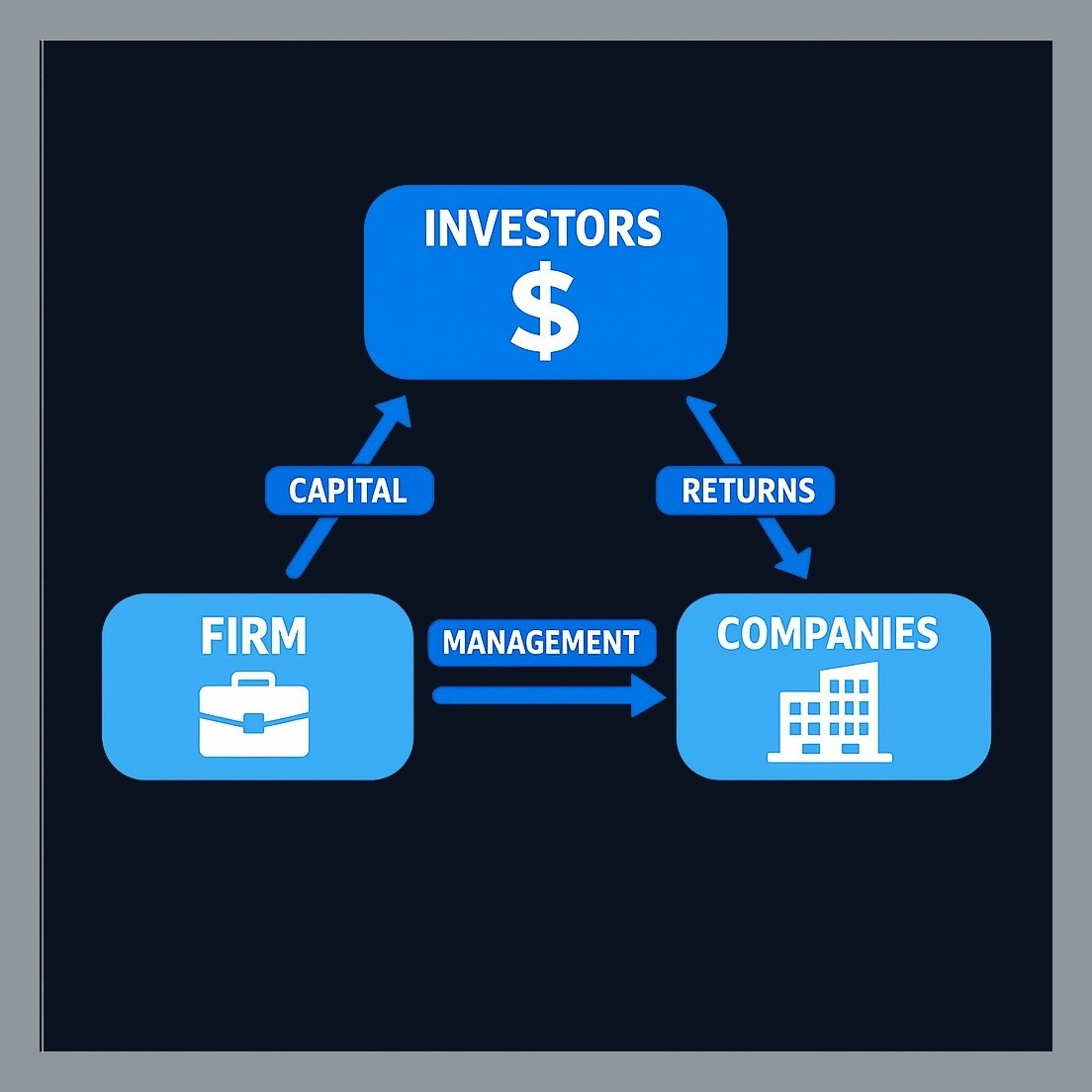
A private equity investment usually involves three groups:
- Investors provide capital to a fund.
- The private equity firm acts as the adviser, selecting and managing investments.
- Portfolio companies receive the capital and become part of the fund’s holdings.
Investor.gov explains that the adviser pools investors’ money and makes investments on behalf of the fund. That structure separates the people supplying the money from the team making day-to-day investment decisions.
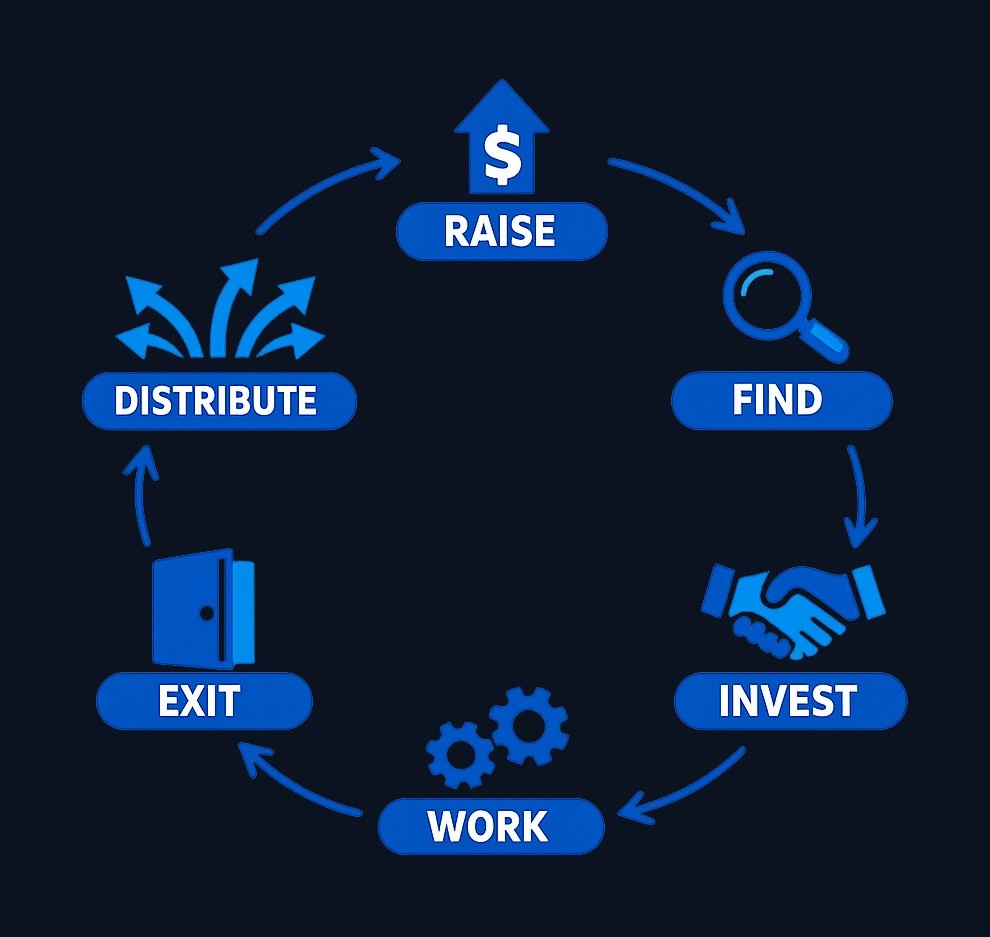
The process can be understood as a cycle:
- Raise capital. A private equity firm gathers commitments from investors.
- Find opportunities. The firm evaluates businesses based on their operations, finances, market position, management, and potential for change.
- Invest. The fund buys an ownership stake, which may be a minority position or control of the company.
- Work with the company. The owners may support operational changes, management decisions, expansion, or a revised financial structure.
- Exit the investment. Eventually, the fund seeks a buyer or another route for converting its ownership into cash.
- Distribute proceeds. After applicable costs and obligations, proceeds flow back through the fund structure.
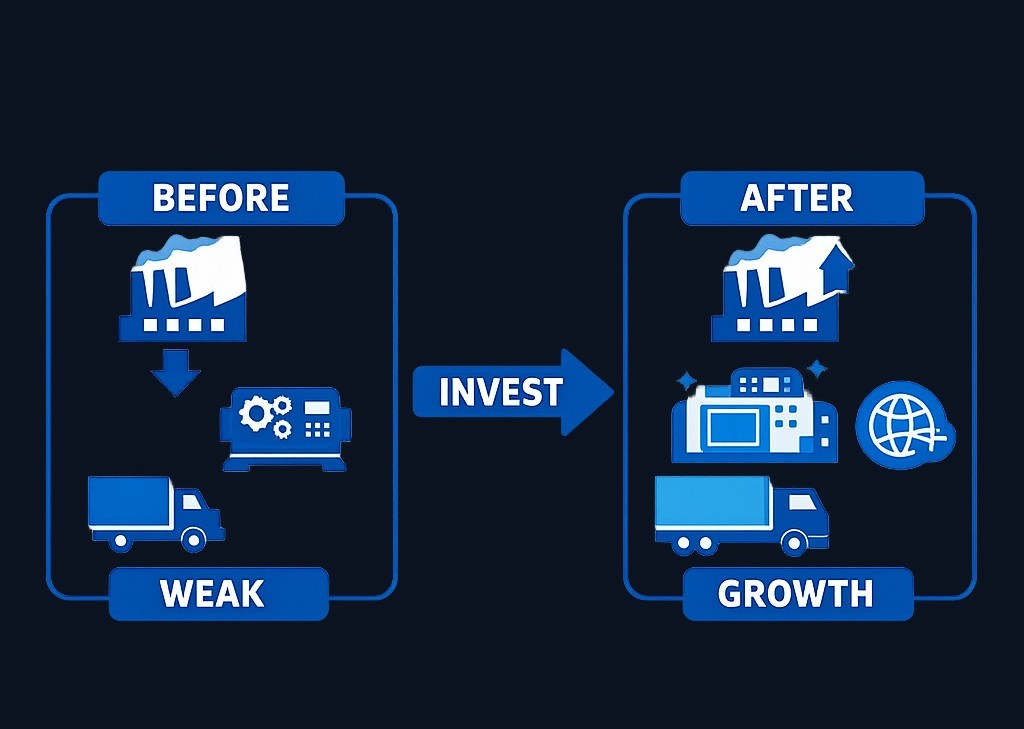
Consider a hypothetical manufacturer with reliable customers but outdated equipment and weak distribution. A private equity fund might invest capital, recruit additional management expertise, modernize operations, and help the company enter new markets. The plan succeeds only if those changes create enough value to outweigh the investment’s costs and risks. There is no guaranteed result.
This active-ownership model is one distinction between private equity and simply purchasing a small holding in a listed company. The private equity owner may have substantial influence, but that influence also creates responsibility: poor strategic choices, excessive financial pressure, or unrealistic growth assumptions can damage the business.
Types of Private Equity Investments
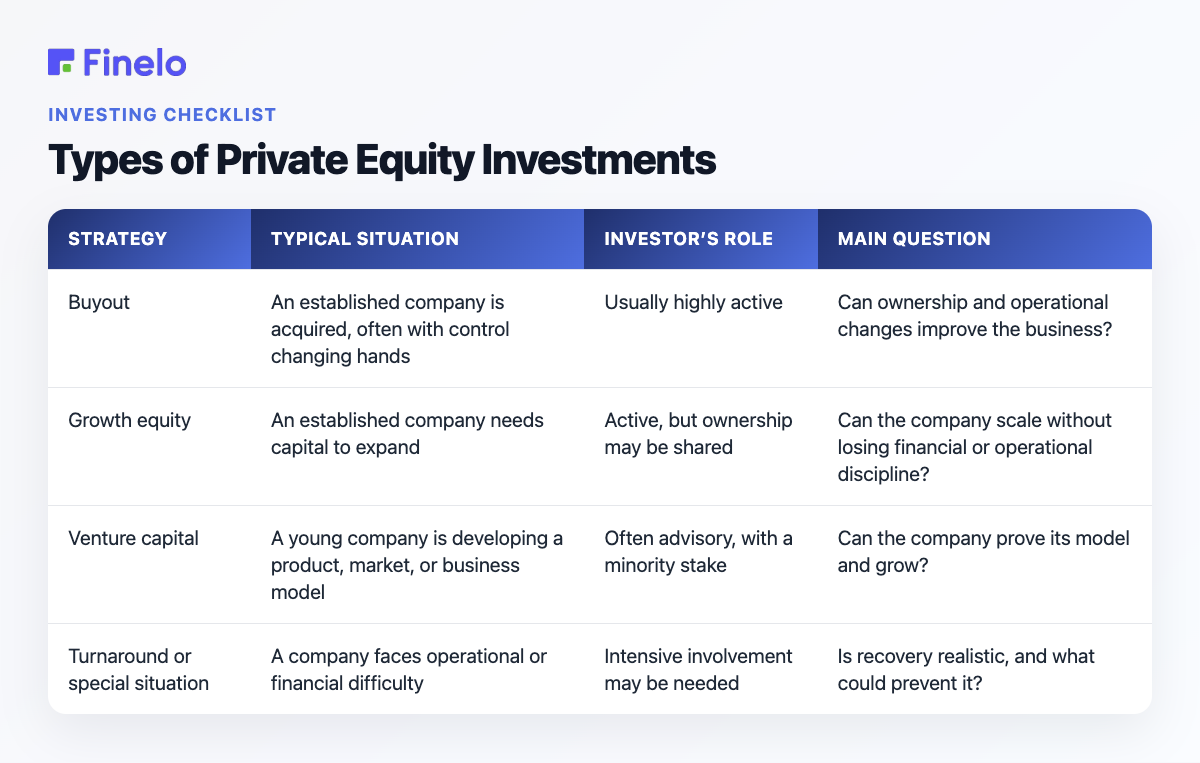
“Private equity” is an umbrella term rather than one uniform strategy. The appropriate category depends on the company’s stage, the size of the ownership stake, and what the capital is intended to accomplish.
| Strategy | Typical situation | Investor’s role | Main question |
|---|---|---|---|
| Buyout | An established company is acquired, often with control changing hands | Usually highly active | Can ownership and operational changes improve the business? |
| Growth equity | An established company needs capital to expand | Active, but ownership may be shared | Can the company scale without losing financial or operational discipline? |
| Venture capital | A young company is developing a product, market, or business model | Often advisory, with a minority stake | Can the company prove its model and grow? |
| Turnaround or special situation | A company faces operational or financial difficulty | Intensive involvement may be needed | Is recovery realistic, and what could prevent it? |
Private equity vs. venture capital
Venture capital is commonly treated as part of the broader private-market landscape, but the terms are not interchangeable in everyday use.
A traditional private equity buyout generally focuses on an established business and may involve acquiring control. Venture capital generally focuses on younger companies where uncertainty is higher and the business may still be proving its product or market. Growth equity sits between those patterns: the company is more developed than an early-stage startup but still needs capital to expand.
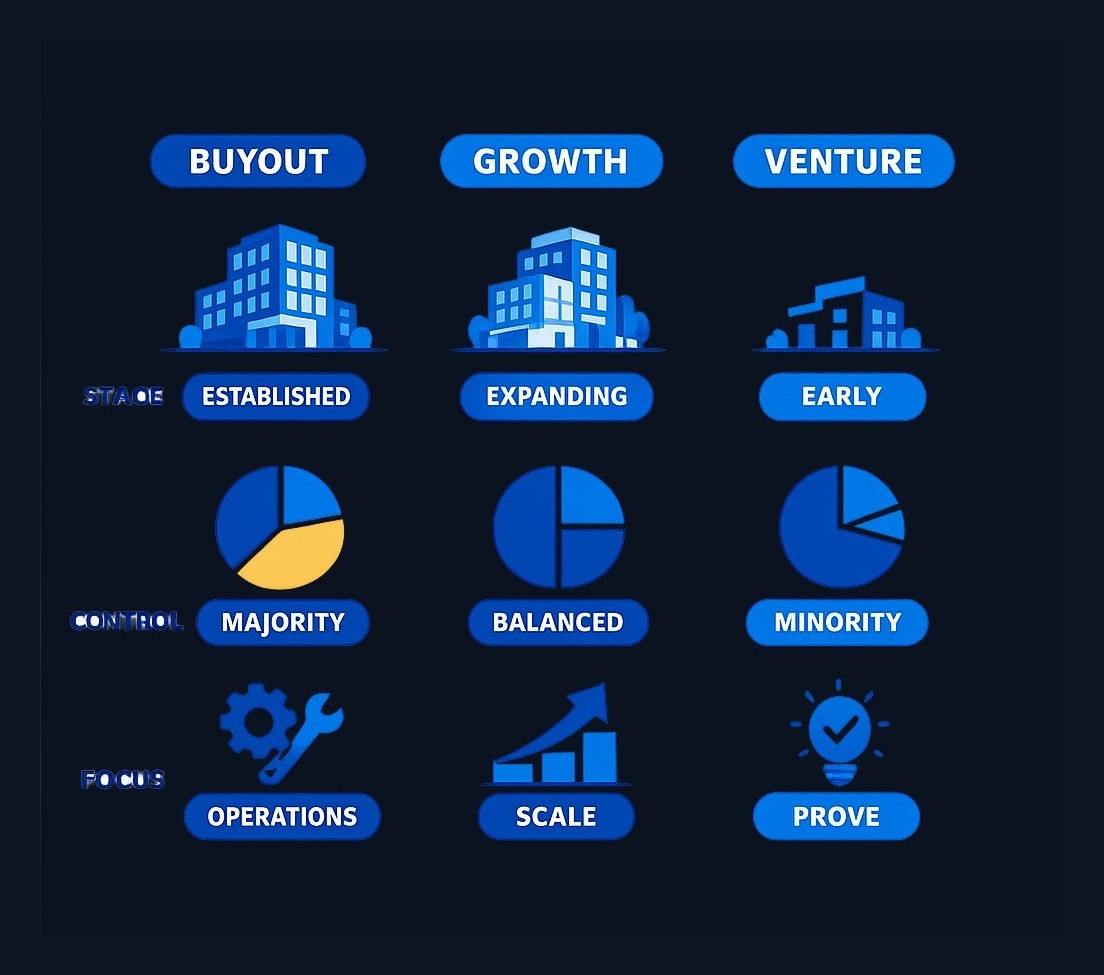
The practical distinction is not simply “large company versus small company.” Ask:
- Is the company already established or still proving its model?
- Is the investor buying control or a minority stake?
- Will value depend mainly on improving current operations or creating a new market?
- How much additional capital may be required?
- What events could make an eventual exit possible—or prevent one?
These questions reveal more than the strategy label alone.
How Private Equity Investments Are Evaluated
No single metric can capture a private equity investment. A useful review separates business performance, cash movement, time, and risk.
Business-level measures
Start with the company itself:
- Is revenue becoming more or less dependable?
- Are operating costs sustainable?
- Is the company generating cash, or does it regularly require new funding?
- Has debt increased the company’s vulnerability?
- Does growth come from repeatable operations or one-off events?
- Is the business overly dependent on one customer, supplier, product, or executive?
These questions help distinguish durable progress from a short-term improvement in presentation.
Fund-level measures
At the fund level, investors may compare the money contributed, the money already returned, the estimated value of investments still held, and the time elapsed. Rather than relying on one summary number, examine how the result was produced.
For example, two funds could appear to have created similar total value, yet one may already have returned much of it in cash while the other relies mainly on estimates for companies that have not been sold. That difference matters because an unsold holding does not have the same certainty as cash received.
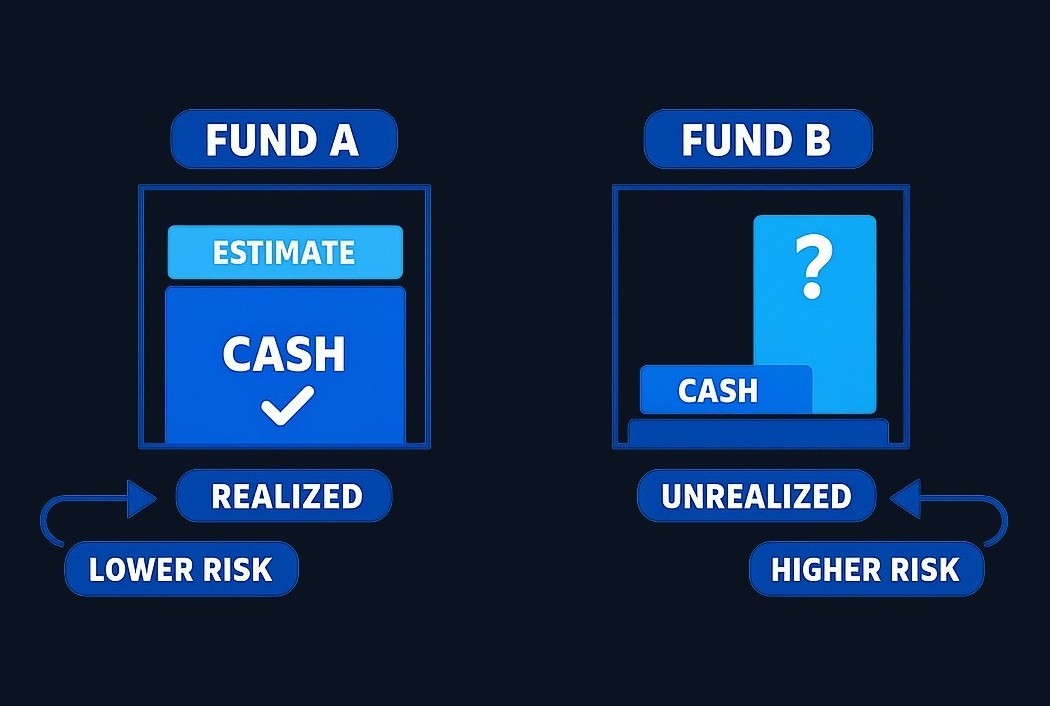
Time also changes interpretation. Receiving proceeds sooner is economically different from waiting much longer for the same amount. However, a time-sensitive return measure should be reviewed alongside absolute value creation, assumptions used to value remaining holdings, fees, and the amount of risk taken.
A practical due-diligence checklist
Before treating a performance figure as meaningful, ask:
- Does it describe the portfolio company, the fund, or the investor’s result?
- Is it based on cash already received or an estimated value?
- Is it shown before or after costs?
- What time period does it cover?
- What assumptions affect the calculation?
- Is the comparison being made against a relevant alternative?
- Did borrowing amplify the apparent result and the downside risk?
The goal is not to find the most impressive number. It is to understand what the number measures and what it leaves out.
Practice investing with Finelo
Build practical investing skills with guided lessons, simulator practice, and structured challenges.
Risks and Important Considerations
Private equity can expose investors to risks that are easy to underestimate when attention is focused on a transformation story.
Limited liquidity. An ownership interest in a private company or fund may be difficult to sell when an investor wants cash. A planned exit can be delayed or may occur under unfavorable conditions.
Valuation uncertainty. Public shares have observable market prices. Private holdings require estimates until a transaction provides stronger evidence of value. Different assumptions can produce different valuations.
Business risk. A portfolio company can lose customers, face stronger competition, encounter operational problems, or fail to execute its plan.
Debt risk. Borrowing can increase the capital available for an acquisition, but repayment obligations can also reduce flexibility. If the business weakens, debt may magnify the damage.
Concentration. A fund or investor may depend heavily on a relatively small set of companies, industries, managers, or exit conditions.
Manager and incentive risk. Investors rely on the private equity firm’s judgment, governance, valuation practices, and alignment with the fund.
Fee and cost risk. Management, transaction, financing, advisory, and performance-related costs can affect what ultimately reaches investors. The relevant documents should be reviewed as a whole rather than focusing on one advertised fee.
Exit risk. A business improvement does not automatically produce an attractive sale. The pool of potential buyers, financing conditions, and company-specific issues can all influence an exit.
There is also a regulatory and disclosure consideration. Private-market investments do not offer the same kind of continuous public information that readers may associate with listed shares. That makes careful review of offering materials, agreements, financial information, conflicts, valuation methods, withdrawal restrictions, and investor eligibility especially important.
For an individual, the key decision is not whether private equity sounds promising in general. It is whether a specific investment’s structure, access restrictions, costs, uncertainty, and lack of liquidity fit that person’s objectives and capacity for loss. This article is educational and does not replace personalized financial, legal, or tax advice.
A Hypothetical Private Equity Case Study
Because outcomes vary and the available evidence here does not support claims about named firms or deals, a hypothetical example is more useful than a selective “success story.”
Imagine a regional software business with recurring customers but slow sales processes and an aging product. A growth-equity investor buys a minority stake and provides expansion capital. The company uses the money to update the product, strengthen customer support, and build a more disciplined sales operation.
Three scenarios could follow:
- Strong outcome: Customer retention improves, sales become more efficient, and a buyer later values the company more highly.
- Mixed outcome: Revenue grows, but costs rise just as quickly, leaving little additional value after expenses.
- Weak outcome: The product update fails, competitors advance, and the company needs more capital than expected.
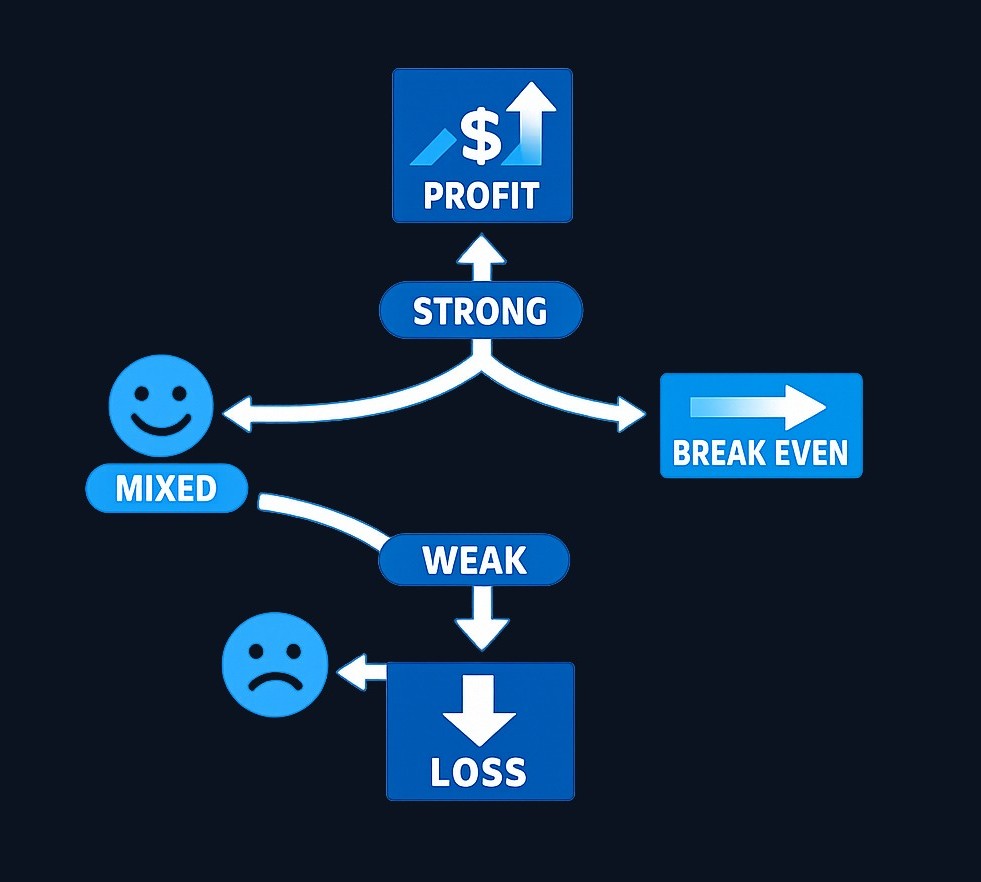
The lesson is that the strategy label does not determine the outcome. Execution, entry price, financing, governance, time, costs, and the eventual exit all matter.
Is Private Equity Relevant to You?
Use your objective to decide the next step:
| If you want to… | A sensible next step |
|---|---|
| Understand the concept | Learn the difference between a fund, its adviser, and its portfolio companies |
| Compare private equity with public investing | Focus on liquidity, disclosure, valuation, control, and access |
| Review a specific opportunity | Read the offering and governing documents and identify every cost, restriction, conflict, and valuation assumption |
| Assess a fund’s record | Separate realized cash from estimated remaining value and examine the time period |
| Build general investing knowledge | Study risk, diversification, financial statements, and return measurement before evaluating complex private investments |
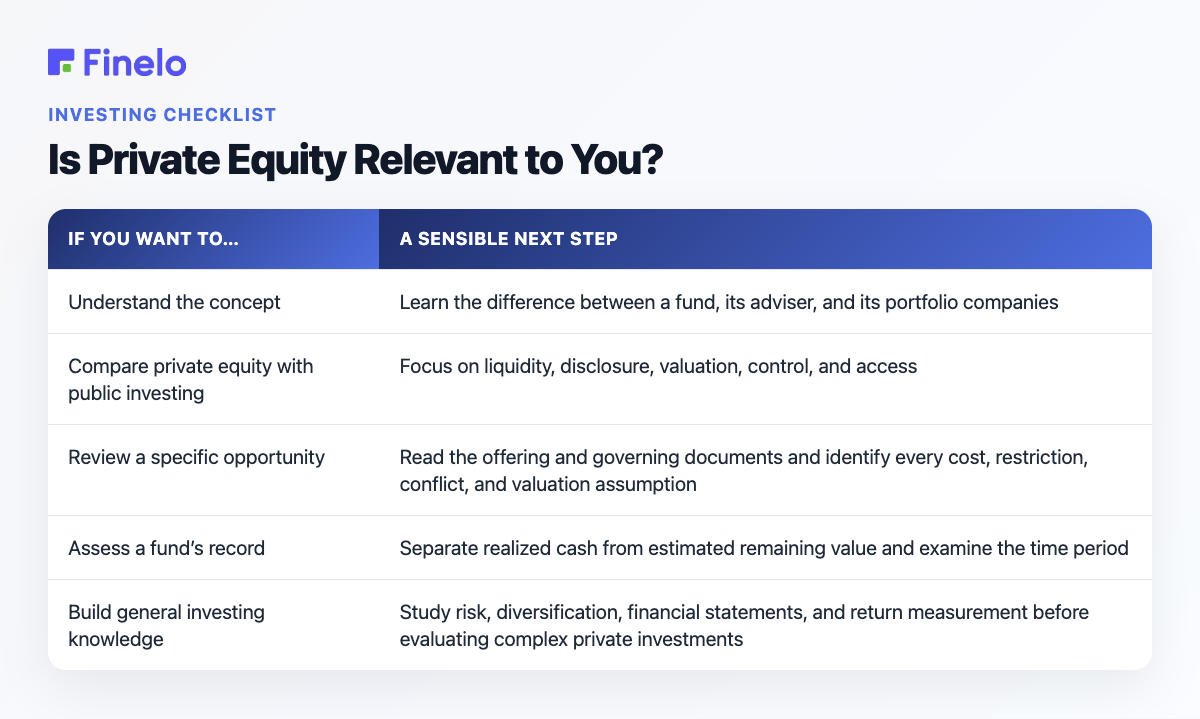
Finelo is an investment-learning resource for readers building foundational knowledge. A useful next step is to continue learning how risk, company analysis, and investment structures interact before considering any specific opportunity.
Frequently asked questions
What is the best simple definition of private equity?
Private equity is ownership capital invested in companies that are not publicly traded, often through a pooled fund managed by a private equity firm. The investor’s return depends on what happens to the underlying businesses and how the ownership interests are eventually sold or otherwise realized.
How do private equity firms choose companies?
The exact process varies, but a sound review considers the company’s finances, competitive position, management, risks, capital needs, potential improvements, purchase terms, and possible exit paths. The important question is not only whether the company can grow, but whether the investment terms leave enough room for uncertainty.
Can individuals invest in private equity?
Access depends on the specific vehicle, its rules, and applicable requirements. Before pursuing an opportunity, an individual should verify eligibility, minimum commitments, withdrawal restrictions, costs, disclosures, and the possibility of losing capital.
How do private equity returns compare with public markets?
The comparison is not straightforward because the investments differ in liquidity, valuation frequency, costs, timing, leverage, and available information. A fair comparison should use a relevant period, account for cash-flow timing and costs, and recognize that estimates for unsold private holdings are not the same as observable public-market prices.
InvestingBeginnerPrivate MarketsMarkets
Practice investing with Finelo
Build practical investing skills with guided lessons, simulator practice, and structured challenges.
About the author
Finelo Team
The Finelo Team creates practical investing and trading education designed to help beginners learn faster with structured challenges, simulator practice, and bite-sized lessons.
Keep reading — Related articles

Investing
I Bonds vs EE Bonds in 2026: Rates, Rules, and Which to Buy for the Long Run
Series I and Series EE savings bonds are both U.S. Treasury retail savings bonds sold on TreasuryDirect. They share ownership, tax treatment, and redemption rules; the key difference is the…
Finelo Team
Investing
Coverdell ESA vs 529 Plan: Limits, Flexibility, and Which to Choose
Quick answer (one minute) Both a Coverdell Education Savings Account (Coverdell ESA) and a 529 plan let money grow tax‑free and be withdrawn tax‑free for qualified education expenses. The…
Finelo Team
Investing
CD vs High Yield Savings Account: Where to Park Your Cash in 2026
Hero answer — CD vs high yield savings account in one line A CD (certificate of deposit) and a high yield savings account are both low‑risk, federally insured homes for cash — the difference…
Finelo Team