The scale of the AI build-out got hard to ignore this week. In the space of a few days, Google posted record capital spending that pushed its cash flow negative, and chipmaker AMD agreed to pour up to $5 billion into AI company Anthropic. Two very different moves, one very clear message: the money going into AI infrastructure is now measured in the hundreds of billions — and it is still climbing.
The AI Spending Boom Just Hit New Records: Inside Big Tech's ~$700 Billion Bet
Google posted record capital spending that pushed its cash flow negative, and AMD agreed to invest up to $5 billion in Anthropic. Here's what's behind the roughly $700 billion AI infrastructure spending wave of 2026.
9 min read
Practice trading with Finelo
Practice in a simulator, learn with bite-sized lessons, and build confidence before risking real money.
Want to learn more?
Practice in a simulator, learn with bite-sized lessons, and build confidence before risking real money.
Explore FineloExplore Finelo's 28-day challenges
Turn learning into a daily habit with guided challenge paths.
Put the pieces together and a trend snaps into focus. Across the largest tech companies, 2026 spending on AI infrastructure — the data centers, chips, and power behind every chatbot and cloud service — is running toward an estimated $700 billion for the year, sharply higher than 2025, according to widely cited industry estimates. This is the story behind a lot of the market's biggest moves right now, so it is worth understanding what is actually being spent, why, and what to watch.
This article is for information and education only and is not financial advice. Nothing here is a recommendation to buy, sell, or hold any security. Company figures are drawn from recent reports and estimates and may be revised.
The boom, by the numbers
Three recent data points capture the pace:
- ~$700 billion: the estimated total 2026 AI-infrastructure spending across the big "hyperscalers" — companies like Google, Microsoft, Amazon, and Meta — a sharp jump from the prior year, per industry estimates.
- ~$44.9 billion: Google's capital spending in a single quarter (Q2 2026), roughly double a year earlier. It was enough to flip the company's free cash flow negative for the first time in about a decade, and it lifted full-year spending guidance to roughly $195–205 billion.
- Up to $5 billion: what AMD agreed to invest in AI company Anthropic, alongside a deal to supply it with tens of billions of dollars of AI server chips.
- ~$35 billion: the largest private credit deal on record, arranged by investment firms to help finance Anthropic's computing expansion — a sign of how much of the build-out is now funded by debt.
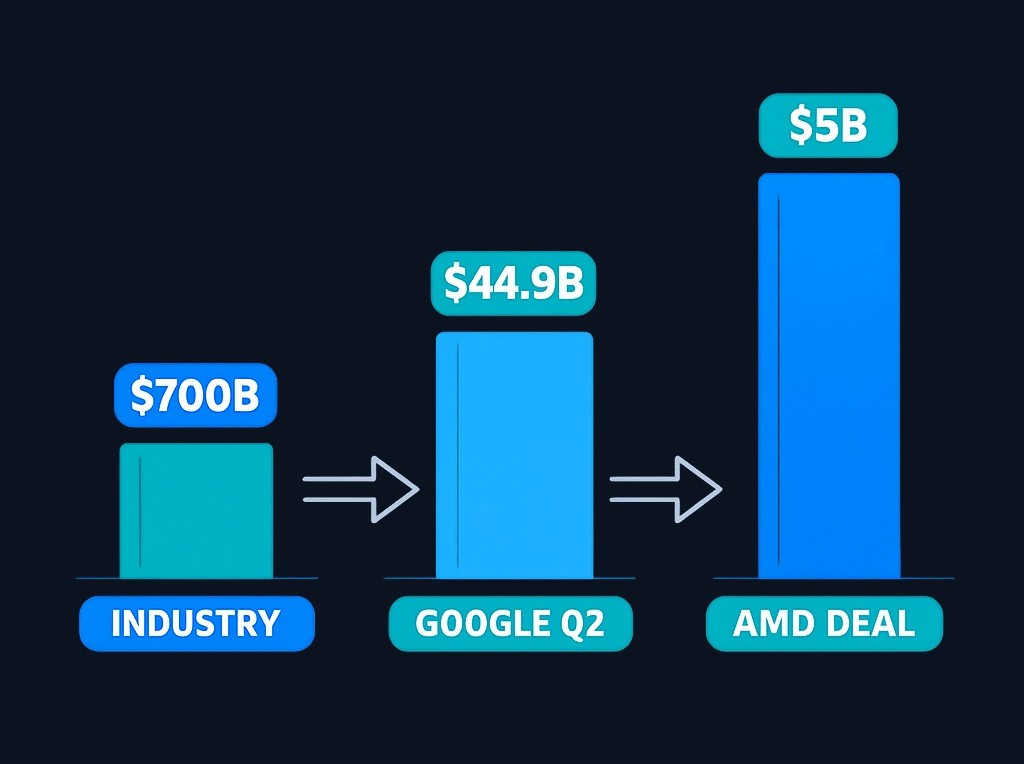
Different companies, different moves — but all pointing the same way: the companies building the most AI computing capacity now are positioning to serve fast-growing demand.
What everyone is actually buying
The spending goes into a few big buckets: data centers, the specialized chips that run AI models, and the electricity to power both. Demand is the reason. AI services are increasingly showing up as real revenue — Google's cloud business, for instance, grew about 82% year over year last quarter — and companies are racing to add enough capacity to serve it. In an arms race like this, spending less than a rival can look riskier than spending more, which is part of why the numbers keep climbing.
The circular twist: when a chipmaker invests in its customer
The AMD-Anthropic deal is a good window into a pattern that has become one of the defining features of this boom. AMD is not just selling chips to Anthropic; it is also investing in it. That combination — a supplier putting money into the very customer that will buy its products — is common enough in AI right now that analysts have a name for it: circular financing (or vendor financing). A leading chipmaker has made similar moves, taking stakes in the AI labs that are among its biggest buyers.
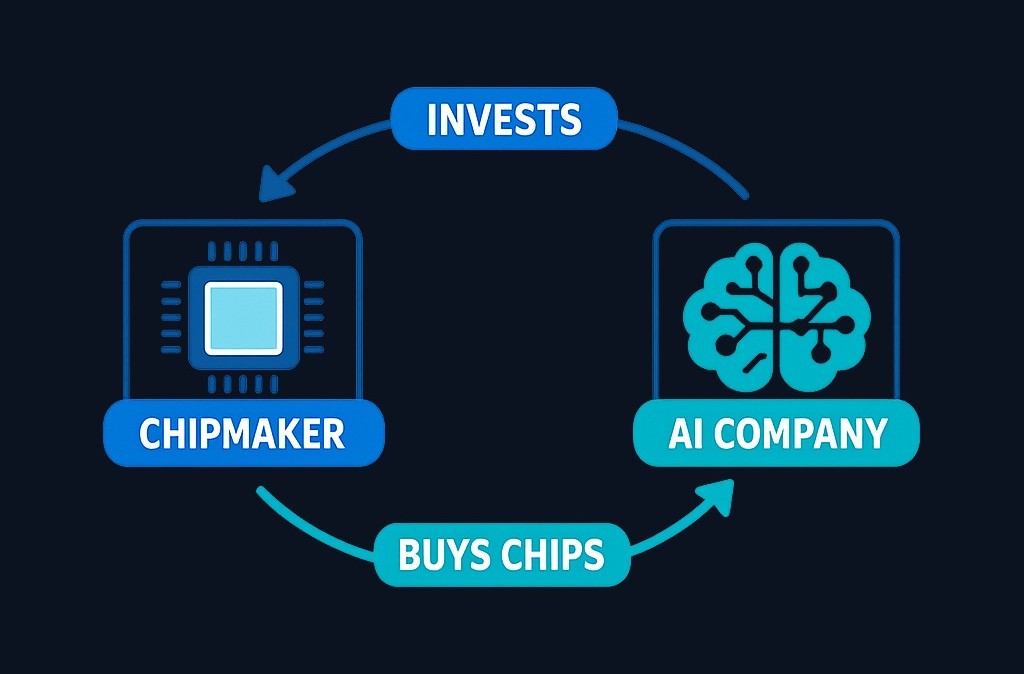
It reflects a broader pattern in the AI industry: partners increasingly investing in one another to build capacity together. The logic is that the investment helps the customer grow, and a bigger customer buys more chips — deepening the partnership on both sides. It is a useful concept to understand, because these kinds of tie-ups are becoming more common as companies line up the pieces they need to expand.
One practical note: Anthropic is a private company, so it is not something an everyday investor can buy shares in directly. The publicly traded names in this story are the chipmakers and cloud giants — but understanding the deal is about reading the trend, not acting on it. For the broader idea of investing in fast-growing private companies, see Finelo's explainer on venture capital.
The cost side: how "record growth" and "negative cash flow" share a quarter
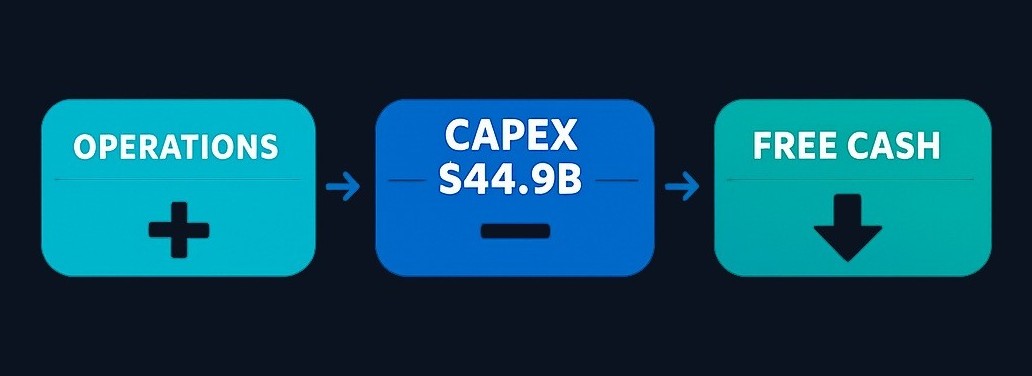
Here is the part that trips up a lot of newer investors. How can a company grow revenue strongly and still report negative free cash flow in the same quarter? Because free cash flow is roughly the cash a business generates from operations minus what it spends on long-term assets (capital expenditure). When a company chooses to spend more on building — as Google did with its record AI capex — than its operations throw off, free cash flow turns negative even as the business booms.
That negative number is not automatically a warning sign; for a highly profitable company it usually reflects a deliberate bet on future growth rather than distress. But it does mean less cash left over for buffers, buybacks, or dividends, and it puts the spotlight on one question: will the investment earn an adequate return? The market's reaction to Google's quarter — strong results, yet a dip in the shares — was investors weighing exactly that. For how this fits with other financial measures, see Finelo's guide to EBITDA.
Practice trading with Finelo
Practice in a simulator, learn with bite-sized lessons, and build confidence before risking real money.
How the boom is being financed
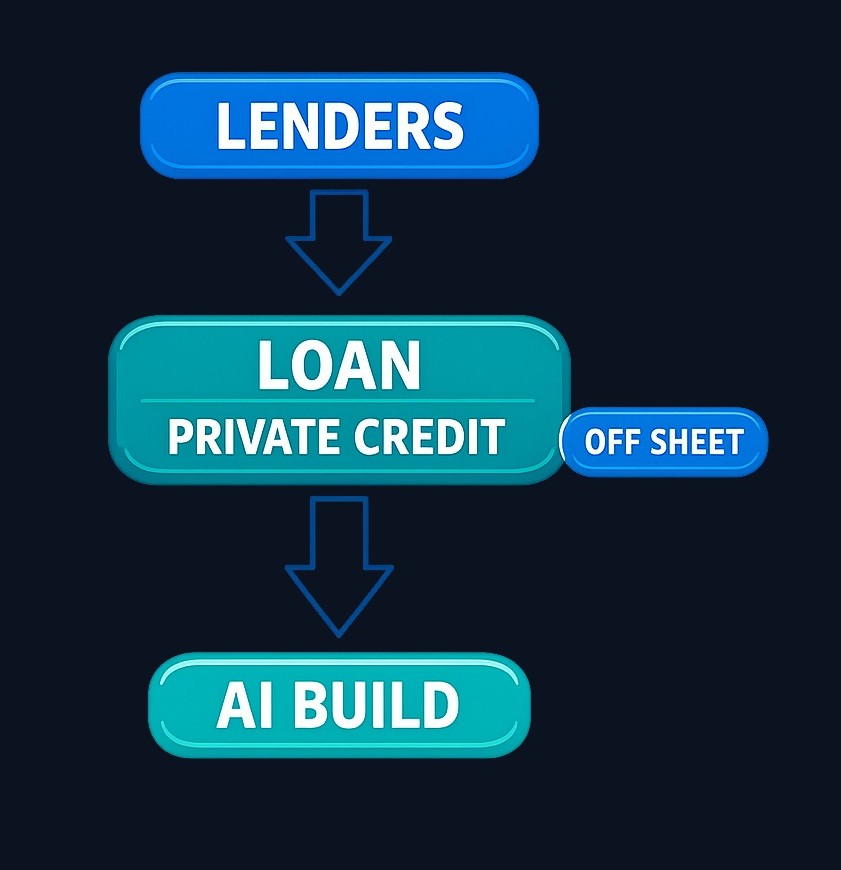
If companies are spending more cash than they generate, where is the rest of the money coming from? Increasingly, from debt — and specifically from private credit, one of the fastest-growing corners of finance. In mid-2026, a group led by major investment firms assembled a roughly $35 billion financing package — reported as the largest private credit deal ever — to fund a huge expansion of AI computing power for Anthropic, built on Broadcom chips. Much of it was structured "off balance sheet," meaning the debt sits in a separate financing vehicle rather than on a company's own books, and banks have since been buying and selling pieces of the package to a wide pool of investors.
Private credit means lending by non-bank institutions — large asset managers and private funds — rather than by traditional banks or public bond markets. It has grown fast in recent years, and the AI build-out has become one of its biggest new frontiers: the sums involved are so large that they are increasingly funded through private loans and off-balance-sheet structures rather than cash alone. It is a useful reminder that the AI story is not only about chips and data centers — it is also about how all of it is paid for, and who ends up holding the risk.
How the spending is being read
The scale of the investment naturally raises the question every big build-out does: how quickly will it pay off? The case for it is straightforward — demand for AI computing is real and growing, and the companies that build the most capacity are best placed to serve it, which is why so many are investing at once. The main thing to watch is execution and timing: investments this large take time to turn into returns, and part of what investors are weighing is how soon that growth shows up. That is normal for a build-out of this magnitude, and early signs like rapidly rising cloud demand are exactly the kind of evidence the spending is meant to capture.
What to watch next
For anyone following the trend, a few markers will shape it:
- Whether capex guidance keeps rising as more companies report, and how they justify the spending.
- Whether AI-driven revenue keeps growing — continued cloud growth is the clearest sign the investment is paying off.
- More chipmaker-customer deals, and whether the circular-financing pattern spreads or draws scrutiny.
- Physical limits like power and data-center capacity, which are becoming real constraints on how fast the build-out can go.
Why it matters for everyday investors
You do not have to trade any of this to benefit from understanding it. The AI-spending wave is moving markets, reshaping how the biggest companies report their numbers, and turning once-obscure concepts — capital expenditure, free cash flow, vendor financing — into the language of the moment. Learning to read those ideas, and to ask why a company is spending rather than reacting to the number alone, is one of the most useful habits an investor can build.
If you are building that foundation, start with Finelo's guides to how the stock market works, AI trading for beginners, and common mistakes beginners make in investing. None of this is a view on any specific company or its shares — it is a way to read the news more clearly.
Finelo is an educational product, not a brokerage. This article is for education and information only and is not financial advice. Figures are based on recent reports and industry estimates as of late July 2026 and may be revised; verify current numbers before drawing any conclusions.
Sources: company earnings reports and coverage from Bloomberg, CNBC, Reuters, Yahoo Finance, Fortune, and industry capex estimates.
Frequently asked questions
Why is Big Tech spending so much on AI?
Because demand for AI computing is growing fast and companies are racing to build the data centers and chips to serve it. AI services are increasingly generating real revenue, and in a competitive race, building more capacity than rivals is seen as a way to capture that demand — which is pushing total industry spending toward an estimated $700 billion in 2026.
What is "circular financing" in AI?
It is when a supplier invests in its own customer — for example, a chipmaker taking a stake in an AI company that also buys its chips, as in the AMD-Anthropic deal. Supporters see it as securing demand and strengthening partnerships; critics warn that money circulating between suppliers and customers can make demand and valuations look stronger than they really are.
Why did Google's free cash flow turn negative?
Because its capital spending — a record roughly $44.9 billion in the quarter, mostly on AI infrastructure — exceeded the cash its operations generated. The negative figure reflects a deliberate surge in investment, not a decline in the underlying business, which grew revenue about 24%.
How is the AI build-out being financed?
Increasingly through debt, not just company cash. Because the sums are so large, companies are turning to private credit — lending by non-bank firms such as large asset managers — and to off-balance-sheet structures. A roughly $35 billion private credit package to fund Anthropic's compute expansion, reported as the largest ever, is a prominent example.
Can I invest in Anthropic?
No. Anthropic is a private company, so its shares are not available to everyday investors on the public market. The publicly traded companies connected to this story are the chipmakers and cloud providers — but this article is about understanding the trend, not a suggestion to invest in anything.
AIBig TechMarket BasicsBeginner
Practice trading with Finelo
Practice in a simulator, learn with bite-sized lessons, and build confidence before risking real money.
About the author
Finelo Team
The Finelo Team creates practical investing and trading education designed to help beginners learn faster with structured challenges, simulator practice, and bite-sized lessons.
Keep reading — Related articles

News
The September Effect Explained: What the Stock Market Data Really Says
September has delivered the S&P 500's weakest average monthly return since 1928, but the result is not a reliable trading signal. Here is how to read the seasonality data.
Finelo Team
News
Nvidia–Hugging Face Deal: What the $12.9 Billion Agreement Changes
Nvidia agreed to acquire Hugging Face for $12.93 billion while promising to keep the platform open. Here is what the price, developer reach, and neutrality pledge mean.
Finelo Team
News
Lululemon Stock Falls to 2018 Levels After Its Q2 Earnings Report
Lululemon shares fell below $100 after revenue declined, comparable sales dropped, and management cut its outlook. The report offers a practical lesson about brand moats and falling knives.
Finelo Team