Last editorial review: September 28, 2026
American Opportunity Tax Credit vs. Lifetime Learning Credit
Compare education-credit amounts, eligible study, income limits, and expenses so you can identify the credit your household may claim.
11 min read
Practice trading with Finelo
Practice in a simulator, learn with bite-sized lessons, and build confidence before risking real money.
Want to learn more?
Practice in a simulator, learn with bite-sized lessons, and build confidence before risking real money.
Explore FineloExplore Finelo's 28-day challenges
Turn learning into a daily habit with guided challenge paths.
The American Opportunity Tax Credit, or AOTC, can offer a larger benefit for eligible students in their first four years of higher education. The Lifetime Learning Credit, or LLC, covers a wider range of study, including graduate education and qualifying job-skill courses.
Start with eligibility, then compare the tax benefit. A larger advertised maximum does not help if the student or expenses do not qualify.
Compare the credits
| Feature | AOTC | LLC |
|---|---|---|
| Maximum credit | $2,500 per eligible student | $2,000 per tax return |
| Calculation | All of the first $2,000 of qualified expenses, plus 25% of the next $2,000 | 20% of up to $10,000 of qualified expenses |
| Refundability | Up to 40% may be refundable; restrictions apply | Nonrefundable |
| Years available | Limited to four tax years per student | No lifetime limit |
| Study requirements | Generally at least half-time toward a degree or recognized credential | Can include a single qualifying course |
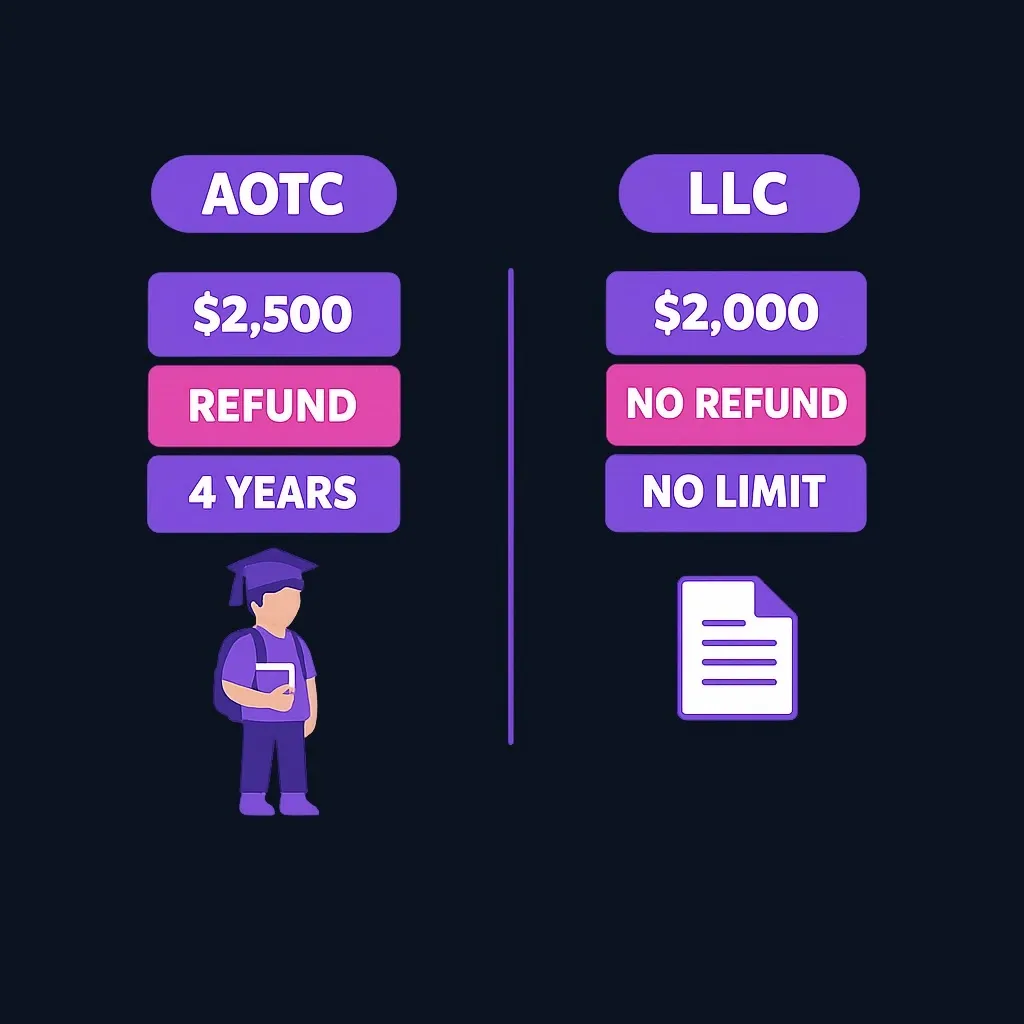
These distinctions come from the IRS education-credit comparison. For 2026 claims, it also flags new work-valid Social Security number requirements. Use the instructions for the tax year you are filing; do not copy identification requirements from an older return.
Check income and filing status first
Under the IRS’s published 2025 Form 8863 instructions, both credits phase out as modified adjusted gross income rises from $80,000 to $90,000 for eligible nonjoint filers, or from $160,000 to $180,000 for married couples filing jointly. At the upper threshold, the credit is unavailable. Married filing separately does not qualify. A student claimed as someone else’s dependent cannot also claim the credit personally.

The Form 8863 instructions also distinguish course materials: AOTC can include required books and supplies bought elsewhere; LLC includes those costs only when payment to the institution is required for enrollment or attendance. Keep receipts instead of assuming every bookstore purchase qualifies.
Those instructions cover 2025 returns. For 2026 expenses, use the applicable year’s instructions and the IRS’s updated identification guidance linked above. A 2025 filing rule should not be presented as confirmation of a 2026 identification requirement.
The expense total needs a second look
Your tuition bill is not automatically your credit calculation. Tax-free scholarships, employer assistance, and expenses used for another tax benefit can change the eligible amount. Room and board and ordinary transportation costs do not become eligible tuition expenses simply because attending college requires them.
For example, a hypothetical student with $4,000 of fully qualifying, unallocated expenses could generate the maximum AOTC before income and other restrictions. If the expenses support only an LLC claim, the same $4,000 produces an $800 credit before limitations. A nonrefundable credit cannot exceed the tax it is allowed to offset.
Can a family claim both?
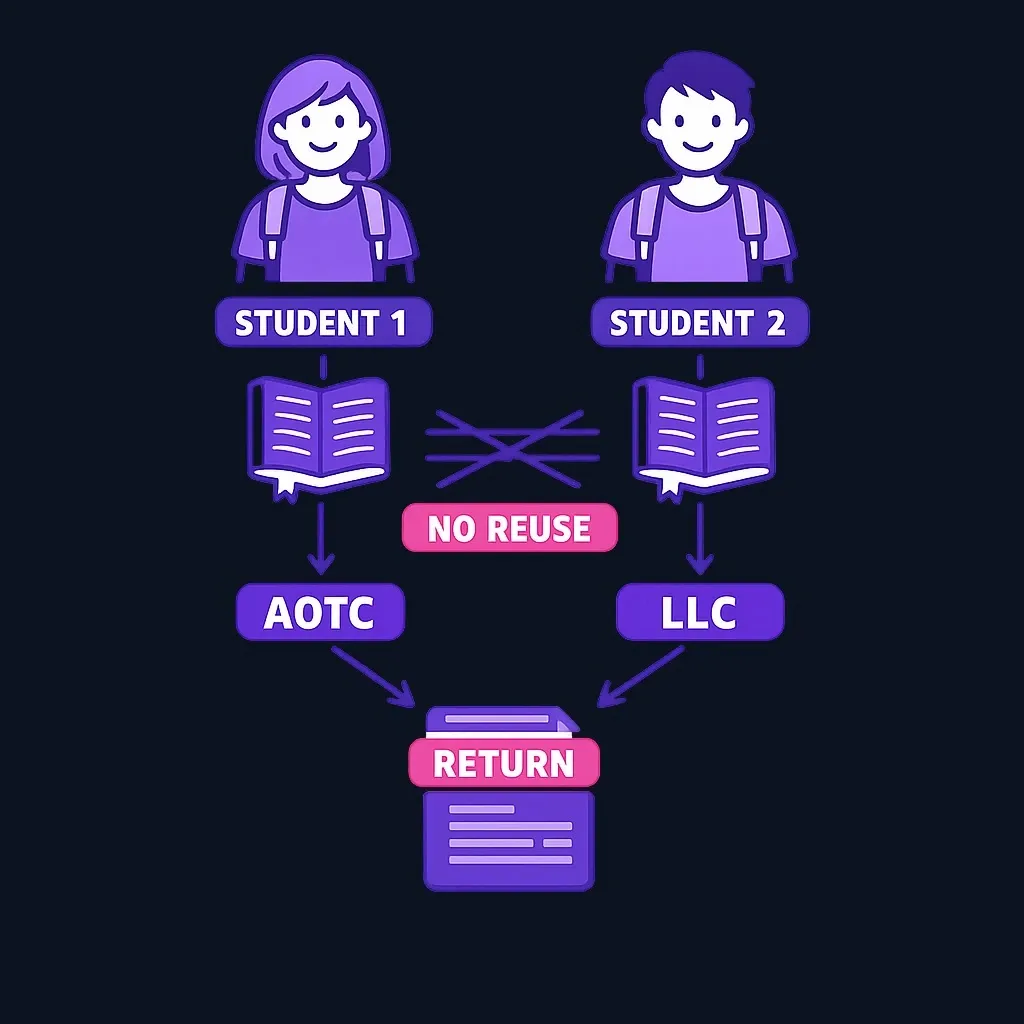
A return may include both credits for different eligible students. It cannot claim both for the same student in the same year or reuse the same expenses for multiple benefits. See IRS Publication 970 for expense allocation and eligibility details.
Gather Form 1098-T, receipts, scholarship records, and information about who claims the student as a dependent. Then complete Form 8863 using the relevant year's instructions. This makes the comparison about the credit you can actually claim, rather than the largest headline amount.
Build an expense ledger before comparing credits
Make one record for each student. List the date a bill was paid, the academic period it covers, the type of expense, who paid it, and whether any reimbursement or tax-free assistance applies. The bill for an academic year and the expenses eligible on one tax return are not necessarily the same total. A receipt can therefore matter as much as the tuition figure advertised by the school.
Form 1098-T is an important starting document, but it should be reconciled with payment records. Books purchased elsewhere, a later adjustment, or assistance applied to an account can require additional information. Do not assume the form alone proves every eligibility condition or captures every allowable expense.
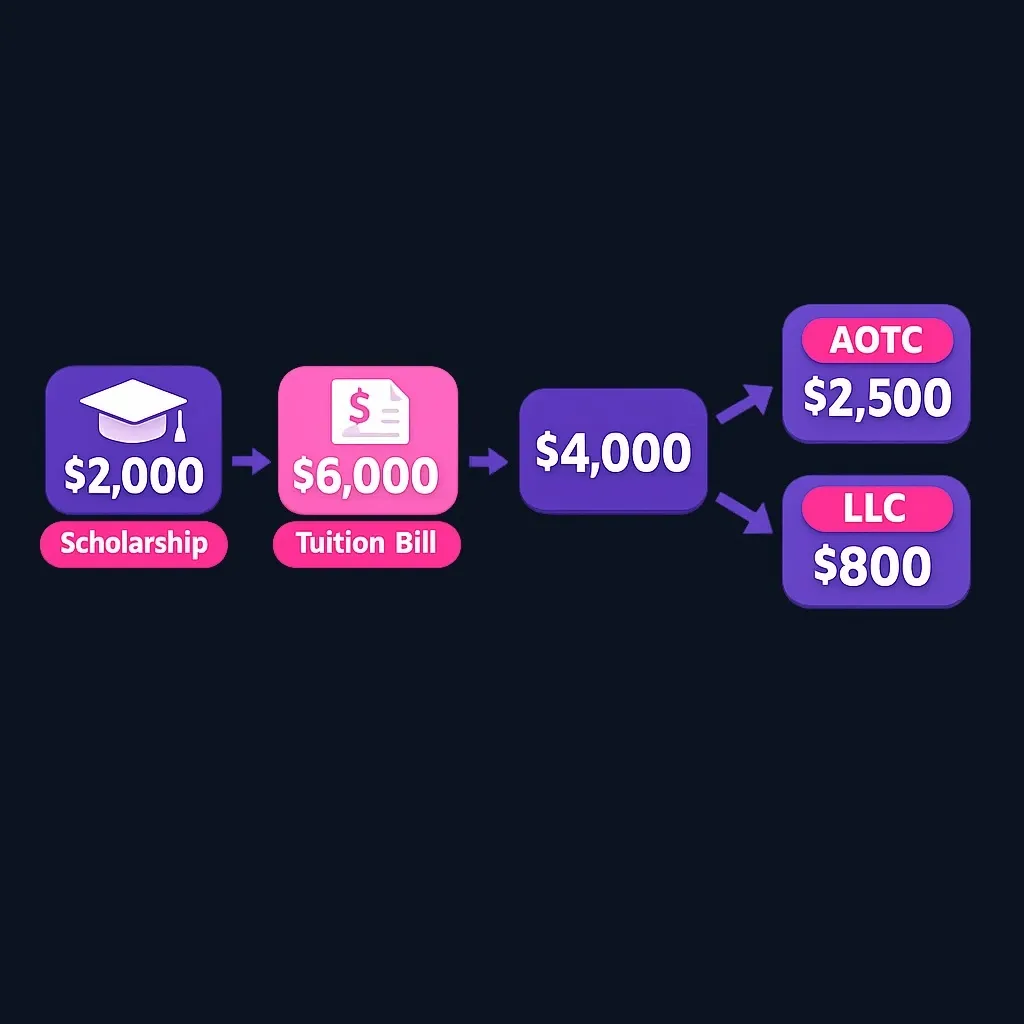
Consider a hypothetical student with $6,000 of otherwise eligible tuition and $2,000 of tax-free assistance allocated to that tuition. That leaves $4,000 for this simplified comparison. Before income restrictions and other eligibility rules, the AOTC formula can reach $2,500, while the LLC formula on those same $4,000 of expenses gives $800. That does not mean every student can choose the AOTC: student status, prior claims, and the other tests still apply.
In a household with two students, make separate expense calculations before combining the return. One student may qualify for AOTC while another's eligible graduate coursework supports LLC. The per-student AOTC calculation and per-return LLC cap make it important to keep their records separate. Neither student’s costs should be counted twice.
Finally, distinguish a tax credit from an immediate tuition discount. The school still expects payment under its billing arrangement. Form 1098-T is generally required, but IRS exceptions and procedures for a missing form exist; absence of the form alone does not settle eligibility. An eventual tax benefit does not necessarily arrive in time to cover the current bill. Use the likely after-tax result for planning without treating it as cash already in the bank.
Practice trading with Finelo
Practice in a simulator, learn with bite-sized lessons, and build confidence before risking real money.
What is the American Opportunity Credit?
The American Opportunity Credit (AOTC) is a federal tax credit designed to reduce the cost of undergraduate postsecondary education for eligible students. It is calculated on qualified tuition and related expenses paid for an eligible student and is administered under the IRS rules for education credits. For authoritative details including dollar limits, refundability, and eligibility criteria, see the IRS education credits page. Key elements you should confirm on the IRS page before claiming:
-
Which expenses count as qualified tuition and related expenses.
-
Enrollment and student-status requirements tied to eligibility.
-
How much of the credit is refundable versus a nonrefundable reduction in tax.
-
Any limits on how many tax years the AOTC can be claimed for a specific student. All of the above are explained by the IRS.
Practical note (what to gather): keep tuition invoices, receipts, and your school’s Form 1098-T (if issued) ready when you prepare the return. The IRS guidance lists required documentation and the tax form used to claim education credits; review that list before filing.
What is the Lifetime Learning Credit?
The Lifetime Learning Credit (LLC) is a federal tax credit that applies more broadly to undergraduate, graduate, and professional courses that help acquire or improve job skills. Unlike credits tied to specific degree-year limits, the LLC is intended to support continuing education and can apply to one or more courses in a year, including many part-time enrollments. For official rules, qualifying expenses, and limitations, consult the IRS education credits page. Practical note (who it helps): the LLC is often useful for adult learners taking certificate programs, graduate students, or working adults taking job-skill classes; verify the exact scope of “qualified expenses” and any per-return restrictions on the IRS page.
How to compare your options
1. Program and student status
- If the student is in early undergraduate years and meets the AOTC’s student-status tests, AOTC often yields the greater benefit. If the student is pursuing graduate coursework or non-degree classes, LLC may be the applicable option. Confirm the program and enrollment rules on the IRS page.
2. Refundability and tax liability
- If part of the credit can be refundable, that matters when the taxpayer has little or no tax liability. If you expect little tax liability, a partially refundable credit can provide cash back; the IRS page explains refund rules and thresholds.
3. Number of students and per-return limits
- When you have more than one student in a household, check whether credits are assessed per student or per return. The IRS specifies whether the credit is claimed per student or limited per tax return.
4. Qualified expenses and scholarship interactions
- Scholarships, employer tuition assistance, and tax-free portions of financial aid can reduce the amount of qualified expenses. The IRS provides guidance on how to treat scholarships and how they affect the amount you can claim.
5. Income phaseouts and filing status
- Both credits are subject to income limits and phaseouts. If your modified adjusted gross income puts you near the thresholds, compute expected phaseout effects before picking a credit. See the IRS for current phaseout ranges and examples.
Decision checklist (quick use):
- Confirm the student’s program level and enrollment status.
- Add up qualified tuition and related expenses net of tax-free assistance.
- Check whether the AOTC or LLC rules produce a larger net tax benefit for the taxpayer’s income level.
- Ensure you have Form 1098-T and receipts before preparing the return and follow the IRS instructions to complete the education-credit form.
When to choose each option
Scenario A — Traditional undergraduate student, multiple eligible expenses
- Typical fit: A student in the first years of a degree program who has substantial qualifying tuition and related expenses and meets the AOTC’s enrollment rules will often receive a larger benefit under the AOTC than under the LLC. Confirm AOTC eligibility details and how many tax years the student can claim the credit on the IRS page.
Scenario B — Graduate student or part-time course taker
- Typical fit: A graduate student or an adult taking occasional professional development courses may not meet AOTC enrollment rules or time limits. The LLC is designed to cover these situations. Because LLC rules differ on enrollment and duration, consult the IRS summary to confirm applicability.
Scenario C — Household with multiple students
- Typical fit: If more than one household member is an eligible undergraduate, AOTC benefits are calculated per eligible student (subject to AOTC rules). If the family’s situation mixes program types, compute both credits carefully and pick the best combination consistent with IRS restrictions (for example, only one credit per student per year). The IRS explains restrictions on claiming both credits for the same student in the same year.
Tradeoffs and caveats
Claiming education credits reduces tax liability but interacts with other tax rules and financial-aid calculations. Below are common pitfalls and how to avoid them, followed by important verification steps.
Common mistakes and how to avoid them
- Double-counting expenses: Do not claim the same qualified expense for more than one tax benefit (for example, Claiming an expense as both a credit and a tax-free scholarship). The IRS describes how scholarships affect qualified expenses.
- Claiming both credits for the same student in one year: IRS rules prohibit claiming both the AOTC and LLC for the same student in the same tax year. Confirm this prohibition on the IRS page before choosing.
- Missing documentation: Schools commonly issue Form 1098-T; keep that form and receipts for tuition and fees. The IRS lists the documentation you should retain when claiming education credits.
- Ignoring phaseouts: Income phaseout rules can reduce or eliminate eligibility for one or both credits. Run sample calculations at your income level using current IRS phaseout thresholds.
Practical verification steps (before filing)
- Verify the student and school meet the IRS definition of eligible student and eligible educational institution.
- Add up qualified expenses and subtract tax-free assistance first.
- Use the IRS education credits instructions to complete the required tax form and attach it to Form 1040.
- If you’re unsure about complex situations (e.g. Scholarships, employer reimbursements, withdrawal midterm), consider a tax preparer or IRS resources for examples.
Can I claim both credits in the same year for the same student?
No. IRS rules do not allow you to claim both the American Opportunity Credit and the Lifetime Learning Credit for the same student in the same tax year; you must choose the credit that produces the best result under IRS rules. See IRS guidance for the exact restriction and examples.
How do I claim these credits on my tax return?
You claim education credits by completing the IRS education-credits form and attaching it to your Form 1040. The IRS provides step-by-step instructions, including required documentation (for example, Form 1098-T) and where to report the credit on the return.
What expenses qualify for each credit?
Qualified expenses generally include tuition and qualifying enrollment fees. AOTC also allows required course materials bought elsewhere; LLC has the narrower institution-payment rule explained above. Room and board, insurance, and ordinary transportation are excluded. The IRS defines “qualified expenses” and gives examples of what to include and exclude—review their definitions.
What documentation should I keep if I plan to claim a credit?
Keep Form 1098-T from your school, receipts for tuition and required fees, and records of scholarships or employer payments that offset qualified expenses. The IRS recommends retaining these documents and explains which records substantiate a claim.
Conclusion and next steps
- Quick next step: Gather the student’s Form 1098-T, receipts for tuition and required fees, and records of scholarships or employer tuition assistance. Then use the IRS education-credits instructions to compute both credits and choose the one that gives the best result for your situation.
If your situation is complex (multiple students, scholarships, withdrawal during the year, or fluctuating income), consider consulting a tax professional or using IRS examples to test both credits before filing.
A credit reduces tax differently from a deduction; our guide explains Standard deduction vs. itemized deductions.
This guide covers U.S. rules. Finelo provides financial education, not personalized financial, investment, tax, or legal advice.
Financial LiteracyU.S. GuideFinancial Education
Practice trading with Finelo
Practice in a simulator, learn with bite-sized lessons, and build confidence before risking real money.
About the author
Finelo Team
The Finelo Team creates practical investing and trading education designed to help beginners learn faster with structured challenges, simulator practice, and bite-sized lessons.
Keep reading — Related articles

Financial Literacy
USDA vs. FHA loan
Compare location and income eligibility, down payments, credit conditions, and upfront and annual program charges for a home purchase.
Finelo Team
Financial Literacy
Term life vs. accidental death insurance
Compare broad term-life protection with accident-only coverage, including exclusions, underwriting, and the family income gap.
Finelo Team

Financial Literacy
Term life insurance laddering vs. one policy
Compare several term policies ending at different times with one policy, using coverage needs, costs, and future insurability.
Finelo Team