A cash-secured put is an options strategy where you sell a put and reserve enough cash to buy the underlying shares at the strike price if assigned. You collect a premium up front; in exchange, you accept a purchase obligation that can be assigned before expiration as well as at expiration. The Options Industry Council's cash-secured put guide explains the standard structure, while OCC's options disclosure document covers the broader risks of standardized options. This article is educational and does not recommend a specific contract or expiration.
Cash-Secured Puts Explained: How the Strategy Works

A cash-secured put is an options strategy where you sell a put and reserve enough cash to buy the underlying shares at the strike price if assigned. You collect a premium up front; in exchange, you accept a purchase…
7 min read
Practice trading with Finelo
Practice in a simulator, learn with bite-sized lessons, and build confidence before risking real money.
Want to learn more?
Practice in a simulator, learn with bite-sized lessons, and build confidence before risking real money.
Explore FineloExplore Finelo's 28-day challenges
Turn learning into a daily habit with guided challenge paths.
What is a cash-secured put?
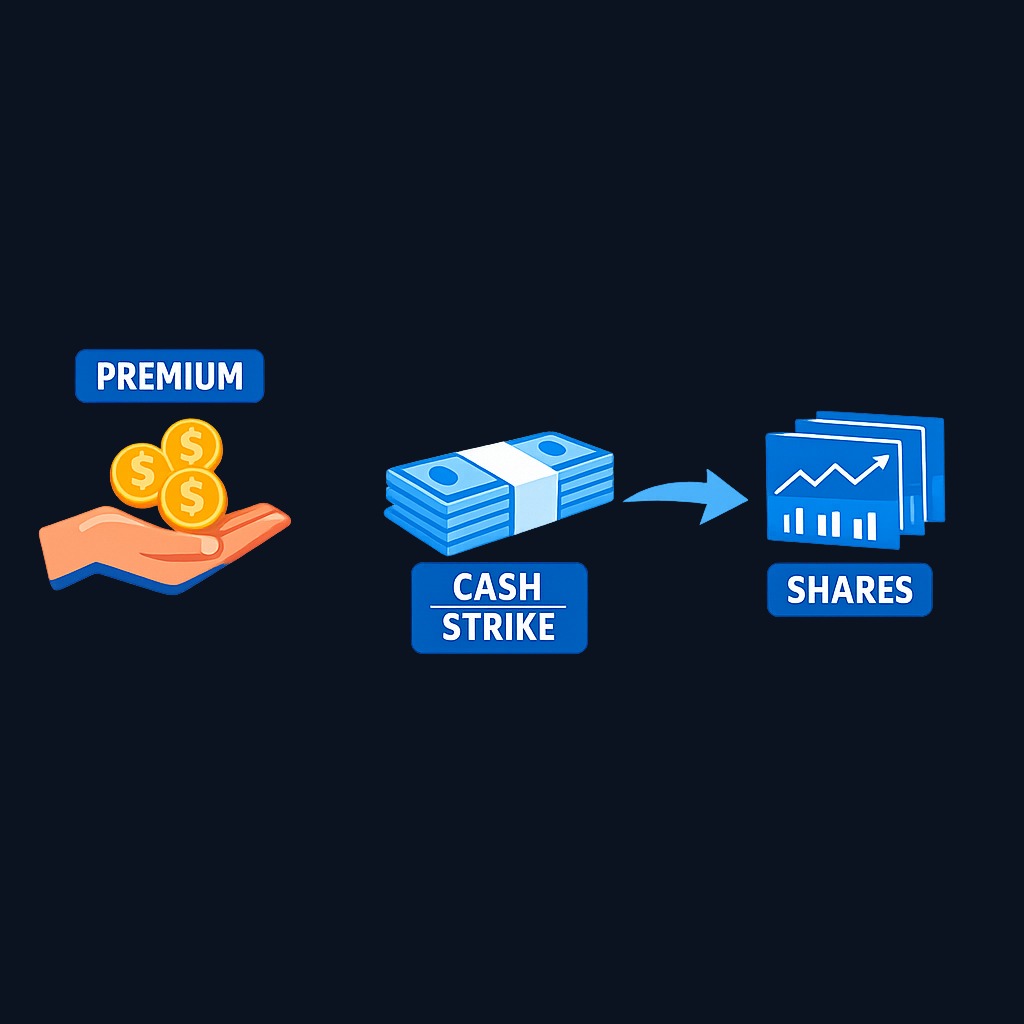
Selling a put means selling someone else the right to sell you 100 shares at a fixed strike price before the expiration date. "Cash-secured" means you hold the full purchase amount in reserve the entire time, so an assignment never forces you to borrow or sell anything else.
The strategy suits a specific mindset: you have researched a stock, you want it at a lower price, and you are patient. Brokerage education materials describe the approach as a way to potentially buy a stock you already like at a discount to today's price while earning income if the pullback never comes, as outlined in Fidelity's overview of cash-secured puts.
How cash-secured puts work
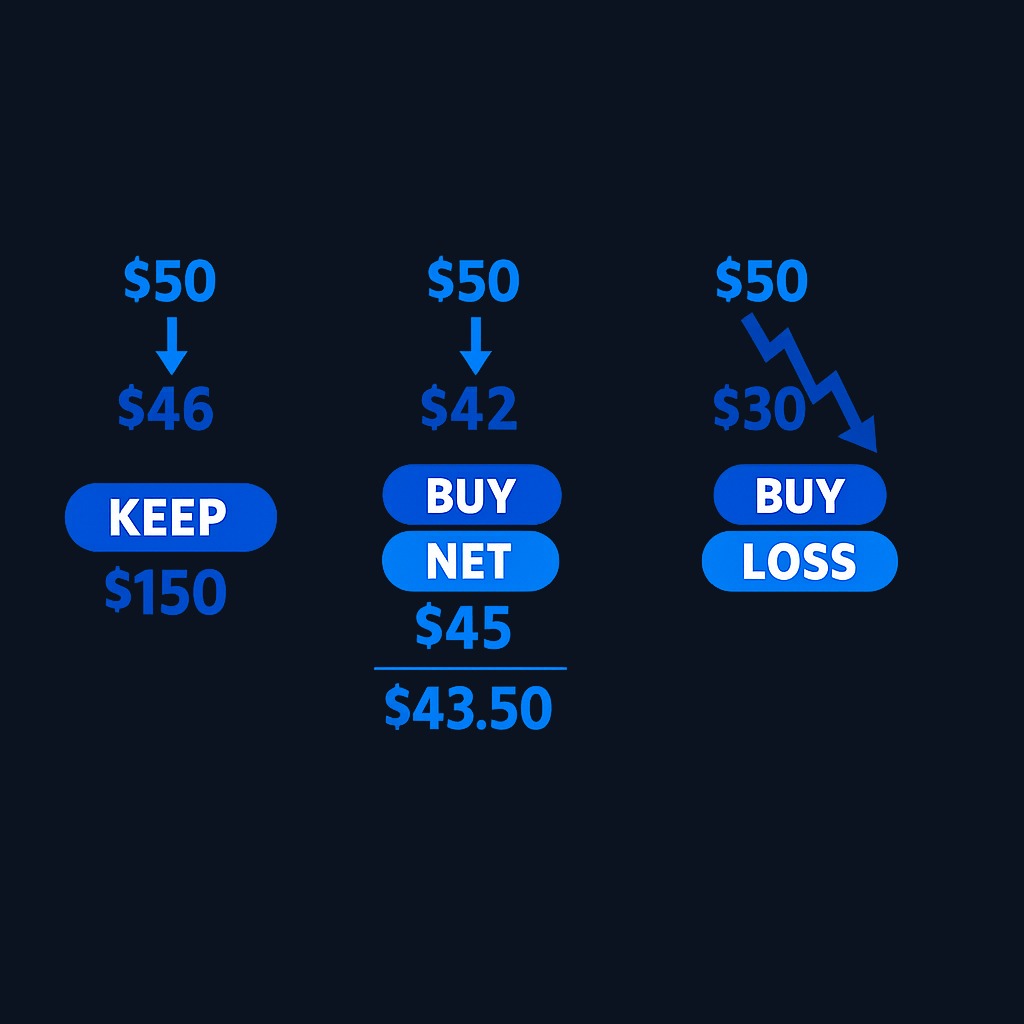
A worked example. A stock trades at $50. You would gladly own it at $45. You sell one 45-strike put expiring in one month for a $1.50 premium and set aside $4,500 in cash.
- Stock stays above $45: the put expires worthless. You keep the $150 premium - roughly a 3.3 percent return on the reserved cash in a month - and can repeat the process.
- Stock falls to $42: you are assigned and buy 100 shares at $45. Your effective cost basis is $43.50 after the premium, better than the $50 the market asked when you started, though above the current $42 price.
- Stock crashes to $30: you still buy at $45. The premium softens the blow only slightly. This is the real risk of the strategy.
The comparison people reach for is a limit order, since both target a purchase below the current market price. The differences matter: a put seller receives premium, but the purchase decision is no longer fully in the seller's control. Standard U.S. equity options are generally American-style, so the holder may exercise and the writer may be assigned on any business day while the option is open. At expiration, in-the-money options are generally subject to exercise-by-exception procedures, although broker instructions, thresholds, and exceptional circumstances can affect the result.
Benefits and risks of cash-secured puts
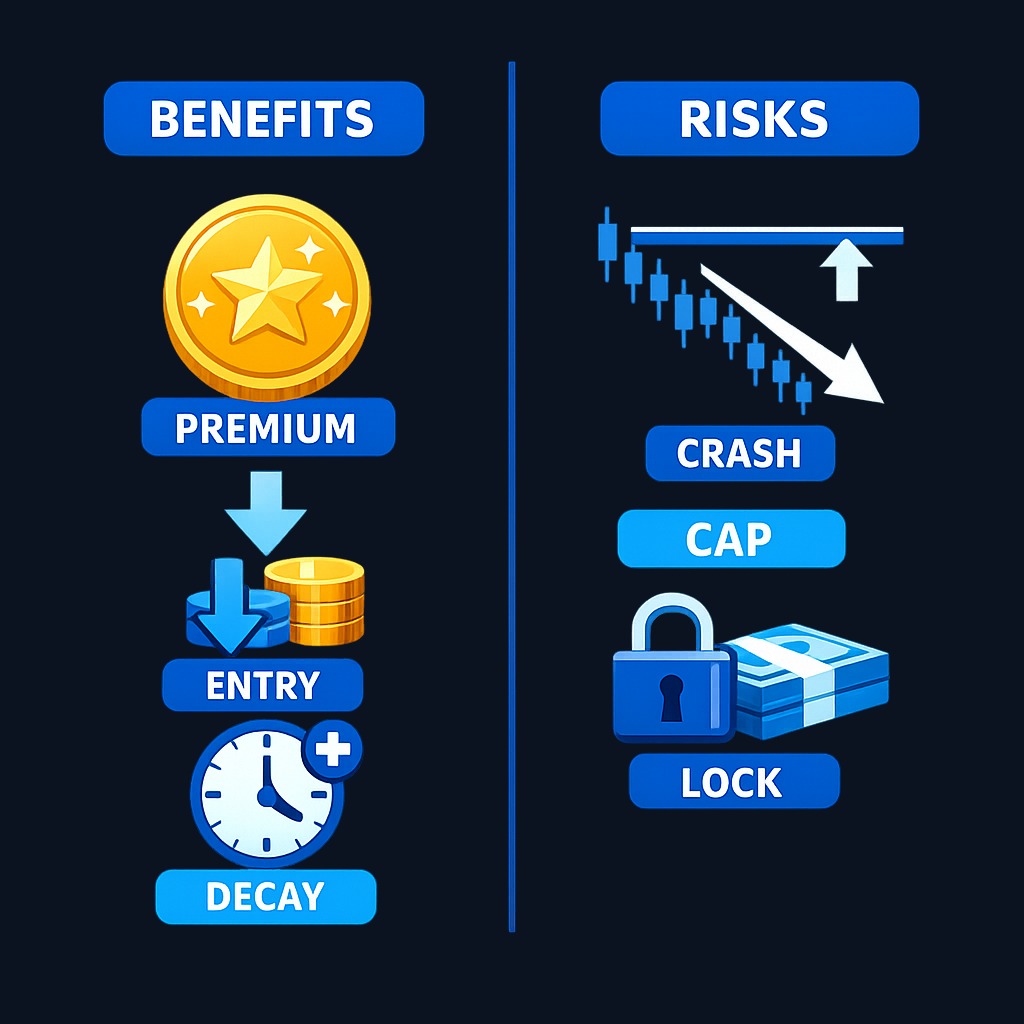
The benefits: you earn premium income immediately, you may acquire a stock you already wanted at a lower effective cost, and the full cash backing means no margin calls or forced selling. Time decay works for you rather than against you, since you are the option seller.
The risks are just as concrete. If the stock collapses, you are obligated to buy at the strike while the shares trade far below it; the premium rarely covers a serious decline. If the stock rockets higher, your gain is capped at the premium - you never own the rally. And your cash sits reserved for the life of the contract, unable to chase other opportunities.
| Approach | Paid while waiting? | Buys the dip automatically? | Upside if stock rallies | Worst case |
|---|---|---|---|---|
| Cash-secured put | Yes, premium | Yes, via assignment | Premium only | Buy at strike during a crash |
| Limit buy order | No | Yes, if price touches | Full ownership after fill | Fill just before further decline |
| Buy stock now | n/a | n/a | Full | Full downside from today's price |
| Wait in cash | No | No | None | Missing the move entirely |
Step-by-step: selling your first cash-secured put
- Pick a stock you genuinely want to own. The strategy only makes sense if assignment feels like a win, not a punishment.
- Confirm options approval and cash. Your brokerage account needs the appropriate options permission level and enough cash to secure the full purchase: strike times 100 per contract.
- Choose a strike and expiration deliberately. There is no universally best 30-to-45-day window. Compare liquidity, bid-ask spread, event dates, assignment risk, premium, and how long you are willing to reserve the cash; validate any repeatable rule before using it.
- Sell the put and reserve the cash. The premium lands in your account immediately.
- Manage the position. If the stock stays strong, let the option expire or buy it back cheaply. If assignment comes, take the shares at your chosen price and decide the next step - hold, or sell covered calls against them.
Practice trading with Finelo
Practice in a simulator, learn with bite-sized lessons, and build confidence before risking real money.
What to know before deciding
Common mistakes cluster around a few themes:
- Selling puts on stocks you do not actually want, purely for the income. Assignment then hands you a position you never believed in.
- Chasing the fattest premiums. High premium means high implied volatility, which usually signals real danger in the underlying stock.
- Ignoring earnings dates and news events that fall before expiration.
- Overcommitting cash. Each contract locks up the full strike value; several open puts can immobilize a portfolio.
- Treating tax as a footnote. U.S. federal treatment depends on whether the put expires, is closed, or is assigned; assignment generally affects the basis and acquisition date of the shares rather than producing the same result as an expired contract. Review the options sections of IRS Publication 550 and consult a qualified tax professional for the actual position.
Decision framework: is a cash-secured put right for the trade?
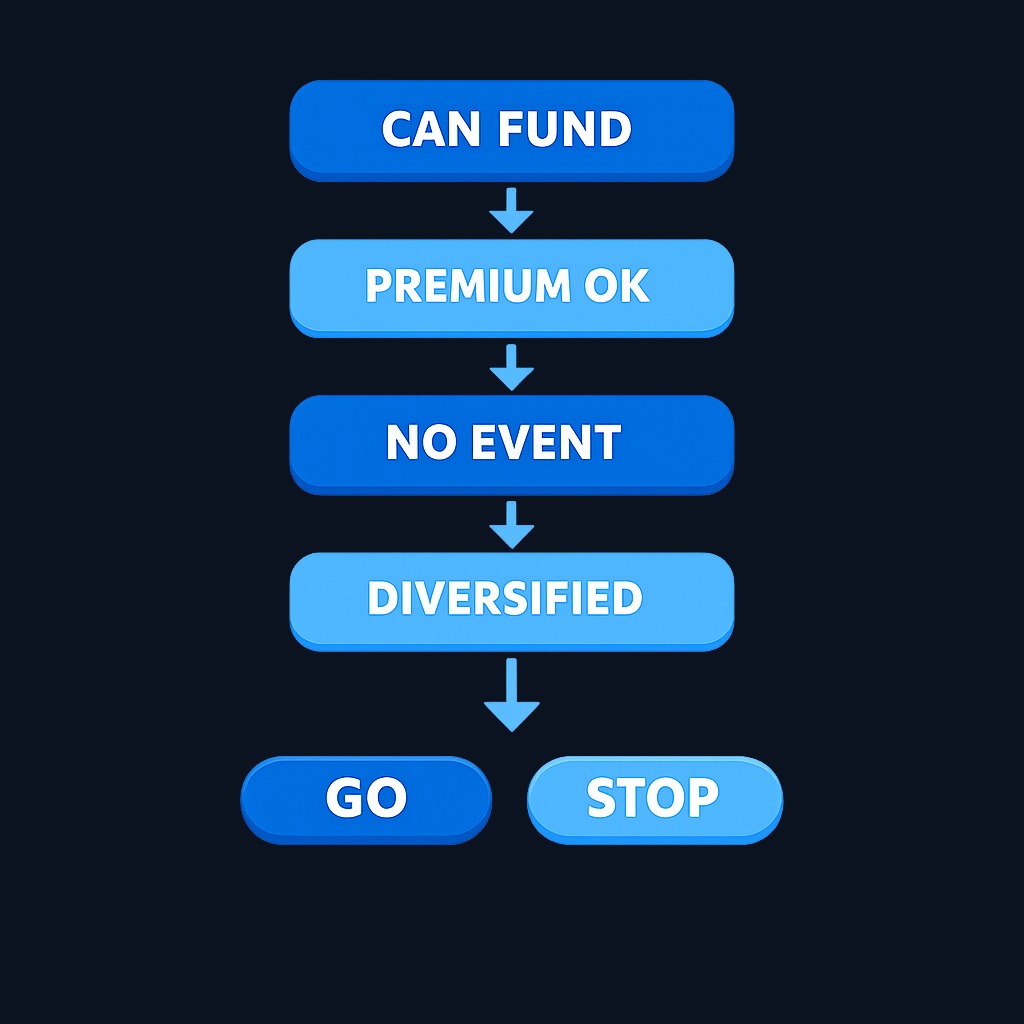
Ask four questions before selling. One: could I fund and tolerate assignment of 100 shares per contract today? Two: does the premium compensate for the downside, liquidity, and opportunity cost without assuming the same short-period return can be repeated all year? Three: is there a known event that could gap the stock far below the strike? Four: would the portfolio remain appropriately diversified if every open put were assigned early at the same time? If any answer is unclear, the position needs more work or should be avoided.
FAQ
What happens if my cash-secured put is assigned?
You buy 100 shares per contract at the strike price, using the cash you reserved. Your effective cost basis equals the strike minus the premium received. From there you own the stock outright and can hold it or sell calls against it.
How much money do I need to sell a cash-secured put?
The strike price times 100 per contract, held in cash. A 45-strike put requires $4,500 of buying power reserved for the life of the trade, regardless of whether assignment ever happens.
Is selling cash-secured puts safer than buying stock?
It carries slightly less risk than buying the same stock today, because the premium and the lower strike provide a buffer. But a severe decline still produces a large loss - the strategy is stock ownership deferred, not eliminated.
Can I close a cash-secured put before expiration?
Yes. You can submit an offsetting purchase while the option market is open, subject to liquidity and execution. Until that closing trade executes, assignment remains possible. Whether closing early is worthwhile depends on the remaining premium, spread, risk, taxes, and your original plan.
Next steps
The cash-secured put turns patience into income: you name the price you would pay for a stock and collect a premium while the market decides whether to deliver it. Keep the strategy honest by only selling puts on businesses you want, sizing cash commitments conservatively, and tracking your annualized returns rather than raw premiums. Before putting real capital to work, run a few complete cycles - sell, monitor, expire or assign - in a simulated environment so the mechanics and the emotions are familiar when it counts.
TradingMarketsOptionsBeginner
Practice trading with Finelo
Practice in a simulator, learn with bite-sized lessons, and build confidence before risking real money.
About the author
Finelo Team
The Finelo Team creates practical investing and trading education designed to help beginners learn faster with structured challenges, simulator practice, and bite-sized lessons.
Keep reading — Related articles

Trading
Understanding Walk Forward Analysis in Trading
Brief educational note: this article is educational — not investment advice — and trading involves the risk of loss.
Finelo Team

Trading
VWAP vs Moving Average: Formulas, Uses, and Limits
VWAP weights price by recorded volume over a defined period, while a moving average summarizes a sequence of prices over a rolling lookback.
Finelo Team

Trading
Volume Profile vs Market Profile: What Each Chart Measures
Volume Profile groups traded volume by price level.
Finelo Team


