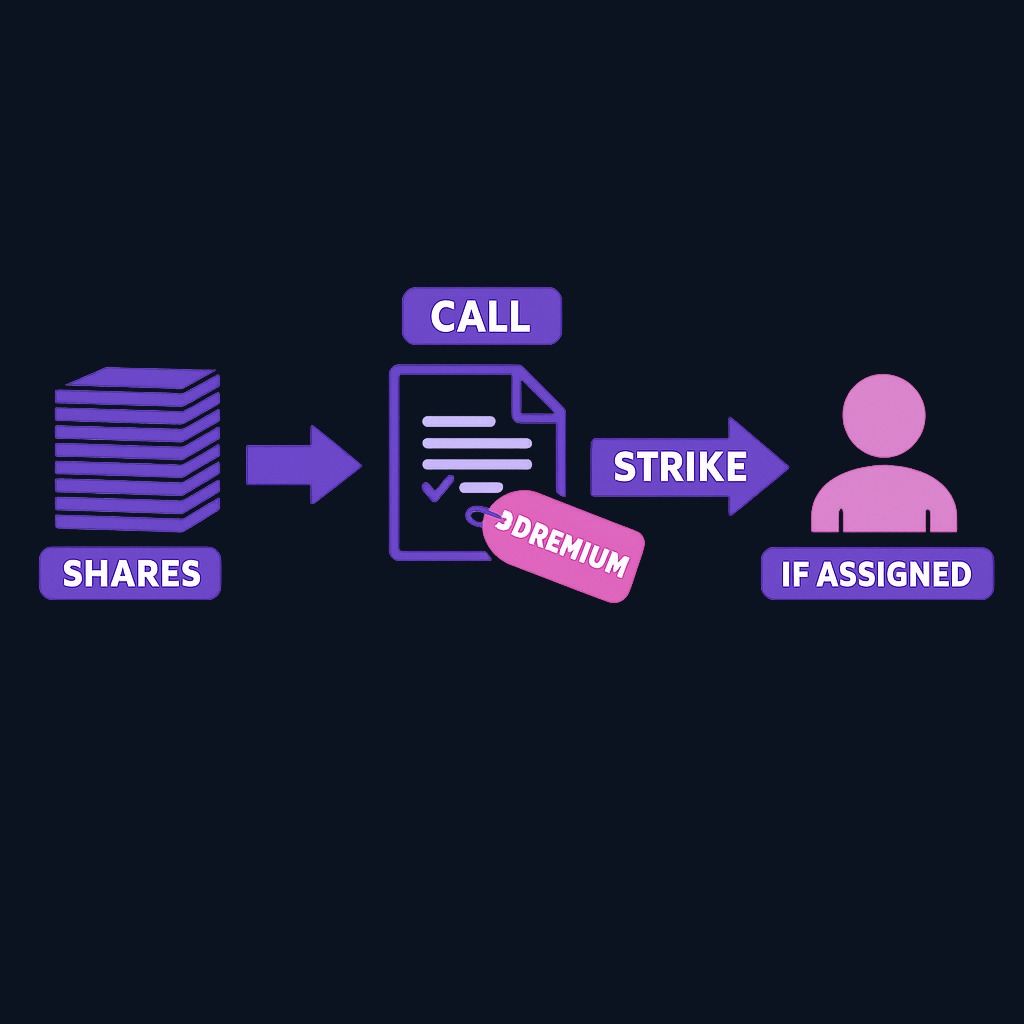
A covered call means selling a call option against shares you own, collecting a premium in exchange for an obligation to deliver those shares at the strike price if assigned. Assignment can occur before expiration, not only at expiration. Owning the shares covers the delivery obligation and avoids the unlimited risk of a naked short call, but it does not cap the downside risk of the stock. See the Options Industry Council's covered-call guide and OCC's options disclosure document before considering the mechanics.
Covered Call Strategy Explained: Income, Risks, and When to Use It
A covered call means selling a call option against shares you own, collecting a premium in exchange for an obligation to deliver those shares at the strike price if assigned. Assignment can occur before expiration, not…
8 min read
Practice trading with Finelo
Practice in a simulator, learn with bite-sized lessons, and build confidence before risking real money.
Want to learn more?
Practice in a simulator, learn with bite-sized lessons, and build confidence before risking real money.
Explore FineloExplore Finelo's 28-day challenges
Turn learning into a daily habit with guided challenge paths.
The short version: a covered call trades away some upside for income today. Whether that trade is smart depends on the stock, the strike, and what you want from the position.
How a covered call works
The setup has two legs. You own at least 100 shares of a stock, and you sell one call option against them, since one contract typically controls 100 shares. Selling the call obligates you to deliver your shares at the strike price if the buyer exercises, and for accepting that obligation you receive a premium immediately.
If the call remains open until expiration, three broad outcomes exist. Before then, the writer can also be assigned—especially when an in-the-money call has little remaining time value or around an ex-dividend date:
- Stock finishes below the strike. The call expires worthless. You keep the shares and the premium, and you can sell another call next cycle.
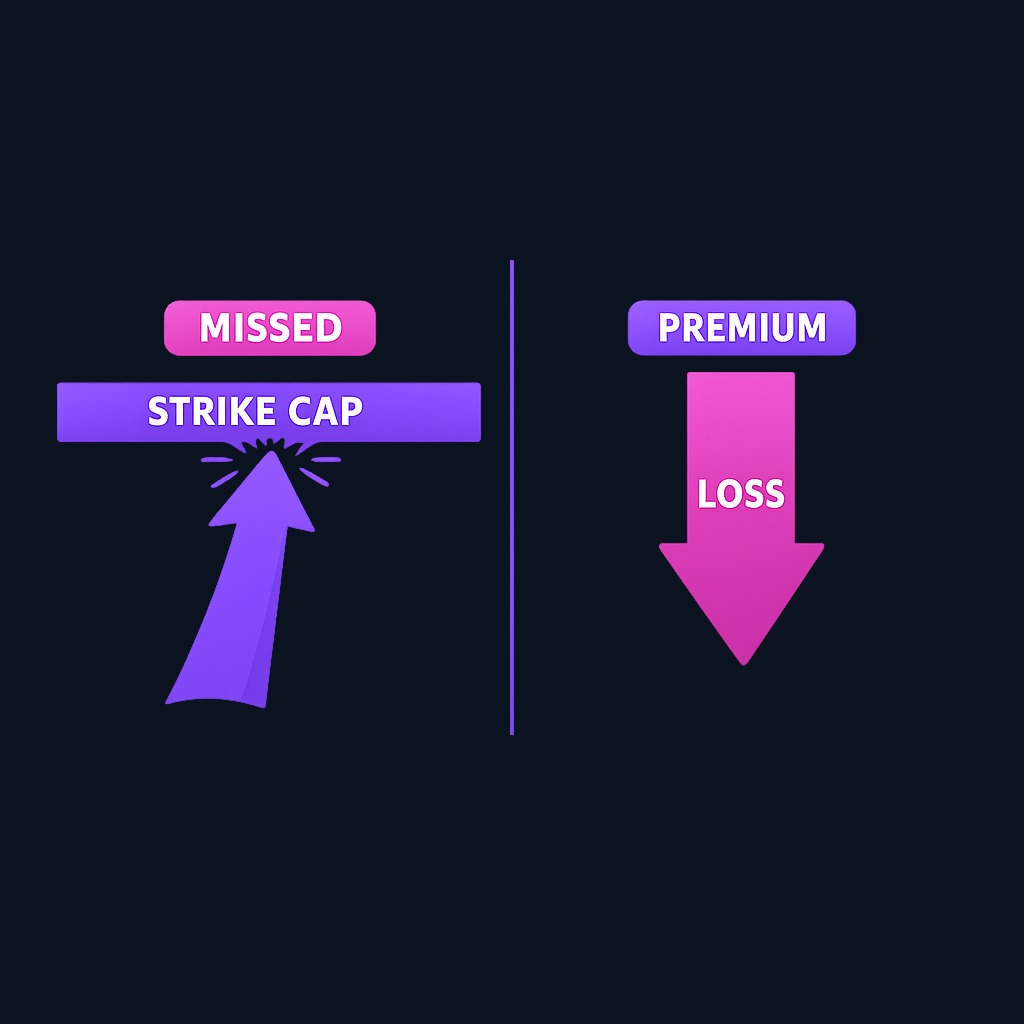
- Stock finishes above the strike. The shares are called away at the strike. You keep the premium plus gains up to the strike, but you forfeit any gain beyond it.
- Stock finishes near the strike. Small assignments-or-not either way; you keep the premium and manage the position into the next cycle.
The word "covered" is the risk story. A trader who sells a call without owning shares faces theoretically unlimited loss if the stock soars. Owning the shares covers that scenario: the worst case on the upside is opportunity cost, not a margin call.
A worked example
Suppose you own 100 shares of a stock trading at $50, and you sell a one-month call with a $55 strike for a $1.50 premium. You collect $150 immediately.
- If the stock closes at $48, the call expires worthless. You keep the $150, softening the $200 paper loss on the shares.
- If it closes at $53, the call expires worthless. You keep $150 plus $300 of unrealized share gains.
- If it closes at $60, your shares are called away at $55. You realize $500 of share gains plus the $150 premium, but you gave up the additional $500 above the strike.
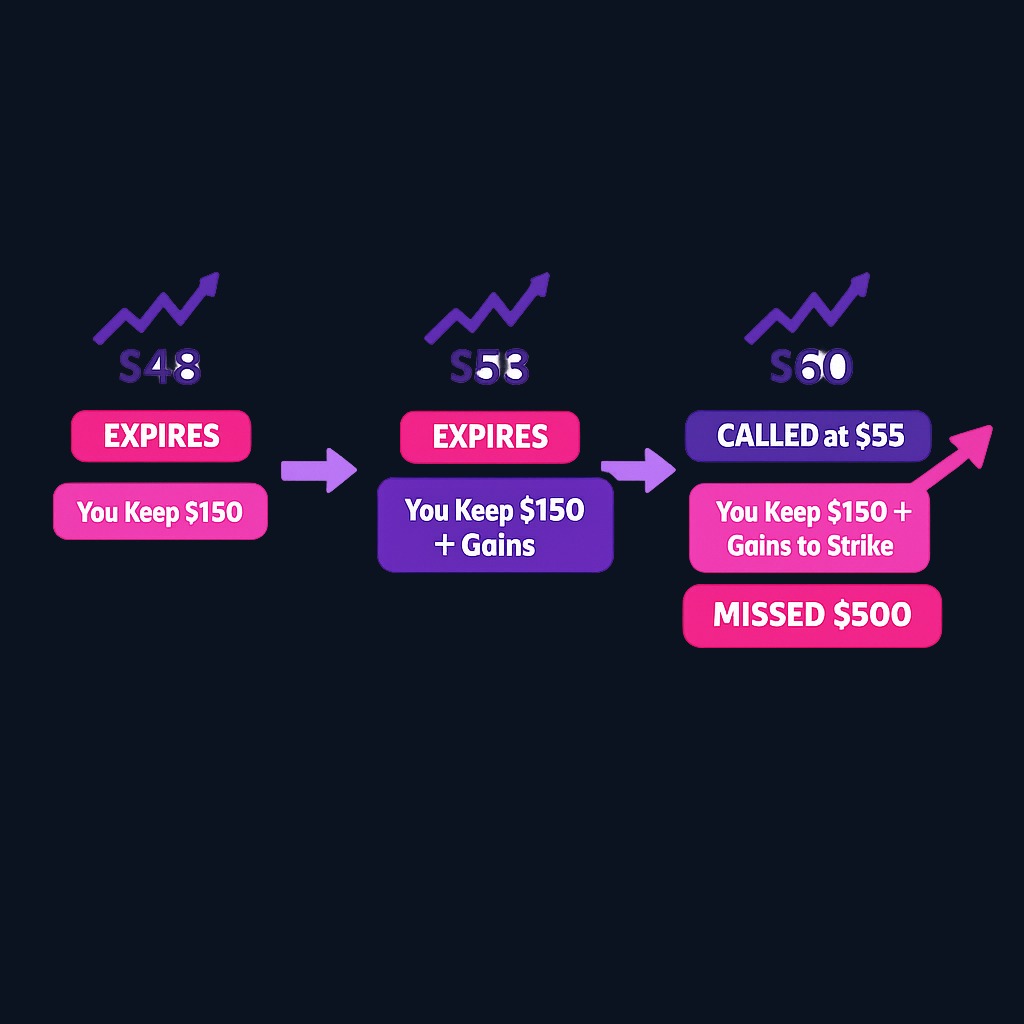
The pattern generalizes: covered calls outperform plain stock ownership in flat, mildly rising, or falling markets, and underperform in strongly rising markets. The premium is real income, but it is compensation for selling your best-case scenario.
Benefits of covered calls
- Immediate cash flow. Premiums arrive up front and are yours regardless of the outcome.
- A cushion on declines. The premium offsets part of a drop in the share price.
- A disciplined exit. If you were planning to sell at the strike anyway, assignment executes your plan and pays you extra for it.
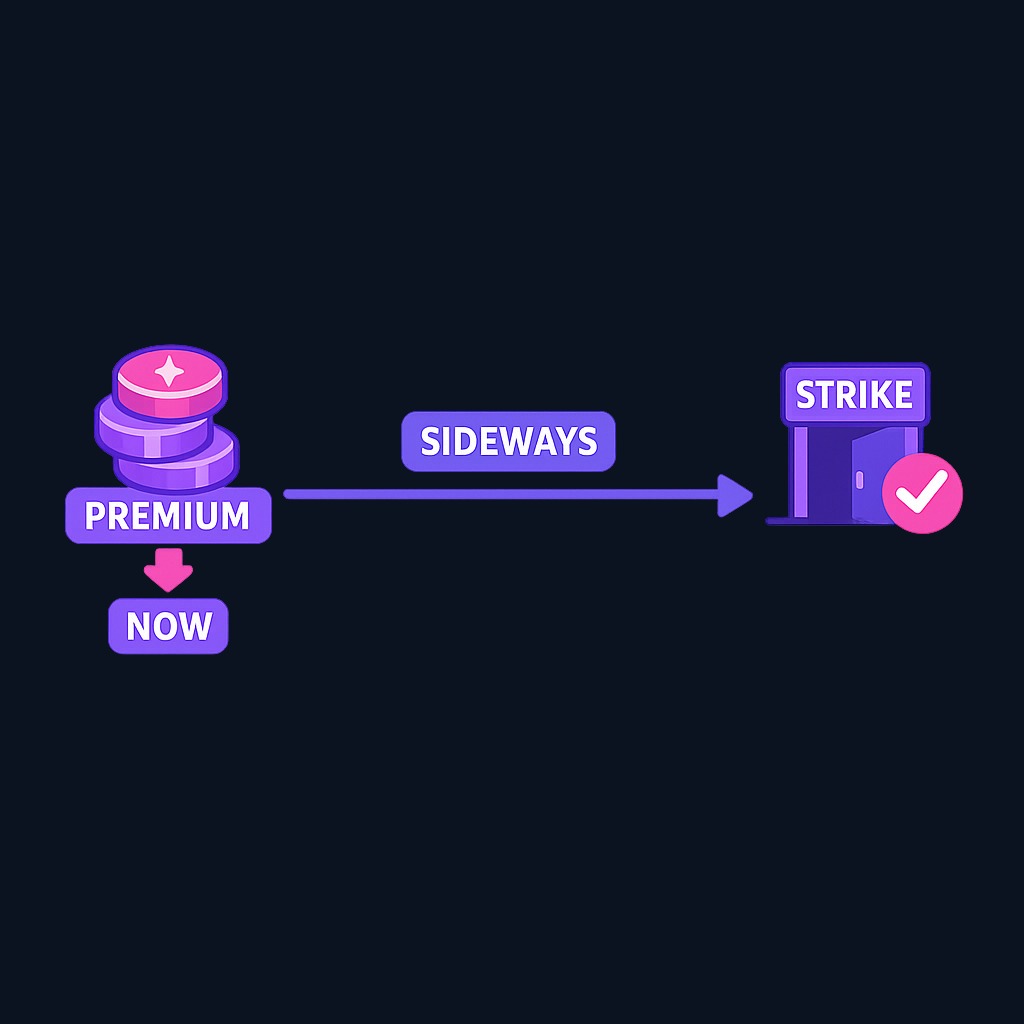
- Reasonable in sideways markets. When the stock goes nowhere, repeated premiums can make a static holding productive.
- Defined obligations. Compared with many options strategies, the risk picture is simple and tied to shares you already hold.
Risks and trade-offs
- Capped upside. The defining cost. A breakout above the strike belongs to the option buyer, not to you.
- Full downside minus the premium. A covered call is not a hedge. If the stock falls 30%, you still own that loss, less the small premium.
- Early assignment. Calls can be exercised before expiration, especially around ex-dividend dates when the option is deep in the money.
- Concentration temptation. Chasing high premiums leads to writing calls on volatile stocks, exactly the ones most likely to blow through a strike or crater. High implied volatility means high premiums because risk is high, not because the market is being generous.
- Transaction friction. Monthly writing means monthly commissions, spreads, and management time.
Practice trading with Finelo
Practice in a simulator, learn with bite-sized lessons, and build confidence before risking real money.
Tax implications of covered calls
In a taxable U.S. account, the result depends on whether the call expires, is closed, or is exercised, as well as the stock's basis and holding period. Premium from an exercised call generally changes the amount realized on the stock sale; an expired or closed call is handled differently. Do not assume every premium is taxed the same way.
Writing certain calls can affect the holding period of the shares and qualified-dividend treatment, and the qualified-covered-call rules are technical. Tax-advantaged accounts follow their own contribution, distribution, and permitted-transaction rules rather than making every tax issue “disappear.” Review IRS Publication 550 and obtain qualified advice for a material position.
Common mistakes to avoid
- Writing calls on stocks you cannot afford to lose. The premium never compensates for a collapse in the underlying.
- Picking strikes by premium alone. The right strike reflects your exit price and outlook, not the biggest number in the option chain.
- Ignoring earnings and ex-dividend dates. Both distort assignment risk and price behavior; write around them deliberately.
- Fighting assignment. Rolling a deep in-the-money call forward month after month to avoid selling usually compounds the original mistake.
- Measuring the wrong benchmark. Judge results against simply holding the stock. In a strong bull market, the covered-call version will lag, and that is expected behavior, not failure.
- Selling calls on shares earmarked for the long term. If you never want to part with the position, capping it repeatedly for small premiums is a mismatch of strategy and intent.
What to know before deciding
Covered calls fit a specific profile: you own the shares, you are neutral to mildly bullish over the option's life, and you would accept selling at the strike. If any leg of that is false, the strategy is misapplied. Income is not free; it is the sale of upside, priced by a market that understands the odds. Position size still governs risk, because the stock itself remains your dominant exposure. And execution details, strike selection, expiration length, and the discipline to let assignment happen, drive more of the outcome than the decision to use covered calls at all. New options users should also confirm their broker approval level and practice mechanics with paper trading before committing shares.
Decision framework: should you write this covered call?
| Your situation | Recommended approach |
|---|---|
| Long-term holder who never wants to sell | Skip covered calls, or write far out-of-the-money sparingly |
| Neutral on the stock for the next month or two | A standard covered call at a strike you would sell at makes sense |
| Already planning to exit near a target price | Write the call at that target and get paid for your own plan |
| Expecting high volatility or earnings surprises | Stand aside; premium is high because outcomes are wild |
| Want income in a retirement account | Covered calls are commonly used there, with fewer tax frictions |
FAQ
What is a covered call in simple terms?
You own 100 shares and sell someone the right to buy them from you at a set price by a set date. They pay you cash now for that right. If the stock stays below the price, you keep the shares and the cash.
Can you lose money on a covered call?
Yes. The main risk is the stock falling; the premium only offsets a small part of a decline. You can also lose opportunity profit if the stock surges far above your strike.
What happens if my shares get called away?
You sell the shares at the strike price and keep the premium. Your total proceeds are the strike price times 100 plus the premium, and the sale is a taxable event in a taxable account.
Do covered calls work in every market?
No. They shine in flat to mildly rising markets, cushion mild declines, and underperform simple stock ownership in strong rallies. Matching the strategy to your outlook is most of the game.
Next steps. Before writing a real contract, paper trade the full cycle once: pick the strike, collect the premium, and watch how the position behaves through expiration. The Finelo app can help you build the underlying options vocabulary, strikes, premiums, expiration, and assignment, through short interactive lessons designed for beginners.
TradingMarketsOptionsFinancial StatementsBeginner
Practice trading with Finelo
Practice in a simulator, learn with bite-sized lessons, and build confidence before risking real money.
About the author
Finelo Team
The Finelo Team creates practical investing and trading education designed to help beginners learn faster with structured challenges, simulator practice, and bite-sized lessons.
Keep reading — Related articles

Trading
Understanding Walk Forward Analysis in Trading
Brief educational note: this article is educational — not investment advice — and trading involves the risk of loss.
Finelo Team

Trading
VWAP vs Moving Average: Formulas, Uses, and Limits
VWAP weights price by recorded volume over a defined period, while a moving average summarizes a sequence of prices over a rolling lookback.
Finelo Team
Trading
Volume Profile vs Market Profile: What Each Chart Measures
Volume Profile groups traded volume by price level.
Finelo Team