Dark pool trading is the buying and selling of securities on private trading venues where orders stay hidden until after they execute. Institutions use these venues to move large blocks of stock without tipping off the public market and moving the price against themselves. This page is for retail investors and market-curious learners who keep hearing about dark pools and want a plain-English explanation of how they work, why they exist, and whether they matter for an ordinary portfolio. Read the breakdown below, then practice reading market structure signals risk-free with Finelo, an investing-education app with guided lessons.
Dark Pool Trading: What It Is and How It Works
Dark pool trading is the buying and selling of securities on private trading venues where orders stay hidden until after they execute. Institutions use these venues to move large blocks of stock without tipping off the…
6 min read
Practice trading with Finelo
Practice in a simulator, learn with bite-sized lessons, and build confidence before risking real money.
Want to learn more?
Practice in a simulator, learn with bite-sized lessons, and build confidence before risking real money.
Explore FineloExplore Finelo's 28-day challenges
Turn learning into a daily habit with guided challenge paths.
What is dark pool trading and how does it work?
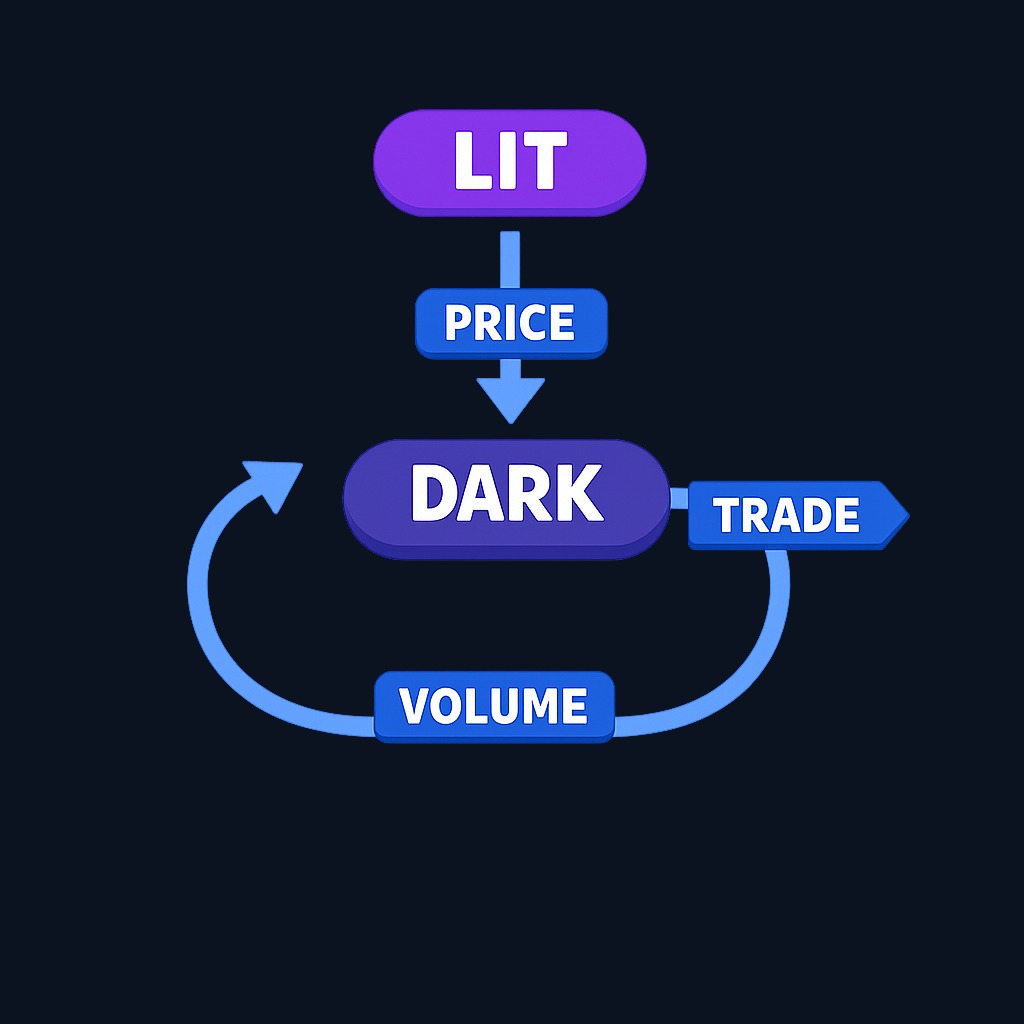
A dark pool is an alternative trading system (ATS) that matches buy and sell orders away from public exchanges. On a public exchange, the order book is visible: anyone can see bid and ask prices and the size of resting orders. In a dark pool, orders are not displayed. The trade becomes public only after it has been completed, which is what makes the venue "dark."
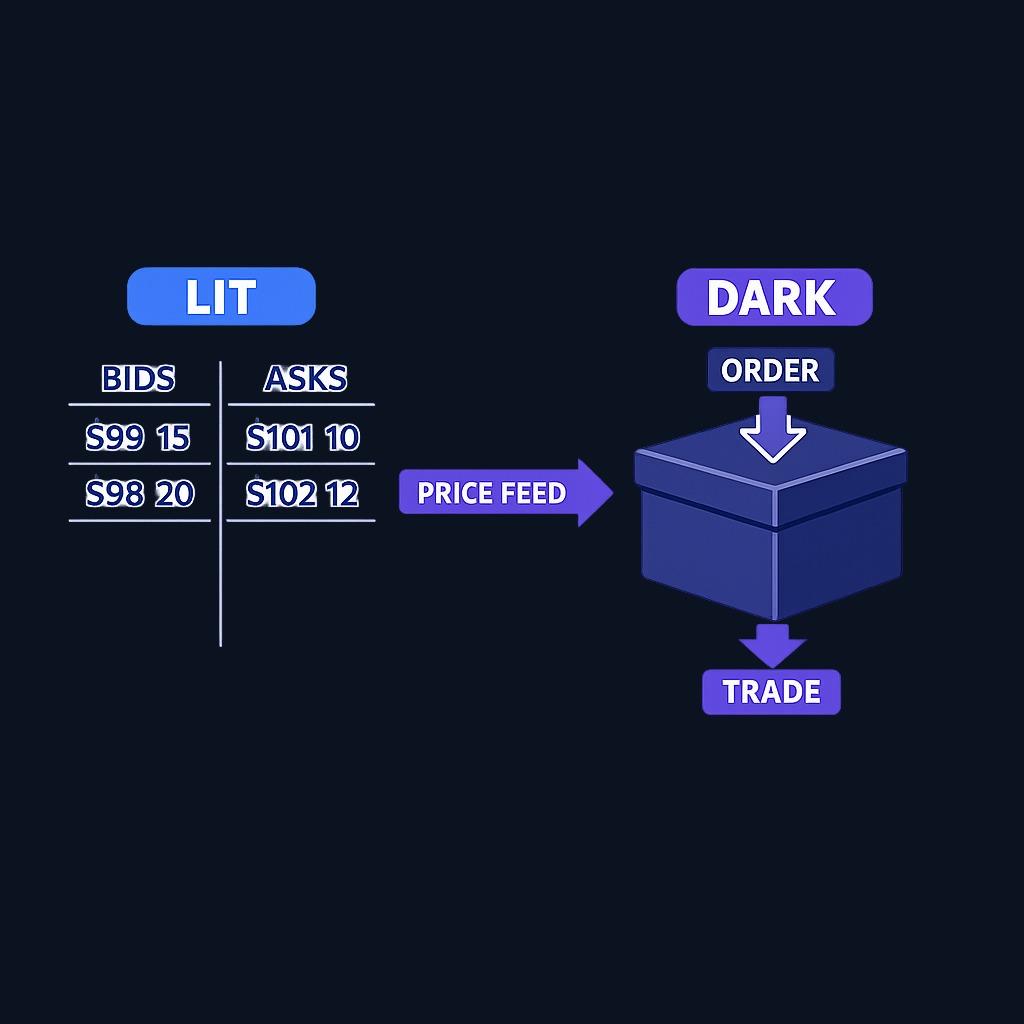
Dark pools are alternative trading systems that do not display their order books publicly before execution. Their number and market share change over time, so a current venue count should come from SEC Form ATS-N filings and FINRA data rather than an undated estimate. FINRA's dark-pool guide explains their role and trade-offs.
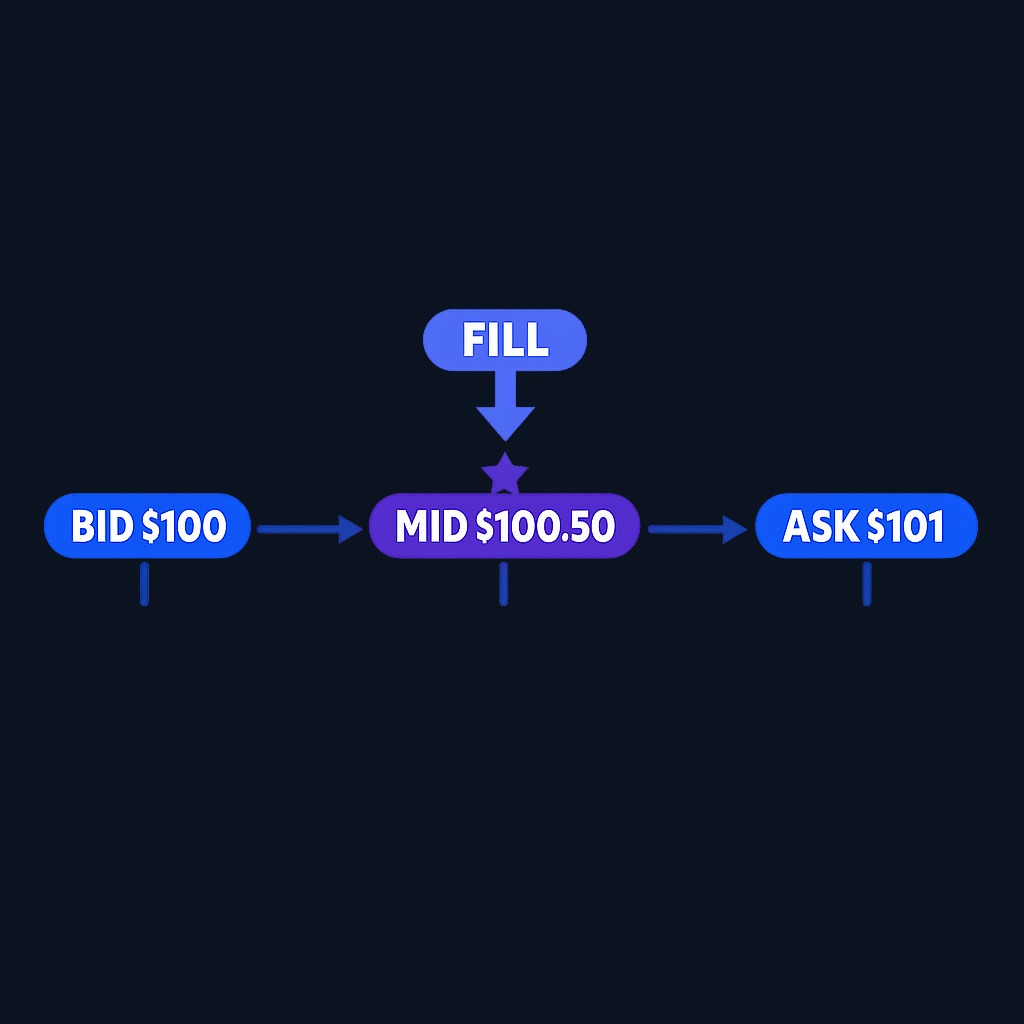
Inside a dark pool, matching typically happens at the midpoint of the national best bid and offer, so participants get a price tied to the public market even though their order was never displayed on it.
Benefits and risks of dark pool trading
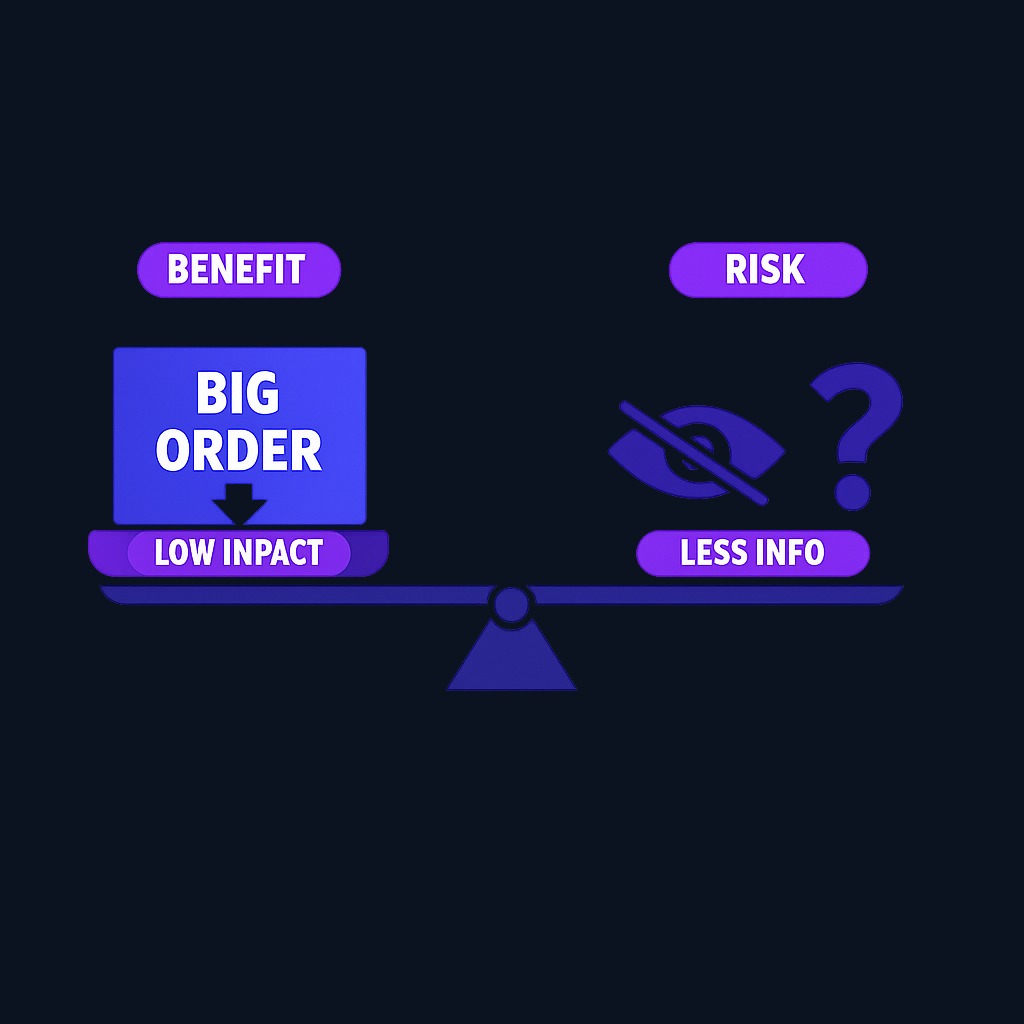
The intended benefit is reduced information leakage and market impact for orders that might otherwise reveal their size. That does not guarantee better execution. Dark-pool volume is only one part of off-exchange trading; internalization and other non-ATS activity must not be counted as dark-pool volume. Use dated FINRA ATS and OTC transparency data for any market-share claim.
The risks mirror the benefits. Hidden orders mean less pre-trade transparency for everyone else. Price discovery happens on lit exchanges, so if too much volume migrates into the dark, the public quote can become less reliable. Retail investors also cannot access most dark pools directly, and conflicts of interest have occurred where operators gave certain participants advantages inside their own venues. Regulators have fined several operators over disclosure failures.
Dark pools vs lit exchanges
| Feature | Dark pool | Lit exchange |
|---|---|---|
| Order visibility | Hidden until after execution | Public order book |
| Typical users | Institutions moving large blocks | All investors, including retail |
| Price formation | Usually pegged to public midpoint | Direct price discovery |
| Market impact of big orders | Lower | Higher |
| Transparency for outsiders | Post-trade only | Pre-trade and post-trade |
Neither venue type is simply better. Lit exchanges provide the reference price that dark pools depend on. Dark pools provide execution quality for size-constrained orders that lit books handle poorly.
Regulation and transparency
Dark pools operate as alternative trading systems under Regulation ATS. Operators make Form ATS or ATS-N filings as applicable, and executed NMS-stock trades are reported through regulatory trade-reporting facilities and reflected in public post-trade data. FINRA publishes ATS transparency statistics. EDGAR contains issuer and ATS-N filings; it is not a complete database of an operator's regulatory history.
Practice trading with Finelo
Practice in a simulator, learn with bite-sized lessons, and build confidence before risking real money.
What to know before deciding
For most individual investors, the practical question is not "should I trade in a dark pool" but "how should dark pool activity shape my thinking." Keep these points in mind:
- You are almost certainly interacting with off-exchange execution already. Many retail brokers route orders to wholesalers that execute off-exchange.
- Dark pool volume data is a lagging, noisy signal. High dark activity in a stock is not by itself bullish or bearish.
- Execution quality matters more than venue labels. Compare fills against the public quote.
- Liquidity conditions change. A stock with thin liquidity behaves differently from a mega-cap regardless of venue.
Decision framework: how to act on dark pool information
Use a simple three-step filter. First, define your role: a long-term investor rebalancing quarterly has little reason to track dark pool prints, while an active trader may treat unusual off-exchange volume as one input among many. Second, verify the data source: prefer FINRA's published ATS statistics over social media screenshots. Third, weigh cost and benefit: if analyzing dark pool data adds hours of work without changing your entries or exits, drop it and focus on position sizing and risk control instead. Signals only earn a place in your process when they change decisions.
FAQ
What is a dark pool in simple terms?
It is a private trading venue where buy and sell orders are hidden from the public until after the trade happens. Institutions use it to trade large blocks of stock without moving the market price.
Can retail investors trade in dark pools?
Usually not directly. Access typically runs through institutional brokers. However, retail orders often execute off-exchange through wholesalers, so many retail fills already happen away from lit exchanges.
Are dark pools legal?
Yes. They are registered alternative trading systems overseen by the SEC and FINRA, with post-trade reporting obligations. Operators have been fined when they misled participants, but the venue type itself is legal and regulated.
Do dark pools hurt ordinary investors?
Evidence is mixed. They reduce market impact for large funds, which can benefit the people invested in those funds, but heavy off-exchange activity can weaken public price discovery. Regulators monitor that balance.
Next steps
Dark pool trading is a structural feature of modern financial markets, not a secret club that decides prices. Understand what the data can and cannot tell you, treat dramatic claims about hidden buying with skepticism, and keep your attention on the fundamentals of your own strategy: costs, diversification, and disciplined execution. If you want to build that foundation with structured practice instead of real money at risk, guided lessons and simulations are a lower-stakes way for an investor to learn how orders, quotes, and venues interact.
TradingMarketsBeginner
Practice trading with Finelo
Practice in a simulator, learn with bite-sized lessons, and build confidence before risking real money.
About the author
Finelo Team
The Finelo Team creates practical investing and trading education designed to help beginners learn faster with structured challenges, simulator practice, and bite-sized lessons.
Keep reading — Related articles
Trading
Understanding Walk Forward Analysis in Trading
Brief educational note: this article is educational — not investment advice — and trading involves the risk of loss.
Finelo Team
Trading
VWAP vs Moving Average: Formulas, Uses, and Limits
VWAP weights price by recorded volume over a defined period, while a moving average summarizes a sequence of prices over a rolling lookback.
Finelo Team
Trading
Volume Profile vs Market Profile: What Each Chart Measures
Volume Profile groups traded volume by price level.
Finelo Team


