For U.S. readers: This article discusses U.S. rules and financial products. State rules and individual eligibility may differ.
What Is a Good Credit Score to Buy a Car? Approval, APR, and Total Cost

No universal credit score guarantees approval for an auto loan.
7 min read
Practice trading with Finelo
Practice in a simulator, learn with bite-sized lessons, and build confidence before risking real money.
Want to learn more?
Practice in a simulator, learn with bite-sized lessons, and build confidence before risking real money.
Explore FineloExplore Finelo's 28-day challenges
Turn learning into a daily habit with guided challenge paths.
Quick answer
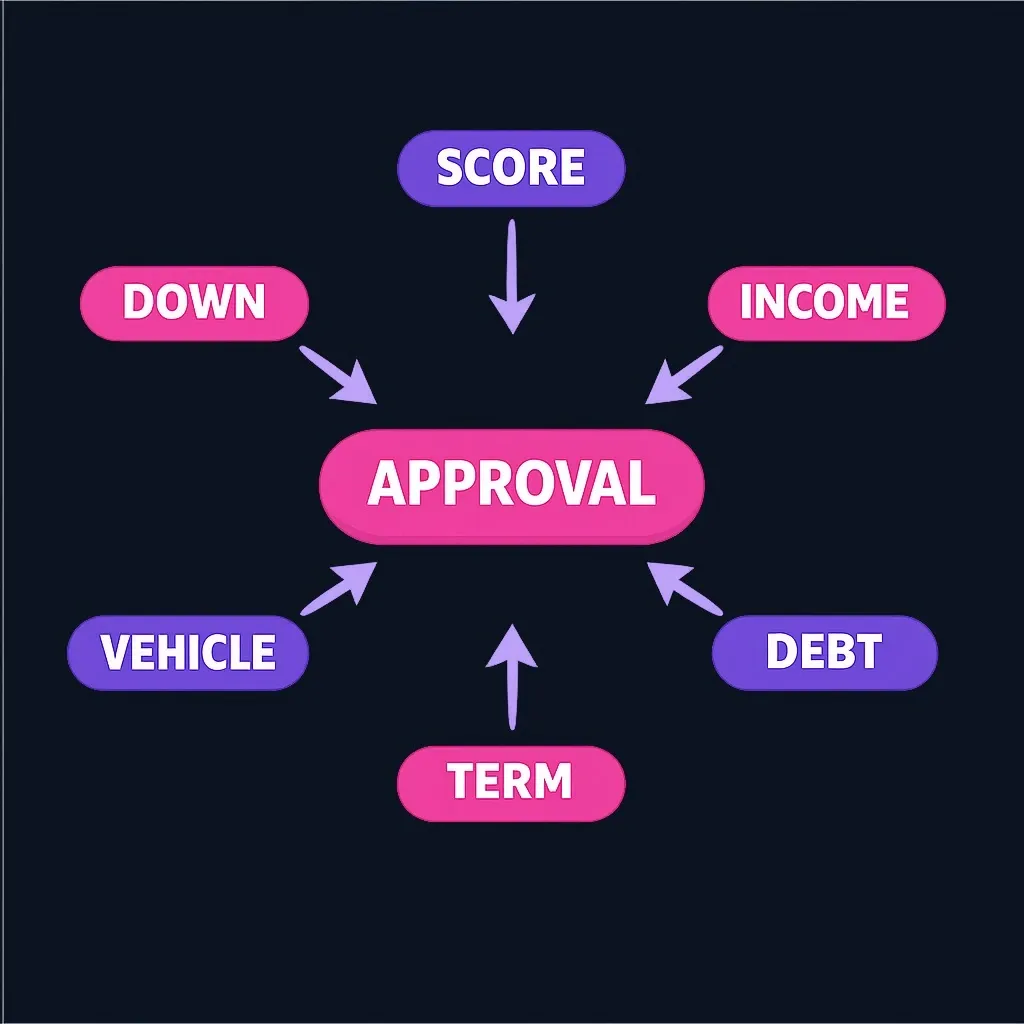
No universal credit score guarantees approval for an auto loan. Lenders select their own scoring models and underwriting standards, then consider the score alongside income, existing debt, down payment, vehicle, amount financed, loan term, and other factors.
A stronger credit profile generally improves access to lenders and pricing, but the useful answer is not a single score cutoff. It is the annual percentage rate, amount financed, finance charge, total of payments, and contract terms a specific lender offers.
Finelo provides general financial education, not lending, legal, tax, investment, or individualized financial advice. Approval and pricing depend on lender policy and the complete application.
Why the same borrower can see different scores
A credit score predicts the likelihood that a consumer will repay credit as agreed. The number can vary because:
- lenders may use different score brands or versions;
- one lender may pull a different credit bureau than another;
- the reports may contain different or newly updated data; and
- auto lenders may use an industry-specific score rather than a general-purpose score shown in a consumer app.
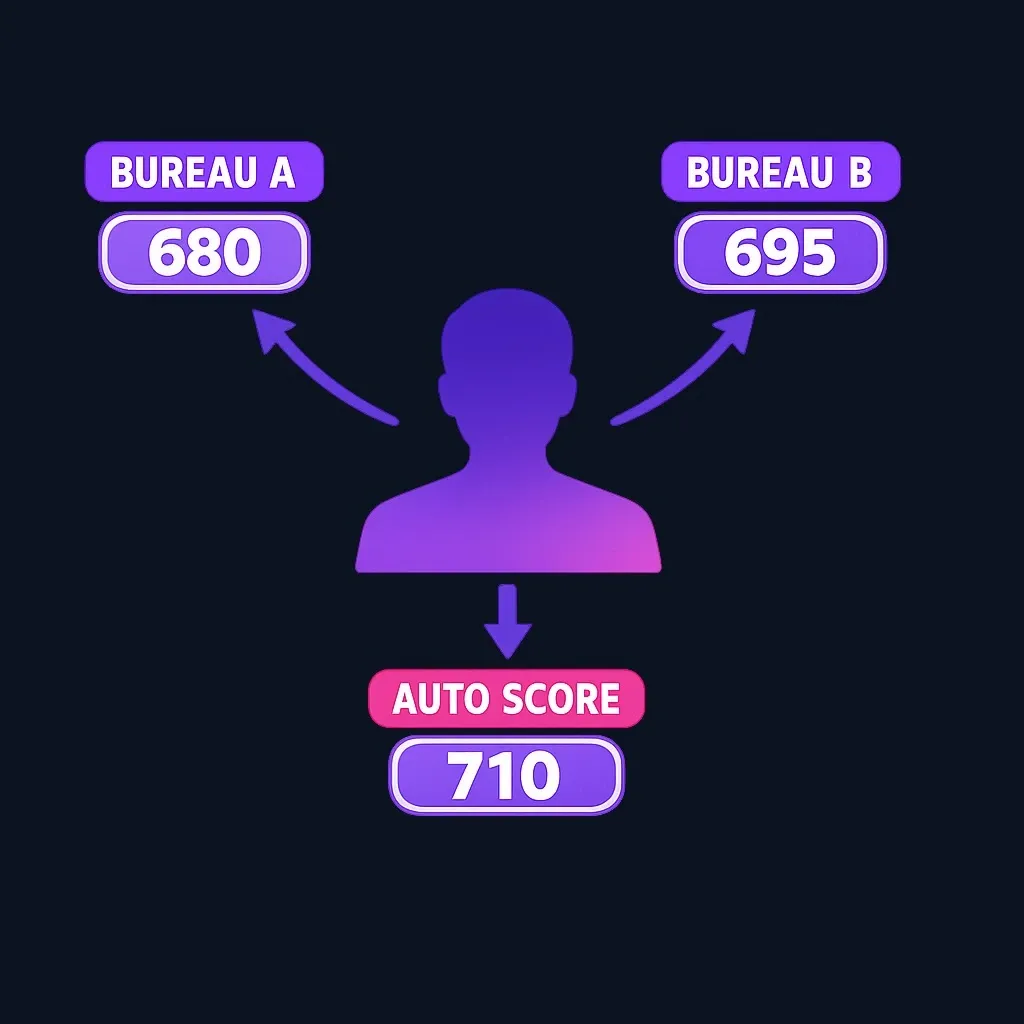
The Consumer Financial Protection Bureau explains that consumers can have multiple credit scores. A score seen before shopping is therefore a reference point, not a guaranteed match for the score used in underwriting. See What is a credit score?.
What lenders review beyond the score
Income and ability to repay
Lenders may verify income and employment and compare monthly obligations with income. A strong score does not guarantee approval when the proposed payment is too large relative to documented resources.
Amount financed and down payment
A down payment reduces the amount borrowed. The CFPB notes that a larger down payment may also reduce the interest rate, but it does not promise that result. See How does a down payment affect an auto loan?.
Vehicle value and age
The vehicle is collateral for the loan. Lenders may restrict vehicle age, mileage, title status, or the amount they will finance relative to value.
Loan term
A longer term can reduce the monthly payment while increasing total interest and the period during which the borrower may owe more than the vehicle is worth. Compare total cost, not only the monthly number.
Existing debt and credit history
Payment history, utilization, recent applications, account age, collections, and other report information can affect the score or the lender’s separate underwriting review.
Score bands are descriptive, not approval rules
Publishers often label score ranges as poor, fair, good, or excellent. Those labels are model-specific and do not create lender requirements.
| Credit profile | What it may mean in practice | What it does not mean |
|---|---|---|
| Stronger | More lenders may compete and offer lower APRs | Approval or the advertised lowest rate is guaranteed |
| Mixed | Offers may vary substantially by lender and loan structure | One rejection means every lender will reject the application |
| Weaker or limited | Rates, required down payments, and available lenders may be less favorable | Dealer-only or “no credit check” financing is the only option |
The only reliable way to know current terms is to obtain actual offers based on the borrower and vehicle.
How to compare auto-loan offers
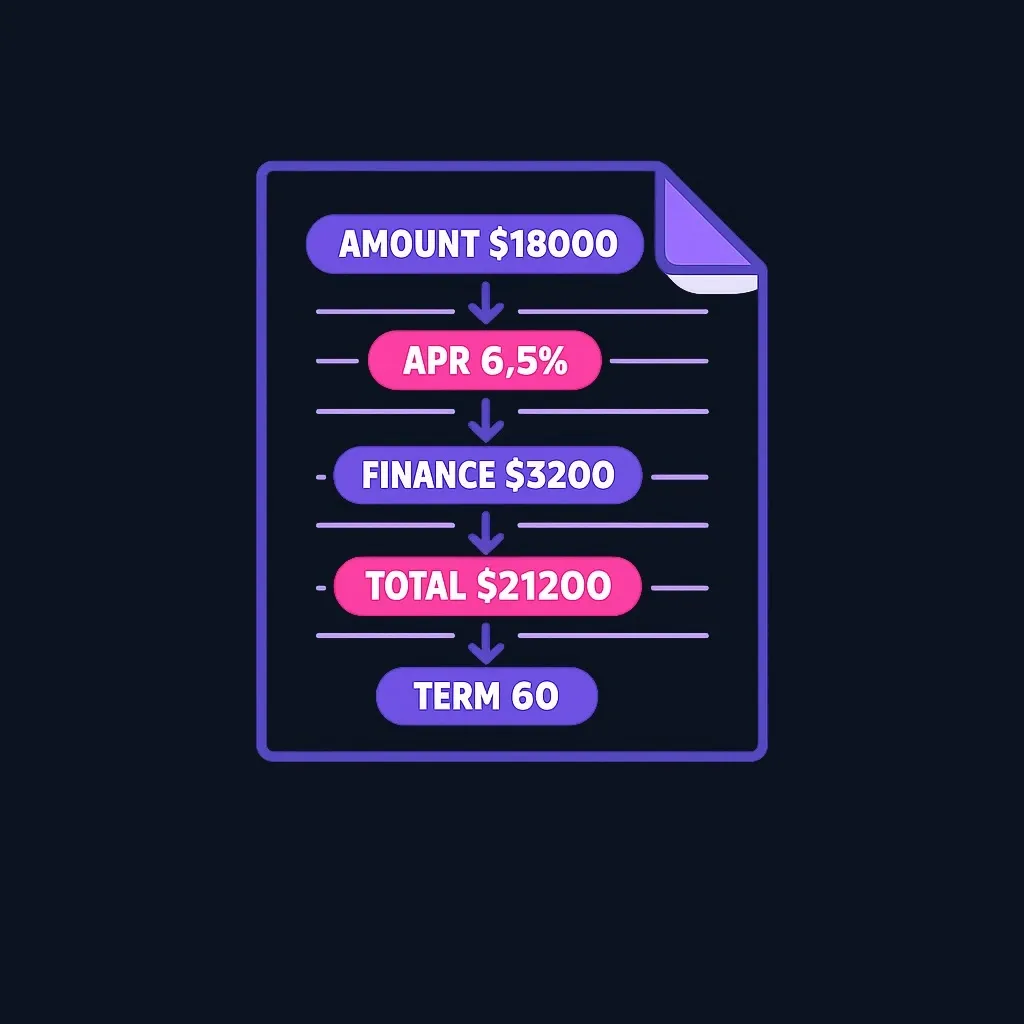
Federal Truth in Lending disclosures provide several numbers that should be reviewed together:
- Annual percentage rate: the yearly cost of credit, including the interest rate and certain fees.
- Finance charge: the dollar cost of credit over the loan term if payments are made as scheduled.
- Amount financed: the amount of credit provided.
- Total of payments: the sum of scheduled payments over the term.
- Payment schedule: the number, amount, and timing of payments.
See the CFPB’s explanation of auto-loan Truth in Lending disclosures.
Also compare:
- vehicle selling price before financing;
- cash down and trade-in value;
- any balance carried from a previous auto loan;
- optional add-ons financed in the contract;
- late fees and prepayment terms; and
- whether the rate is fixed or variable.
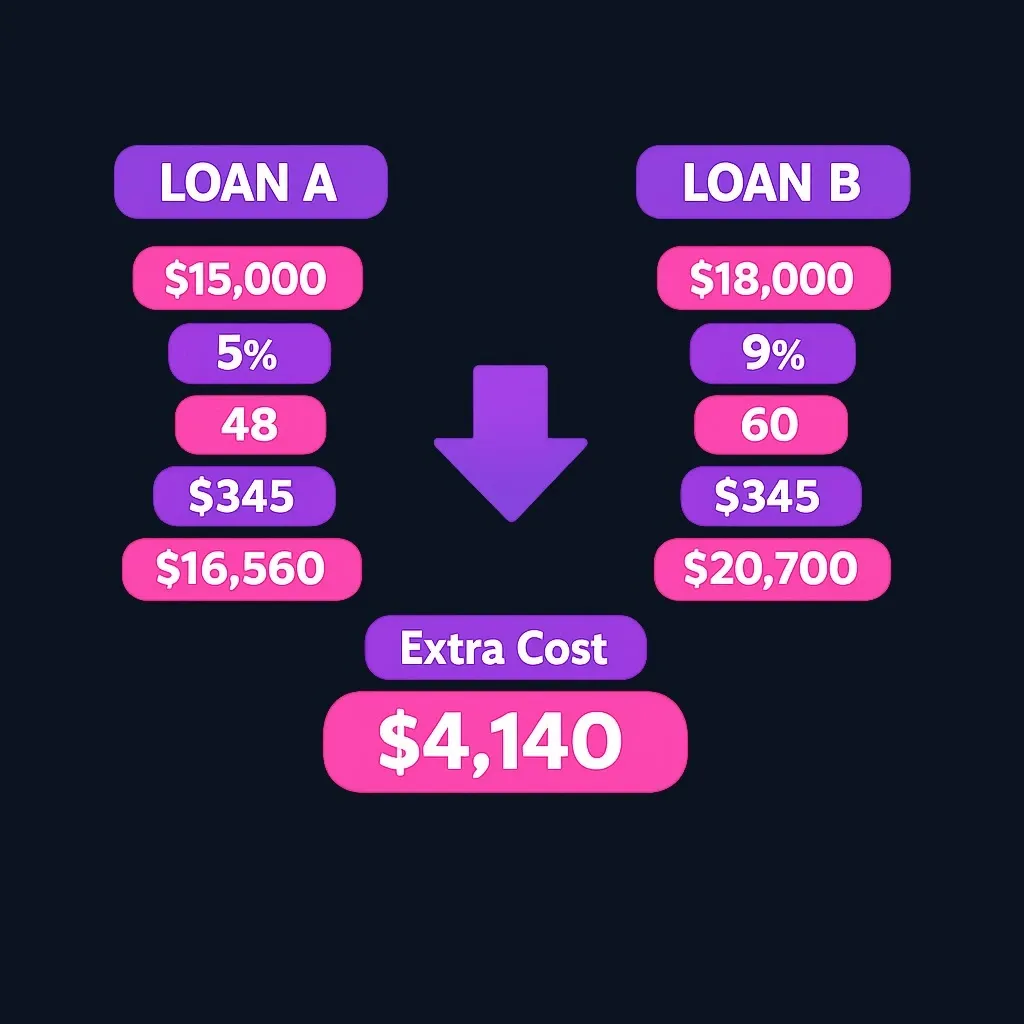
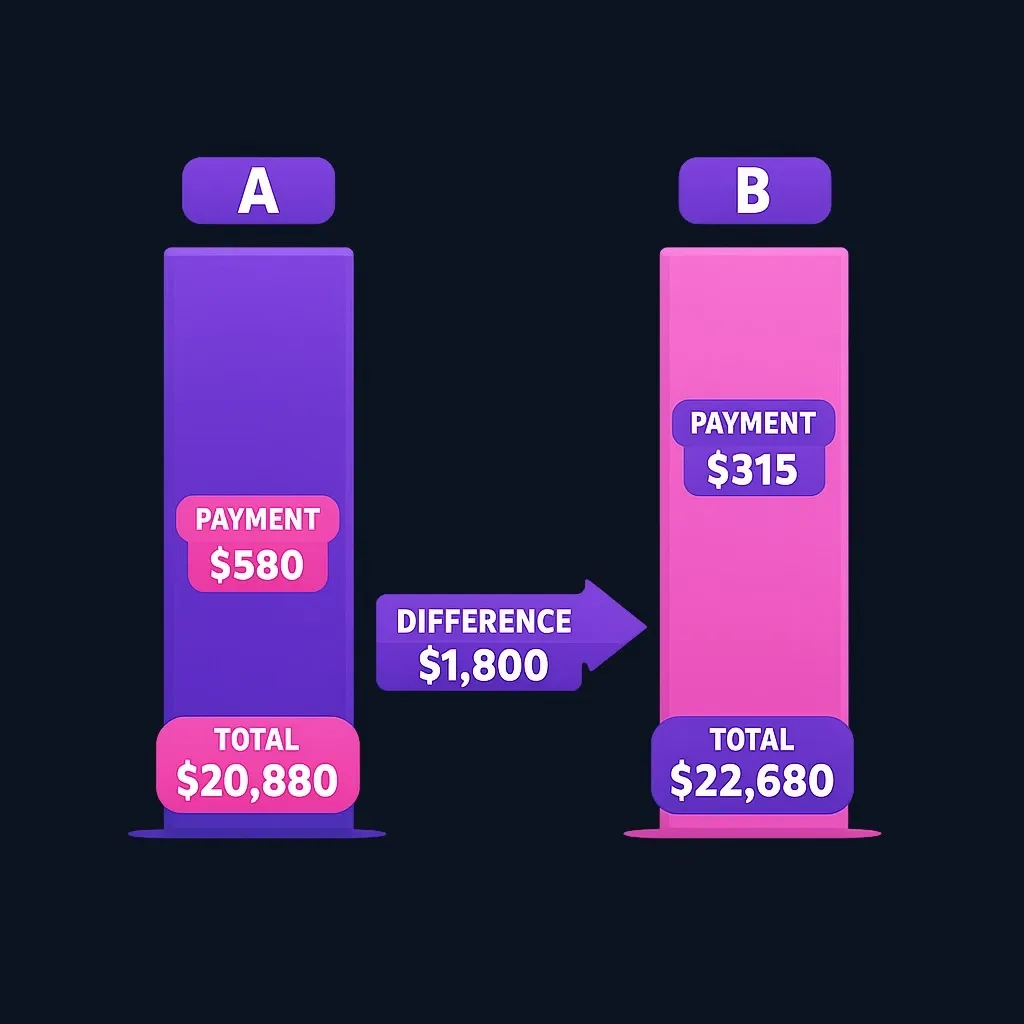
Two loans with the same monthly payment can have very different total costs because the amount financed, APR, or term differs.
Practice trading with Finelo
Practice in a simulator, learn with bite-sized lessons, and build confidence before risking real money.
A practical shopping process
1. Check all three credit reports
Use AnnualCreditReport.com—the federally authorized source—to review reports. Dispute inaccurate information with the reporting company and the furnisher. Accurate negative information generally cannot be removed merely because it is unfavorable.
2. Set a total transportation budget
Include the vehicle price, taxes, registration, insurance, maintenance, fuel or charging, parking, and repairs. The maximum a lender will approve may exceed the payment that fits the household budget.
3. Compare financing before the dealership
Request offers or preapprovals from more than one bank, credit union, or other lender. Prequalification may use a soft inquiry, while preapproval or a full application may use a hard inquiry; confirm before submitting.
4. Keep rate shopping within a focused period
The CFPB says auto-loan inquiries made within a typical 14-to-45-day shopping window are generally treated as one inquiry for scoring purposes, although the exact treatment depends on the scoring model. See How will shopping for an auto loan affect my credit?.
5. Negotiate the vehicle and financing separately
Know the vehicle price, trade-in value, and loan terms. A lower monthly payment created by a longer term is not the same as a lower price.
6. Review the final contract
Confirm that the final APR, amount financed, add-ons, payment schedule, and total of payments match the accepted offer before signing.
What may improve an application
No action guarantees a score increase or loan approval. Depending on the credit report and lender, useful preparation may include:
- correcting material reporting errors;
- reducing revolving balances before their next statement is reported;
- avoiding unrelated credit applications during the shopping period;
- saving a larger down payment without exhausting emergency cash;
- selecting a less expensive vehicle or borrowing less; and
- documenting stable, verifiable income.
A co-signer can strengthen an application, but the co-signer becomes legally responsible for the debt and late payments can affect both parties’ credit. It should not be described as a simple approval tool.
Risks of high-cost financing
“Buy here, pay here” and other subprime financing may be available to consumers with weak or limited credit, but availability is not the same as affordability. Compare:
- APR and finance charge;
- loan term;
- required add-ons;
- payment frequency;
- late and repossession terms;
- whether on-time payments are reported to credit bureaus; and
- whether the contract includes devices or provisions related to vehicle disablement or repossession.
The CFPB recommends comparing bank or credit-union offers even when credit is not strong. See different ways to finance a vehicle.
Frequently asked questions
What credit score is needed to buy a car?
There is no nationwide minimum. The result depends on the lender, score model, income, debt, vehicle, down payment, amount financed, and other underwriting factors.
Can someone finance a car with a low score?
Possibly, but approval may come with a higher APR, larger down payment, smaller approved amount, shorter eligible vehicle list, or other restrictions. Compare total cost and avoid assuming the first approval is the only available offer.
Does checking a personal credit score hurt it?
Checking one’s own score or report is generally a soft inquiry and does not affect the score. A lender’s application inquiry may be hard. Ask which type of inquiry will occur.
Is a longer loan better because the payment is lower?
Not necessarily. A longer term usually increases total interest and can increase the period of negative equity. Compare the finance charge and total of payments.
Should a borrower focus on the interest rate or APR?
Review both. The APR is broader because it incorporates the interest rate and certain mandatory fees, while the contract’s dollar disclosures show the projected total cost.
Bottom line
A “good” auto-loan score is not a universal number. The meaningful result is the complete written offer: APR, amount financed, finance charge, total of payments, term, add-ons, and conditions.
Review credit reports, set a total transportation budget, compare several offers in a focused shopping window, and verify the final contract before signing.
For more plain-language borrowing education, visit the Finelo Blog.
Financial LiteracyFinancial Education
Practice trading with Finelo
Practice in a simulator, learn with bite-sized lessons, and build confidence before risking real money.
About the author
Finelo Team
The Finelo Team creates practical investing and trading education designed to help beginners learn faster with structured challenges, simulator practice, and bite-sized lessons.
Keep reading — Related articles

Financial Literacy
Mercury Books Review 2026: Is It Worth It for Startups?
Mercury Books brings double-entry accounting into Mercury. Review its $35 pricing, reports, AI features, integrations, and migration limits.
Finelo Team
Financial Literacy
Why is My FICO Score Lower Than My Credit Score?
Example takeaway: seeing a higher score in a bank app doesn’t guarantee lenders will see the same FICO number at application time; lenders often pull a specific FICO version from a specific bureau.
Finelo Team
Financial Literacy
Why Is My FICO Score Higher Than My Credit Score?
Brief educational note: this article is educational, not financial or investment advice; investing and credit decisions involve risk and possible loss.
Finelo Team


