For U.S. readers: This article discusses U.S. rules and financial products. State rules and individual eligibility may differ.
How Much Should You Set Aside for Taxes When Self-Employed?
There is no reliable universal percentage.
8 min read
Practice trading with Finelo
Practice in a simulator, learn with bite-sized lessons, and build confidence before risking real money.
Want to learn more?
Practice in a simulator, learn with bite-sized lessons, and build confidence before risking real money.
Explore FineloExplore Finelo's 28-day challenges
Turn learning into a daily habit with guided challenge paths.
Quick answer
There is no reliable universal percentage. A sound federal estimate combines expected income tax, self-employment tax, and any other federal taxes, then subtracts expected withholding and refundable credits. State and local obligations are calculated separately. For 2026, the IRS says estimated tax generally applies when you expect to owe at least $1,000 after withholding and credits and those prepayments will be below the applicable threshold (IRS Publication 505 for 2026).
A percentage such as 25% or 30% can be a temporary cash-management placeholder, but it is not an IRS rule and may be too high or too low. Use the 2026 Form 1040-ES worksheet or tax software to turn your own income, deductions, credits, filing status, and prior-year tax into a dollar estimate.
Finelo provides financial education, not tax, financial, or investment advice. Federal rules change, state rules differ, and individual circumstances can materially change the result.
What your set-aside may need to cover
Federal income tax
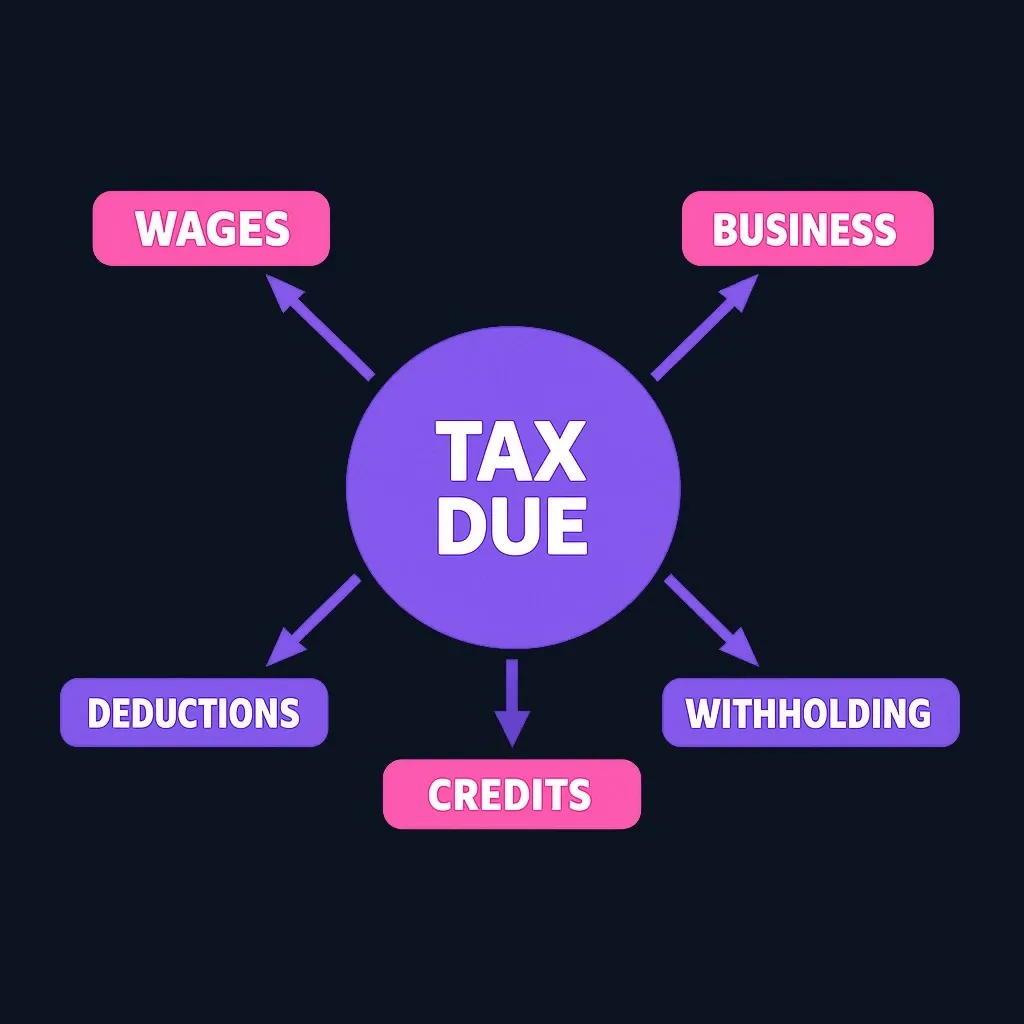
Federal income tax uses progressive brackets and depends on the taxpayer's entire return, not just business profit. Wages, investment income, a spouse's income, filing status, deductions, and credits can all change the amount.
Self-employment tax
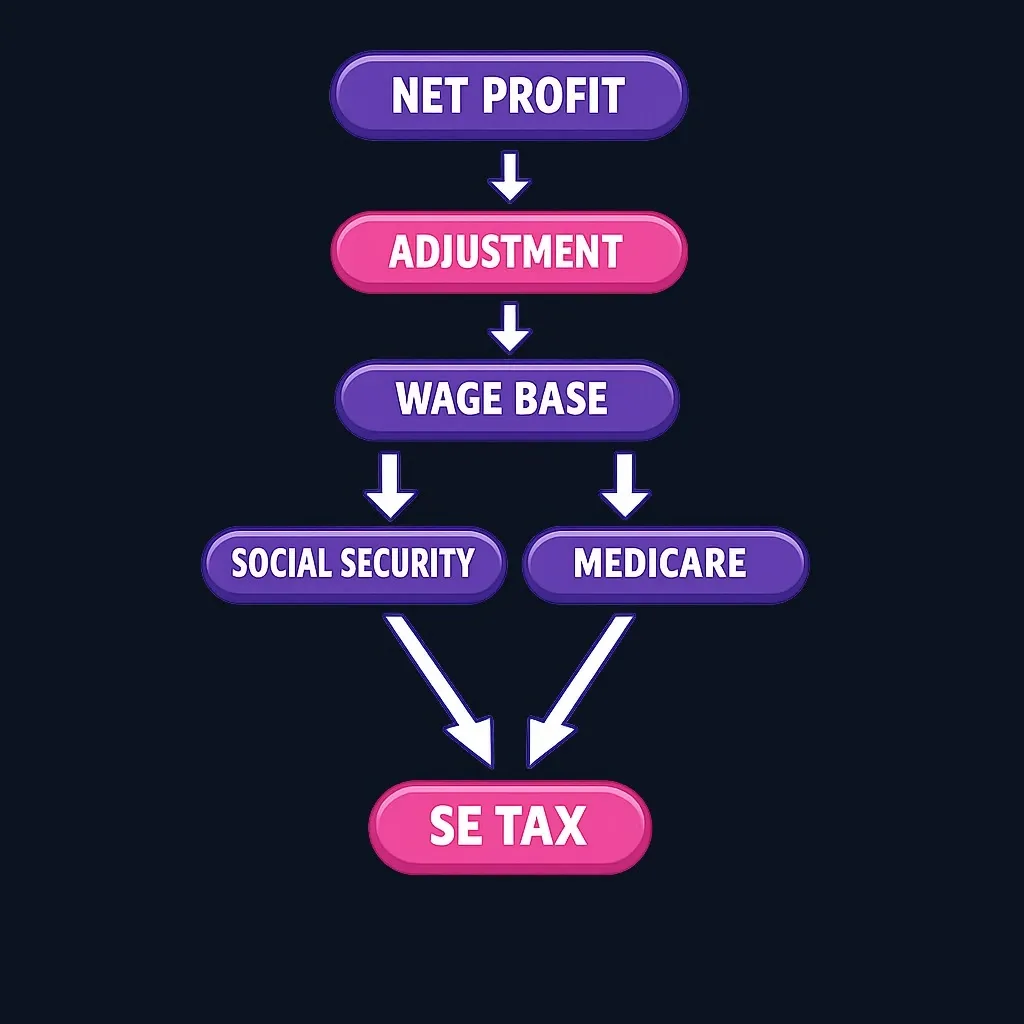
Self-employment tax generally funds Social Security and Medicare for people with net earnings from self-employment. Schedule SE is the official calculation form (IRS Schedule SE information). Do not simply multiply gross receipts by the headline tax rate: the calculation starts from net profit, applies the Schedule SE net-earnings adjustment, coordinates the Social Security wage base with wages, and may include Additional Medicare Tax in higher-income cases.
State and local tax
State treatment varies. Depending on location and business structure, the total may include individual income tax, franchise or gross-receipts tax, local income tax, or other business charges. A federal worksheet does not cover these amounts.
Other taxes and credits
The estimated-tax worksheet can also reflect items such as alternative minimum tax, net investment income tax, household employment tax, refundable credits, and other amounts reported on an individual return. That is another reason a flat percentage can miss the result.
A practical calculation method for 2026
Use this workflow for planning; use the official worksheet for the filed payment amount.
- Project full-year gross business income. Include invoices expected to be paid during the tax year under the accounting method you use.
- Subtract ordinary and necessary business expenses. Use reasonable estimates supported by current records; do not count personal spending as a business expense.
- Estimate self-employment tax. Complete the Schedule SE portion of the 2026 Form 1040-ES worksheet or use tax software.
- Estimate adjusted gross income and taxable income. Include income outside the business, expected adjustments, the applicable standard or itemized deduction, and qualified business income treatment if applicable.
- Estimate credits and other taxes. Include only credits you reasonably expect to qualify for.
- Subtract expected withholding. Withholding from a job or a spouse's job counts toward federal prepayments.
- Compare the current-year and prior-year methods. Publication 505 explains the required annual payment and the special rule for higher-income taxpayers.
- Add state and local estimates separately. Use the relevant state tax agency's current instructions.
- Divide the amount into cash-flow transfers. Moving a portion of each payment into a separate savings account can help, but the official payment schedule—not the savings transfer schedule—controls tax timing.
The federal estimated-tax threshold and safe-harbor rules
For most individuals in 2026, estimated tax is generally required when both conditions apply:
- expected tax due after withholding and refundable credits is at least $1,000; and
- withholding and refundable credits are expected to be less than the smaller of 90% of the tax shown on the 2026 return or 100% of the tax shown on the 2025 return.
The prior-year percentage generally becomes 110% when 2025 adjusted gross income exceeded $150,000, or $75,000 for a 2026 return filed as married filing separately. Farmers, fishers, nonresident aliens, estates, and trusts have additional or different rules. These are penalty-planning thresholds, not estimates of the final tax bill. The full rules and exceptions are in IRS Publication 505.
If you had no 2025 tax liability, were a U.S. citizen or resident alien for the entire year, and the 2025 return covered 12 months, Publication 505 says estimated tax is not required for 2026. State rules may differ.
Equal installments versus irregular income
The familiar “quarterly” shorthand can be misleading. Federal estimated-tax due dates do not divide the calendar into four equal three-month quarters, and a payment can be late even if the annual total is ultimately enough.
If income arrives unevenly—for example, most revenue is earned late in the year—the annualized income installment method may better match payments to when income was earned. It requires additional calculations and generally involves Form 2210 Schedule AI. Withholding is treated differently from estimated payments for timing purposes, so someone who also has wages may be able to adjust Form W-4 instead. Publication 505 explains both approaches.
Practice trading with Finelo
Practice in a simulator, learn with bite-sized lessons, and build confidence before risking real money.
Illustrative example—not a tax calculation
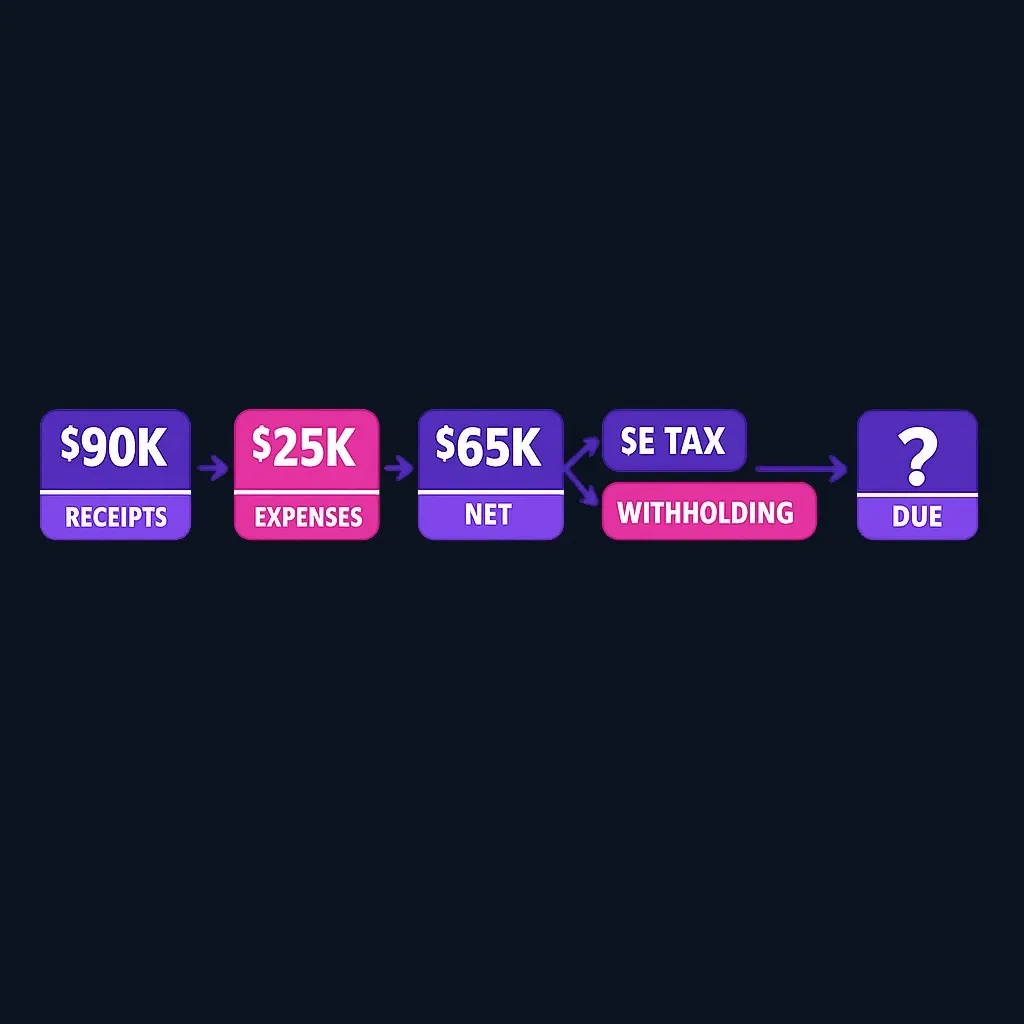
Suppose a freelance designer projects $90,000 of receipts and $25,000 of ordinary business expenses. Projected net business profit is $65,000. The designer also has part-time wages with federal withholding.
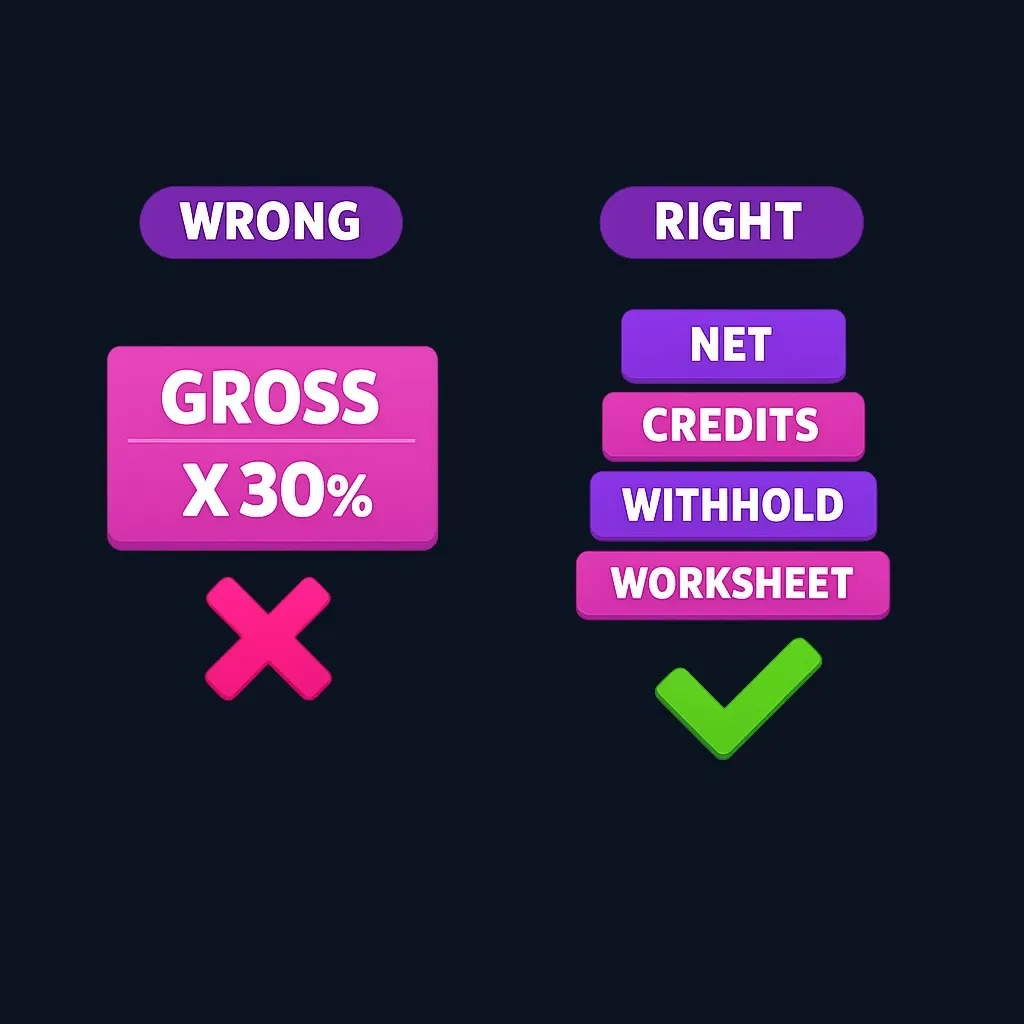
The correct next step is not to multiply $65,000 by a generic 30%. The designer would:
- enter the projected net profit into the Schedule SE calculation;
- combine business income, wages, and other expected income;
- estimate deductions and credits;
- subtract wage withholding;
- compare the current-year result with the applicable prior-year safe-harbor amount; and
- add a separate state estimate.
The result may be converted into a percentage of each invoice for cash management, but that personal percentage should be recalculated when profit, withholding, or credits change.
Recordkeeping that improves the estimate
- Reconcile business income and expenses at least monthly.
- Keep receipts and supporting records for claimed expenses.
- Separate business and personal transactions where practical.
- Save the completed estimated-tax worksheet and confirmation for each payment.
- Reforecast after a major contract, expense, job change, marriage, move, or change in credits.
- Record federal and state payments separately so they are not counted twice.
An expense is not valuable merely because it is deductible. A deduction generally reduces taxable income; it does not reimburse the full cost. Spend based on a genuine business need, then document the correct tax treatment.
Common mistakes
Applying a flat percentage to gross receipts
Gross receipts ignore business expenses, other household income, withholding, and credits. Use a flat transfer rate only as a temporary savings mechanism, then reconcile it to an actual estimate.
Treating the safe harbor as the final tax bill
Paying enough to reduce an underpayment penalty does not erase any remaining balance due with the return.
Dividing the annual estimate by four after income changes
If earlier payments were too low or income is seasonal, equal installments may not produce the right timing result. Recalculate with the current instructions.
Forgetting state obligations
Federal prepayments do not satisfy state or local tax bills. Check the official revenue-department site for every jurisdiction where the business may have a filing obligation.
Assuming every home-office or vehicle cost is deductible
Each category has qualification and substantiation rules. Keep records and use the current IRS instructions rather than relying on a generic checklist.
Checklist before making a payment
- Projected business receipts and expenses are current.
- Wages and other household income are included.
- Expected federal withholding is included once.
- The 2026 Form 1040-ES or Publication 505 worksheet is complete.
- The 2025 return was checked for the prior-year safe-harbor calculation.
- Higher-income, farming, fishing, or nonresident rules were considered if relevant.
- State and local calculations were completed separately.
- Payment confirmations and worksheet versions will be retained.
FAQ
Is 30% always enough for self-employed taxes?
No. It could be more than necessary for one taxpayer and insufficient for another. The answer depends on net profit, filing status, other income, Social Security wages, deductions, credits, state law, and payment timing.
Can I pay through withholding instead of quarterly estimated payments?
Potentially. The IRS states that employees may ask an employer to withhold more by submitting a new Form W-4. Whether that covers the required amount depends on the household's full projection and timing.
What if my income changes during the year?
Recalculate. Publication 505 includes a worksheet for revising the estimate and an annualized method for uneven income. Preserve each version so the payment history can be reconstructed.
Does a separate tax savings account count as paying the IRS?
No. Moving money into your own account helps with budgeting, but tax is not paid until it reaches the IRS or the relevant state agency.
Where should I verify current federal figures?
Use IRS Publication 505 for 2026, the current Form 1040-ES instructions, and Schedule SE. A qualified tax professional can apply them to a complex or changing situation.
Bottom line
The strongest set-aside method is a current dollar projection, not a universal percentage. Estimate federal income tax and self-employment tax with the official 2026 worksheet, subtract withholding and credits, compare the applicable penalty-safe-harbor methods, add state obligations, and revise the calculation when income changes. A per-invoice percentage can then be used to fund that estimate—not replace it.
Financial LiteracyFinancial Education
Practice trading with Finelo
Practice in a simulator, learn with bite-sized lessons, and build confidence before risking real money.
About the author
Finelo Team
The Finelo Team creates practical investing and trading education designed to help beginners learn faster with structured challenges, simulator practice, and bite-sized lessons.
Keep reading — Related articles

Financial Literacy
Mercury Books Review 2026: Is It Worth It for Startups?
Mercury Books brings double-entry accounting into Mercury. Review its $35 pricing, reports, AI features, integrations, and migration limits.
Finelo Team

Financial Literacy
Why is My FICO Score Lower Than My Credit Score?
Example takeaway: seeing a higher score in a bank app doesn’t guarantee lenders will see the same FICO number at application time; lenders often pull a specific FICO version from a specific bureau.
Finelo Team

Financial Literacy
Why Is My FICO Score Higher Than My Credit Score?
Brief educational note: this article is educational, not financial or investment advice; investing and credit decisions involve risk and possible loss.
Finelo Team


