A margin call is a demand from your broker to add cash or securities to your account because your equity has fallen below the required minimum for positions bought with borrowed money. If you do not meet the call in time, the broker can sell your holdings, often without asking which ones. This page is for investors who use, or are considering, a margin account and want the mechanics of a margin call explained in plain language: what triggers one, what happens next, how to respond, and how to keep it from happening. If you take one step after reading, review your account's maintenance requirement and current equity cushion today.
Margin Call Explained: What Every Investor Should Know

A margin call is a demand from your broker to add cash or securities to your account because your equity has fallen below the required minimum for positions bought with borrowed money. If you do not meet the call in…
9 min read
Practice trading with Finelo
Practice in a simulator, learn with bite-sized lessons, and build confidence before risking real money.
Want to learn more?
Practice in a simulator, learn with bite-sized lessons, and build confidence before risking real money.
Explore FineloExplore Finelo's 28-day challenges
Turn learning into a daily habit with guided challenge paths.
What is a margin call?
Buying on margin means borrowing part of the purchase price of securities from your broker, using the account's holdings as collateral. The loan magnifies both gains and losses: a 10% move in the stock is a larger percentage move on the cash you actually put in.
Because the broker's loan is secured by your securities, the broker requires your equity, the account's value minus what you owe, to stay above a minimum percentage. When falling prices push equity below that line, the broker issues a margin call: a demand to restore the cushion by depositing funds, adding securities, or selling positions.
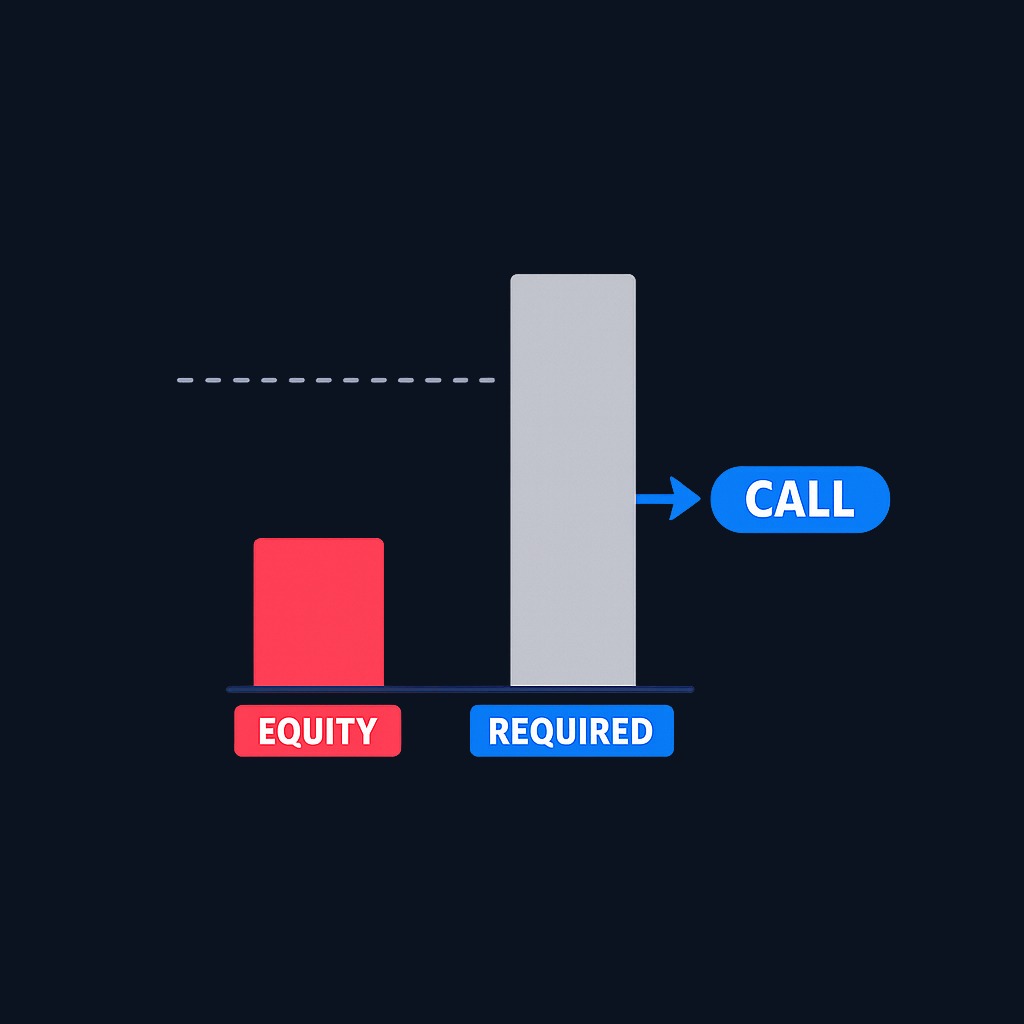
A margin call is not a courtesy notice. It is a contractual demand under your margin agreement, and brokers can act on it quickly.
How margin accounts and margin requirements work
Margin lending in the United States operates under federal rules and self-regulatory requirements, with brokers layering their own, often stricter, "house" requirements on top. Three numbers matter:
- Initial margin. Under Federal Reserve Regulation T, the initial requirement is generally 50% for eligible margin-equity securities, subject to exceptions and broker rules.
- Maintenance margin. FINRA's minimum for long margin securities is generally 25% of current market value, while brokers commonly impose higher house requirements.
- House requirements. Brokers can raise requirements on specific securities at any time, sometimes overnight, which by itself can trigger a call even when prices have not moved.
FINRA's current margin-call guidance explains the 50% initial framework, 25% maintenance minimum, higher house requirements, and the broker's ability to liquidate securities without consulting the customer.
A worked example
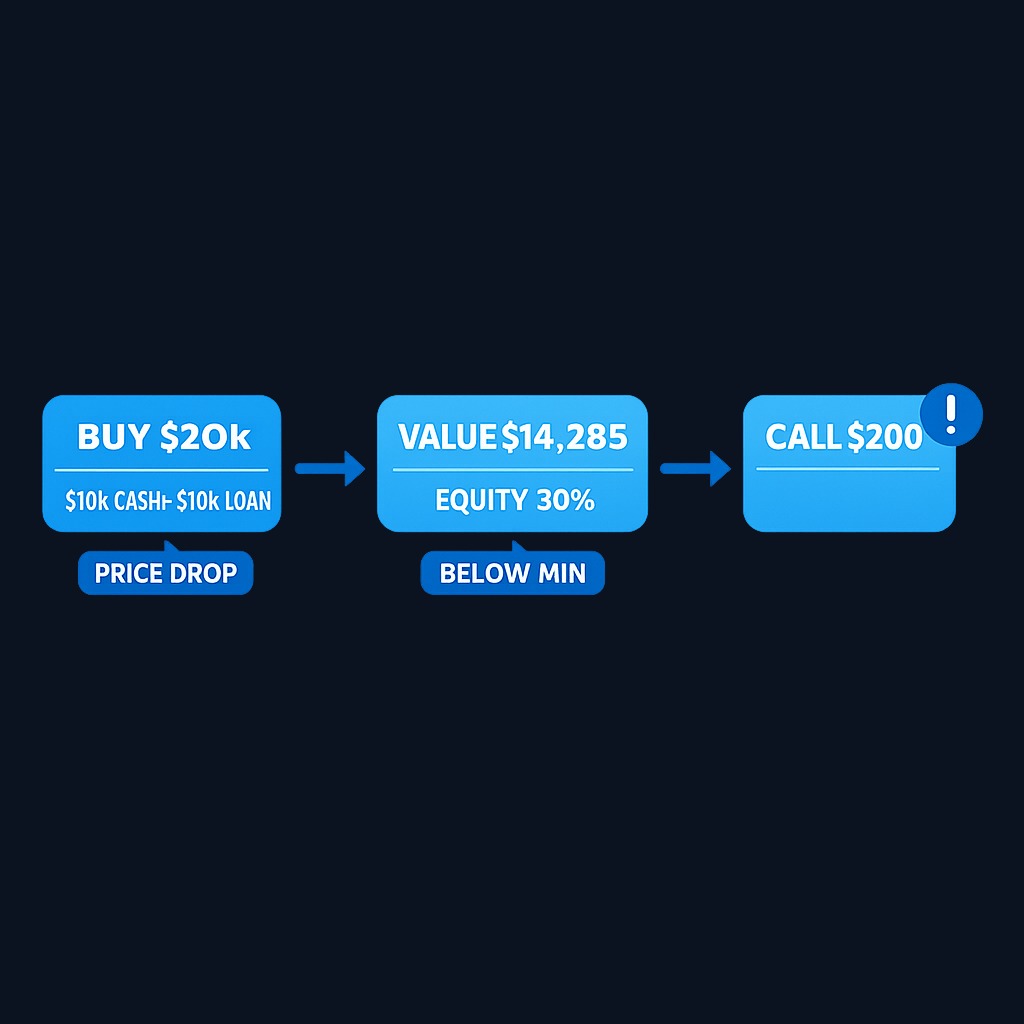
Say you buy $20,000 of stock using $10,000 of your own cash and a $10,000 margin loan, and your broker's maintenance requirement is 30%.
| Scenario | Account value | Loan | Your equity | Equity % | Status |
|---|---|---|---|---|---|
| At purchase | $20,000 | $10,000 | $10,000 | 50% | Comfortable |
| Stock falls 20% | $16,000 | $10,000 | $6,000 | 37.5% | Still above 30% |
| Stock falls 30% | $14,000 | $10,000 | $4,000 | 28.6% | Margin call |
At a 30% requirement, your account value can fall to about $14,285 before equity breaches the line. The call amount is the sum needed to restore the required percentage, roughly $200 of new equity in the last row, and more if the stock keeps sliding while you decide.
What triggers a margin call
- Falling prices. The most common cause: the market value of margined positions drops far enough that equity breaches the maintenance requirement.
- Raised requirements. Brokers increase house margin on volatile names, hard-to-borrow stocks, or concentrated accounts. A requirement hike can create a call with no price change at all.
- Concentration. A single position dominating the account often carries a higher requirement, and its fall hits equity harder than a diversified book would.
- Volatility events. Sharp market-wide drawdowns produce calls across many accounts simultaneously, which is also when selling to meet them is most painful.
- Withdrawals and fees. Taking cash out of a thinly cushioned account, or accumulating margin interest on the loan, can quietly erode equity toward the line.
What happens if you do not meet a margin call
The consequences escalate quickly:
- Forced liquidation. The broker can sell securities in your account to restore the requirement. Your margin agreement typically allows this without advance notice and without letting you choose which positions go.
- Locked-in losses. Forced sales happen at prevailing prices, often near the bottom of a decline, converting paper losses into real ones.
- Tax consequences. Involuntary sales can realize gains or losses at unplanned times, complicating your tax position.
- A remaining debt. If liquidation proceeds do not cover the loan, you still owe the difference. A margined account can lose more than the cash you deposited.
- Account restrictions. Repeated calls can lead to reduced borrowing limits, higher requirements, or closure of margin privileges.
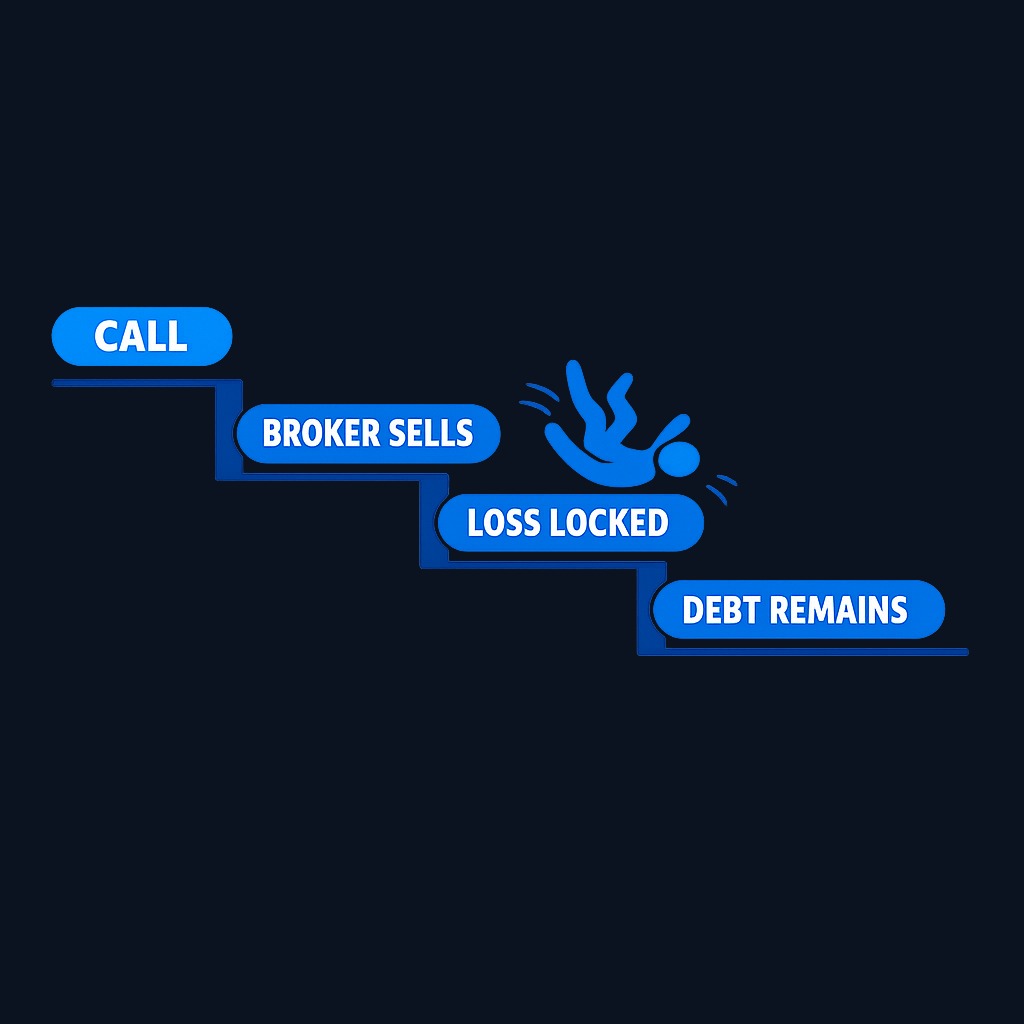
Brokers are not obligated to give you the courtesy period you might expect. In fast markets, sales can begin the same day the call is issued.
How to respond to a margin call
If you receive a call, act deliberately and fast:
- Verify the numbers. Check the call amount, the deadline, and which positions drove the breach.
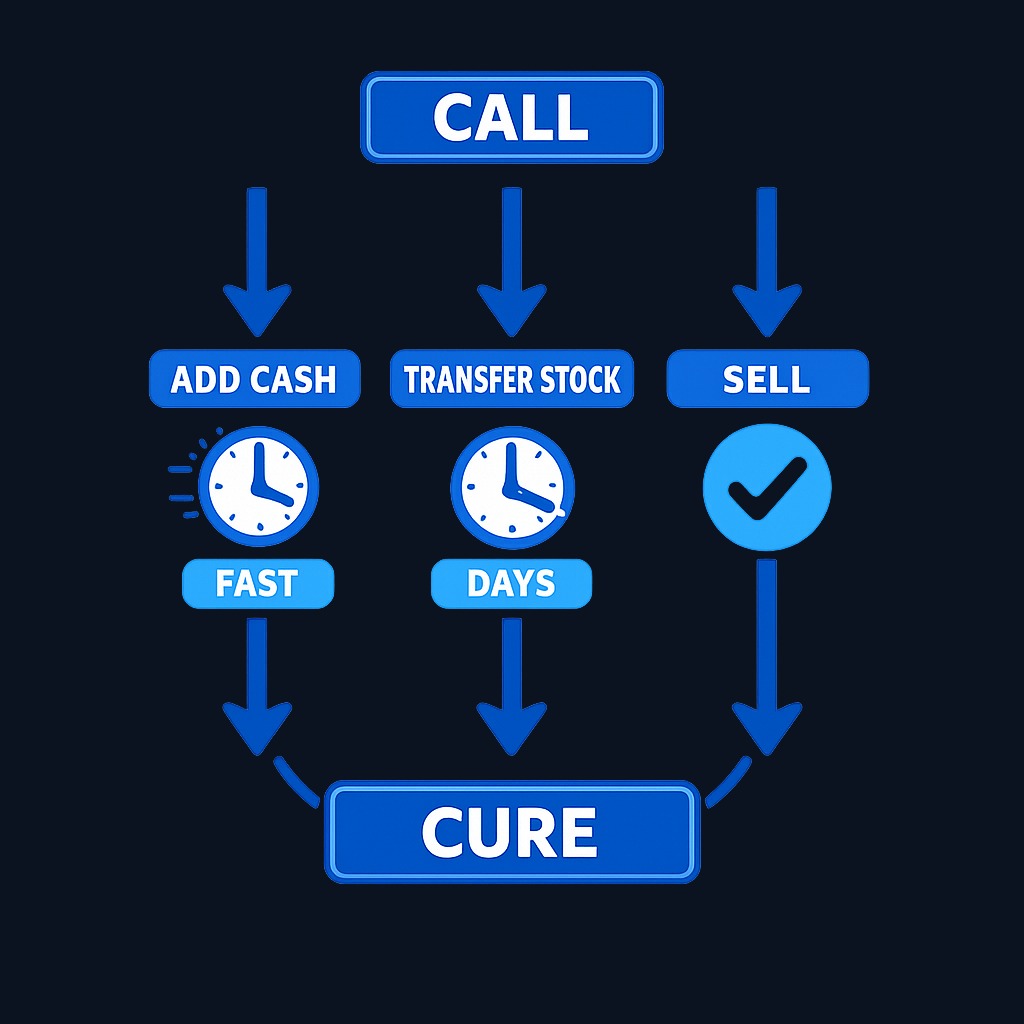
- Choose your cure. You can deposit cash, transfer in marginable securities, or sell positions yourself. Selling your own choice of holdings is usually better than letting the broker choose.
- Prioritize speed. Transfers that settle in days may not arrive before the deadline. Confirm timing with the broker before relying on them.
- Do not average down to fix it. Buying more of the falling stock with more borrowed money increases the exact exposure that caused the call.
- Talk to the broker. Extensions exist in some cases, but treat them as exceptions, not entitlements, and get any agreement in writing.
Practice trading with Finelo
Practice in a simulator, learn with bite-sized lessons, and build confidence before risking real money.
How to avoid margin calls
- Borrow far less than the maximum. A 50% loan-to-value cushion at purchase disappears quickly in a drawdown. Many careful investors keep borrowing to a small fraction of the limit.
- Watch equity, not just prices. Track your equity percentage against the requirement, and set alerts well above the trigger level.
- Diversify margined positions. Concentration raises both the odds of a breach and the broker's requirement itself.
- Keep a cash reserve. Ready funds let you meet a call without selling into weakness.
- Understand house rules. Read the margin agreement: notice terms, liquidation rights, and how requirement changes are communicated.
- Reassess in volatile markets. Reducing leverage before a storm is cheaper than reacting inside one.
What to know before deciding
Margin is a tool with a narrow set of good uses and a wide set of expensive mistakes. Before using borrowed money:
- Know the full cost. Margin loans accrue interest daily, and the rate compounds against your returns whether the position works or not.
- Size for the worst week, not the average one. The question is not whether you can afford the loan today, but whether a fast 30% drawdown would force you out.
- Accept the asymmetry. Leverage magnifies losses at exactly the moments liquidity and judgment are worst.
- Remember who controls the account. The margin agreement gives the broker broad rights over your collateral once requirements are breached.
- Paper losses become real. Long-term conviction does not protect a leveraged position from a short-term forced sale.
Decision framework: is margin borrowing right for you
- Purpose. If the goal is simply "more exposure", reconsider; leverage rewards precise, time-limited theses, not general optimism.
- Cushion. Model the price drop that would trigger a call at your intended borrowing level. If a routine correction gets you there, borrow less.
- Cash backstop. Confirm you could meet a plausible call from reserves without selling.
- Cost hurdle. Compare the loan's interest rate with realistic expected returns; the borrowing cost is a guaranteed drag, the return is not guaranteed at all.
- Temperament. If a 20% drawdown would push you into panicked decisions unleveraged, margin will make that worse.
If any step fails, a cash account, or a smaller margined position, is the stronger choice.
FAQ
What is a margin call in simple terms?
It is your broker telling you that your account's equity has fallen below the required minimum for money you borrowed, and that you must add funds or securities, or sell something, to restore the cushion, or the broker will sell for you.
How long do I have to meet a margin call?
Deadlines vary by broker and market conditions, commonly a few business days, but brokers can demand immediate action and can liquidate without waiting in fast markets. The margin agreement, not custom, governs the timing.
Can I lose more money than I deposited?
Yes. If liquidation does not cover the loan, you owe the shortfall. That possibility is the defining risk difference between a margin account and a cash account.
Does a margin call affect my credit score?
The call itself is an account matter with your broker, not a credit-bureau event. An unpaid deficiency after liquidation, however, can be pursued as a debt, and that process can affect you like any other unpaid obligation.
Conclusion and next steps
The mechanics behind every margin call explained above reduce to one sentence: borrowed money plus falling collateral equals a demand you must meet on someone else's timeline. The reliable defenses are modest leverage, a real cash reserve, diversified positions, and knowing your broker's rules before you need them. If you hold margined positions now, check your equity percentage against the maintenance requirement today and decide your response plan before any call arrives. If you are still learning the vocabulary of leverage, requirements, and risk, the Finelo app teaches these concepts through short interactive lessons built for beginners.
TradingMarketsOptionsFinancial StatementsBeginner
Practice trading with Finelo
Practice in a simulator, learn with bite-sized lessons, and build confidence before risking real money.
About the author
Finelo Team
The Finelo Team creates practical investing and trading education designed to help beginners learn faster with structured challenges, simulator practice, and bite-sized lessons.
Keep reading — Related articles

Trading
Understanding Walk Forward Analysis in Trading
Brief educational note: this article is educational — not investment advice — and trading involves the risk of loss.
Finelo Team

Trading
VWAP vs Moving Average: Formulas, Uses, and Limits
VWAP weights price by recorded volume over a defined period, while a moving average summarizes a sequence of prices over a rolling lookback.
Finelo Team

Trading
Volume Profile vs Market Profile: What Each Chart Measures
Volume Profile groups traded volume by price level.
Finelo Team