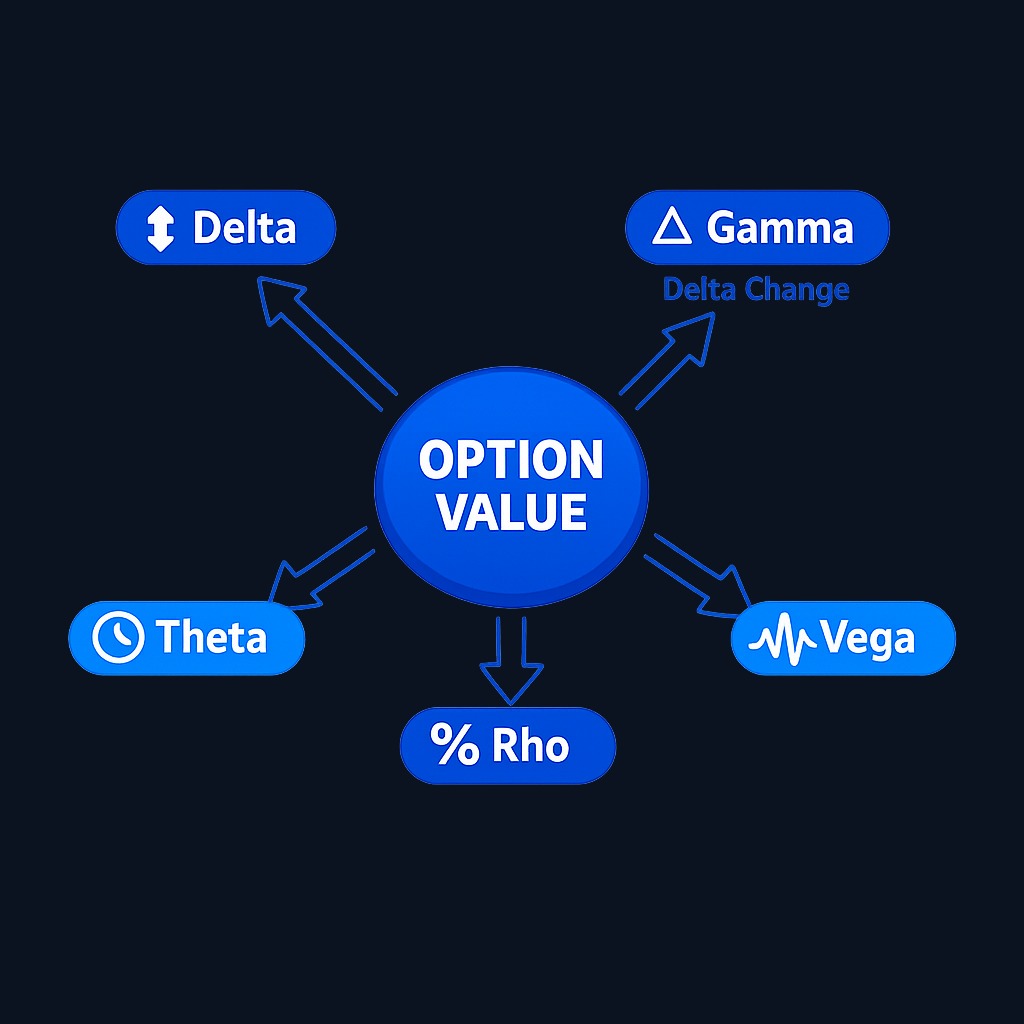
Option Greeks are model-derived estimates of how an option's theoretical value responds to small changes in specified inputs: delta (underlying price), gamma (the change in delta), theta (time), vega (implied volatility), and rho (interest rates). They are sensitivities, not standardized promises, and values can differ across models and data inputs. The Options Industry Council's Greek overview and OCC's options disclosure document provide the appropriate foundation before using them.
Option Greeks Explained: Delta, Gamma, Theta, Vega, and Rho
Option Greeks are model-derived estimates of how an option's theoretical value responds to small changes in specified inputs: delta (underlying price), gamma (the change in delta), theta (time), vega (implied…
7 min read
Practice trading with Finelo
Practice in a simulator, learn with bite-sized lessons, and build confidence before risking real money.
Want to learn more?
Practice in a simulator, learn with bite-sized lessons, and build confidence before risking real money.
Explore FineloExplore Finelo's 28-day challenges
Turn learning into a daily habit with guided challenge paths.
What are option greeks?
Every option contract has a price, called the premium, and that price depends on several moving parts at once: where the underlying stock trades, how much time remains until the expiration date, how volatile the market expects the stock to be, and the prevailing interest rate. The greeks isolate each factor. Each greek answers one question: if this single input changes a little and everything else stays still, how much does the option's value change?
Traders use them as a dashboard. Instead of guessing why a position gained or lost, you can attribute the change: some came from the stock moving (delta), some from time decay (theta), some from a shift in implied volatility (vega).
The five main greeks
Delta: sensitivity to the underlying price
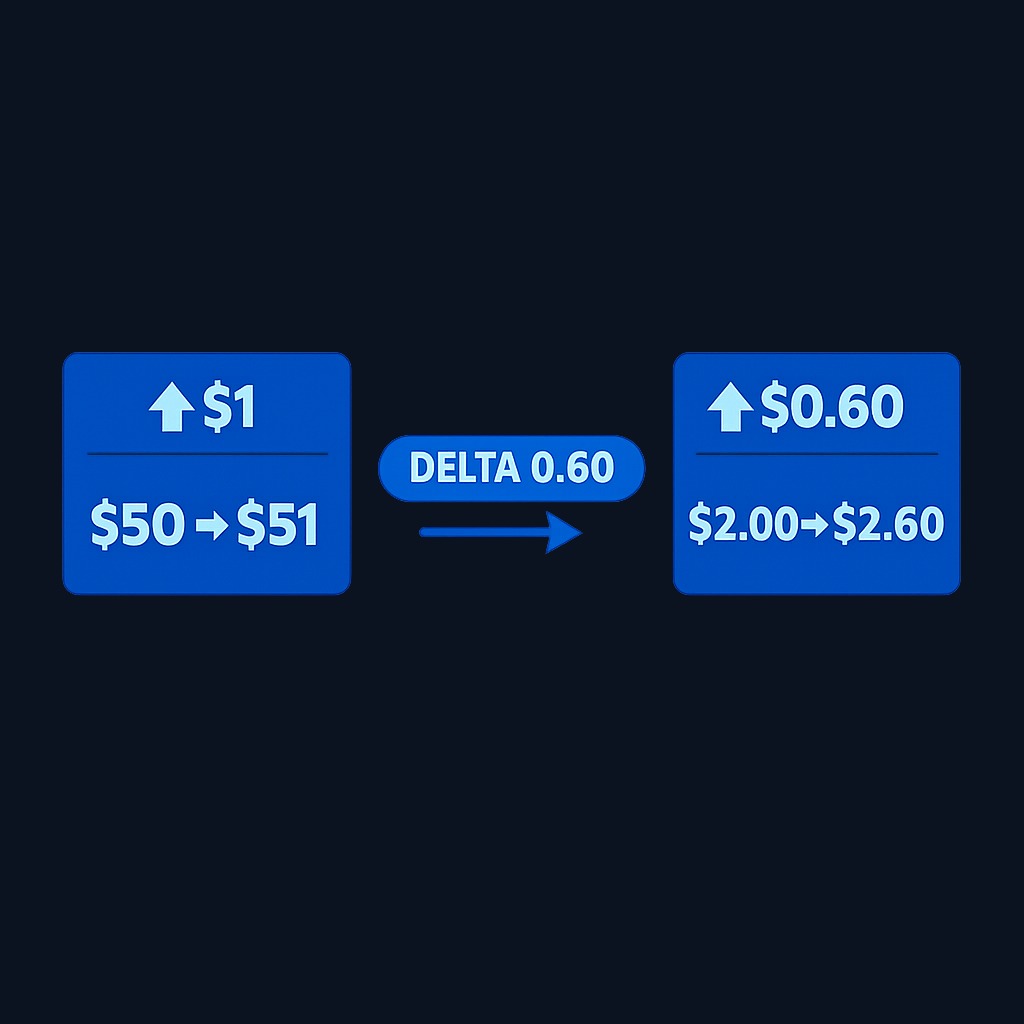
Delta estimates the first-order change in an option's theoretical value for a small move in the underlying, holding other model inputs constant. A long call with delta 0.60 would be expected to gain about $0.60 per share for a small $1 rise before gamma and other inputs are considered. Long calls generally have positive delta and long puts negative delta. Some traders use call delta as a rough probability-of-expiring-in-the-money heuristic, but that interpretation depends on model assumptions and is not the same as a forecast or the option's real-world success probability.
Gamma: how fast delta changes
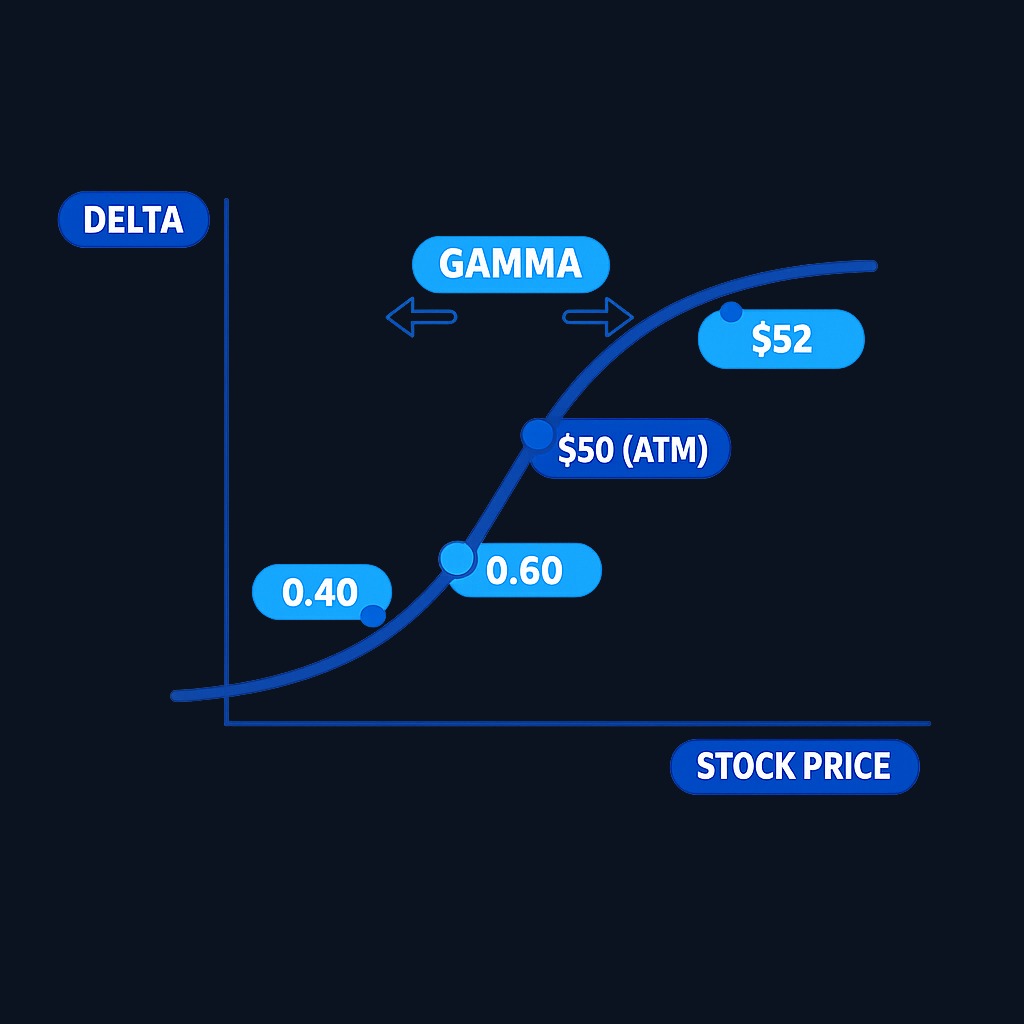
Gamma measures the change in delta per $1 move in the underlying. It is highest for at-the-money contracts close to expiration, which is why short-dated options can flip from sleepy to explosive in a single session.
Theta: time decay
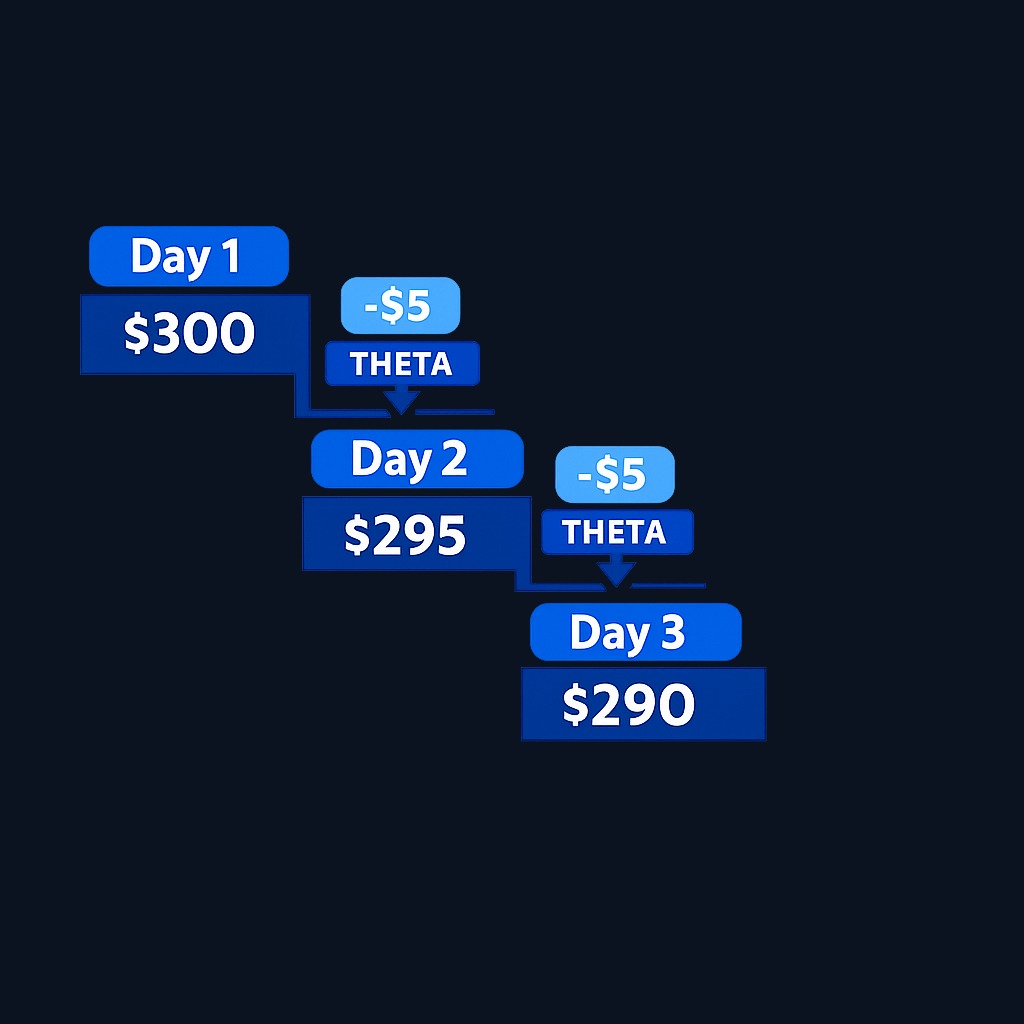
Theta estimates the change in theoretical value as time passes, with other inputs held constant. A long option may show theta of -0.05, or roughly a $5 decline per standard 100-share contract for one day under the model; the corresponding short position has the opposite sign. Time decay is nonlinear and varies with moneyness, volatility, and time to expiration, so “accelerates near expiration” is not a complete rule for every contract.
Vega: sensitivity to implied volatility
Vega measures the price change for a one-percentage-point move in implied volatility. When fear rises, implied volatility usually rises, inflating premiums even if the stock price is unchanged. When volatility collapses after an event, options can lose value fast - the classic post-earnings "volatility crush."
Rho: sensitivity to interest rates
Rho tracks the effect of a one-percentage-point change in interest rates. It matters most for long-dated contracts. You can follow the benchmark rates that feed into rho through the Federal Reserve's H.15 selected interest rates release.
How the greeks shape prices and strategies
| Greek | Measures | Helps most with | Biggest for |
|---|---|---|---|
| Delta | $ move per $1 in underlying | Directional exposure | Deep in-the-money options |
| Gamma | Change in delta | Risk near expiry | At-the-money, short-dated |
| Theta | Change associated with time passing | Long-versus-short decay exposure | Often largest in magnitude near the money as expiration approaches, with important exceptions |
| Vega | Move per 1% volatility change | Event trades | Long-dated, at-the-money |
| Rho | Move per 1% rate change | Long-term positions | LEAPS-style contracts |
Strategy design is mostly greek management. Buying a call or put means paying theta to own delta and vega. Selling premium flips the trade: you collect decay but accept gamma risk. Spreads net one contract's greeks against another to keep the exposures you want and shed the ones you do not.
Applying the greeks: two quick scenarios
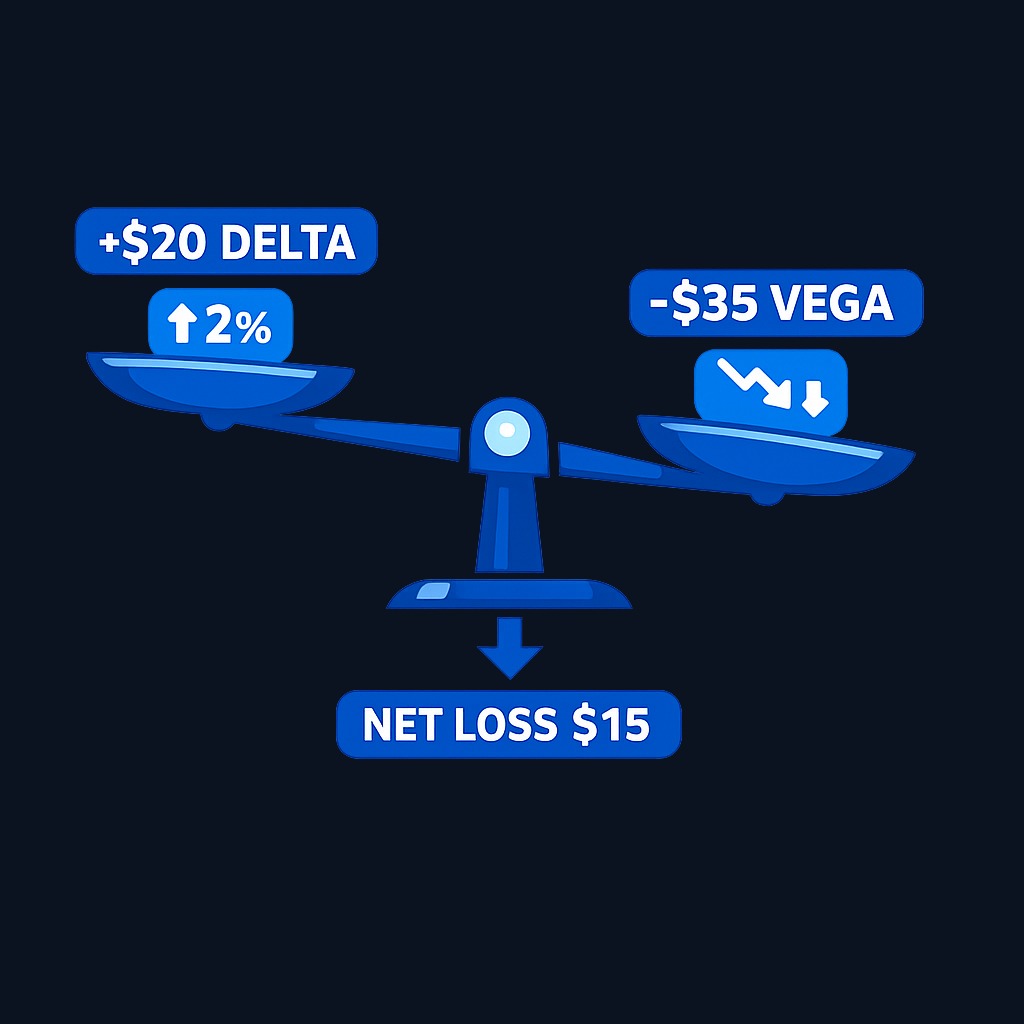
Scenario 1: the earnings trade. A trader buys a call the day before earnings, the stock rises 2 percent, and the option still loses money. Delta added value, but the post-announcement volatility crush cut implied volatility sharply, and vega losses overwhelmed the delta gain. Checking vega before the event would have flagged the risk.
Scenario 2: a short-dated option. A trader holds an at-the-money option with three days left. Theta may represent a large daily headwind to the long position, while high gamma can change delta quickly if the underlying moves. That is not a coin flip: the distribution of outcomes, implied volatility, strike, and price paid determine the odds and payoff. The Greeks describe local sensitivities; they do not state exactly what must happen or the probability of profit.
Practice trading with Finelo
Practice in a simulator, learn with bite-sized lessons, and build confidence before risking real money.
What to know before deciding
A few realities keep the greeks honest:
- Greeks are estimates from pricing models, not guarantees. They drift as inputs change, and model values assume everything else stays constant, which never quite holds.
- Greeks interact. A big price move changes delta through gamma, and often changes implied volatility at the same time.
- A common misconception is that delta is a literal probability or that theta is a fixed daily charge. Both are changing model outputs, and the common acceleration pattern has exceptions across moneyness and volatility.
- Every option position carries all five exposures at once whether you monitor them or not.
Decision framework: using greeks before you trade
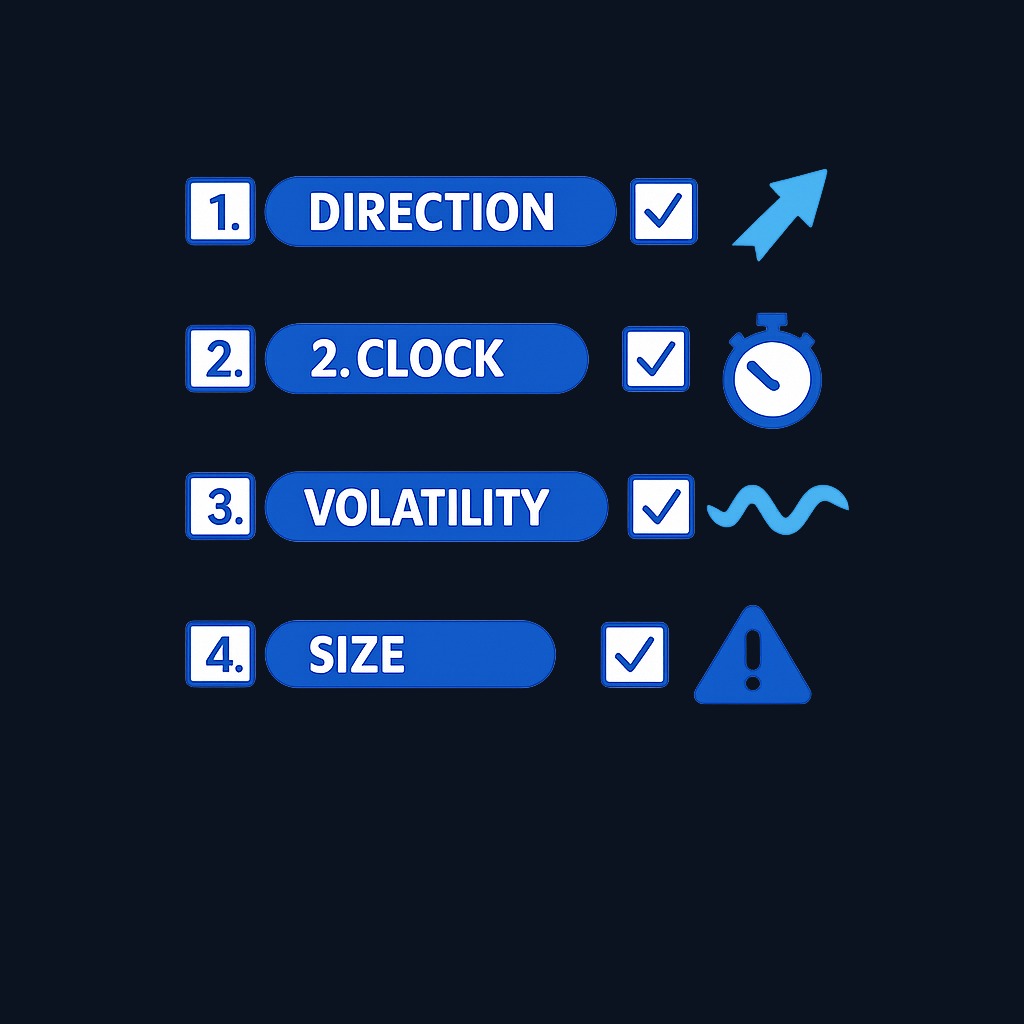
Run four checks before entering any contract. One, direction: does the delta match how strongly you expect the underlying stock to move? Two, clock: can your thesis play out faster than theta drains the premium? Three, volatility: is implied volatility unusually high or low for this name, and does your vega exposure match that reading? Four, size: given gamma, how much could your effective exposure grow against you in a fast market? If any answer is "I do not know," the position is not ready.
FAQ
What are the most important option greeks for beginners?
Start with delta and theta. Delta tells you how much directional exposure you own, and theta tells you what that exposure costs per day. Add vega once you begin trading around events, and treat gamma as the reason short-dated positions change character quickly.
Do option greeks change over time?
Yes, constantly. Greeks are recalculated as the underlying price, time to expiration, implied volatility, and interest rates shift. A contract's delta today can be very different next week even if the stock has not moved.
Where can I see the greeks for an option?
Most brokerage platforms display them in the options chain view for every strike and expiration. Values are model-based, so small differences between platforms are normal.
Can I trade options without understanding the greeks?
You can, but you would be accepting risks you cannot see. The greeks are how the market prices time, movement, and uncertainty; ignoring them means finding out about those forces only after they cost you money.
Next steps
The greeks turn options from a guessing game into a set of measurable exposures. Learn delta and theta first, layer in vega and gamma as your trades get more event-driven, and keep rho in view for long-dated positions. Before committing real capital, rehearse: model a trade, predict how it should behave under a price move or a volatility shift, and compare the outcome. Structured practice builds that intuition faster than losses do.
TradingMarketsOptionsBeginner
Practice trading with Finelo
Practice in a simulator, learn with bite-sized lessons, and build confidence before risking real money.
About the author
Finelo Team
The Finelo Team creates practical investing and trading education designed to help beginners learn faster with structured challenges, simulator practice, and bite-sized lessons.
Keep reading — Related articles
Trading
Understanding Walk Forward Analysis in Trading
Brief educational note: this article is educational — not investment advice — and trading involves the risk of loss.
Finelo Team
Trading
VWAP vs Moving Average: Formulas, Uses, and Limits
VWAP weights price by recorded volume over a defined period, while a moving average summarizes a sequence of prices over a rolling lookback.
Finelo Team
Trading
Volume Profile vs Market Profile: What Each Chart Measures
Volume Profile groups traded volume by price level.
Finelo Team