A protective put combines owned shares with a put that gives the holder the right to sell the matching shares at the strike price during the option's exercise period. The premium buys a defined payoff floor while the hedge is in force, but the position's maximum loss also depends on the stock's cost basis and the premium. The Options Industry Council's protective-put guide and OCC's options disclosure document explain the standardized structure and risks.
Protective Put Strategy: How It Works and When to Use It

A protective put combines owned shares with a put that gives the holder the right to sell the matching shares at the strike price during the option's exercise period. The premium buys a defined payoff floor while the…
9 min read
Practice trading with Finelo
Practice in a simulator, learn with bite-sized lessons, and build confidence before risking real money.
Want to learn more?
Practice in a simulator, learn with bite-sized lessons, and build confidence before risking real money.
Explore FineloExplore Finelo's 28-day challenges
Turn learning into a daily habit with guided challenge paths.
What is a protective put?
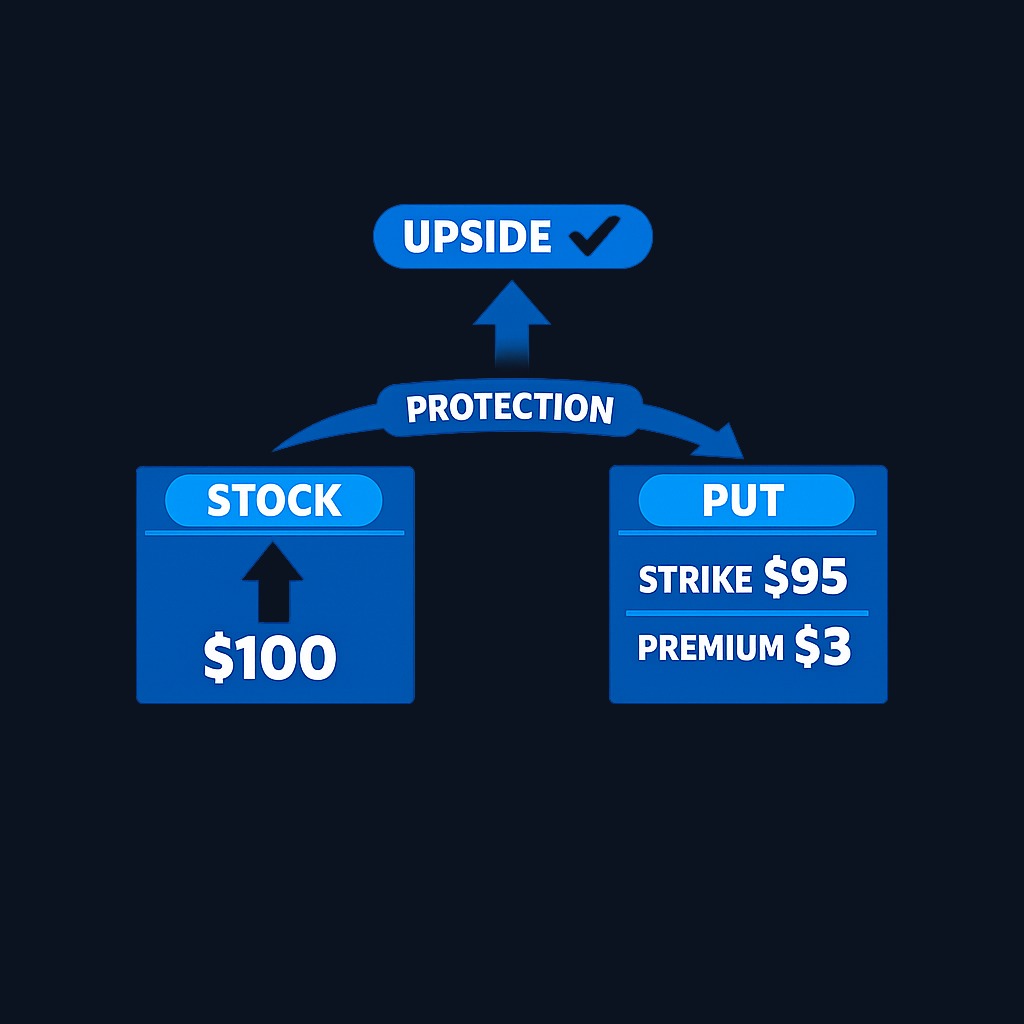
A protective put combines two positions: long stock and a long put option on that same stock. The put option gives you the right, not the obligation, to sell your shares at a fixed strike price before the contract's expiration date. Because you already own the shares, the put acts purely as protection rather than as a bet on a decline.
The structure is often called a “married put” when the stock and put are bought together. For a matched position held through the relevant exercise period, upside in the shares remains open while the minimum terminal position value before transaction costs is based on the strike. The premium lowers net returns and increases maximum loss; it is not subtracted from the strike to define an “exit price.”
How the protective put strategy works
One standard option contract covers 100 shares, so an investor protecting 300 shares would buy three puts.
A worked example. Suppose you own 100 shares of a stock trading at $100 and you buy one three-month put with a $95 strike for a $3 premium ($300 total).
- If the stock falls to $70: you can still sell at $95. Your loss is capped at $5 of stock decline plus the $3 premium, or $8 per share, instead of $30.
- If the stock stays at $100: the put expires worthless. You lose only the $3 premium, similar to an insurance policy you never claimed.
- If the stock rises to $120: you keep the full gain minus the $3 premium. Your effective profit is $17 per share.
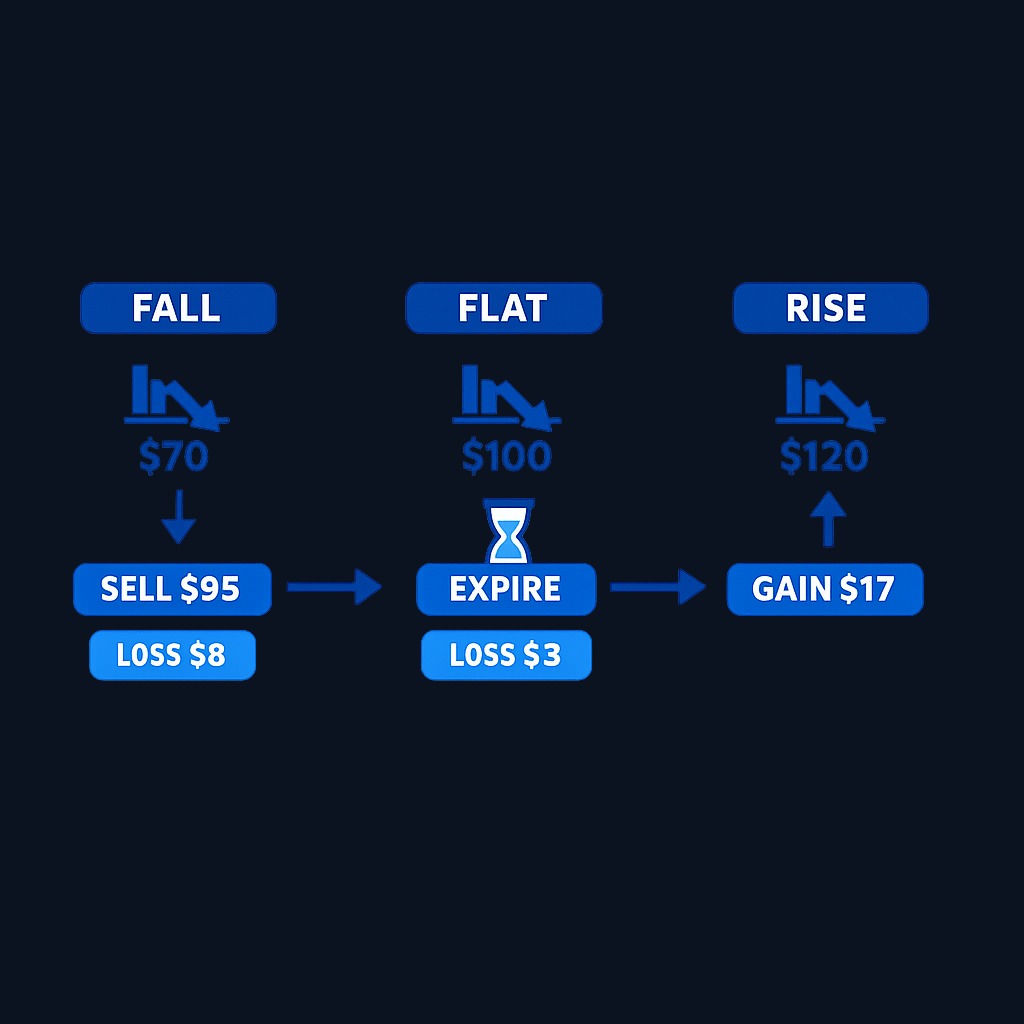
At expiration, the break-even price for a newly purchased stock-and-put position is the stock purchase price plus the premium. The maximum loss per share before fees is the stock purchase price minus the strike plus the premium. In this example, that is $100 − $95 + $3 = $8. The strike is the exercise price; “strike minus premium” is not the position's guaranteed sale price.
Choosing the strike and expiration
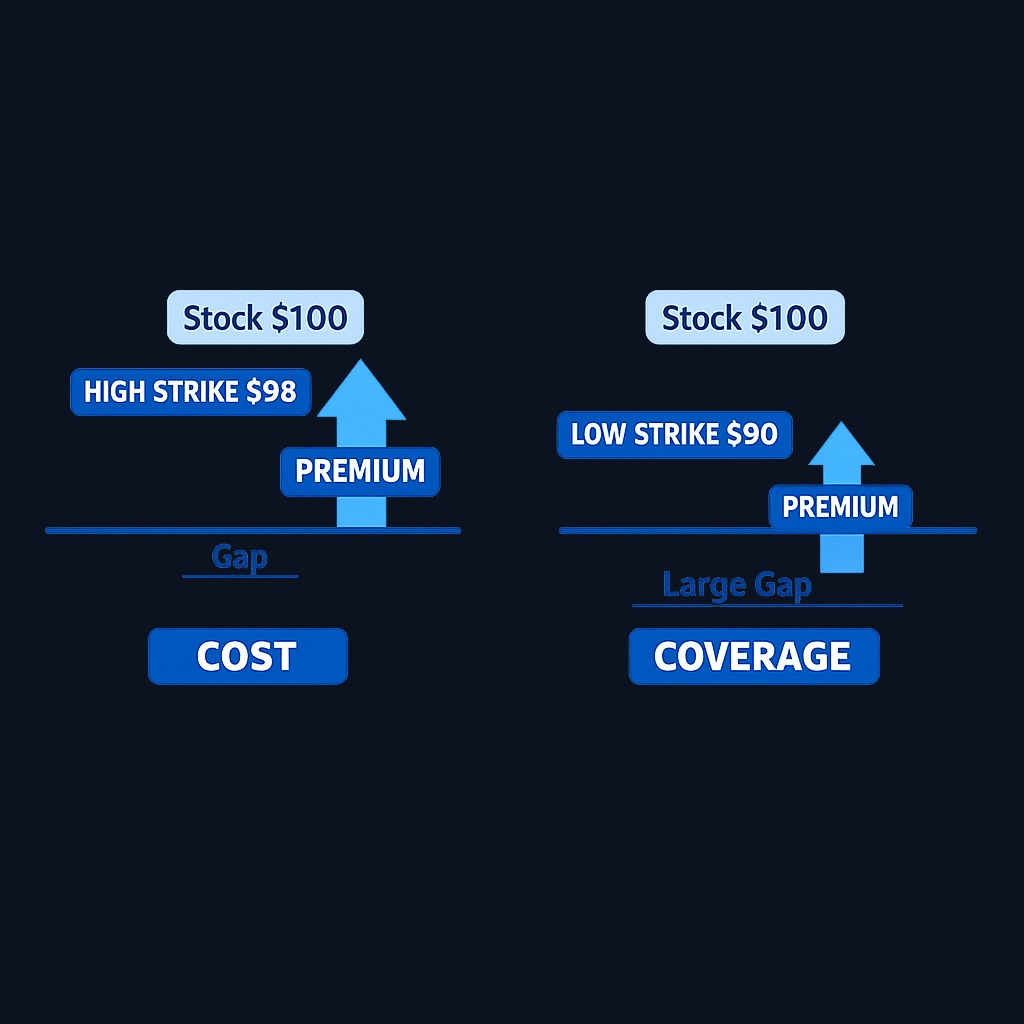
A higher strike (closer to the current price) raises the floor but costs more. A lower strike is cheaper but leaves more room to lose before protection starts, like a bigger insurance deductible. Longer-dated puts cost more in total but less per month, and they suffer slower time decay. Many investors buy protection that lasts through a specific known risk, such as an earnings report, rather than paying for year-round coverage.
Benefits of using a protective put
- A defined payoff while matched and in force. The standard expiration payoff can be calculated in advance, subject to premium, fees, contract coverage, exercise instructions, and counterparty/clearing mechanics.
- Upside remains. Unlike selling the shares, the position retains stock upside minus the premium and trading costs.
- No forced exit. A stop-loss order can be triggered by a brief intraday plunge and executed at a bad price in a fast market. A put cannot be shaken out; it simply sits there as a right you may exercise.
- Emotional discipline. Investors holding a floor tend to panic less during drawdowns, because the damage is already quantified.
- Flexibility around events. You can protect a position through a single high-risk window and let the insurance lapse afterward.
Costs, risks, and key considerations
The premium is the obvious cost, and it recurs every time you re-hedge. Persistent hedging can consume several percent of a position's value per year, which drags on long-term returns. Time decay works against you: the put loses value daily even if the stock does not move, and elevated implied volatility makes protection most expensive exactly when investors want it most.
Taxes deserve attention too. A put can affect a stock's holding period and straddle treatment, and the result depends on when the shares and option were acquired and how the option is closed or exercised. Review the relevant options and straddle sections of IRS Publication 550 and consult a qualified tax professional before hedging a material low-basis position.
Finally, a protective put protects one position, not your judgment. If the underlying business is deteriorating, insurance only delays the decision to sell.
Real-world applications
Hypothetical earnings hedge. An investor with an unrealized gain buys a one-month put below the market before an earnings report. At expiration, a drop below the strike is offset by put intrinsic value, while a rise retains stock upside less the hedge cost. Before expiration, option value also depends on time, volatility, liquidity, and execution.
Concentrated positions. An employee holding a large block of company stock hedges part of it with puts while diversifying gradually, keeping a floor under net worth that depends heavily on one company.
Volatile markets. During a period of macro uncertainty, a trader hedges an index-tracking position for a quarter, accepting a known premium cost in exchange for sleeping through the noise.
Practice trading with Finelo
Practice in a simulator, learn with bite-sized lessons, and build confidence before risking real money.
Protective puts vs other hedging approaches
| Approach | Downside protection | Upside kept? | Ongoing cost | Main weakness |
|---|---|---|---|---|
| Protective put | Hard floor at strike | Yes, minus premium | Premium per period | Cost, time decay |
| Stop-loss order | Depends on execution | Yes | None | Gaps and whipsaws can betray it |
| Covered call | Only the premium collected | Capped at call strike | None (income) | No real crash protection |
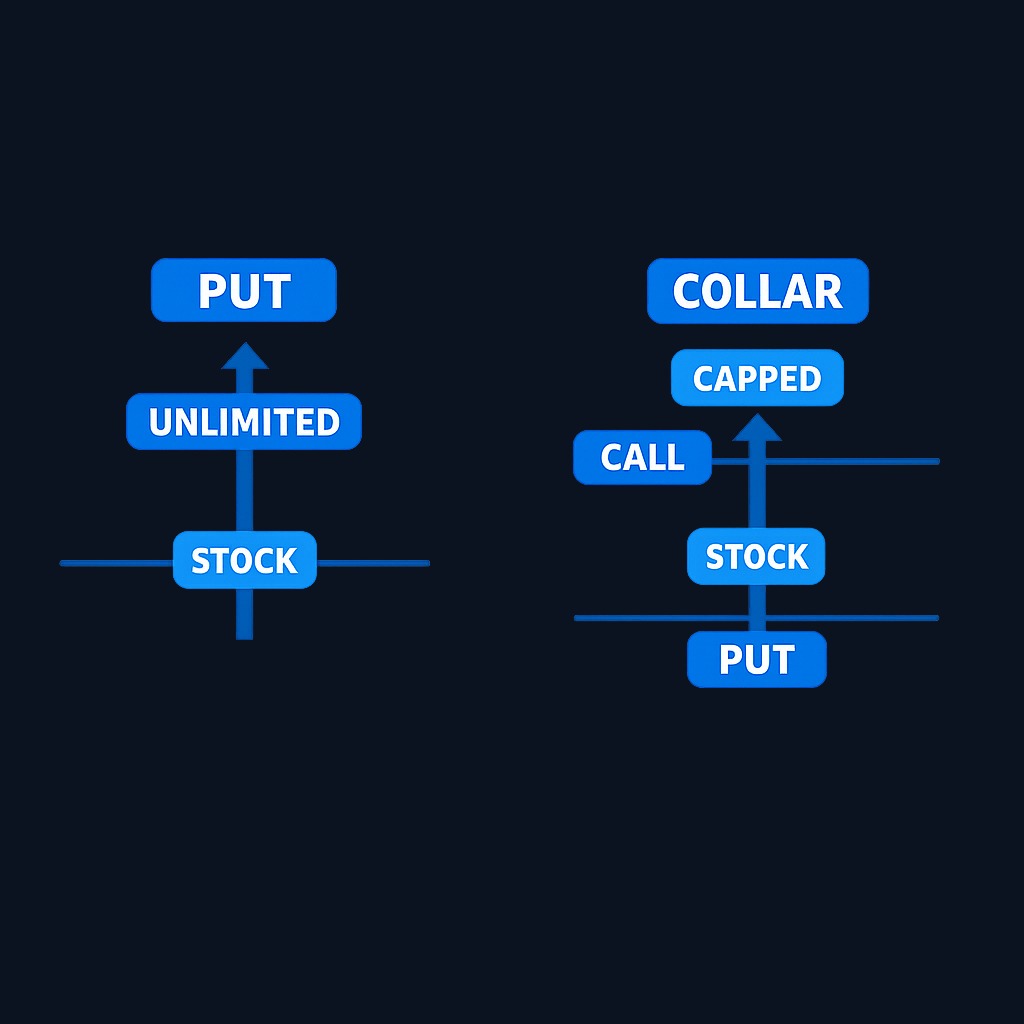
| Collar (put + short call) | Hard floor | Capped | Low or zero net | Gives up big rallies |
| Selling the shares | Total | None | Possible tax bill | You exit the investment |
The collar is the protective put's budget version: selling a call pays for some or all of the put, trading away upside beyond the call strike in exchange for cheap insurance.
What to know before deciding
- Hedging costs compound. Price protection as an annual percentage of the position and ask whether the risk justifies it.
- Match the hedge to a specific risk window when possible; permanent insurance on every holding is rarely economical.
- Check option liquidity. Wide bid-ask spreads on thinly traded puts quietly raise the cost of every hedge.
- Portfolio-level diversification is often a cheaper first line of defense than single-stock insurance.
- Options approval, margin rules, and contract mechanics vary by broker, so confirm the practical details in your account before relying on the strategy.
Decision framework: should you hedge with a put?
Work through four questions. First, what exactly am I protecting - a specific gain, a concentrated position, or general nerves? A vague fear usually calls for diversification, not a put. Second, over what window is the risk concentrated? Buy protection for that window only. Third, what does the floor cost? Compare the premium against the loss it prevents in a realistic bad case, not the worst case imaginable. Fourth, would I rather just trim the position? Selling some shares provides free "protection" at the cost of upside and possible taxes. If the put still looks like the best tool after those four answers, size it to the shares you genuinely need to protect.
FAQ
What is the maximum loss on a protective put strategy?
The stock's purchase price minus the put's strike price, plus the premium paid. In the example above - stock at $100, $95 strike, $3 premium - the maximum loss is $8 per share regardless of how far the stock falls.
When is the best time to buy a protective put?
There is no universally best time. Compare the cost, implied volatility, liquidity, time horizon, tax consequences, and the alternative of reducing the stock position. A known event can raise implied volatility before it occurs, making the hedge expensive even when the broader market is calm.
Is a protective put the same as a married put?
Economically, yes. "Married put" traditionally describes buying the stock and the put simultaneously, while "protective put" describes adding a put to shares you already own. The payoff profile is identical.
Why not just use a stop-loss order instead?
A stop order has no option premium but can execute below its stop price after a gap and can be triggered by a temporary decline. A put supplies an exercise right at the strike while it is valid; the net position result still includes the premium, fees, stock basis, and the holder's exercise or closing instructions.
Next steps
The protective put strategy converts an open-ended risk into a fixed, known cost - the closest thing investing has to genuine insurance. Use it deliberately: define the risk, choose a strike and expiration that match it, price the protection honestly, and re-evaluate when the contract expires rather than rolling it on autopilot. Before spending real premium, run through a full hedge cycle on paper so the mechanics feel routine when money is on the line.
TradingMarketsOptionsBeginner
Practice trading with Finelo
Practice in a simulator, learn with bite-sized lessons, and build confidence before risking real money.
About the author
Finelo Team
The Finelo Team creates practical investing and trading education designed to help beginners learn faster with structured challenges, simulator practice, and bite-sized lessons.
Keep reading — Related articles

Trading
Understanding Walk Forward Analysis in Trading
Brief educational note: this article is educational — not investment advice — and trading involves the risk of loss.
Finelo Team

Trading
VWAP vs Moving Average: Formulas, Uses, and Limits
VWAP weights price by recorded volume over a defined period, while a moving average summarizes a sequence of prices over a rolling lookback.
Finelo Team

Trading
Volume Profile vs Market Profile: What Each Chart Measures
Volume Profile groups traded volume by price level.
Finelo Team


