Last editorial review: September 8, 2026
Private Credit vs. Private Equity: Returns, Liquidity, Fees, and Risks
Private credit is private-market lending, where the investor’s return depends mainly on borrower payments. Private equity is private-market ownership, where the investor’s return depends…
16 min read
Practice trading with Finelo
Practice in a simulator, learn with bite-sized lessons, and build confidence before risking real money.
Want to learn more?
Practice in a simulator, learn with bite-sized lessons, and build confidence before risking real money.
Explore FineloExplore Finelo's 28-day challenges
Turn learning into a daily habit with guided challenge paths.
U.S. scope: This article discusses U.S. institutions, financial products, tax rules, and dollar examples unless stated otherwise. Rules and product terms may change; verify current official guidance for your situation.
Private credit is private-market lending, where the investor’s return depends mainly on borrower payments. Private equity is private-market ownership, where the investor’s return depends mainly on the company’s value when it is sold or otherwise exited. Both sit inside the private-market alternatives universe; Fidelity lists private equity, private credit, and private real assets as three major private-market alternative asset classes (Fidelity).
The best short answer: private credit fits investors comparing income, repayment risk, and shorter cash-flow paths. Private equity fits investors comparing long-term growth, ownership risk, and less predictable exits.
This comparison is educational, not financial or investment advice. Investing can involve loss, and private-market products can be complex, illiquid, and costly.
Quick comparison answer
Private credit and private equity differ most in claim type. Credit investors are lenders. Equity investors are owners. That difference affects almost everything else: cash flow, downside protection, upside potential, fees, liquidity, reporting, and what happens in stress.
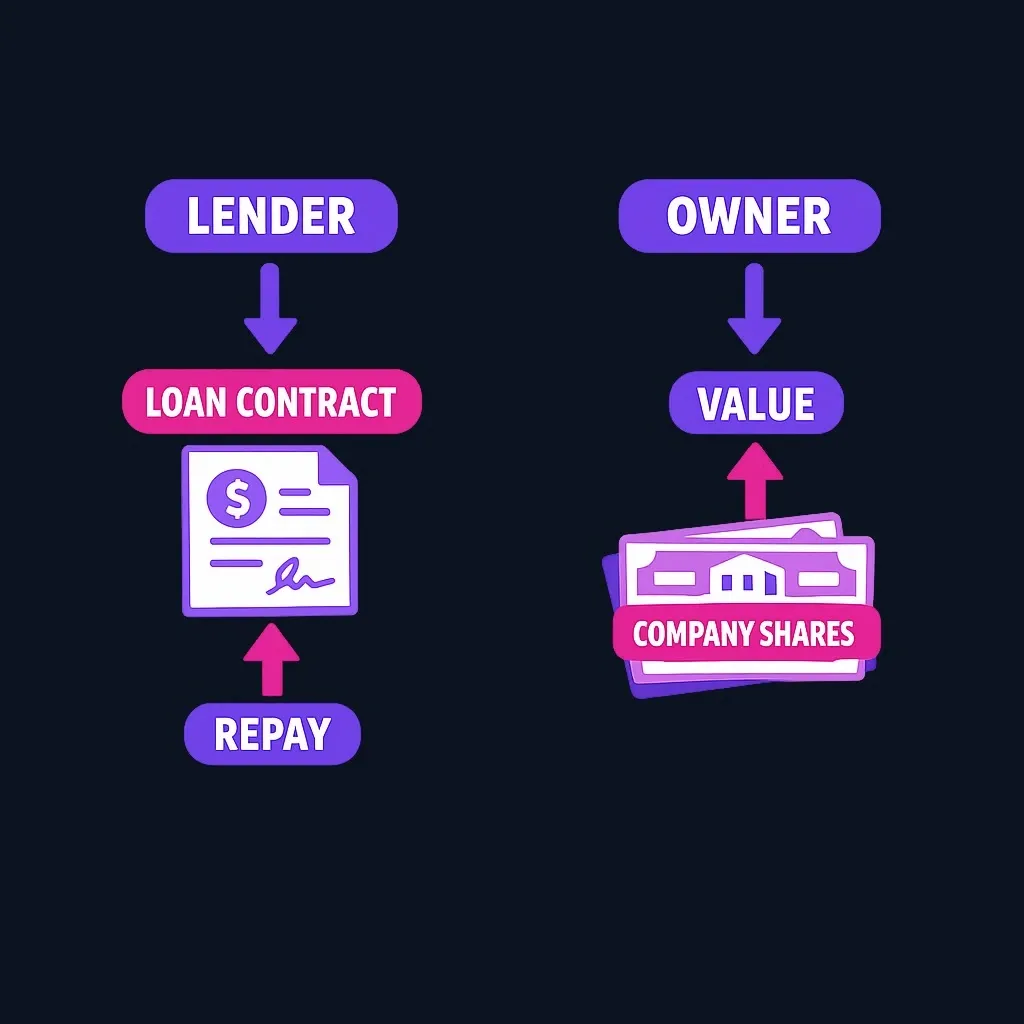
A simple way to frame it:
- Private credit asks: “Will the borrower repay, and are the loan terms strong enough?”
- Private equity asks: “Can the company become more valuable before exit?”
Private equity funds can invest in fast-growing companies or startups through minority investments, according to Investor.gov (Investor.gov). Private credit is usually evaluated more like a loan portfolio: borrower quality, collateral, covenants, rate exposure, and default scenarios matter.
Quick example
Imagine the same private company needs capital.
A private credit fund may lend money and expect interest plus repayment. If the company grows sharply, the lender’s upside is still mostly limited to the agreed loan economics. A private equity fund may buy an ownership stake. If the company’s value rises, the equity investor may benefit more. If the company underperforms, the equity investor can absorb larger losses.

That is the core tradeoff: private credit tends to cap upside in exchange for a contractual claim, while private equity accepts more outcome uncertainty for ownership upside.
Side-by-side comparison table
| Dimension | Private credit | Private equity |
|---|---|---|
| Basic role | Lender to a private borrower | Owner of a private company or ownership stake |
| Private-market category | One of the major private-market alternative asset classes listed by Fidelity (Fidelity) | One of the major private-market alternative asset classes listed by Fidelity (Fidelity) |
| Main return source | Interest, fees, and repayment outcomes | Business growth, valuation change, and exit outcome |
| Upside profile | Usually more limited because loan economics are contractual | Potentially higher because equity owns residual value |
| Downside driver | Borrower default, weak collateral, poor underwriting, illiquidity | Business failure, valuation decline, leverage, poor exit timing |
| Cash-flow pattern | Often built around scheduled or negotiated payments | Often back-ended, depending on exit timing |
| Liquidity | Usually limited; depends on fund or vehicle terms | Usually limited; depends on fund or vehicle terms |
| Fees to review | Management fees, fund expenses, performance fees, origination economics, servicing costs | Management fees, fund expenses, carried interest, transaction fees, monitoring fees |
| Due diligence focus | Borrower quality, collateral, covenants, seniority, default handling | Manager skill, value-creation plan, leverage, exit path, valuation discipline |
| Best compared against | Private or public credit, income strategies, direct lending exposure | Public equities, venture capital, buyouts, long-term growth strategies |
The table compresses the comparison, but it does not decide suitability. Two funds with the same label can behave very differently. A senior secured lending strategy and an opportunistic distressed credit strategy do not have the same risk profile. A minority growth equity fund and a highly leveraged buyout fund also differ.
Decision criteria
Use the criteria below to compare private credit vs. private equity without reducing the decision to “which has higher returns?” The better question is: which risk do you want to be paid for, and can you tolerate the liquidity terms?
1. Claim type: debt claim vs. ownership claim
Private credit starts with the borrower’s obligation to pay. The investor evaluates whether the borrower can service debt, what protections exist, and what happens if repayment fails.
Private equity starts with ownership value. The investor evaluates whether the company can grow, improve margins, expand strategically, or sell at an attractive valuation. Investor.gov notes that some private equity funds specialize in minority investments in fast-growing companies or startups (Investor.gov).
Worked example: If a company’s revenue rises modestly but it keeps paying interest, private credit may perform as expected. If the same company doubles in value, private equity may capture more upside. If the company fails, both can lose money, but they lose for different reasons.
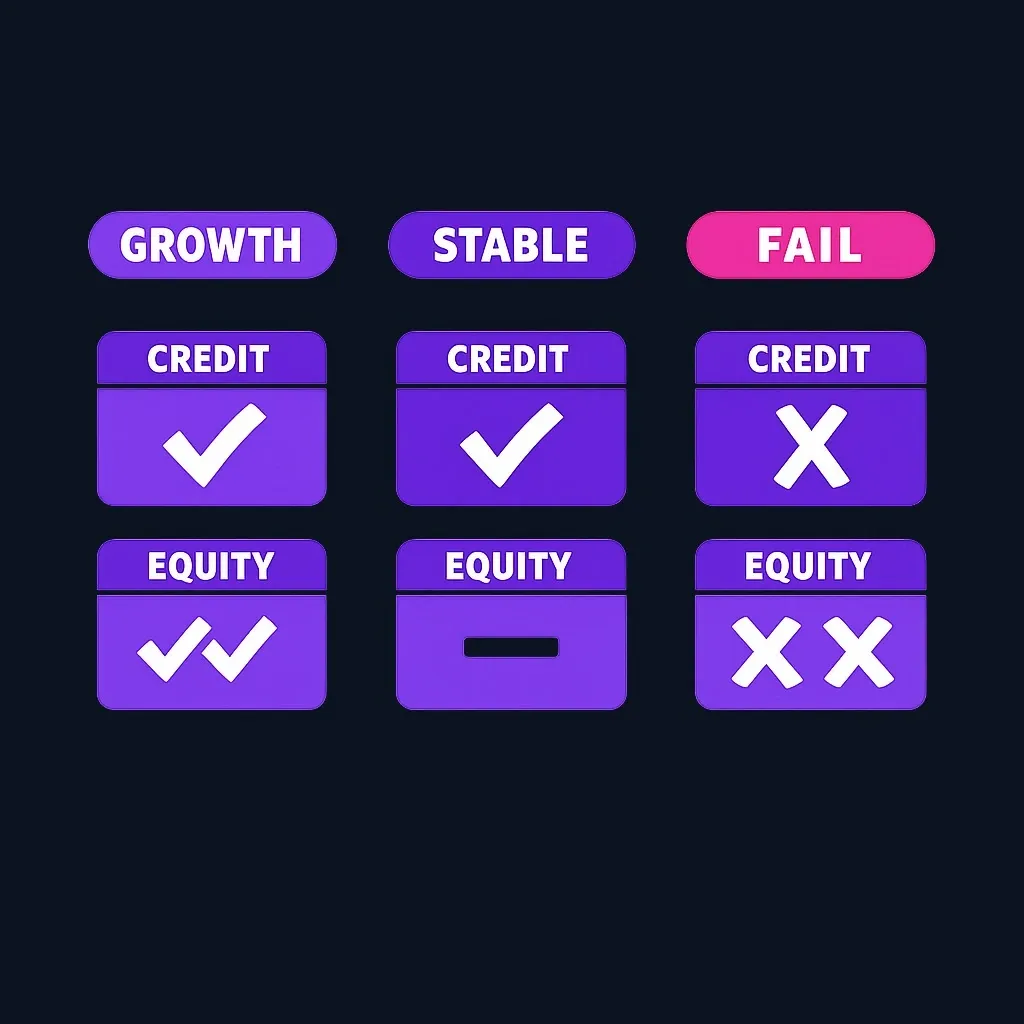
2. Return pattern: income first vs. exit first
Private credit returns usually depend on loan economics. Investors focus on interest, fees, repayment timing, defaults, and recoveries.
Private equity returns usually depend on exit value. The fund may need time to improve the business, find a buyer, or wait for better market conditions. That can create a longer and less predictable return path.
A useful test is to ask: Would you rather underwrite recurring payments or future sale value? If you prefer analyzing cash-flow coverage, private credit may be easier to evaluate. If you prefer underwriting long-term business transformation, private equity may be more intuitive.
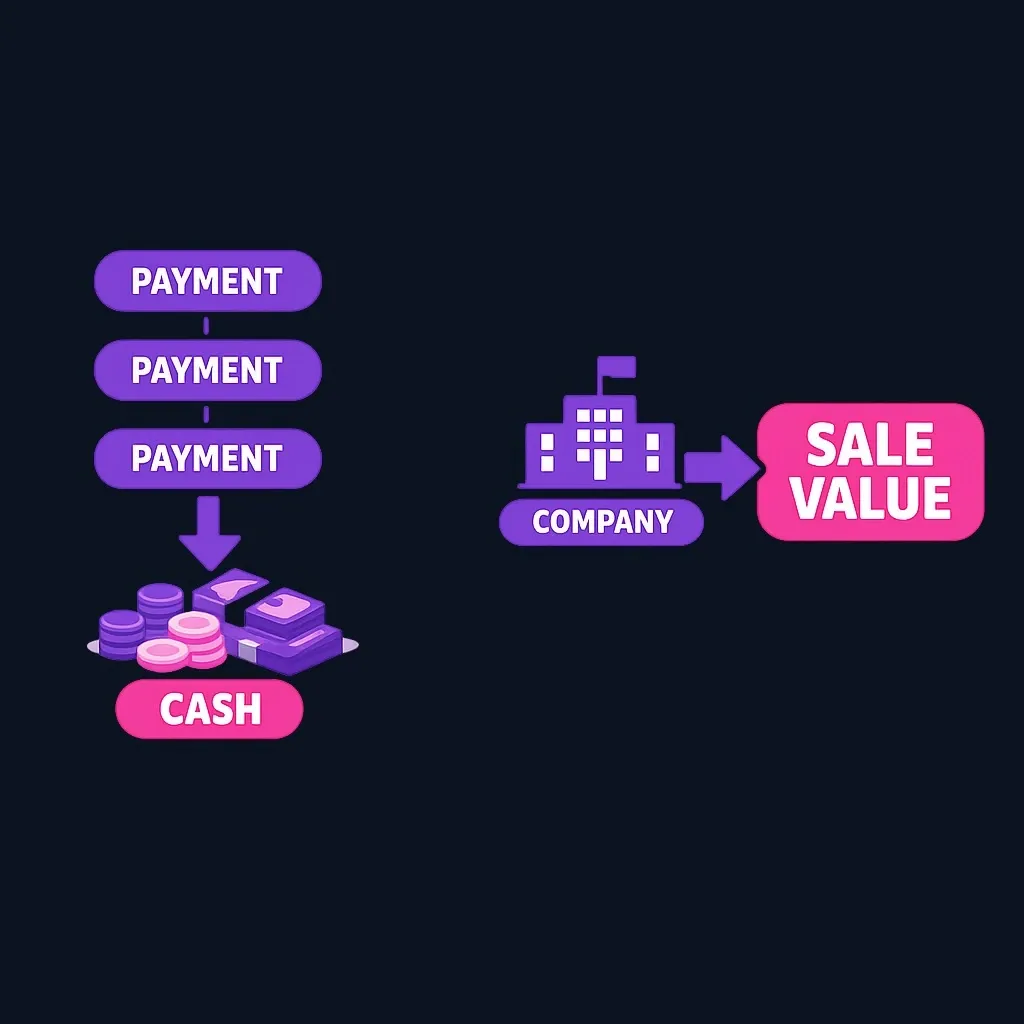
3. Liquidity: when can capital come back?
Both private credit and private equity can be illiquid. The key difference is how investors expect capital to return.
Private credit may return capital through interest, amortization, refinancing, or repayment. Private equity usually depends more on exit events. That could include a sale to another buyer or another fund.
Do not assume “credit” means easy liquidity. A private credit fund can still restrict redemptions, hold hard-to-sell loans, or delay distributions. Also do not assume private equity always takes the same time. Fund terms, asset quality, and market conditions matter.
4. Fees: compare net return, not headline return
Fees matter because private-market structures can include several layers of cost. For private credit, review management fees, fund expenses, servicing costs, performance fees, and any economics linked to loan origination. For private equity, review management fees, fund expenses, carried interest, transaction fees, and monitoring fees.
The practical mistake is comparing a gross private equity target with a net private credit distribution, or the reverse. Use the same basis for both. Compare net return after fees, expected losses, and timing.
Simple fee check: Before comparing two funds, list every cost that can reduce investor return. Then ask whether the return target is gross or net. If the answer is unclear, the comparison is not ready.
5. Manager skill: underwriting vs. operating value creation
Private credit managers need strong borrower underwriting, documentation discipline, workout skill, and portfolio monitoring. Private equity managers need sourcing ability, operating judgment, governance skill, and exit discipline.
The same investor may prefer one skill set over the other. Credit analysis often starts with downside protection. Equity analysis often starts with value creation and exit potential.
A strong decision process asks: What must the manager be good at for this strategy to work? Then review whether the fund’s process matches that requirement.
Risk and return analysis
Private credit and private equity both involve risk, but they expose investors to different failure modes. Private credit can disappoint when borrowers cannot repay, collateral values fall, or loan terms prove weak. Private equity can disappoint when growth slows, leverage becomes burdensome, valuations compress, or exits take longer than planned.
How returns compare
Private equity is often discussed as the higher-upside category because equity participates in residual business value. That upside comes with wider possible outcomes. If the company performs well, equity can benefit meaningfully. If the company performs poorly, equity can lose heavily.
Private credit usually has a more defined return path. The lender’s upside is commonly tied to agreed economics, while the downside depends on default severity and recovery. That can make private credit feel more predictable, but it does not make it risk-free.
Scenario example: A borrower hits a weak sales period. A private credit investor wants to know whether the company can still meet interest payments. A private equity investor wants to know whether the company’s long-term value has changed. The same business problem creates different questions for each investor.
Downturn impact
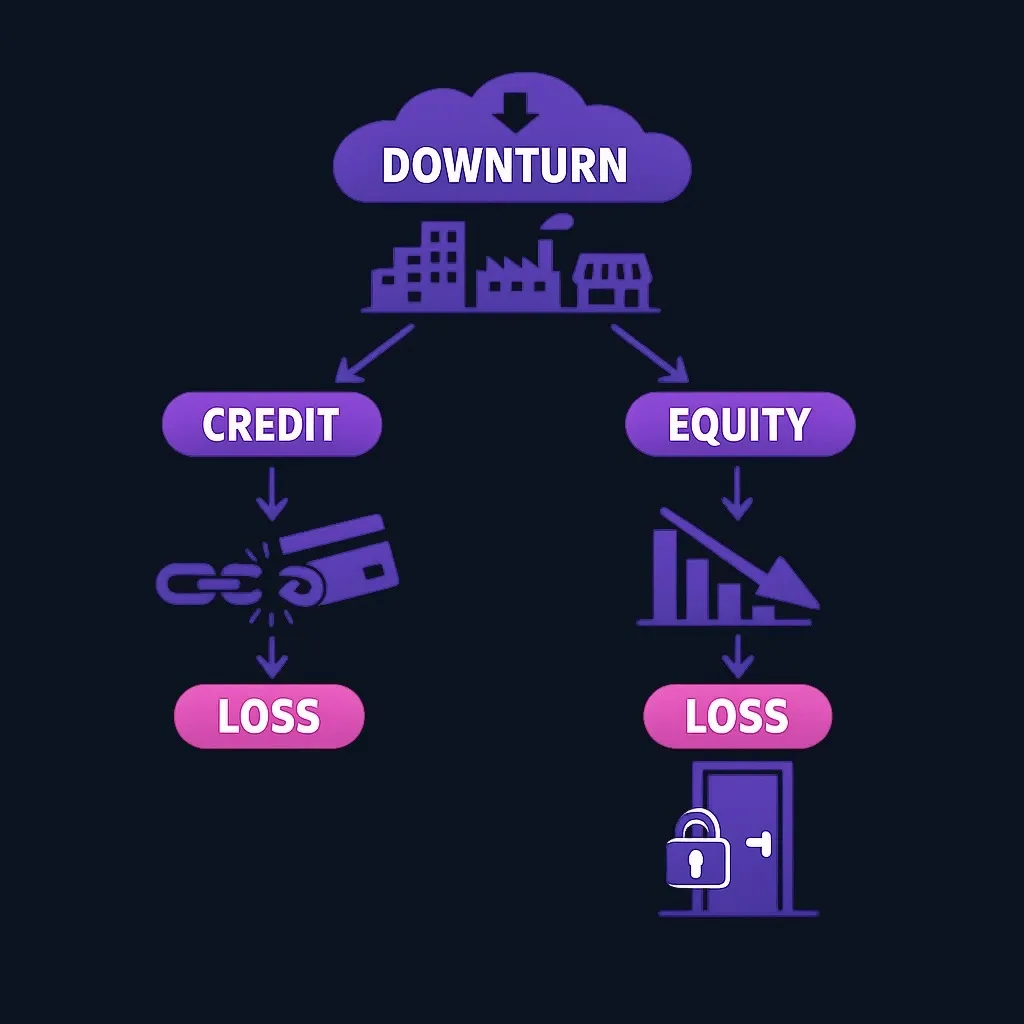
In an economic downturn, private credit can face rising defaults, weaker borrower cash flow, and lower collateral values. Private equity can face lower valuations, slower exits, and tougher financing conditions.
The stress test should not ask, “Which one is safe?” A better test is:
- What happens if revenue falls?
- What happens if refinancing becomes difficult?
- What happens if valuations fall before exit?
- What happens if capital is locked up longer than expected?
Private credit may look more defensive if loans are senior, documentation is strong, and borrowers remain solvent. Private equity may recover strongly if companies survive and markets reopen. The result depends on structure, price, leverage, and manager decisions.
A practical risk framework
Use a four-part framework before comparing allocations:
- Loss source: default risk for credit; business and valuation risk for equity.
- Liquidity source: repayment for credit; exit for equity.
- Control source: covenants and creditor rights for credit; ownership and governance for equity.
- Return source: income for credit; appreciation for equity.
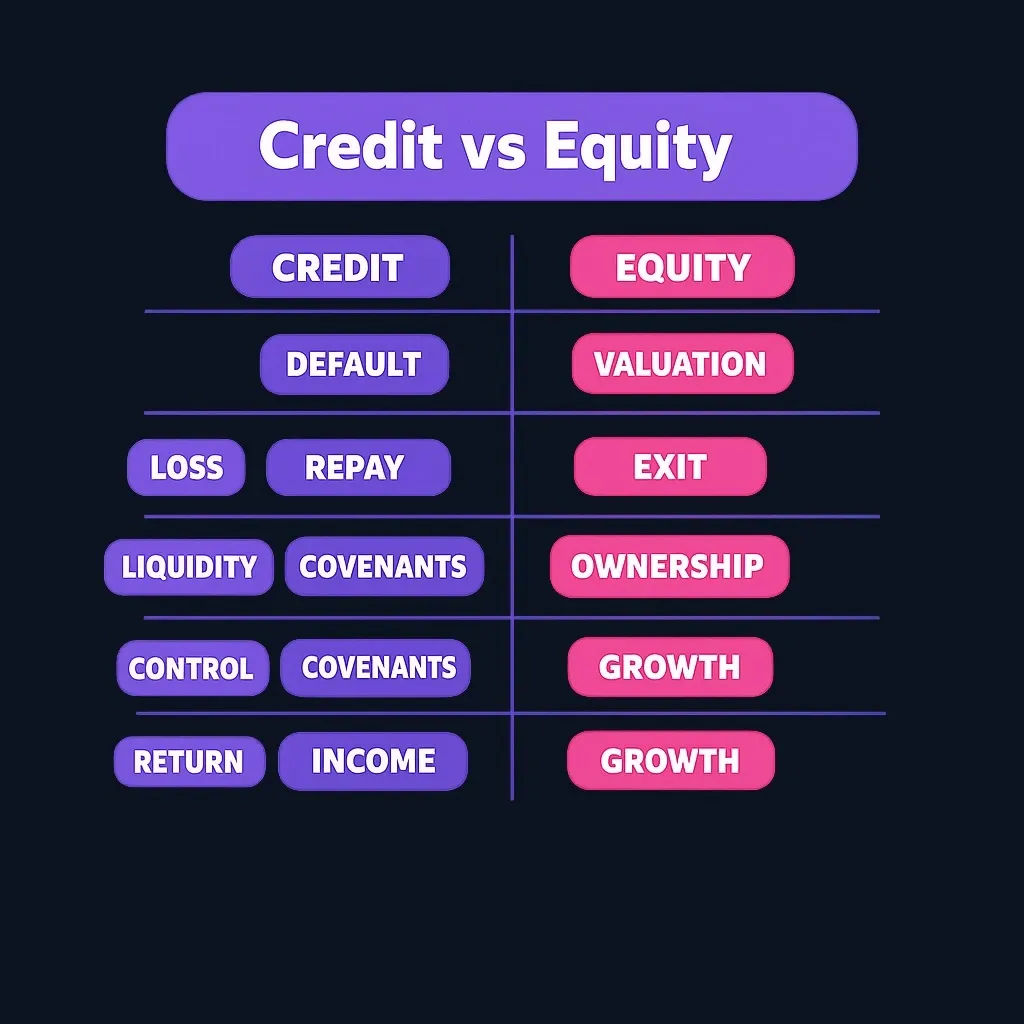
This framework helps avoid a common mistake: choosing based only on expected return. Expected return means little without understanding how losses occur.
Market context and regulatory environment
Private credit and private equity are both part of private markets, which Fidelity describes as including private equity, private credit, and private real assets (Fidelity). For investors, the important market context is not just growth. It is also access, transparency, valuation, and oversight.
What to check before relying on market-growth claims
Market-size claims can vary because data providers define private credit and private equity differently. One report may include direct lending, mezzanine debt, distressed credit, and opportunistic credit. Another may use a narrower definition. Private equity data can also vary by whether it includes buyouts, growth equity, venture capital, or secondaries.
When you see a growth chart, check:
- Which strategies are included?
- Is the figure fundraising, assets under management, deal value, or dry powder?
- Is the data global or regional?
- Does it include closed-end funds, evergreen vehicles, or both?
- Are numbers gross, net, estimated, or reported?
This matters because private credit and private equity can appear more or less attractive depending on the dataset. A chart about fundraising does not prove better investor outcomes.
Regulatory and disclosure differences to evaluate
Private-market funds often rely on offering documents, subscription agreements, fund reports, and manager disclosures. The investor’s job is to understand what information is available before and after investing.
For both private credit and private equity, review:
- Eligibility requirements
- Redemption or lockup terms
- Valuation policy
- Fee disclosures
- Conflicts of interest
- Use of leverage
- Reporting frequency
- Risk factors
- Manager disciplinary history
- Independent administration or audit details
The difference is what those disclosures emphasize. Private credit materials should explain loan selection, seniority, collateral, covenants, defaults, and workout procedures. Private equity materials should explain deal sourcing, ownership strategy, operational involvement, valuation practices, and exit planning.
Example: A private credit fund with weak disclosure around defaults is hard to evaluate. A private equity fund with vague valuation methods is also hard to evaluate. In both cases, missing clarity raises due diligence risk.
Investor profiles: who typically compares each option?
This page is for investors who already understand the basic idea of alternative investments and want a sharper comparison. It is also useful for finance students, analysts, and self-directed investors who are learning how private-market strategies differ.
Investors who may evaluate private credit
Private credit often attracts investors focused on income, contractual repayment, and downside analysis. They may be comparing it with public bonds, leveraged loans, income funds, or other credit strategies.
Typical questions include:
- How strong are the borrowers?
- Are loans senior or subordinated?
- What happens after default?
- How often are positions valued?
- Can capital be redeemed, transferred, or only distributed over time?
This profile usually cares less about owning the company and more about being paid for lending risk.
Investors who may evaluate private equity
Private equity often attracts investors focused on long-term growth and business ownership. They may be comparing it with public equities, venture capital, growth equity, or buyout exposure.
Typical questions include:
- How does the manager create value?
- What is the exit path?
- How much leverage is used?
- How are portfolio companies valued?
- What happens if exits are delayed?
This profile accepts that returns may be uneven. The tradeoff is access to private-company ownership opportunities, including minority investments in fast-growing companies or startups, which Investor.gov identifies as one area private equity funds may specialize in (Investor.gov).
Practice trading with Finelo
Practice in a simulator, learn with bite-sized lessons, and build confidence before risking real money.
When to choose each option
There is no universal winner in private credit vs. private equity. The better choice depends on objective, risk tolerance, time horizon, liquidity needs, and confidence in the manager.
Private credit may fit better when…
Private credit may be more relevant when the investor wants to analyze income, borrower repayment, collateral, covenants, and default risk. It can also fit an investor who prefers a more defined return path than equity ownership.
Use this checklist:
- You want exposure linked mainly to lending economics.
- You can evaluate borrower quality and loan structure.
- You accept limited liquidity.
- You understand that defaults can reduce returns.
- You are comparing net returns after all fund costs.
Example: An investor wants private-market exposure but does not want returns to depend mainly on a company sale. A private credit strategy may be easier to evaluate because the key questions are repayment, loan protections, and recovery.
Private equity may fit better when…
Private equity may be more relevant when the investor wants long-term ownership exposure and accepts that returns may depend on business improvement and exit timing. It may also fit an investor who can tolerate capital being tied up while the manager works through a value-creation plan.
Use this checklist:
- You want exposure linked mainly to company value growth.
- You can tolerate delayed or uneven distributions.
- You understand exit timing risk.
- You can evaluate manager skill and valuation discipline.
- You compare net returns after fees and carried interest.
Example: An investor believes a manager can source strong private companies and improve operations. Private equity may match that thesis better than private credit because the return depends on ownership value, not just repayment.
A quick decision rule
If your first concern is “How do I get paid back?”, start your analysis with private credit. If your first concern is “How much more valuable can this company become?”, start with private equity.
That rule is not a recommendation. It is a way to identify which questions matter most.
Tradeoffs and caveats
The biggest caveat is that category labels can hide strategy differences. A conservative private credit strategy can look very different from a distressed or opportunistic credit strategy. A growth equity fund can look very different from a highly leveraged buyout fund.
Common mistakes to avoid
Mistake 1: Treating private credit as a bond substitute. Private credit can have limited liquidity, complex valuation, and borrower-specific risks. Review redemption terms and default procedures before comparing it with public bonds.
Mistake 2: Treating private equity as automatically higher returning. Equity upside is not guaranteed. Entry valuation, leverage, business quality, and exit timing can materially affect outcomes.
Mistake 3: Ignoring fee drag. Private-market fees can reduce net returns. Compare fee structures on the same basis before judging performance potential.
Mistake 4: Comparing fund labels instead of cash flows. Map when money goes out, when it might come back, and what must happen for returns to materialize.
A worked comparison
Suppose two funds invest in similar companies.
The private credit fund lends to those companies. Its success depends on whether borrowers make payments and whether loan protections hold during stress. The private equity fund buys ownership stakes. Its success depends on whether the companies grow and can exit at attractive values.
Now add a downturn. Borrowers may struggle to repay, hurting credit returns. Company valuations may fall, delaying private equity exits. Neither option avoids risk. They simply concentrate risk in different places.
Final decision framework
Before choosing either exposure, answer five questions:
- Objective: income, growth, diversification, or learning?
- Time horizon: how long can capital remain illiquid?
- Risk tolerance: default risk or equity valuation risk?
- Fee sensitivity: what is the expected return after all costs?
- Information quality: are reporting, valuation, and risk disclosures clear?
If those answers are unclear, pause the comparison. Private markets reward careful due diligence more than quick category selection.
For more investing education, you can also see Finelo’s learning resources through Finelo’s learning hub.
FAQ
What are the main differences between private credit and private equity?
Private credit is lending-focused, while private equity is ownership-focused. The main differences are return source, risk type, liquidity path, and due diligence focus. Fidelity lists both as major private-market alternative asset classes (Fidelity).
Which is less risky: private credit or private equity?
Private credit often has a more defined repayment path, but it still carries default, liquidity, and valuation risk. Private equity often has wider outcome potential because returns depend on ownership value and exit timing. The lower-risk option depends on the specific fund, terms, leverage, and manager quality.
How do returns compare between private credit and private equity?
Private credit returns usually come from interest, fees, and repayment outcomes. Private equity returns usually come from company value growth and exit outcomes. Private equity can offer more upside, but it can also produce more variable results.
Who invests in private credit?
Private credit is commonly evaluated by investors seeking private-market credit exposure, income potential, and borrower-level underwriting. The right fit depends on eligibility, liquidity needs, risk tolerance, fund terms, and cost structure. Always review official offering documents before committing capital.
Sources and Further Verification
More from Finelo
- Private REIT vs. Public REIT: Key Differences
- Is Long-Term Care Insurance Worth It? Costs, Coverage, and Alternatives
- REIT vs. Rental Property: Costs, Income, Liquidity, and Key Trade-Offs
Disclaimer
This article is provided by Finelo for educational and informational purposes only. Finelo does not provide financial, investment, tax, legal, or insurance advice. Consider your circumstances and consult an appropriately qualified professional before making financial decisions.
Financial LiteracyBeginner GuidePersonal Finance
Practice trading with Finelo
Practice in a simulator, learn with bite-sized lessons, and build confidence before risking real money.
About the author
Finelo Team
The Finelo Team creates practical investing and trading education designed to help beginners learn faster with structured challenges, simulator practice, and bite-sized lessons.
Keep reading — Related articles

Financial Literacy
Mercury Books Review 2026: Is It Worth It for Startups?
Mercury Books brings double-entry accounting into Mercury. Review its $35 pricing, reports, AI features, integrations, and migration limits.
Finelo Team

Financial Literacy
Why is My FICO Score Lower Than My Credit Score?
Example takeaway: seeing a higher score in a bank app doesn’t guarantee lenders will see the same FICO number at application time; lenders often pull a specific FICO version from a specific bureau.
Finelo Team
Financial Literacy
Why Is My FICO Score Higher Than My Credit Score?
Brief educational note: this article is educational, not financial or investment advice; investing and credit decisions involve risk and possible loss.
Finelo Team


