Last editorial review: September 8, 2026
Private REIT vs. Public REIT: Key Differences
The private reit vs public reit decision comes down to access, liquidity, transparency, and fit. Publicly traded REITs are a market category alongside public non-traded and private REITs,…
9 min read
Practice investing with Finelo
Build practical investing skills with guided lessons, simulator practice, and structured challenges.
Want to learn more?
Build practical investing skills with guided lessons, simulator practice, and structured challenges.
Explore FineloExplore Finelo's 28-day challenges
Turn learning into a daily habit with guided challenge paths.
U.S. scope: This article discusses U.S. institutions, financial products, tax rules, and dollar examples unless stated otherwise. Rules and product terms may change; verify current official guidance for your situation.
Quick comparison answer
The private reit vs public reit decision comes down to access, liquidity, transparency, and fit. Publicly traded REITs are a market category alongside public non-traded and private REITs, according to Fidelity’s REIT overview (Fidelity). Private REITs are a separate category identified by Investor.gov in addition to publicly traded and non-traded REITs (Investor.gov). In practice, public options usually suit investors who want easier monitoring and exit flexibility. Private options may suit investors who can evaluate a less transparent, less liquid real estate vehicle.
What are REITs?
A REIT, or real estate investment trust, is a vehicle used to invest in real estate through an entity rather than by directly buying a property. Fidelity describes REITs as falling into market-based categories, including publicly traded, public non-traded, and private REITs (Fidelity).
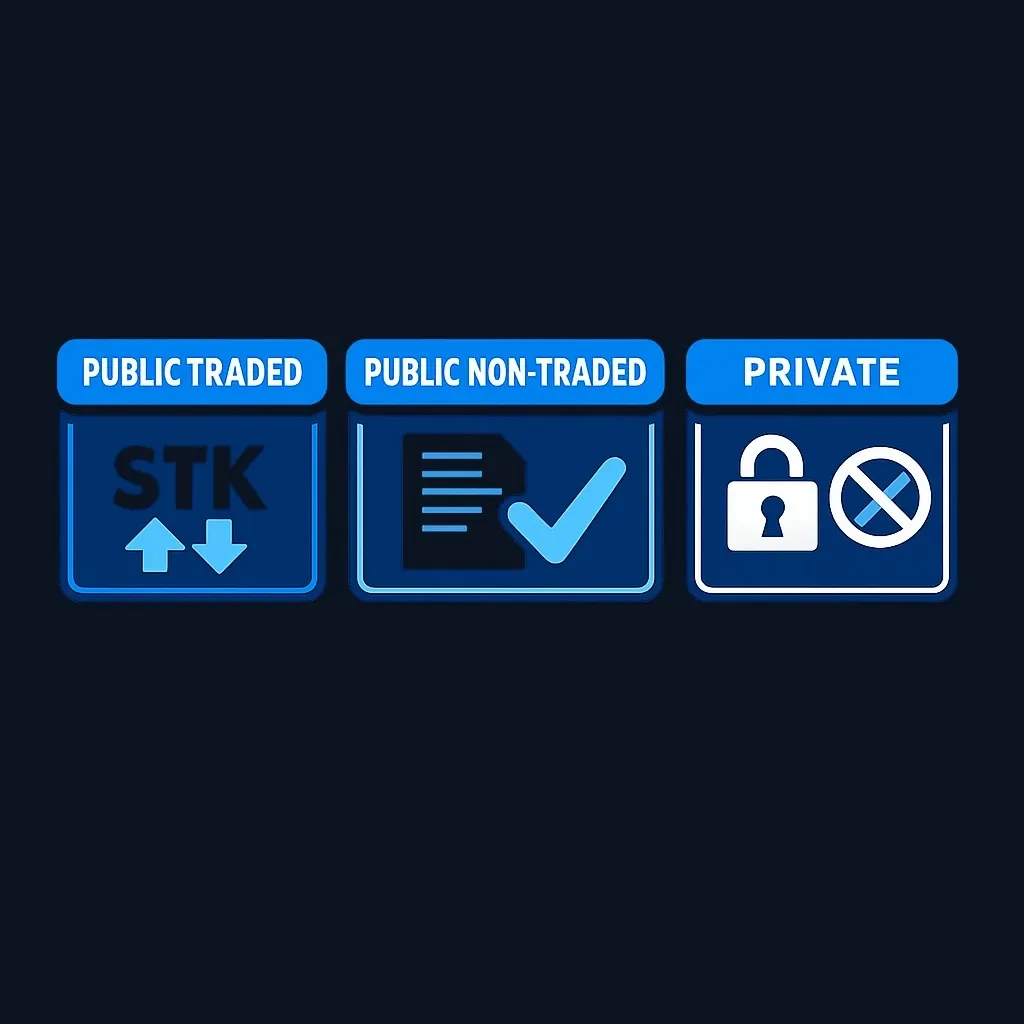
That classification matters because two REITs can own similar property types yet feel very different to an investor. One may be priced in a public market and easier to follow. Another may be offered privately and require more careful review of offering documents, fees, valuation methods, and exit rules.
A simple way to think about the choice is this: the real estate exposure is only one part of the decision. The wrapper also matters. The wrapper affects how you enter, how you exit, what information you receive, and how much uncertainty you accept between valuations.
Side-by-side comparison table
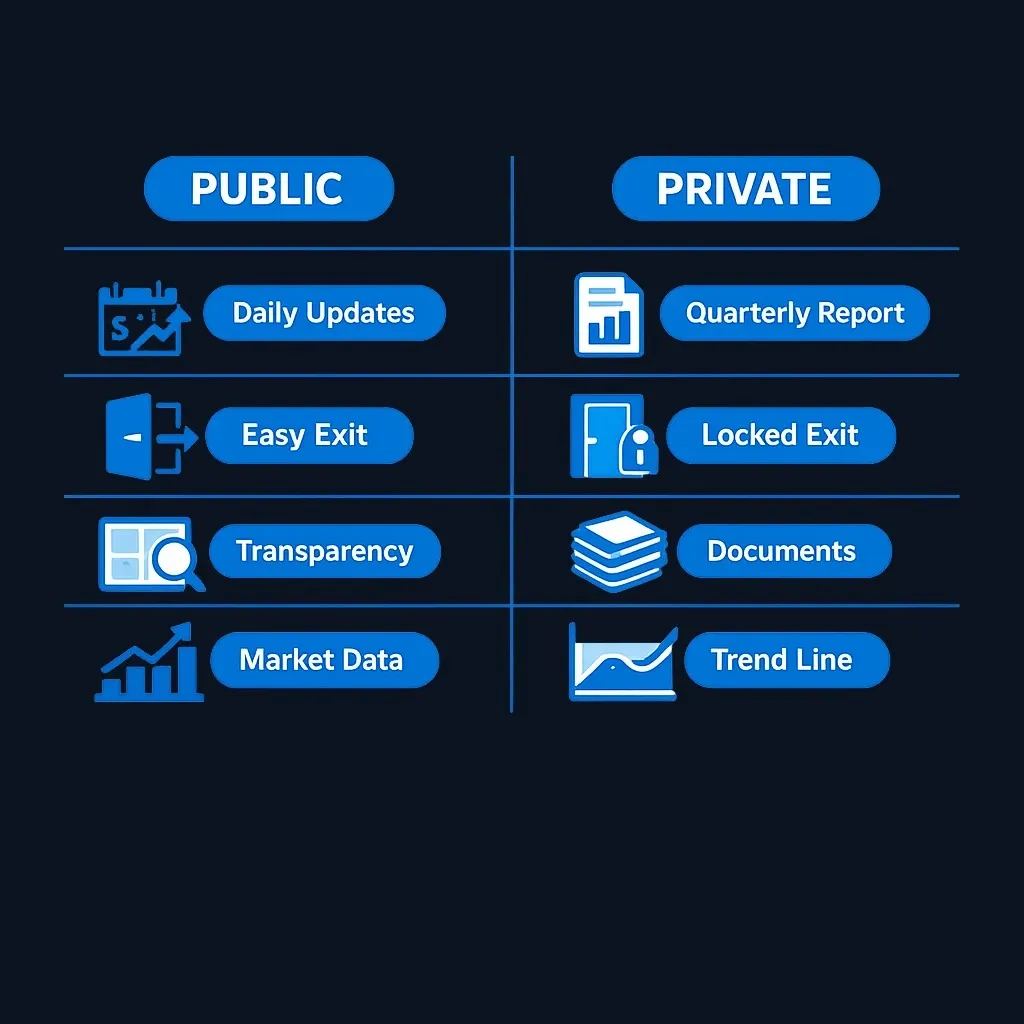
| Criterion | Public REIT | Private REIT |
|---|---|---|
| Market category | Publicly traded REITs are one recognized REIT market category (Fidelity). | Private REITs are identified as a separate category in addition to publicly traded and non-traded REITs (Investor.gov). |
| Access and monitoring | Often easier to compare because public-market vehicles usually have more visible pricing and public information. | Often requires deeper review because the investor may rely more on private materials and sponsor reporting. |
| Liquidity focus | Better fit when the ability to adjust or exit matters to the investor. | Better fit only when the investor can tolerate limited exit options and longer holding periods. |
| Valuation experience | Prices can move frequently, which may make volatility more visible. | Values may appear smoother, but that does not remove underlying property or financing risk. |
| Due diligence burden | Still requires review of holdings, strategy, costs, and risk. | Usually requires heavier review of sponsor quality, valuation policy, conflicts, and redemption terms. |
| Best use in a portfolio discussion | Useful when transparency and flexibility are high priorities. | Potentially useful when an investor accepts complexity for a specific real estate strategy. |
The table gives a practical comparison, not a ranking. A public option is not automatically better because it is easier to observe. A private option is not automatically better because it may seem less tied to daily market moves. The right comparison starts with what problem the REIT is supposed to solve in the portfolio.
Decision criteria
Start with liquidity. If you may need cash quickly, a vehicle with limited exit options can create pressure at the worst time. This matters even if the underlying real estate strategy looks attractive. A good investment idea can still be a poor fit if the exit path does not match your life.
Next, consider transparency. Public-market investments are generally easier to watch, compare, and benchmark. Private vehicles can require more trust in the sponsor’s reporting process. That does not make them unsuitable by default, but it raises the standard for due diligence.
Then review valuation. Public pricing can feel uncomfortable because market swings are visible. Private valuations may feel steadier, but smoother reporting is not the same as lower risk. The underlying buildings, tenants, financing costs, and economic conditions still matter.
Finally, check costs and conflicts. Do not compare only headline yield, target return, or property type. Read how the sponsor is paid, whether related parties are involved, and how valuations are determined. If those details are hard to understand, that is part of the risk assessment.
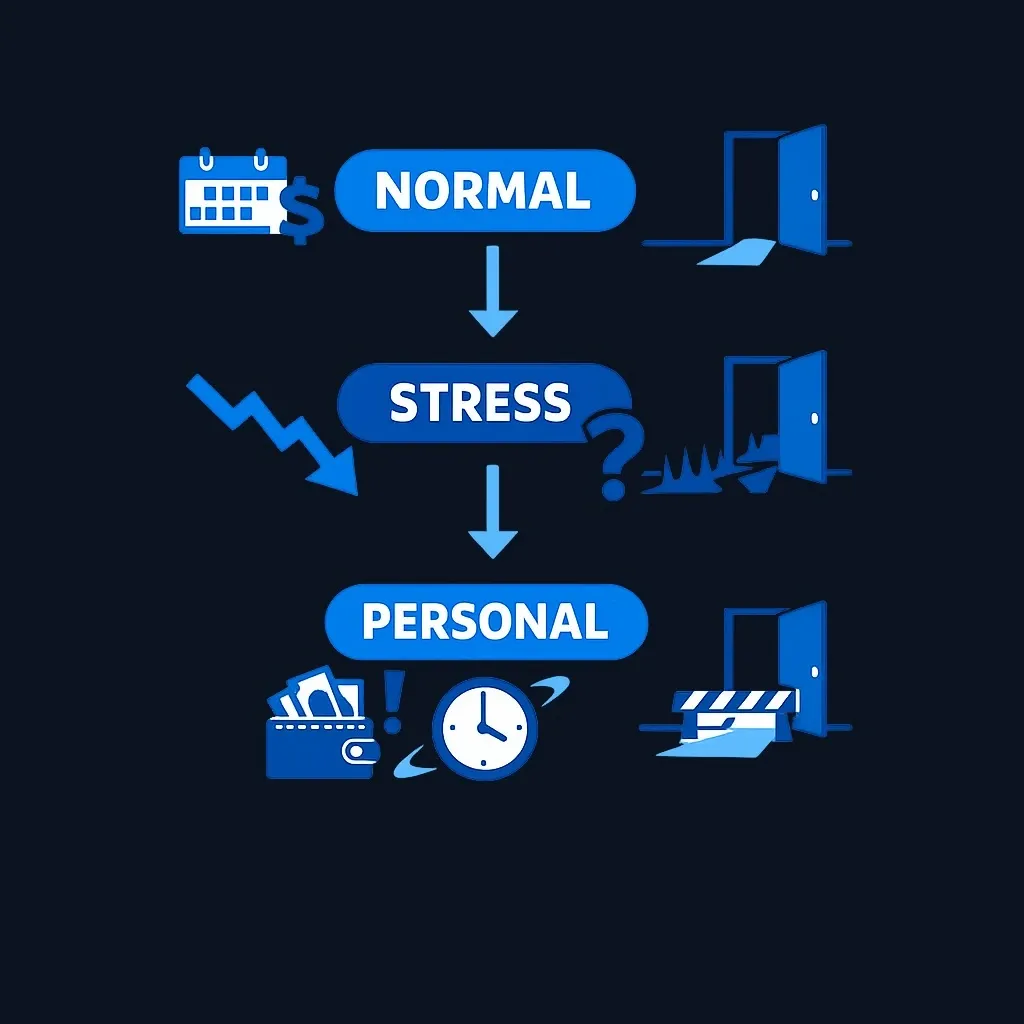
A useful filter is the “three-exit test”:
- Normal exit: How would you leave if the investment performs as expected?
- Stress exit: What happens if real estate markets weaken?
- Personal exit: What happens if your own cash needs change?
If any answer is unclear, slow down before comparing expected returns.
When to choose each option
A public REIT may be the more practical option when you want a real estate allocation that is easier to monitor. It can also make sense when you are still learning how REITs react to market news, interest-rate expectations, and property-sector headlines. The main tradeoff is emotional: visible price changes can tempt investors to overreact.
A private REIT may be worth evaluating when you have a longer time horizon and can handle less frequent visibility. It may also fit investors who want exposure to a particular sponsor, property approach, or private-market strategy. The main tradeoff is control: you may have fewer ways to exit if your view changes.
Consider two simplified scenarios.
Scenario 1: The flexibility-first investor
An investor wants real estate exposure but may need funds for a home purchase. For that person, liquidity is not a side issue. Even a compelling private offering may be a mismatch if exit terms are restrictive or uncertain. The better comparison starts with cash timing, not projected return.
Scenario 2: The long-horizon evaluator
Another investor has a long time horizon and does not expect to sell quickly. They are comfortable reading offering documents and comparing sponsor incentives. For that person, a private REIT could be part of a deeper review. The key is not assuming that privacy equals stability.
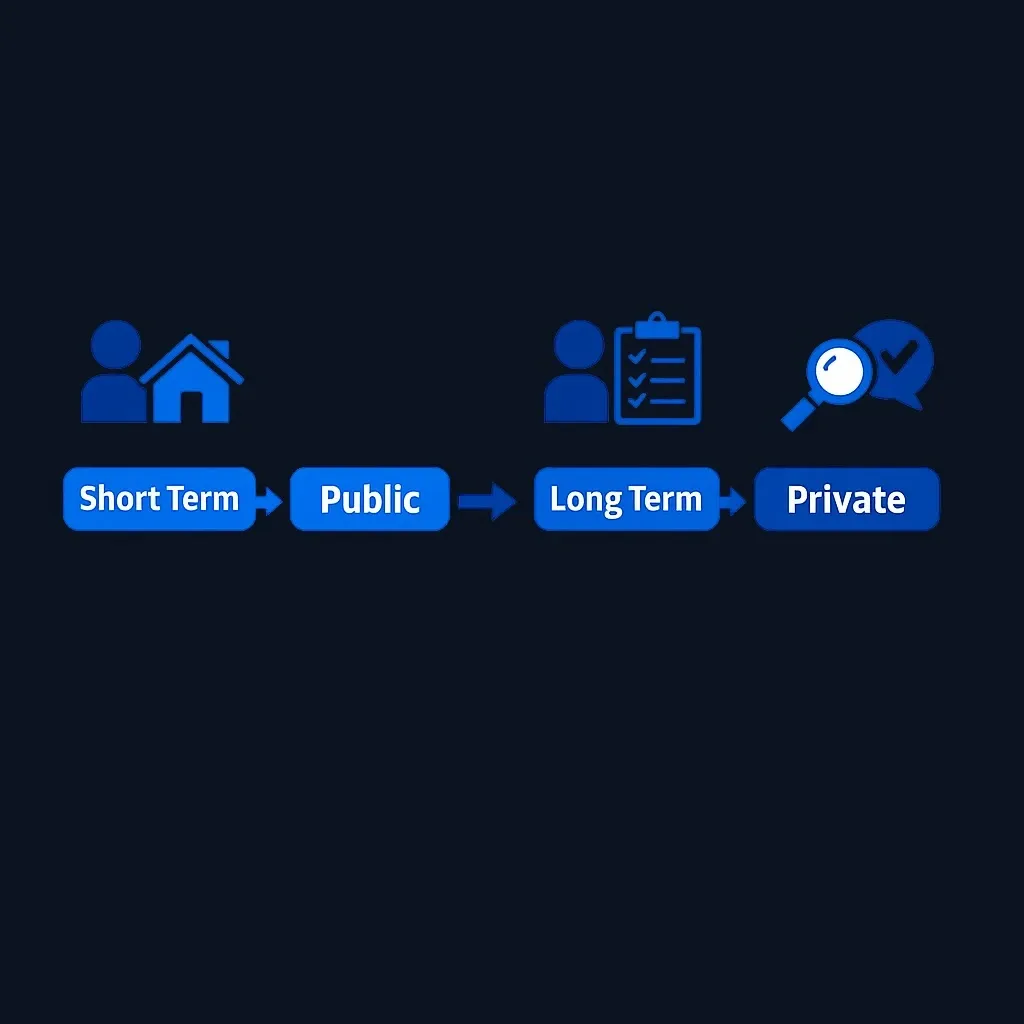
Tradeoffs and caveats
The biggest mistake in this comparison is treating public and private as shorthand for “risky” and “safe.” Both can carry real estate risk, manager risk, financing risk, and valuation risk. The risks simply show up in different ways.
Public REIT investors often see volatility immediately. That can be useful because market pricing gives constant feedback. It can also be uncomfortable because prices may move faster than property fundamentals. A drop in market price does not always mean the underlying properties changed overnight.
Private REIT investors may see less frequent valuation changes. That can reduce day-to-day noise, but it can also hide how quickly conditions are changing. If a redemption program, valuation policy, or fee structure is hard to interpret, treat that as a due diligence issue.
Economic downturns matter for both types. Real estate can be affected by tenant demand, financing conditions, property income, and investor appetite. Public vehicles may react quickly through market pricing. Private vehicles may show stress through valuation updates, distribution changes, financing pressure, or exit limitations.
The practical caveat is simple: compare the full structure, not just the label. Ask what the REIT owns, how leverage is used, how values are calculated, how you can exit, and what fees reduce investor return.

Practice investing with Finelo
Build practical investing skills with guided lessons, simulator practice, and structured challenges.
Tax implications of investing in REITs
The tax comparison should be handled carefully because outcomes depend on the investor, account type, jurisdiction, holding period, and the character of any payments or gains. Public and private REITs may both create tax reporting questions, but the investor experience can differ.
For a public REIT, the tax workflow may be easier to anticipate because the investment is typically held through a brokerage account. For a private REIT, investors may need to pay closer attention to the timing and format of tax documents, the nature of reported income, and any state-level considerations. The key point is not that one category is always tax-favorable. The key point is that tax friction can differ.
Use this checklist before investing:
- What tax forms should you expect, and when?
- Are payments characterized in different ways for tax purposes?
- Does the investment create state-level filing complexity?
- Will you hold it in a taxable account or a tax-advantaged account?
- Could an exit, redemption, or sale create a taxable event?
Do not let the tax tail wag the investment dog. A tax feature is only useful if the investment still fits your risk, liquidity, and portfolio needs. For personal tax treatment, speak with a qualified tax professional.
Market trends that can affect both
Market conditions can influence both public and private REITs, even when the pricing experience looks different. The most important trends to watch are financing conditions, property income, tenant demand, occupancy, lease rollover, and the health of the property sector.
For example, a REIT focused on office properties can face a different set of risks than one focused on apartments, warehouses, or healthcare properties. The public or private label does not erase sector exposure. It only changes how quickly investors may see market reactions.
Interest-rate changes can also affect the comparison. Higher financing costs can pressure real estate owners that rely on debt. They can also change how investors compare REIT income with other income-producing assets. Public REIT prices may adjust quickly. Private valuations may adjust with a lag.
A practical review habit is to separate three questions:
- Property trend: Is demand for this property type improving or weakening?
- Capital trend: Is financing becoming easier or harder?
- Investor trend: Are investors rewarding or avoiding this type of real estate exposure?
That framework works for both categories and helps avoid overfocusing on the wrapper.

FAQ
What are the main differences between private and public REITs?
The main differences are market category, liquidity, transparency, valuation experience, and due diligence burden. Fidelity identifies publicly traded, public non-traded, and private REITs as market-based categories (Fidelity).
Can I sell shares in a private REIT easily?
Do not assume that you can exit a private REIT easily. Review the offering documents, redemption terms, limits, timing, and any sponsor discretion before investing. Liquidity should be a primary decision factor, not an afterthought.
Are private REITs less risky because they are not publicly traded?
Not necessarily. Less visible price movement does not mean the underlying real estate is safer. Private vehicles can still face property, financing, valuation, fee, and exit risks.
What should I review before choosing either option?
Review the property strategy, costs, leverage, valuation method, sponsor incentives, reporting quality, liquidity terms, and tax workflow. Then compare those points against your time horizon, cash needs, and ability to tolerate uncertainty.
Sources and Further Verification
More from Finelo
- Private Credit vs. Private Equity: Returns, Liquidity, Fees, and Risks
- REIT ETFs for Beginners: Costs, Risks, Income, and How to Compare Funds
- REIT vs. Rental Property: Costs, Income, Liquidity, and Key Trade-Offs
Disclaimer
This article is provided by Finelo for educational and informational purposes only. Finelo does not provide financial, investment, tax, legal, or insurance advice. Consider your circumstances and consult an appropriately qualified professional before making financial decisions.
InvestingBeginner GuideFinancial Education
Practice investing with Finelo
Build practical investing skills with guided lessons, simulator practice, and structured challenges.
About the author
Finelo Team
The Finelo Team creates practical investing and trading education designed to help beginners learn faster with structured challenges, simulator practice, and bite-sized lessons.
Keep reading — Related articles

Investing
Yield to Call vs Yield to Maturity: Assumptions and Bond Risks
Yield to call (YTC) estimates a bond's yield if the issuer redeems it on an eligible call date; yield to maturity (YTM) estimates yield if it remains outstanding to final maturity.
Finelo Team

Investing
Will My Employer Know If I Take a 401(k) Loan?
Who this page is for: readers new to 401(k) loans who want a practical, privacy‑focused explanation — what your employer can see, how to limit visibility, and the financial tradeoffs to weigh.
Finelo Team

Investing
What Medical Expenses Qualify for a 401(k) Hardship Withdrawal?
Before you decide, confirm three things with your plan administrator:
Finelo Team