Last editorial review: September 8, 2026
Qualified vs. Nonqualified Annuities: Key Differences

A qualified vs nonqualified annuity decision is mainly about the tax wrapper and funding source. A qualified annuity is tied to a retirement-plan structure, while a nonqualified annuity is…
11 min read
Practice investing with Finelo
Build practical investing skills with guided lessons, simulator practice, and structured challenges.
Want to learn more?
Build practical investing skills with guided lessons, simulator practice, and structured challenges.
Explore FineloExplore Finelo's 28-day challenges
Turn learning into a daily habit with guided challenge paths.
U.S. scope: This article discusses U.S. institutions, financial products, tax rules, and dollar examples unless stated otherwise. Rules and product terms may change; verify current official guidance for your situation.
Quick comparison answer
A qualified vs nonqualified annuity decision is mainly about the tax wrapper and funding source. A qualified annuity is tied to a retirement-plan structure, while a nonqualified annuity is funded outside that structure. The practical differences show up in taxes, contribution rules, withdrawal planning, fees, and how the annuity fits with other retirement income.
What an annuity is
An annuity is generally used as a retirement-income planning tool. The contract may be designed around future payments, income timing, investment exposure, insurance features, or a mix of those goals. The qualified or nonqualified label does not tell you whether the annuity is fixed, variable, indexed, immediate, or deferred. It tells you how the contract is funded and how the tax review should begin.
What a qualified annuity is
A qualified annuity is evaluated inside the rules of a qualified retirement arrangement. That means the annuity decision is not only about the contract. It is also about the retirement account, contribution rules, distribution rules, and how future payments may affect taxable income.
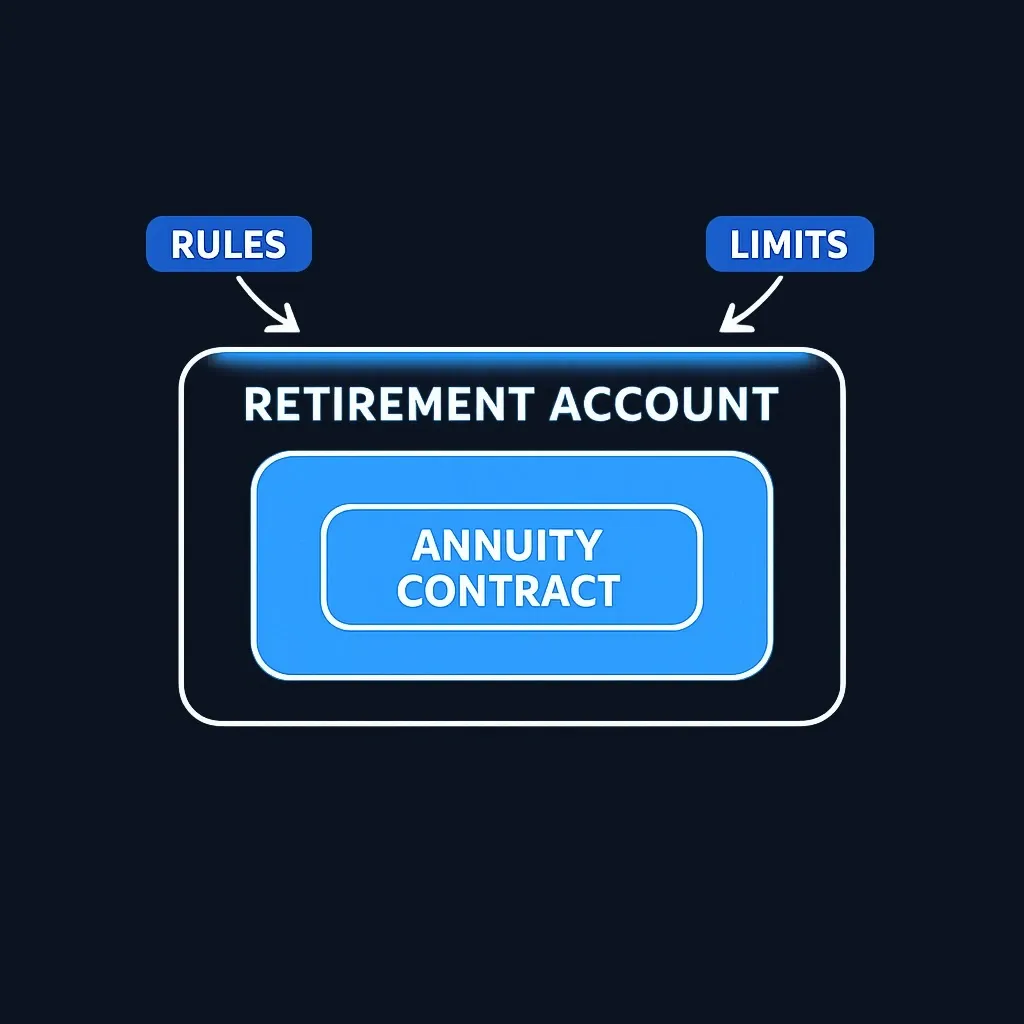
The main benefit is coordination with retirement money that may already be earmarked for long-term income. The main limitation is complexity. The annuity may add contract fees, surrender terms, or rider costs on top of rules that already apply to the retirement account.
What a nonqualified annuity is
A nonqualified annuity is evaluated outside a qualified retirement arrangement. It may be considered when someone has taxable savings and wants to convert part of that money into future retirement income.
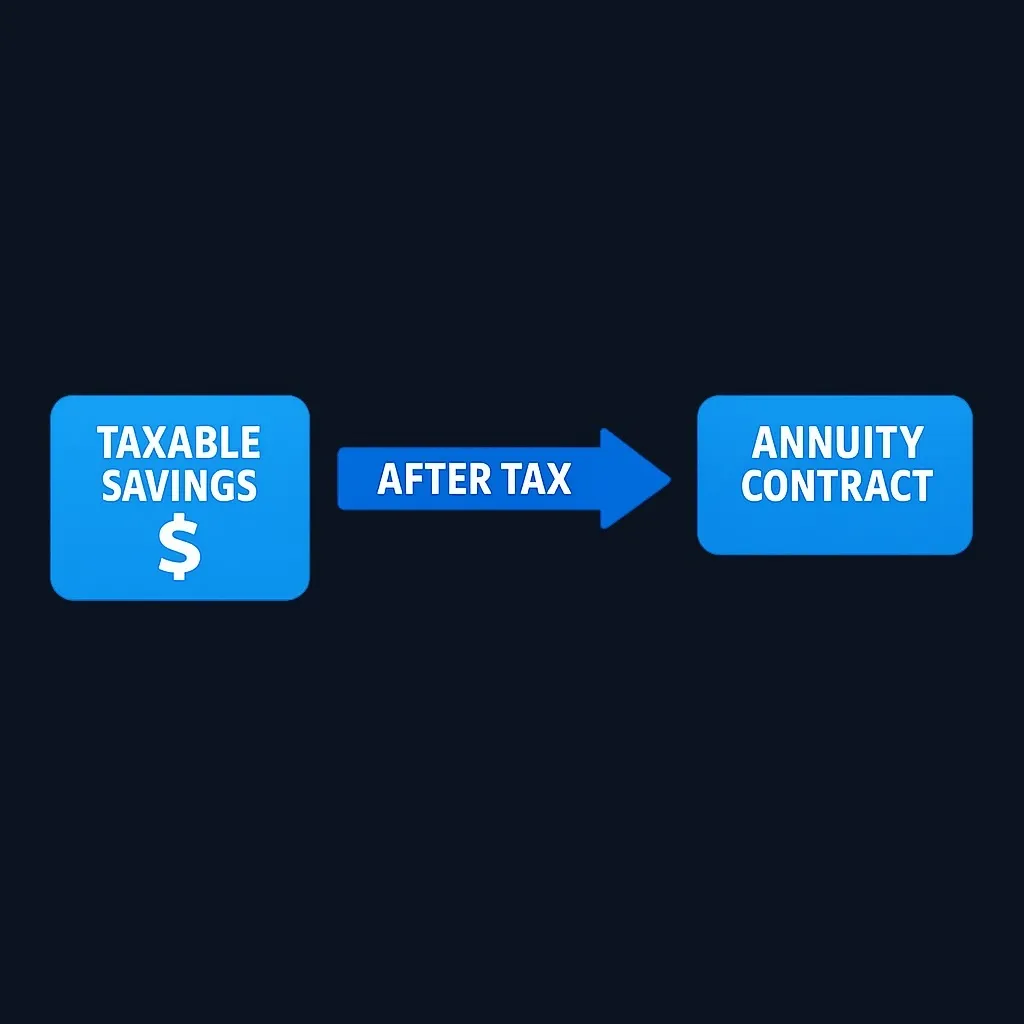
The tax review is different. The IRS states that distributions from an annuity under a nonqualified plan are considered net investment income for purposes of figuring the Net Investment Income Tax, or NIIT (IRS Publication 939). That does not mean every owner owes NIIT. It means the tax category can matter.
Side-by-side comparison table
| Decision factor | Qualified annuity | Nonqualified annuity |
|---|---|---|
| Funding lens | Starts with retirement-plan coordination | Starts with taxable savings and contract design |
| Tax review | Focuses on retirement-account rules and annuity distributions | Includes contract taxation and possible NIIT treatment for distributions (IRS Publication 939) |
| Contribution limits | Follow the applicable retirement arrangement and current plan rules | Usually reviewed through insurer contract terms and tax treatment |
| Withdrawal planning | Requires coordination between plan rules, annuity rules, and taxes | Requires review of taxable gains, contract access, and possible NIIT exposure |
| Best starting point | Money is already inside a retirement-planning structure | Money is outside retirement accounts and intended for future income |
| Main caution | May duplicate benefits already inside the retirement account | May be mistaken for a liquid savings vehicle |
| Fee review | Contract costs still matter, even inside a retirement account | Contract costs, riders, and exit terms still matter |
The table compresses the main comparison, but it should not be the whole decision. Two annuities can show similar income projections and still create different after-tax outcomes. The real comparison is the funding source, tax path, contract terms, and flexibility together.
Decision criteria
Start with the money source
The first question is simple: where will the dollars come from?
If the money is already in a retirement arrangement, the qualified route is usually the first scenario to evaluate. If the money is outside retirement accounts, the nonqualified route is usually the first scenario to evaluate. This does not decide the answer by itself, but it avoids comparing the wrong products.
A useful framing is: “Am I trying to solve an income problem inside an existing retirement plan, or am I trying to turn taxable savings into future income?” That question usually narrows the decision faster than comparing sales illustrations.
Compare taxes before comparing payments
Many buyers focus first on the projected payment amount. That can be a mistake. A larger quoted payment may not be better if taxes, fees, or liquidity limits make the contract less useful.
For a qualified annuity, the tax review starts with the retirement arrangement. For a nonqualified annuity, the review starts with the contract’s tax treatment. The IRS specifically notes that distributions from a nonqualified annuity can be net investment income for NIIT purposes (IRS Publication 939).
A practical tax review should cover three moments:
- Funding: What account or savings source provides the premium?
- Growth: How are earnings treated while money remains in the contract?
- Distribution: What happens when payments, withdrawals, or income begin?

This is where a tax professional can add value. The answer may depend on income level, filing status, state rules, other retirement income, and timing.
Review contribution limits correctly
For qualified annuities, contribution limits are not a standalone annuity feature. They depend on the retirement arrangement being used. The practical step is to check the current IRS rules, plan documents, and account custodian rules before funding the contract.
For nonqualified annuities, the contribution question is different. The review usually centers on the insurer’s contract terms, suitability, liquidity, and tax impact. Do not assume that “more room to contribute” automatically makes the nonqualified option better. Large deposits can still create concentration risk, liquidity problems, or tax complications later.
Compare fees by job, not by label
Neither label tells you whether a contract is cheap or expensive. A simple contract with few add-ons can look very different from one with multiple riders, complex crediting methods, or limited liquidity.
Use this fee checklist for both types:
- Base contract cost: What does the core annuity charge?
- Investment cost: Are there subaccount, fund, or index-related costs?
- Rider cost: Are income, withdrawal, or death benefit features optional add-ons?
- Exit cost: What happens if you need money earlier than expected?
- Tax cost: Could withdrawals create a larger tax bill than expected?
Investor.gov directs investors to evaluate annuity products carefully as investment products, including their features and risks (Investor.gov annuities overview). The key is to compare the total job the contract performs, not only the label on the account.

When to choose each option
When a qualified annuity may fit
A qualified annuity may be worth evaluating when the money is already part of a retirement plan and the goal is to create more structured income from that pool. For example, someone approaching retirement may want to convert part of a retirement account into scheduled future payments.
The better question is not “Is a qualified annuity good?” It is “What job would this contract do inside the retirement plan?” Possible jobs include organizing retirement income, reducing reinvestment decisions, or creating a clearer spending structure.
A common mistake is buying one only because it sounds tax-efficient. The retirement wrapper may already provide tax advantages. If the annuity adds costs without solving a real income, longevity, or behavior problem, the tradeoff may be weak.
When a nonqualified annuity may fit
A nonqualified annuity may be worth evaluating when the money is outside retirement accounts and the investor wants to turn taxable savings into future income. For example, someone may have cash, brokerage assets, or proceeds from a sale and want to reserve part of that money for later-life income.
This route can be useful to analyze when retirement-account contribution room is not the main issue. The focus becomes contract design, liquidity, beneficiary planning, tax treatment, and how the annuity interacts with other assets.
A common mistake is treating a nonqualified annuity like a savings account. It is still a contract. Access terms, surrender charges, riders, and tax treatment can all affect the real outcome.
Worked example: same product, different starting point
Imagine two people reviewing the same income-style annuity.
Buyer A has money in a retirement account and wants to turn part of it into predictable retirement income. The qualified scenario is the first one to evaluate because the funding source already sits inside a retirement-planning structure. The review should focus on plan coordination, taxes, fees, and whether the contract solves a defined income problem.
Buyer B has taxable savings and wants to reduce the risk of spending too much early in retirement. The nonqualified scenario is the first one to evaluate because the funding source is outside a retirement account. The review should focus on contract access, taxable distributions, NIIT exposure, and whether a simpler alternative could do the same job.
The same annuity could be unsuitable for one buyer and reasonable to evaluate for the other. The difference is not the product name. It is the funding source, tax path, and retirement-income role.

Tradeoffs and caveats
The largest tradeoff is flexibility versus structure. Annuities can help create a more structured retirement-income plan, but that structure may reduce access to lump sums. If short-term liquidity is important, solve that issue before locking money into a long-term contract.
Tax complexity is another caveat. Nonqualified annuity distributions can be treated as net investment income for NIIT purposes, according to IRS guidance (IRS Publication 939). Qualified annuities also require coordination with retirement-account rules. Neither option should be chosen based on a headline tax benefit alone.
Fees deserve their own review. Ask what each charge pays for. A rider may be useful if it solves a real planning need, but it may be unnecessary if it duplicates a feature you do not need.
There is also a risk of solving the wrong problem. If the real issue is overspending, market anxiety, tax timing, or lack of an income plan, an annuity may help only if the design matches that problem. If the real issue is emergency cash access, an annuity may be the wrong tool.
Use this pre-purchase checklist:
- What money source will fund the annuity?
- What specific retirement-income problem should it solve?
- What taxes apply at funding, growth, and withdrawal?
- What annual fees, rider fees, and exit costs apply?
- What happens if income needs change?
- What simpler alternatives should be compared first?
For readers still building investing basics, Finelo provides financial education resources for learning core investing concepts before evaluating complex products through Finelo’s learning hub.
Practice investing with Finelo
Build practical investing skills with guided lessons, simulator practice, and structured challenges.
Decision table: choosing between qualified and nonqualified annuities
| Your situation | Option to evaluate first | Why it may be the better starting point |
|---|---|---|
| Most of the money is already in a retirement arrangement | Qualified annuity | The funding source already points toward retirement-plan coordination |
| You want to use taxable savings for future income | Nonqualified annuity | The decision centers on contract terms and nonqualified tax treatment |
| You need near-term liquidity | Pause before either option | Contract access terms need careful review |
| You are comparing only payment quotes | Review both more deeply | Payment size does not answer tax, fee, or flexibility questions |
| You are unsure which account should fund it | Model both paths | The tax wrapper may change the practical result |
| You mainly want tax deferral | Compare alternatives first | The value depends on costs, time horizon, and future tax treatment |
A simple decision framework is source, solve, stress-test.
First, identify the source of the dollars. Retirement money and taxable savings lead to different questions. Next, name the problem the annuity should solve. Income structure, longevity planning, and spending discipline are different goals. Finally, stress-test the choice. Ask what happens if you need cash, tax rules affect withdrawals, markets move, or retirement timing changes.

FAQ
What is the difference between qualified and nonqualified annuities?
The main difference is the tax wrapper and funding source. A qualified annuity is reviewed through a retirement-plan structure, while a nonqualified annuity is reviewed outside that structure.
How are withdrawals taxed for each type?
For qualified annuities, withdrawal taxation depends on the retirement arrangement and distribution rules. For nonqualified annuities, the IRS states that distributions under a nonqualified plan are considered net investment income when figuring NIIT (IRS Publication 939).
Are there contribution limits for qualified annuities?
The limit question follows the retirement arrangement, not just the annuity contract. Check current IRS rules, plan documents, and custodian requirements before funding a qualified annuity.
Can someone have both types?
A person may evaluate both if they have different money sources and planning goals. The important step is to avoid overlap, duplicated fees, and tax surprises across the full retirement-income plan.
Sources and Further Verification
More from Finelo
- Fixed Annuity vs. CD: Key Differences
- Immediate vs. Deferred Annuities: Key Differences
- Pension Lump Sum vs. Annuity: Key Differences
Disclaimer
This article is provided by Finelo for educational and informational purposes only. Finelo does not provide financial, investment, tax, legal, or insurance advice. Consider your circumstances and consult an appropriately qualified professional before making financial decisions.
InvestingBeginner GuideFinancial Education
Practice investing with Finelo
Build practical investing skills with guided lessons, simulator practice, and structured challenges.
About the author
Finelo Team
The Finelo Team creates practical investing and trading education designed to help beginners learn faster with structured challenges, simulator practice, and bite-sized lessons.
Keep reading — Related articles

Investing
Yield to Call vs Yield to Maturity: Assumptions and Bond Risks
Yield to call (YTC) estimates a bond's yield if the issuer redeems it on an eligible call date; yield to maturity (YTM) estimates yield if it remains outstanding to final maturity.
Finelo Team

Investing
Will My Employer Know If I Take a 401(k) Loan?
Who this page is for: readers new to 401(k) loans who want a practical, privacy‑focused explanation — what your employer can see, how to limit visibility, and the financial tradeoffs to weigh.
Finelo Team

Investing
What Medical Expenses Qualify for a 401(k) Hardship Withdrawal?
Before you decide, confirm three things with your plan administrator:
Finelo Team


