Last editorial review: September 8, 2026
Fixed Annuity vs. CD: Key Differences
A fixed annuity may fit longer-term retirement-oriented savings when you value a stated minimum interest guarantee during the accumulation phase. A CD may fit shorter, clearly timed savings…
12 min read
Practice investing with Finelo
Build practical investing skills with guided lessons, simulator practice, and structured challenges.
Want to learn more?
Build practical investing skills with guided lessons, simulator practice, and structured challenges.
Explore FineloExplore Finelo's 28-day challenges
Turn learning into a daily habit with guided challenge paths.
U.S. scope: This article discusses U.S. institutions, financial products, tax rules, and dollar examples unless stated otherwise. Rules and product terms may change; verify current official guidance for your situation.
Quick comparison answer
A fixed annuity may fit longer-term retirement-oriented savings when you value a stated minimum interest guarantee during the accumulation phase. A CD may fit shorter, clearly timed savings because a bank CD offers interest in exchange for keeping money deposited for a specified term, usually from three months to five years or more. The best answer to “fixed annuity vs cd” depends on your time horizon, need for access, tax situation, current quotes, and comfort with contract terms.
What is a fixed annuity?
A fixed annuity is an annuity contract where the accumulation value earns at least a minimum interest rate during the accumulation phase, according to Investor.gov’s explanation of fixed annuities. In plain terms, the product is built around a contract rather than a simple deposit account.
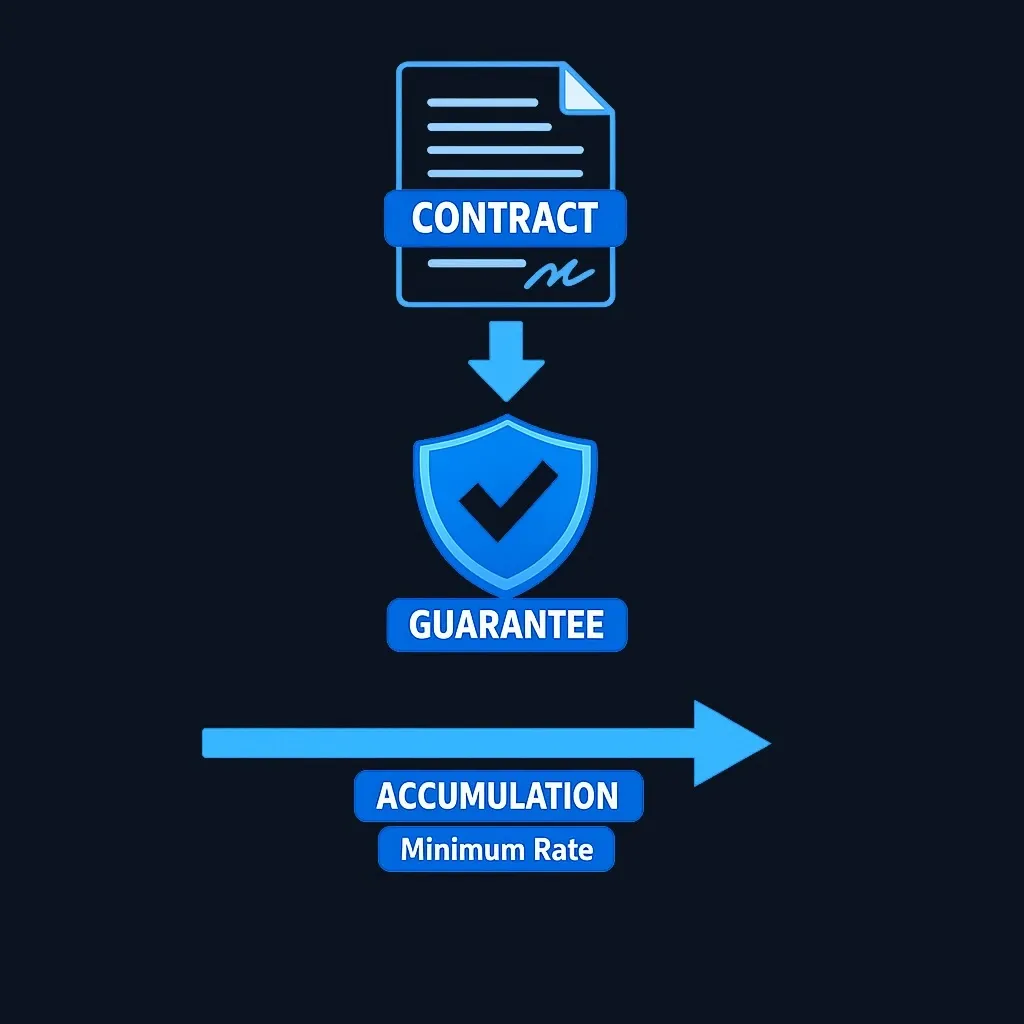
That contract structure matters. Before buying one, a reader should understand the guaranteed rate, how long that rate applies, what happens after that period, and what access rules apply. The headline rate is only one part of the comparison.
Fixed annuities are often considered by people who are thinking beyond a near-term savings goal. They can be useful to evaluate when the money has a longer intended holding period, and when the contract’s terms match the owner’s broader retirement plan.
A practical way to read an annuity quote is to ask four questions:
- What rate is guaranteed, and for how long?
- What access do I have if plans change?
- What costs or charges could apply?
- How would withdrawals affect my taxes and income plan?
The key is not whether an annuity sounds “safer” or “better.” The question is whether the contract fits the job you are asking it to do.
What is a Certificate of Deposit (CD)?
A certificate of deposit is a bank deposit product. The FDIC says a bank CD typically offers a higher interest rate than a regular savings account in exchange for keeping the money on deposit for a specified term, usually from three months to five years or more FDIC.
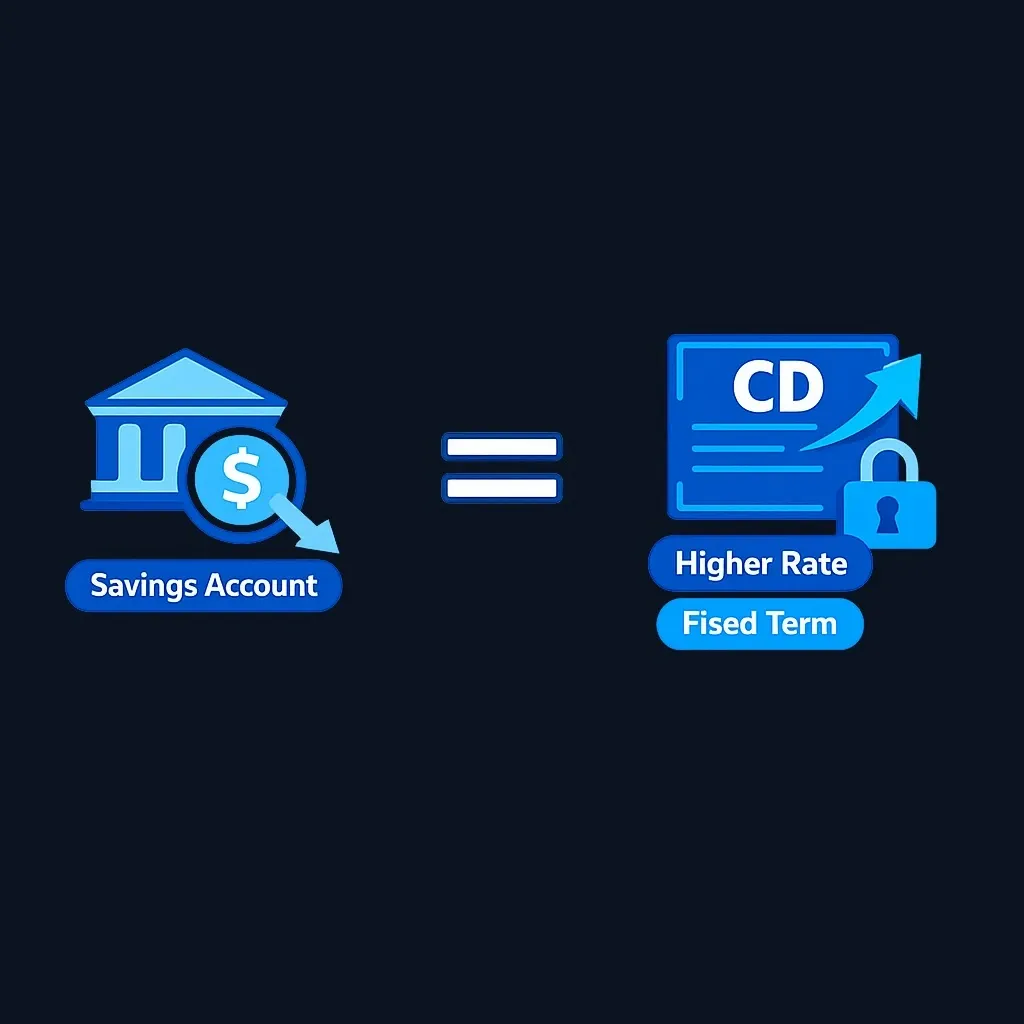
That tradeoff is the core CD idea. You accept a defined term so you can evaluate a known rate for a known savings window. This can make CDs easier to match with planned expenses than products with more complex contract features.
For example, a CD may be easier to evaluate when you know you need money for a home project, tuition payment, tax bill, or reserve fund at a future date. The term gives structure to the decision.
Still, CDs are not just “set it and forget it.” The rate, term length, renewal process, and early-access rules should all be checked before funding. A CD that looks attractive today may be less useful if the term does not match when you need the cash.
Side-by-side comparison table
| Decision point | Fixed annuity | CD |
|---|---|---|
| Basic structure | An annuity contract with at least a minimum interest rate during the accumulation phase Investor.gov | A bank deposit product that pays interest for keeping money deposited for a specified term FDIC |
| Typical planning use | Longer-term savings or retirement-planning analysis | Timed savings goals with a defined maturity window |
| Term mindset | Review the contract period, guarantees, and access rules together | Match the CD term to when you expect to need the money |
| Liquidity question | What happens if I need money before the planned holding period ends? | What happens if I need money before the CD term ends? |
| Tax question | How would the contract’s tax treatment affect my after-tax result? | How would the interest affect my after-tax result? |
| Main risk to compare | Contract complexity, access limits, and issuer or product terms | Reinvestment timing, access limits, and rate changes after maturity |
| Best fit when | You can commit money for a longer purpose and understand the contract | You want a simpler term-based savings tool |
The biggest fixed annuity vs CD difference is not just rate. It is structure. A CD is easier to map to a date. A fixed annuity requires closer review of the contract, because the guarantee, access terms, and long-term role work together.
Decision criteria
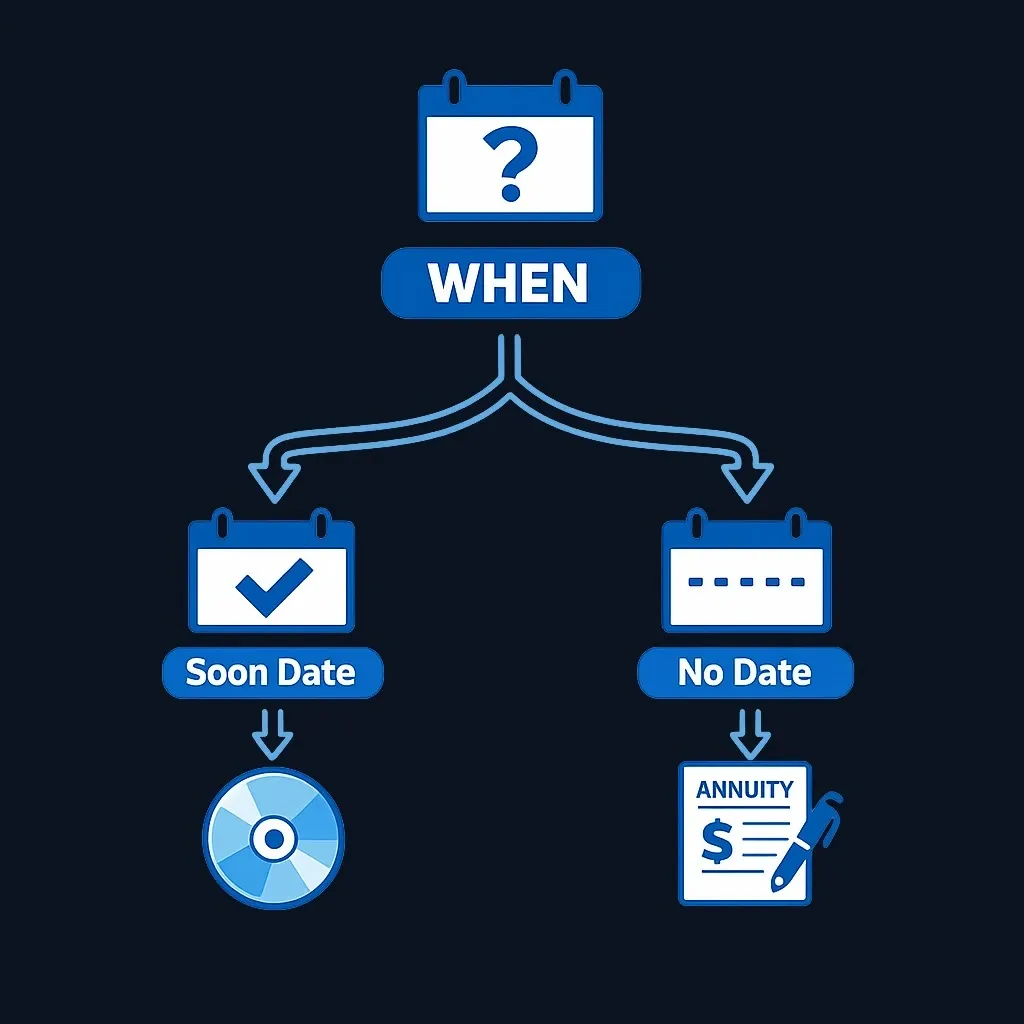
1. Match the product to the time horizon
Start with the date when the money may be needed. If the goal has a clear date, a CD can be easier to evaluate because the FDIC describes CDs as deposits for a specified term, usually from three months to five years or more FDIC.
If the goal is more open-ended, a fixed annuity may deserve review. Investor.gov notes that fixed annuities guarantee at least a minimum interest rate during the accumulation phase Investor.gov. That feature may matter more when the money is not assigned to a near-term expense.
A useful rule: start with the calendar, not the rate. A higher quoted rate can be a poor fit if the money is needed too soon.
2. Compare access before comparing yield
Liquidity is where many comparison mistakes happen. Readers often focus on the interest rate first, then notice access rules later. Reverse that process.
Ask, “What would I do if I needed part of this money early?” Then read the CD terms or annuity contract with that situation in mind. If the answer feels unclear, the product may be too restrictive for that portion of your savings.
A simple fix is to separate money into buckets. Keep near-term cash needs in tools designed for access. Use CDs or annuities only for money that can follow their terms.
3. Use after-tax thinking, not just headline rates
Taxes can change the practical result. The right comparison is not only “Which quote is higher?” It is “Which option may leave me with the better after-tax outcome for my situation?”
Because tax treatment can depend on account type, product structure, income, and withdrawal timing, this is a point to verify before committing money. A tax professional can help compare outcomes if the amount is meaningful.
A useful worksheet has three lines: expected interest, expected access timing, and expected tax impact. If one line is uncertain, avoid treating the headline rate as the final answer.
4. Check current quotes and contract terms
Rates change. Product terms also matter. Before deciding, compare current CD rates, current annuity quotes, and the exact documents you would sign.
Do not compare a promotional CD to a generic annuity description. Do not compare an annuity illustration to an old CD rate. Use current, written terms for both.
When to choose each option
When a fixed annuity may make more sense
A fixed annuity may be worth evaluating when the money is tied to a longer-term plan, and you do not expect to use it for near-term spending. The key appeal is the minimum interest guarantee during the accumulation phase described by Investor.gov Investor.gov.
Consider a retirement-focused scenario. Lena has separate emergency savings and does not expect to use a certain pool of money soon. She is comparing a fixed annuity quote against CDs. Her main questions are contract length, guaranteed rate period, access rules, and taxes.
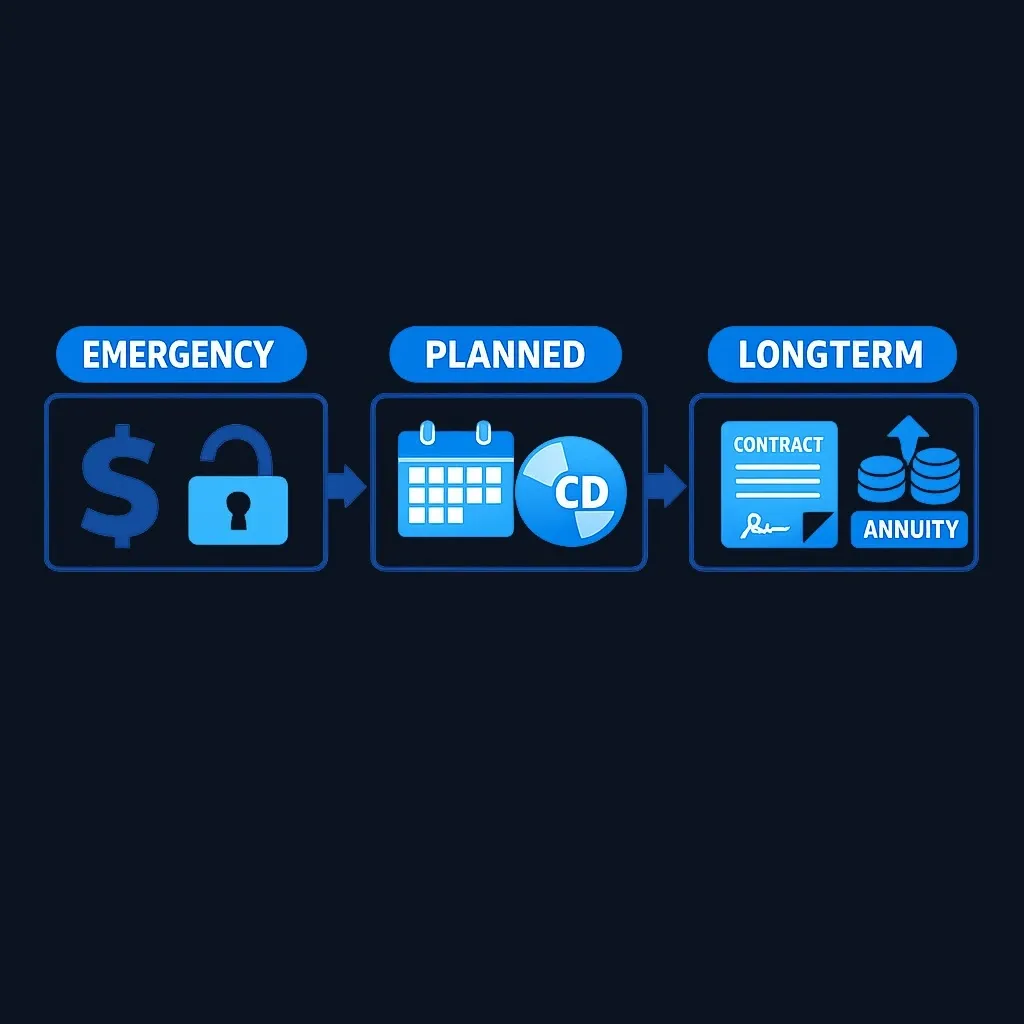
In that case, the annuity is not competing with her emergency fund. It is competing for money assigned to a longer-term purpose. That distinction makes the comparison cleaner.
A fixed annuity may also be considered when a person wants structure. Some savers dislike rolling over short-term products repeatedly. A contract-based product may feel more aligned if the terms are understood and the holding period fits.
The common mistake is using annuity money as backup cash. If early access would cause stress, the product may be serving the wrong role.
When a CD may make more sense
A CD may make more sense when the goal has a clear date and the reader wants a simpler term-based structure. The FDIC describes a CD as offering interest in exchange for keeping money deposited for a specified term FDIC.
Consider a planned-expense scenario. Marco expects to replace a car in a future year. He does not want market exposure for that money, but he also does not need it this month. A CD term that lines up with the purchase window may be easier to evaluate than a contract with more moving parts.
CDs can also work well for people who want to stage maturities. Instead of putting all savings into one term, a saver can build a CD ladder if suitable terms are available. That means dividing money among CDs with different maturity dates.
For example, a saver could divide a reserve into several pieces and place each piece into a different available term. As each CD matures, the saver can reassess cash needs and current rates. This does not remove tradeoffs, but it can reduce the problem of locking all money into one date.
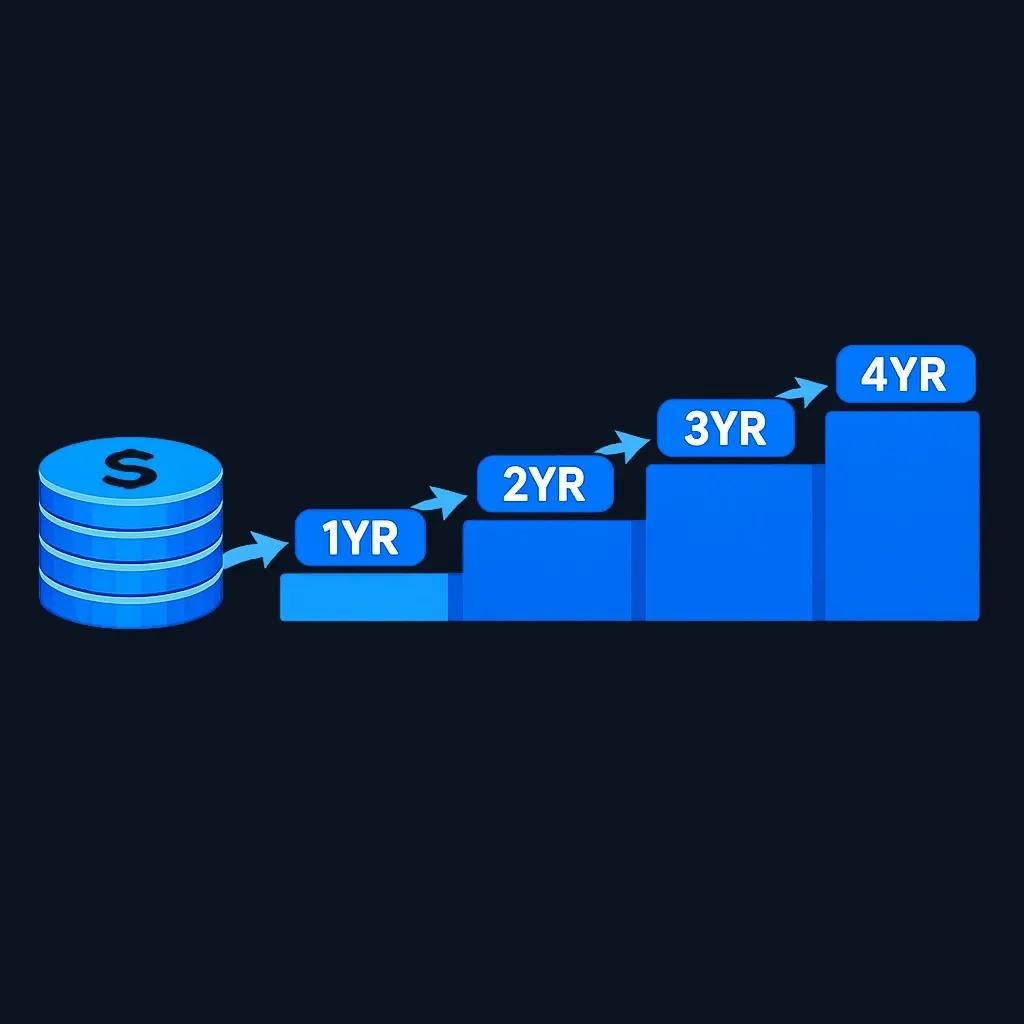
The common mistake is chasing the longest or highest quoted rate without checking the calendar. A CD works best when the maturity date fits the spending plan.
Practice investing with Finelo
Build practical investing skills with guided lessons, simulator practice, and structured challenges.
Tradeoffs and caveats
Pros and cons at a glance
| Option | Potential advantages | Main cautions |
|---|---|---|
| Fixed annuity | Minimum interest guarantee during accumulation; may fit longer-term planning Investor.gov | Contract terms can be harder to compare; access and tax details need careful review |
| CD | Term-based structure; bank CD terms commonly range from three months to five years or more FDIC | May be a poor fit if the maturity date does not match cash needs |
| Both | Can help plan around a stated rate or term | Current quotes, access rules, and after-tax results matter more than labels |
Interest rates are only one input
A rate comparison can be useful, but it is incomplete. Two products with similar rates can behave very differently if one has a better-fitting term, clearer access rules, or a more favorable tax outcome for the buyer.
Think of the rate as the final screen, not the first screen. First remove options that fail your time horizon, access needs, or tax review. Then compare current quotes among the remaining choices.
Do not mix emergency money with long-term money
A strong decision starts with purpose. Emergency funds, planned expenses, and retirement-oriented savings should not be judged by the same standard.
Emergency money needs access. Planned expenses need date matching. Longer-term money may allow more structure. When those buckets are mixed, the comparison becomes confusing.
Read renewal and exit details before funding
Before using either product, ask what happens at the end of the term or contract period. Also ask what happens if you need to exit earlier than planned.
This is where a short checklist helps:
- What date or period am I committing to?
- What rate is stated in writing?
- What happens when the period ends?
- What happens if I need money early?
- What tax reporting or tax timing should I expect?
- Who do I contact if I have a dispute or question?
If any answer is unclear, pause before funding. Clarity is part of the return.
Decision Framework: Fixed Annuity or CD?
Use this framework before comparing quotes:
- Define the job for the money. Is it emergency cash, a planned expense, or long-term savings?
- Set the time horizon. If there is a known date, write it down.
- Screen for access. Remove any option that creates too much stress if plans change.
- Compare tax impact. Use after-tax thinking, especially for larger balances.
- Compare current written terms. Use actual quotes, not general product descriptions.
- Decide whether one product or both fit. Some savers may use CDs for timed goals and evaluate annuities for longer-term money.
Here is a simple flow:
Do you need the money soon or unpredictably?
|
|-- Yes --> Avoid tying that portion to long commitments.
|
|-- No --> Is there a specific date for the goal?
|
|-- Yes --> Compare CD terms that match the date.
|
|-- No --> Review fixed annuity terms alongside other long-term options.
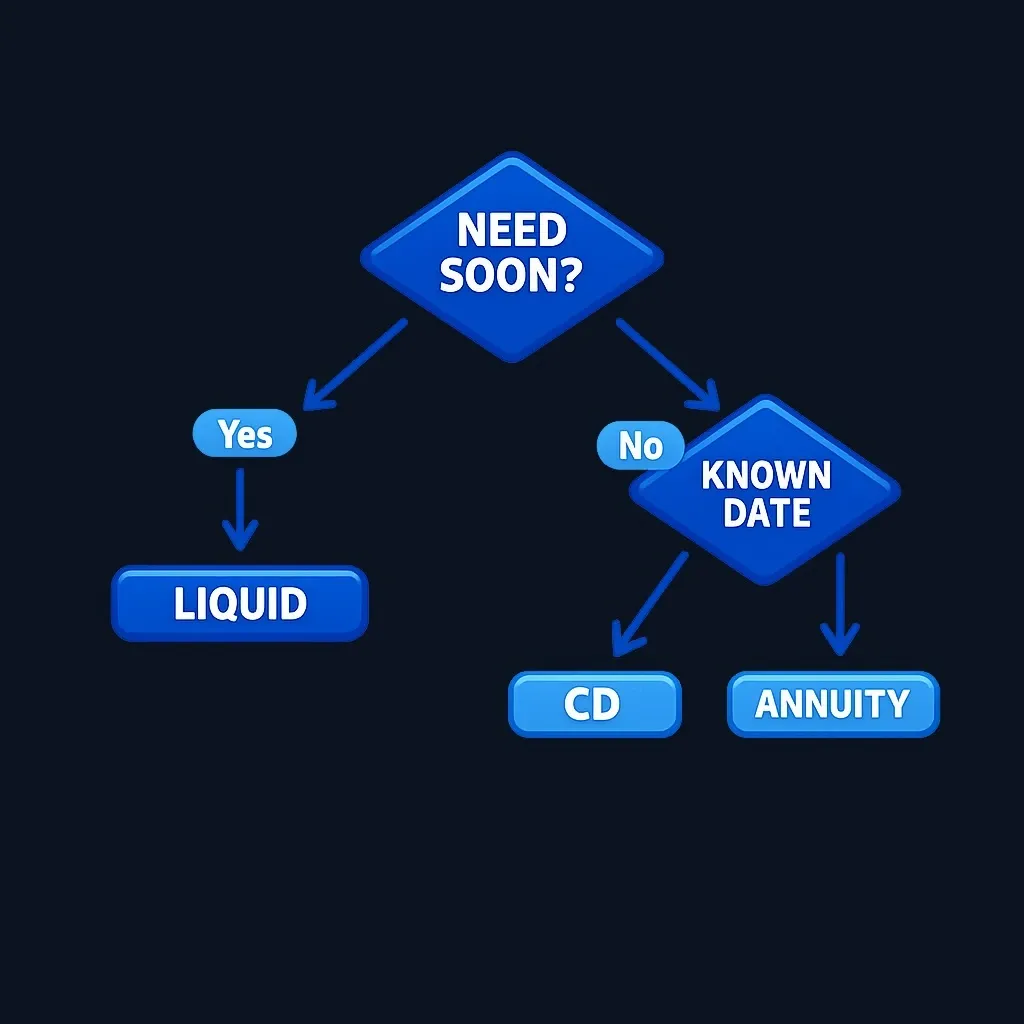
A blended approach can also be reasonable. For example, a saver could keep liquid cash separate, use CDs for known expenses, and evaluate a fixed annuity only for money assigned to longer-term planning. That avoids forcing one product to solve every problem.
If you want to keep learning before comparing products, you can explore broader investing and financial education resources at Finelo.
FAQ
What is the main difference between a fixed annuity and a CD?
A fixed annuity is an annuity contract with at least a minimum interest guarantee during the accumulation phase Investor.gov. A CD is a bank deposit product that pays interest when money is kept deposited for a specified term FDIC.
Which option is better for long-term savings?
It depends on the goal, access needs, taxes, and current terms. A fixed annuity may deserve review for longer-term planning, while a CD may be easier when the goal has a known date.
How do taxes affect the comparison?
Taxes can change the after-tax result, so the highest quoted rate may not produce the best outcome. Review tax treatment before committing money, especially if the amount is significant.
Can I use both?
Yes, a comparison does not have to end with one product winning every role. A CD can match a timed goal, while a fixed annuity can be evaluated separately for longer-term savings.
Sources and Further Verification
More from Finelo
- Immediate vs. Deferred Annuities: Key Differences
- Pension Lump Sum vs. Annuity: Key Differences
- Qualified vs. Nonqualified Annuities: Key Differences
Disclaimer
This article is provided by Finelo for educational and informational purposes only. Finelo does not provide financial, investment, tax, legal, or insurance advice. Consider your circumstances and consult an appropriately qualified professional before making financial decisions.
InvestingBeginner GuideFinancial Education
Practice investing with Finelo
Build practical investing skills with guided lessons, simulator practice, and structured challenges.
About the author
Finelo Team
The Finelo Team creates practical investing and trading education designed to help beginners learn faster with structured challenges, simulator practice, and bite-sized lessons.
Keep reading — Related articles

Investing
Yield to Call vs Yield to Maturity: Assumptions and Bond Risks
Yield to call (YTC) estimates a bond's yield if the issuer redeems it on an eligible call date; yield to maturity (YTM) estimates yield if it remains outstanding to final maturity.
Finelo Team

Investing
Will My Employer Know If I Take a 401(k) Loan?
Who this page is for: readers new to 401(k) loans who want a practical, privacy‑focused explanation — what your employer can see, how to limit visibility, and the financial tradeoffs to weigh.
Finelo Team

Investing
What Medical Expenses Qualify for a 401(k) Hardship Withdrawal?
Before you decide, confirm three things with your plan administrator:
Finelo Team


