Last editorial review: September 8, 2026
Per Stirpes vs. Per Capita: Which Distribution Method Fits Your Estate Plan?

The per stirpes vs per capita decision determines how a share can pass when a beneficiary dies before distribution. Per stirpes keeps each family branch's share intact. Per capita at each…
8 min read
Practice investing with Finelo
Build practical investing skills with guided lessons, simulator practice, and structured challenges.
Want to learn more?
Build practical investing skills with guided lessons, simulator practice, and structured challenges.
Explore FineloExplore Finelo's 28-day challenges
Turn learning into a daily habit with guided challenge paths.
U.S. scope: This article discusses U.S. institutions, financial products, tax rules, and dollar examples unless stated otherwise. Rules and product terms may change; verify current official guidance for your situation.
Quick comparison answer
The per stirpes vs per capita decision determines how a share can pass when a beneficiary dies before distribution. Per stirpes keeps each family branch's share intact. Per capita at each generation pools shares assigned to deceased members of one generation, then divides that pool equally among eligible descendants in the next generation. The better fit depends on whether branch equality or generation equality matches the intended result.
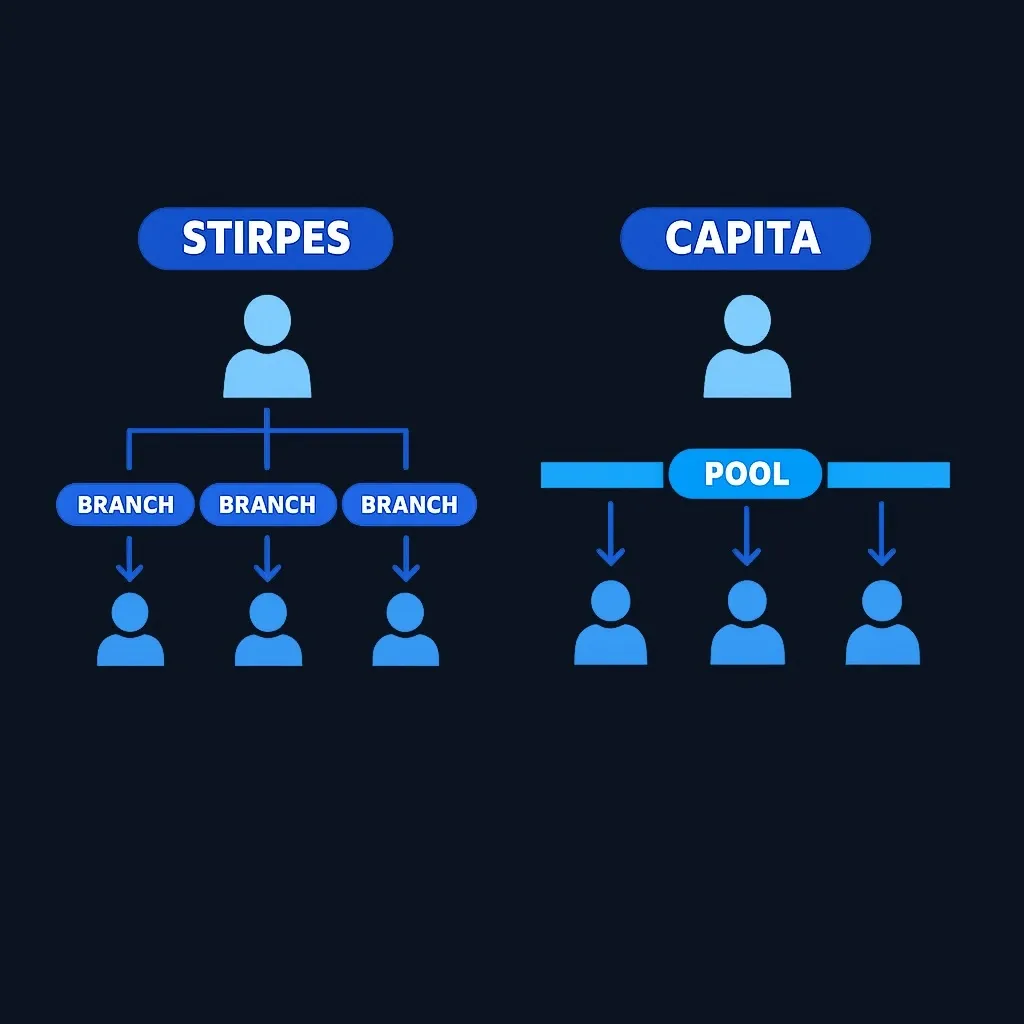
How the two distribution methods work
Both methods answer a difficult planning question: who receives a share when an intended beneficiary dies before distribution? The important difference is not the first split. It is what happens to a deceased beneficiary's share after that split.
Per stirpes follows family branches
Under a per-stirpes structure, the distribution starts with the designated ancestor's children. Each living child represents one branch. A deceased child who left descendants also represents one branch.
Arizona's statute describes the initial division as equal shares for surviving children and deceased children who left surviving descendants. That deceased child's branch is then divided among the descendants in that branch. The Arizona Legislature's definition provides a useful official example of the mechanics.
Consider a $900,000 illustrative estate and three family branches:
- Beth is living.
- Chris died earlier and left one child.
- Dana died earlier and left two children.
The first split creates three $300,000 branch shares. Beth receives $300,000. Chris's child receives that branch's $300,000. Dana's two children divide their branch, receiving $150,000 each.
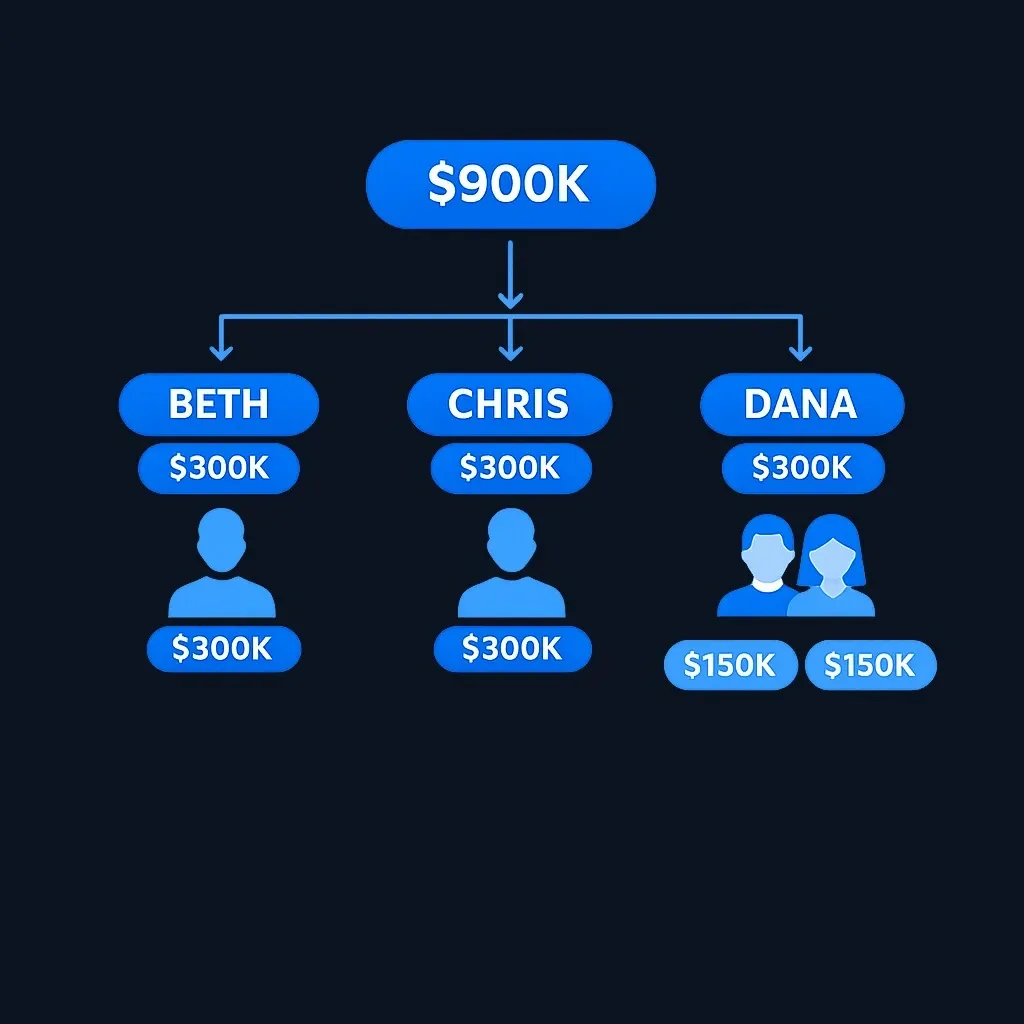
The central idea is branch preservation. The number of descendants inside one branch does not enlarge that branch's original share. This can help a planner protect the relative weight assigned to each child's family line.
Per capita at each generation equalizes within a generation
Per capita at each generation begins with the nearest generation containing a living descendant. It also counts members of that generation who died but left descendants. Living members receive their shares, while the shares linked to deceased members are pooled.
Massachusetts law uses this structure for property distributed “per capita at each generation.” It counts living descendants in the nearest generation and deceased descendants there who left surviving descendants. See the Massachusetts Legislature's distribution rule.
Apply that method to the same $900,000 example. Beth receives one $300,000 share. The two shares linked to Chris and Dana form a $600,000 pool. Their three children are in the same generation, so each receives $200,000.
This method produces equal shares for similarly situated descendants in the same generation. It does not preserve the original $300,000 amount for each deceased parent's branch.
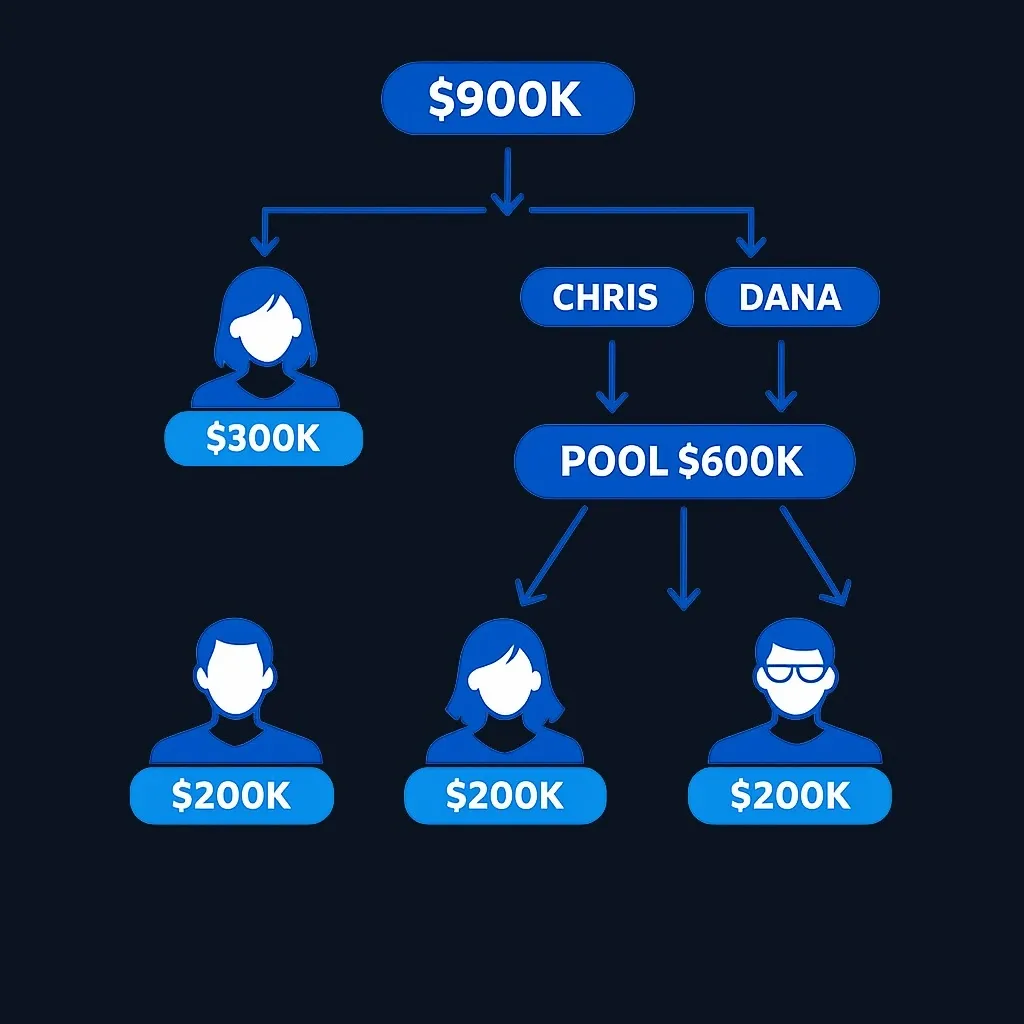
Side-by-side comparison table
| Decision point | Per stirpes | Per capita at each generation |
|---|---|---|
| Organizing principle | Family branch | Descendant generation |
| First reference point | Children of the designated ancestor | Nearest generation with a living descendant |
| Deceased beneficiary's share | Stays inside that beneficiary's branch | Joins other deceased members' shares at that generation |
| Next-level division | Divided within each separate branch | Pooled, then divided among eligible descendants at the next generation |
| Same example result | Grandchildren may receive different amounts across branches | Grandchildren in the same generation may receive equal amounts |
| Useful planning question | “Should each child's branch retain an equal starting share?” | “Should descendants in the same generation receive equal shares?” |
| Main clarity risk | Forgetting how deeper branches subdivide | Using “per capita” without defining the intended version |
| Review focus | Branch map and substitute beneficiaries | Generation map and pooling rule |
The table shows why neither term is automatically fairer. Each method applies a different definition of equality. The intended result should be tested against the actual family tree.
Decision criteria
1. Define what “equal” means
Start with a plain-language sentence before choosing legal wording. One person may mean, “Each of my children's branches gets one-third.” Another may mean, “All grandchildren who ultimately inherit should receive equal amounts.” Those goals can create different results.
The $900,000 example exposes the difference. Per stirpes gives Chris's only child more than either of Dana's children. Per capita at each generation gives all three grandchildren the same amount.
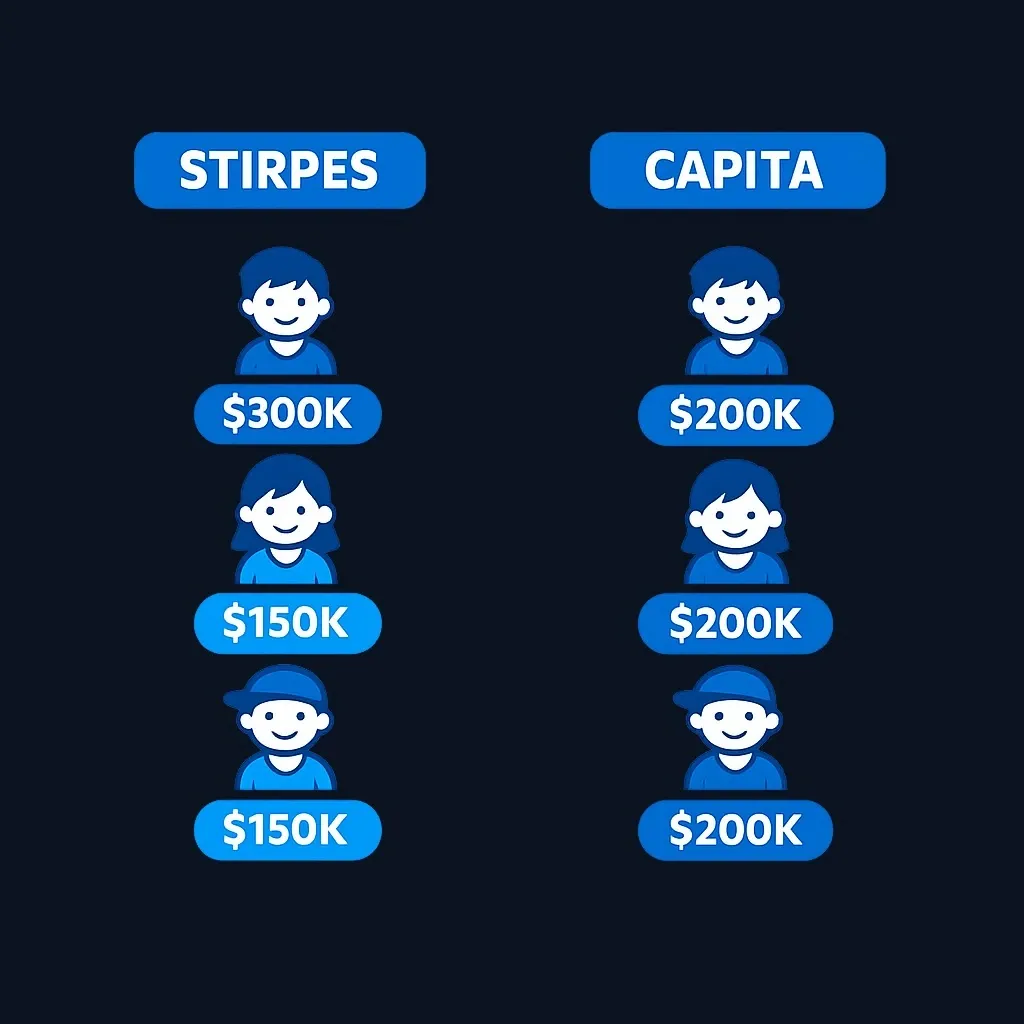
2. Map plausible survival scenarios
Test more than today's family structure. Draw one row for children, another for grandchildren, and a third if relevant. Then mark who is living in each scenario.
Run at least these cases:
- Every named beneficiary survives.
- One beneficiary dies and leaves descendants.
- Two beneficiaries die and leave different numbers of descendants.
- A deceased beneficiary leaves no descendants.
- A descendant is born or adopted after the document is signed.
The exercise is not a prediction. It is a way to reveal whether the wording behaves as expected under several family arrangements.
3. Separate class gifts from named gifts
“My descendants” describes a class. A list of named people can create a different drafting problem. Avoid assuming that adding “per stirpes” after several names resolves every question.
For example, a plan naming three friends and one child needs more than a family-tree rule. It should explain what happens if any named recipient dies before distribution.
4. Decide how much flexibility the document needs
A simple family tree may be easy to model. Blended families, multiple relationships, stepchildren, trusts, and unequal gifts require more explicit instructions. A separate contingent-beneficiary clause may communicate the intent better than a Latin label alone.
When to choose each option
Per stirpes may align with the goal when each child's branch should retain an equal starting share. It can also fit when grandchildren should step into their deceased parent's place without changing other branches.
Per capita at each generation may align with the goal when equal treatment among descendants at the same generational level matters more. It can reduce differences caused only by one branch having more children than another.
Use this decision check:
- Choose the branch lens if the sentence “each child's family line keeps its share” states the intent accurately.
- Choose the generation lens if “eligible descendants in the same generation share equally” states it more accurately.
- Pause if neither sentence works. The plan may need custom percentages, named contingent beneficiaries, or trust language.
No checklist can select the right legal wording for a particular family. Its purpose is to make the desired outcome concrete before the document is reviewed.
Tradeoffs and caveats
State rules and document wording matter
The official Arizona and Massachusetts provisions show how statutes can define these terms. A will, trust, beneficiary form, and state law may interact differently. A familiar label should not replace a review of the full clause.
The two methods also answer an allocation question, not every estate-planning question. They do not identify the assets controlled by a will, appoint a fiduciary, or resolve every tax issue. Those matters require separate analysis.
“Per capita” can be too vague on its own
In everyday speech, per capita often means “per person.” Estate documents may use the more specific phrase “per capita at each generation.” Writing the complete term and describing the pooling step can reduce ambiguity.
Equal percentages can create unequal practical outcomes
Two beneficiaries can receive equal percentages but face different circumstances. One asset may be difficult to divide, or a trust may delay a distribution. The distribution method should therefore be reviewed with the asset list and the rest of the plan.
Practice investing with Finelo
Build practical investing skills with guided lessons, simulator practice, and structured challenges.
Common mistakes to avoid
One common mistake is checking a per-stirpes box without drawing the family branches. A second is assuming grandchildren always receive equal amounts. That is not true in the worked per-stirpes example.
Another mistake is treating a beneficiary designation as isolated from the broader plan. Review retirement accounts, insurance forms, payable-on-death instructions, wills, and trusts as separate documents. Confirm that each uses language matching the same intent.
Finally, avoid relying on a label that no one has tested. Ask for a dollar-based illustration using the current family tree. If the illustration feels surprising, update the instruction before signing.
FAQ
What is the main difference between per stirpes and per capita?
Per stirpes preserves shares by family branch. Per capita at each generation pools shares linked to deceased members of one generation, then divides the pool among eligible descendants in the next generation.
Do grandchildren always receive equal shares under per stirpes?
No. Grandchildren divide the share assigned to their parent's branch. Cousins can therefore receive different amounts when their branches contain different numbers of descendants.
What happens if a beneficiary dies without descendants?
The result depends on the governing document and applicable law. Test that scenario explicitly and make sure the document identifies who receives the unused share.
Can a will use both approaches?
A document can contain different distribution instructions for different gifts. Each clause should identify the relevant beneficiaries, triggering event, and method clearly. A qualified estate-planning attorney can check whether the clauses work together.
Next steps
Write the desired outcome in plain English, draw the family tree, and calculate at least three survival scenarios. Compare the results under both methods. Then review every relevant beneficiary document and have the final language checked under the law that governs the plan.
Sources and Further Verification
More from Finelo
- 1031 Exchange vs. Opportunity Zone: Key Differences
- 83(b) Election: Deadlines, Tax Risks, and When Early Filing May Fit
- After-Tax 401(k) vs. Roth 401(k): Key Differences
Disclaimer
This article is provided by Finelo for educational and informational purposes only. Finelo does not provide financial, investment, tax, legal, or insurance advice. Consider your circumstances and consult an appropriately qualified professional before making financial decisions.
InvestingBeginner GuideFinancial Education
Practice investing with Finelo
Build practical investing skills with guided lessons, simulator practice, and structured challenges.
About the author
Finelo Team
The Finelo Team creates practical investing and trading education designed to help beginners learn faster with structured challenges, simulator practice, and bite-sized lessons.
Keep reading — Related articles

Investing
Yield to Call vs Yield to Maturity: Assumptions and Bond Risks
Yield to call (YTC) estimates a bond's yield if the issuer redeems it on an eligible call date; yield to maturity (YTM) estimates yield if it remains outstanding to final maturity.
Finelo Team

Investing
Will My Employer Know If I Take a 401(k) Loan?
Who this page is for: readers new to 401(k) loans who want a practical, privacy‑focused explanation — what your employer can see, how to limit visibility, and the financial tradeoffs to weigh.
Finelo Team

Investing
What Medical Expenses Qualify for a 401(k) Hardship Withdrawal?
Before you decide, confirm three things with your plan administrator:
Finelo Team