If you want to understand what's really happening in the AI trade right now, don't look at Nvidia. Look at SanDisk.
SanDisk Stock Drops 55%: Why SNDK Fell and What It Means for Investors
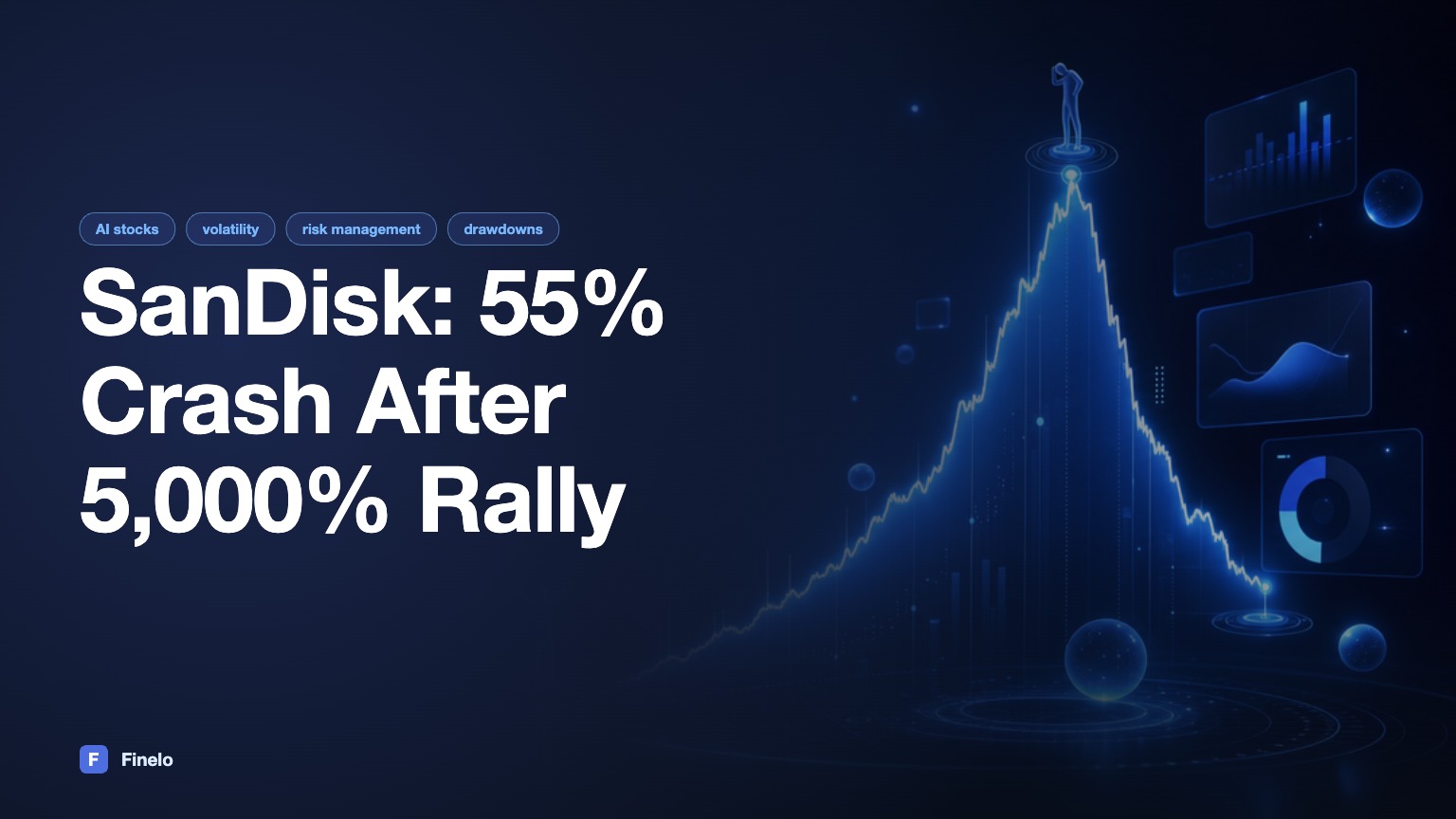
SanDisk crashed roughly 55% in about 25 trading days after a parabolic AI-memory rally. Here's the drawdown math, why early holders are still up, and what trophy stocks teach investors.
5 min read
Practice trading with Finelo
Practice in a simulator, learn with bite-sized lessons, and build confidence before risking real money.
Want to learn more?
Practice in a simulator, learn with bite-sized lessons, and build confidence before risking real money.
Explore FineloExplore Finelo's 28-day challenges
Turn learning into a daily habit with guided challenge paths.
The memory maker's stock has crashed roughly 55% in about 25 trading days — from a peak near $2,354 in late June to the $1,080–1,120 range this week — erasing on the order of $190–200 billion in market value. That would be a shocking collapse for any company. For this one, it's only half the story.
Because before the crash came one of the most extraordinary rallies in modern market history.
This article is for information and education only and is not financial advice.
The rocket ride up
SanDisk was spun off from Western Digital in early 2025 at a share price around $40. Then the AI boom found it: data centers need enormous amounts of flash storage, NAND memory supply was tight, and SanDisk sat in the sweet spot. By June 2026 the stock traded above $2,300 — a gain measured in the thousands of percent in roughly eighteen months. It became the trophy stock of the AI memory trade.
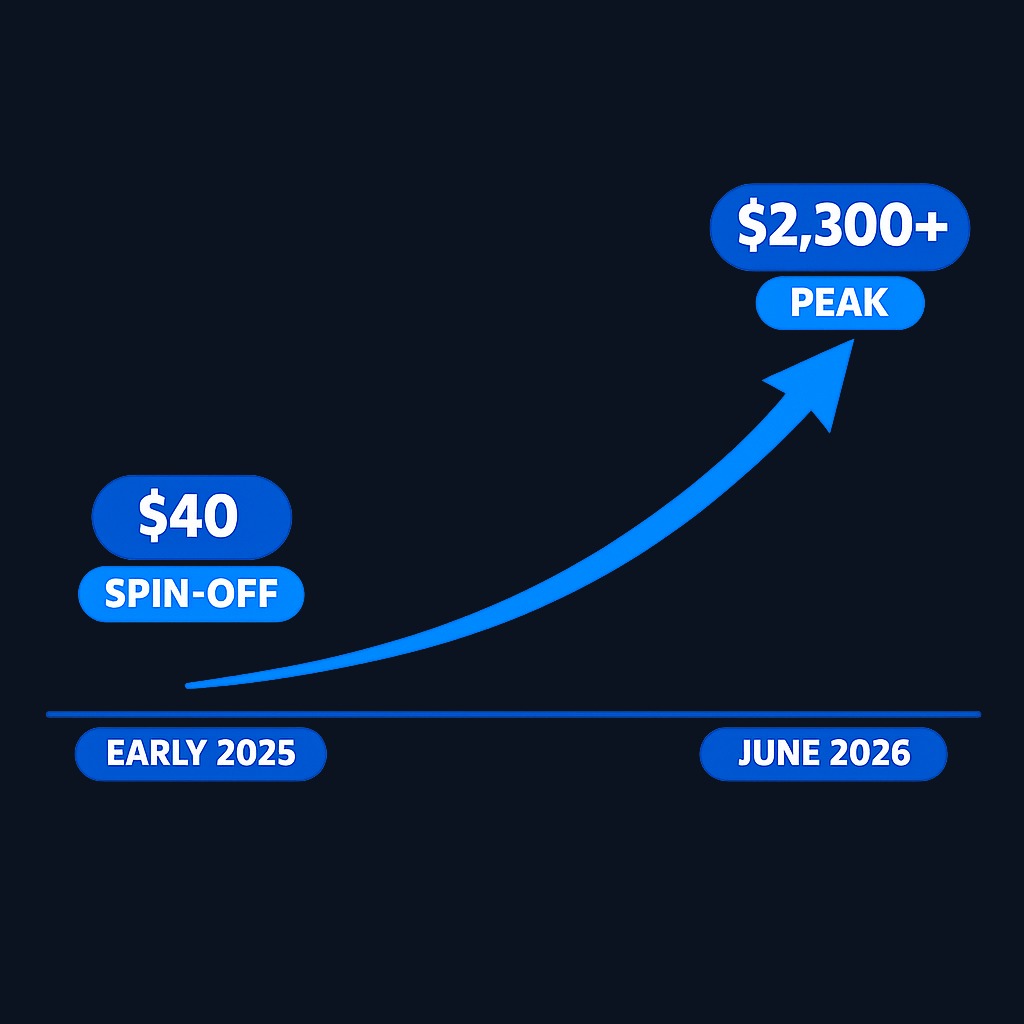
Then, in under five weeks, half of it vanished. The same forces battering the sector all month did the damage: profit-taking after a vertical run, deteriorating memory spot prices, fears of Chinese competition (CXMT again — the same company whose IPO helped crash Korea's market), and the broader repricing of everything AI. SanDisk fell 12% in the July 13 rout, 11% on Monday, and kept falling — three consecutive double-digit daily drops at one stretch.
Practice trading with Finelo
Practice in a simulator, learn with bite-sized lessons, and build confidence before risking real money.
The math nobody does on the way up
Here's the lesson hiding in the wreckage, and it's about arithmetic, not memory chips.
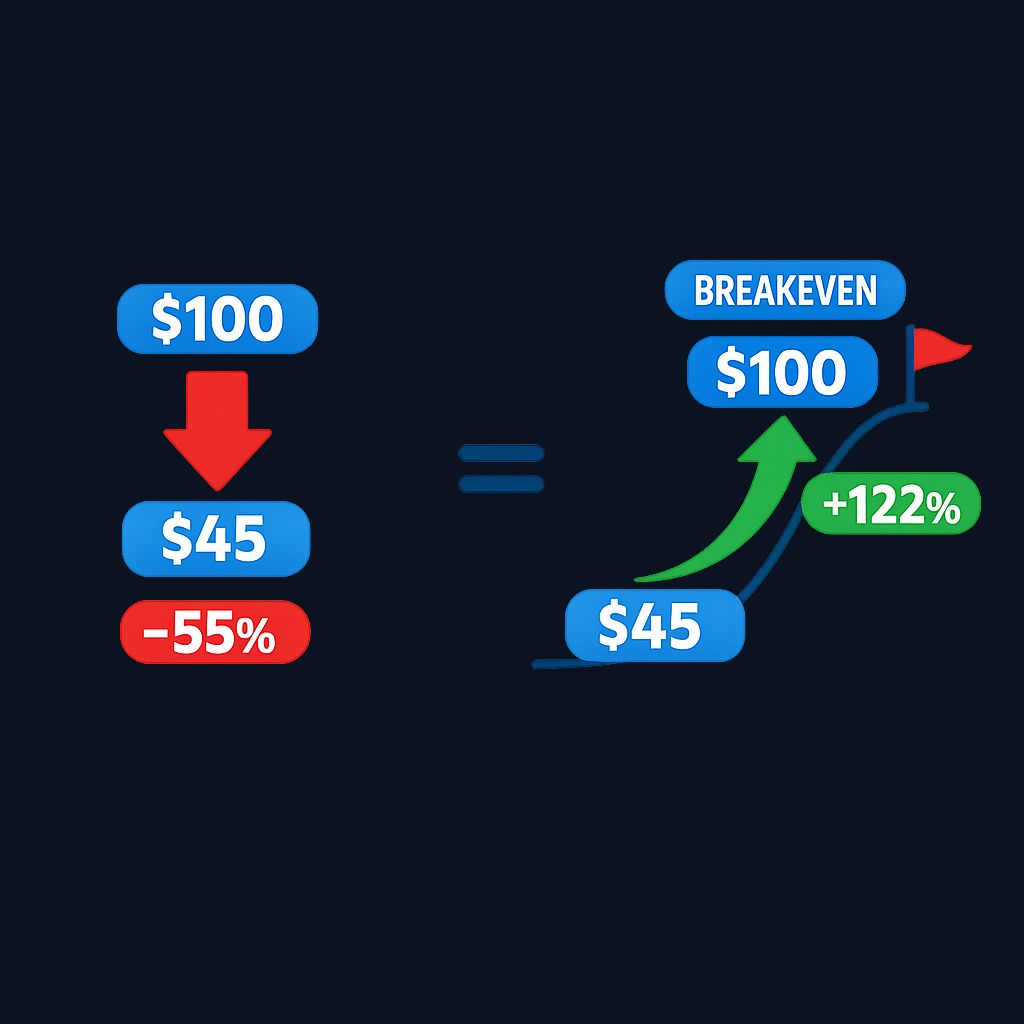
Losses are heavier than gains. A stock that falls 55% must rise +122% just to get back to even. Investors who bought SanDisk at the June peak don't need it to have a good quarter — they need it to more than double.
And yet the early holders are still massively up. Anyone who bought the spin-off near $40 is still sitting on gains of ~2,600% even after the crash. Same stock, same month — one group is devastated, another is euphoric. Your entry price, not the company, determines your outcome.
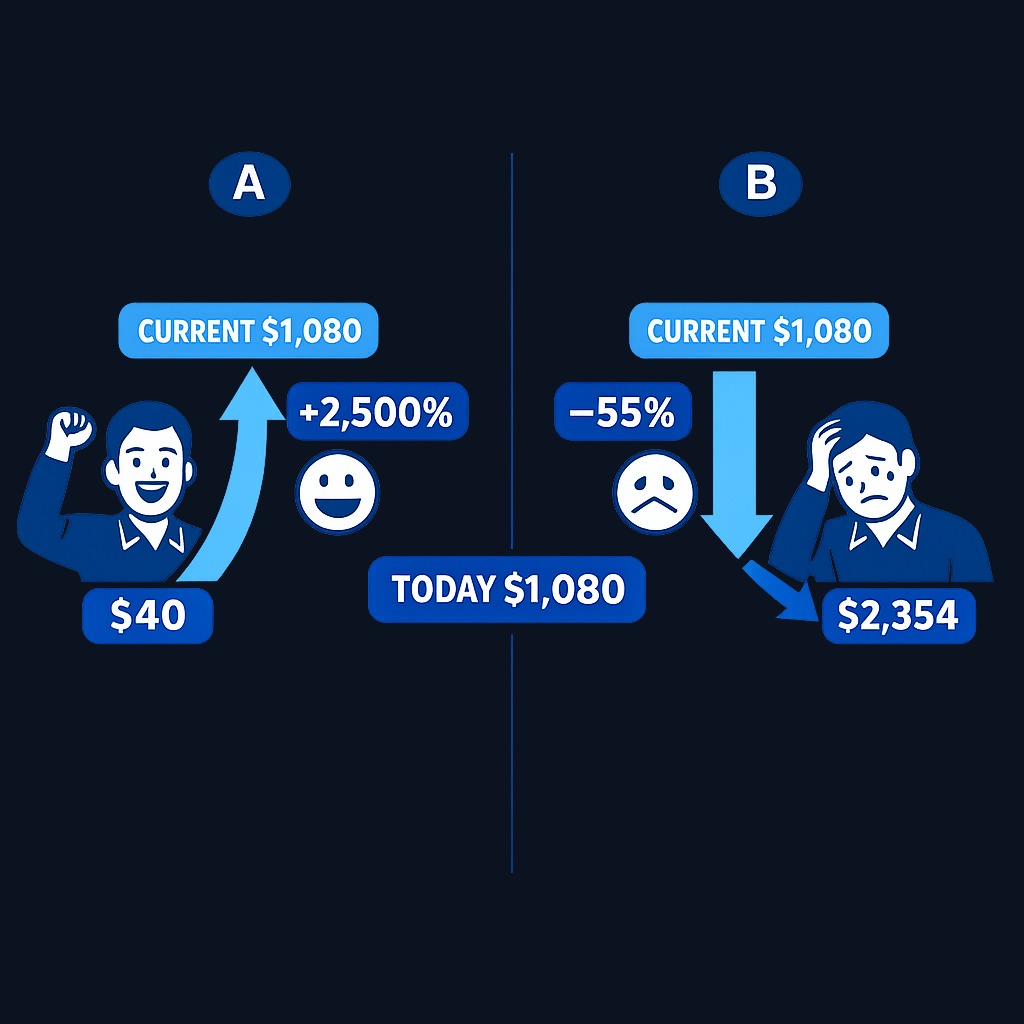
Parabolic charts are a warning, not an invitation. Rises this steep almost always borrow from future returns. The crowd that arrives last — drawn in by the vertical chart — supplies the exit liquidity for the crowd that arrived first. It's the oldest pattern in markets, and the AI era hasn't repealed it.
Notably, analysts at several major firms still defend SanDisk's long-term fundamentals — AI data centers really do need oceans of storage. Both things can be true: a real business, and a price that ran far ahead of it. "Great company" and "great stock at any price" are different claims — a distinction this whole week keeps teaching (SK Hynix posted record revenue Wednesday and fell 9.6% anyway).
Why this matters to YOU
Beware the trophy stock. Every boom elevates one or two names into lottery-ticket status. By the time a stock is famous for going up, most of the going-up has usually happened.
Position sizing is survival. The difference between "painful" and "ruinous" in a 55% drawdown is how much of your portfolio was riding on it. No conviction justifies a bet you can't watch get cut in half.
Volatility is the price of admission. SanDisk didn't stop being an AI story. But holding hyper-growth stocks means accepting that 50% drawdowns are a feature of the ride — if you can't stomach the trip down, don't board the rocket.
This crash is one thread of the week's bigger story — the repricing of the entire AI memory trade that halted Korea's market twice: Kospi Index Drops 6%: Why South Korea's Stock Market Paused Trading Again.
Finelo does not provide investment advice. This article is for informational and educational purposes only.
Sources: FX Leaders — SanDisk's 55% decline, Seeking Alpha — consecutive double-digit slides, The Motley Fool — why SanDisk keeps crashing
Frequently asked questions
Why did SanDisk stock drop so much?
After a parabolic AI-memory rally, the stock was hit by profit-taking, weaker memory spot prices, fears of Chinese competition (including CXMT), and a broader repricing of AI-linked names. The move erased roughly half of the peak value in about 25 trading days.
How much does a stock need to rise after a 55% drop?
A stock that falls 55% needs to rise about 122% just to get back to even. Entry price matters as much as the company story — early spin-off buyers can still be far ahead while peak buyers need a more-than-double recovery.
Does a big crash mean SanDisk is no longer an AI story?
Not necessarily. Analysts at several firms still defend long-term AI storage demand. A real business and a price that ran ahead of fundamentals can both be true at once — "great company" and "great stock at any price" are different claims.
SanDiskSNDKAI memorydrawdowninvestingvolatility
Practice trading with Finelo
Practice in a simulator, learn with bite-sized lessons, and build confidence before risking real money.
About the author
Finelo Team
The Finelo Team creates practical investing and trading education designed to help beginners learn faster with structured challenges, simulator practice, and bite-sized lessons.
Keep reading — Related articles

News
U.S. Gas Prices Reach $4.46: What the Increase Means for Inflation and Household Costs
The EIA's U.S. all-grades gasoline average reached $4.455 per gallon. See what changed, why regions differ and how fuel prices affect inflation.
Finelo Team
News
China Sets a Stronger Yuan Fix at 6.7521: What It Means for USD/CNY
China set its September 18 yuan reference rate at 6.7521 per dollar. Learn how the official fixing differs from market rates and why the move matters.
Finelo Team
News
BOJ Raises Its Policy Rate to 1.25%: What the Decision Means for the Yen
The BOJ raised its overnight policy-rate target to around 1.25%. Learn why the yen can still weaken after a rate increase and what the decision says.
Finelo Team


