Last editorial review: September 28, 2026
Social Security disability vs. early retirement
Compare disability eligibility with reduced early retirement, including work history, timing, and the effect of an overlapping claim.
9 min read
Practice trading with Finelo
Practice in a simulator, learn with bite-sized lessons, and build confidence before risking real money.
Want to learn more?
Practice in a simulator, learn with bite-sized lessons, and build confidence before risking real money.
Explore FineloExplore Finelo's 28-day challenges
Turn learning into a daily habit with guided challenge paths.
Social Security Disability Insurance, or SSDI, is for people who meet Social Security's disability and work-history requirements. Early retirement benefits are based on age and an eligible earnings record. They are not interchangeable options with the same qualification process.
If health problems prevent you from working, check disability eligibility before assuming early retirement is the only route.
Compare the basis for benefits
| Question | SSDI | Early retirement |
|---|---|---|
| Main eligibility | Qualifying disability and insured work record | Retirement eligibility, generally starting at age 62 |
| Evaluation | Medical and work-related evidence | Retirement application and earnings record |
| Benefit issue | Disability calculation and applicable offsets | Reduction for starting before full retirement age |
| Work while receiving benefits | Disability-specific work rules | Retirement earnings-test rules before full retirement age |
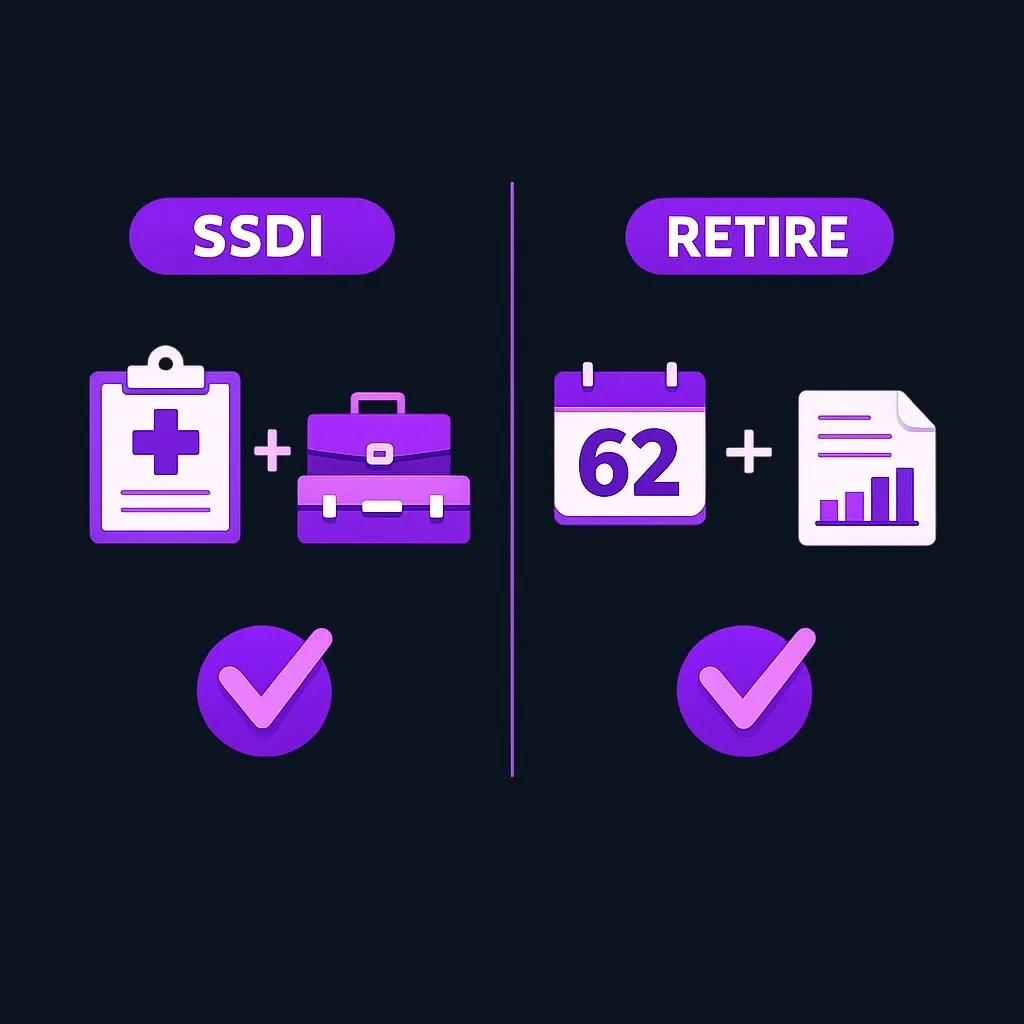
The SSA disability qualification guide explains the medical and work tests. Difficulty finding work, a diagnosis alone, or a private insurer's decision does not automatically establish SSDI eligibility.
Understand the timing tradeoff
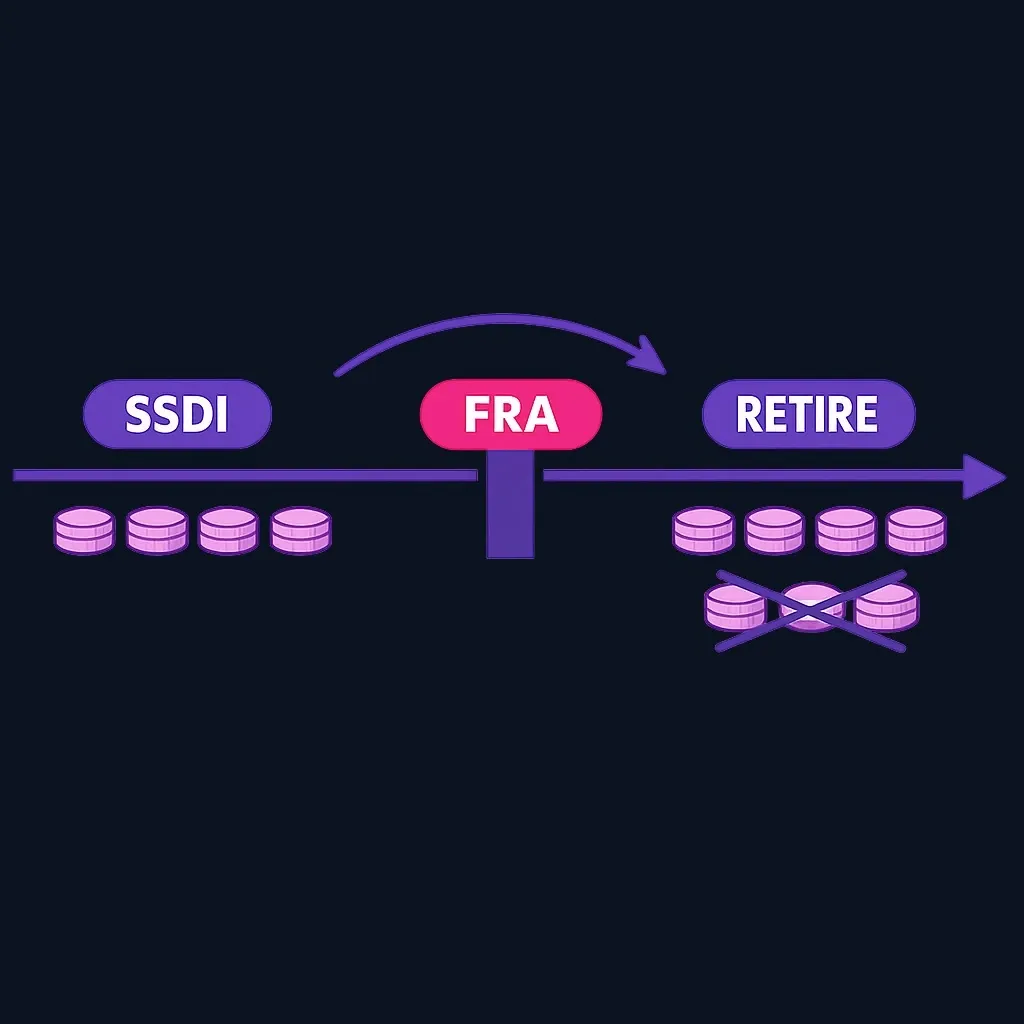
Claiming retirement early generally reduces the retirement benefit. If you receive early retirement while a disability claim is pending, the final outcome can depend on the established disability onset date and months of retirement benefits received. Do not assume an eventual SSDI approval erases every early-retirement reduction.
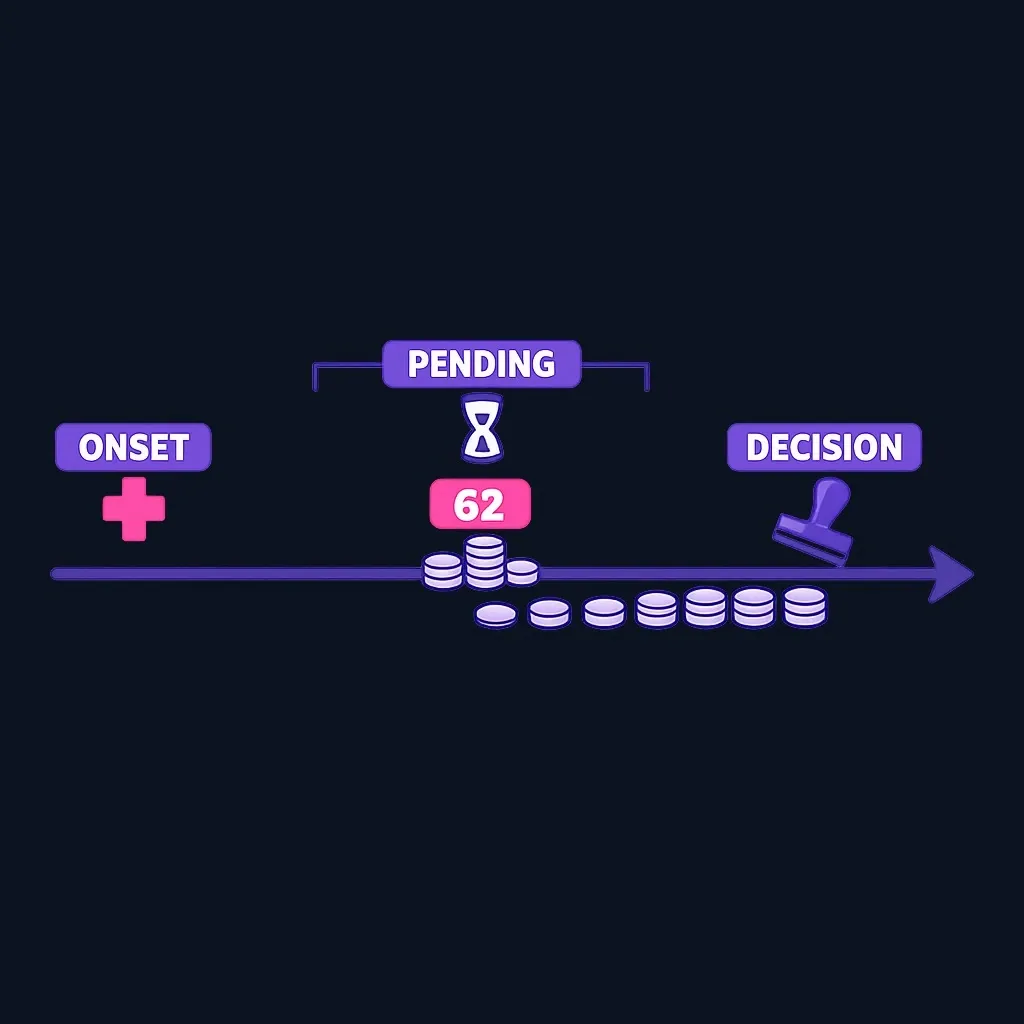
Ask SSA to explain the amounts and dates for your situation. SSDI generally converts to retirement benefits at full retirement age; these are not two full benefits paid together on the same record.
Separate healthcare and SSI
Early retirement does not by itself provide Medicare before the usual age-based eligibility. SSDI has its own Medicare timing and exceptions. Supplemental Security Income, or SSI, is a different, means-tested program.
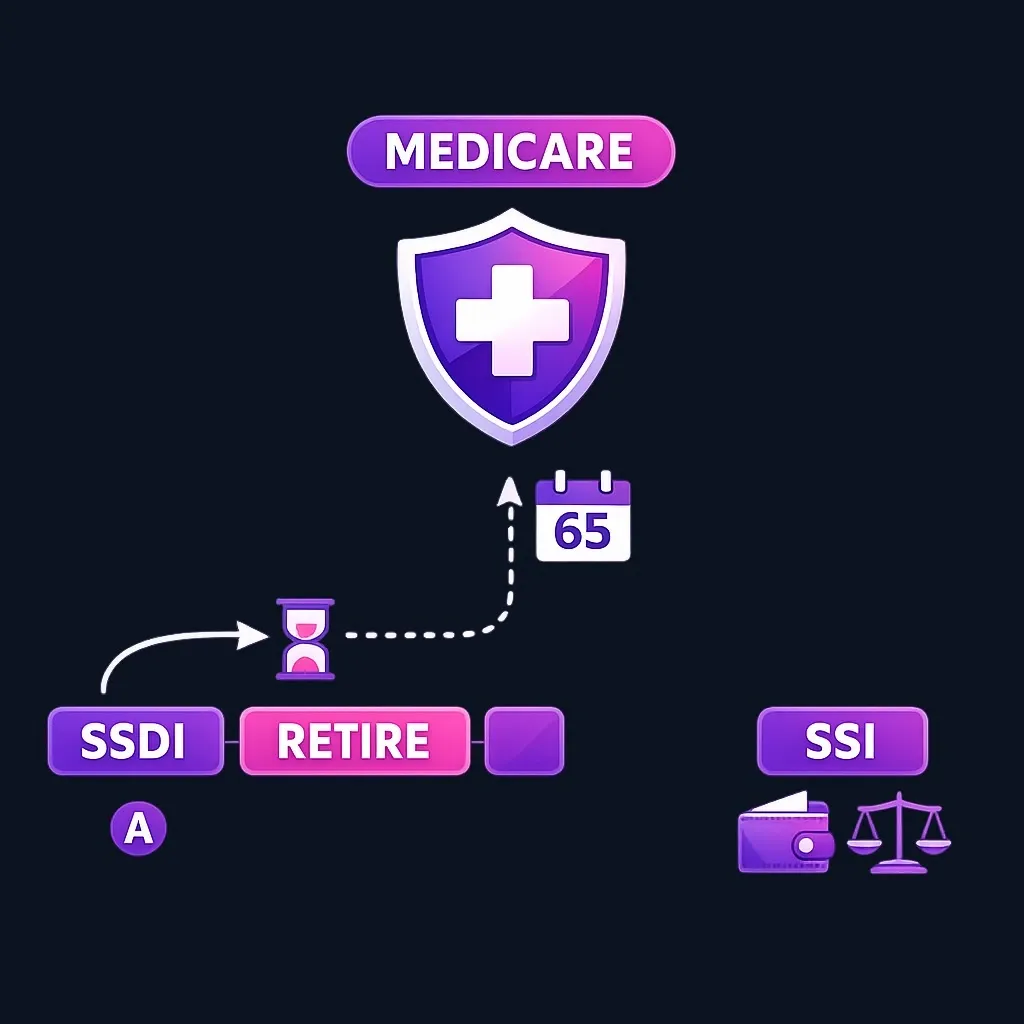
Gather work history, medical records, treatment information, and a budget for the application period. Compare the expected benefit, healthcare coverage, and consequences of starting retirement while the disability decision is pending. Individual dates matter too much for a single blanket recommendation.
Treat disability eligibility as its own determination
Wanting to stop work and meeting Social Security's disability standard are different questions. SSDI depends on the applicable work and medical requirements. A diagnosis alone does not establish approval, and a retirement estimate does not tell you whether the disability application will succeed.
Gather medical records, treatment information, work history, and the dates relevant to when work became limited. Describe functional limitations accurately rather than relying only on a condition's name. Follow SSA's requests and keep copies of submissions and decisions. If an application is denied, use the notice to identify the next step and deadline.
Compare income while the application is pending
A person old enough for reduced retirement may have an immediate cash need while disability is being considered. Discuss the interaction with SSA before treating reduced retirement as a harmless placeholder. The eventual result can depend on the established disability onset date and the benefit months involved.
Build a budget that does not assume a prompt approval or a particular retroactive award. Consider available household income, accessible savings, and other benefits for which the person may qualify. Keep SSDI separate from SSI: the programs have different eligibility rules even though SSA administers both.
Practice trading with Finelo
Practice in a simulator, learn with bite-sized lessons, and build confidence before risking real money.
Include healthcare and the full-retirement-age transition
Health coverage can be as important as the monthly payment. SSDI-related Medicare timing is not identical to receiving reduced retirement benefits before 65. Confirm the applicable waiting period and exceptions for the person's situation rather than assuming a payment automatically begins Medicare immediately.
At full retirement age, the relationship between disability and retirement changes under SSA rules. Obtain an explanation for the actual benefit record, including any earlier reduced-retirement months. Comparing official estimates and timelines provides a stronger basis for planning than choosing whichever label appears to promise a larger check.
What is Early Retirement?
Early retirement means taking Social Security retirement benefits before your full retirement age; you may be eligible to begin as early as age 62. Taking benefits early typically reduces the monthly amount compared with waiting until full retirement age, because payments start sooner and are spread over a longer expected period. People choose early retirement for many reasons: health limitations that make work difficult, job loss near retirement, family responsibilities, or a preference for current income over higher future payments. Decision caveat: Early retirement is a timing choice tied to age and to the retirement benefit calculation. It is not a substitute for SSDI when a disabling medical condition prevents work and would otherwise qualify for disability benefits.
How to compare your options
Use this checklist to evaluate which path fits your situation:
- Medical capacity: SSA considers whether you can do past work or adjust to other work, along with its duration and earnings requirements. Difficulty doing your former job alone does not establish eligibility.
- Timing and income needs: Do you need income immediately and expect to live many years in retirement? Early retirement gives income earlier but usually at a reduced monthly rate.
- Work history and credits: SSDI eligibility depends in part on prior work and contributions; confirm your work record before applying.
- Likelihood of approval vs. time horizon: SSDI applications can take time and sometimes require appeals; if immediate income is essential, short-term options should be part of your plan.
- Future earnings plans: If you expect to return to substantial work, understand how earnings affect SSDI eligibility and how working while collecting retirement benefits might affect retirement amounts.
- Family and survivor considerations: Consider how each choice affects spouse or survivor benefits under Social Security rules.
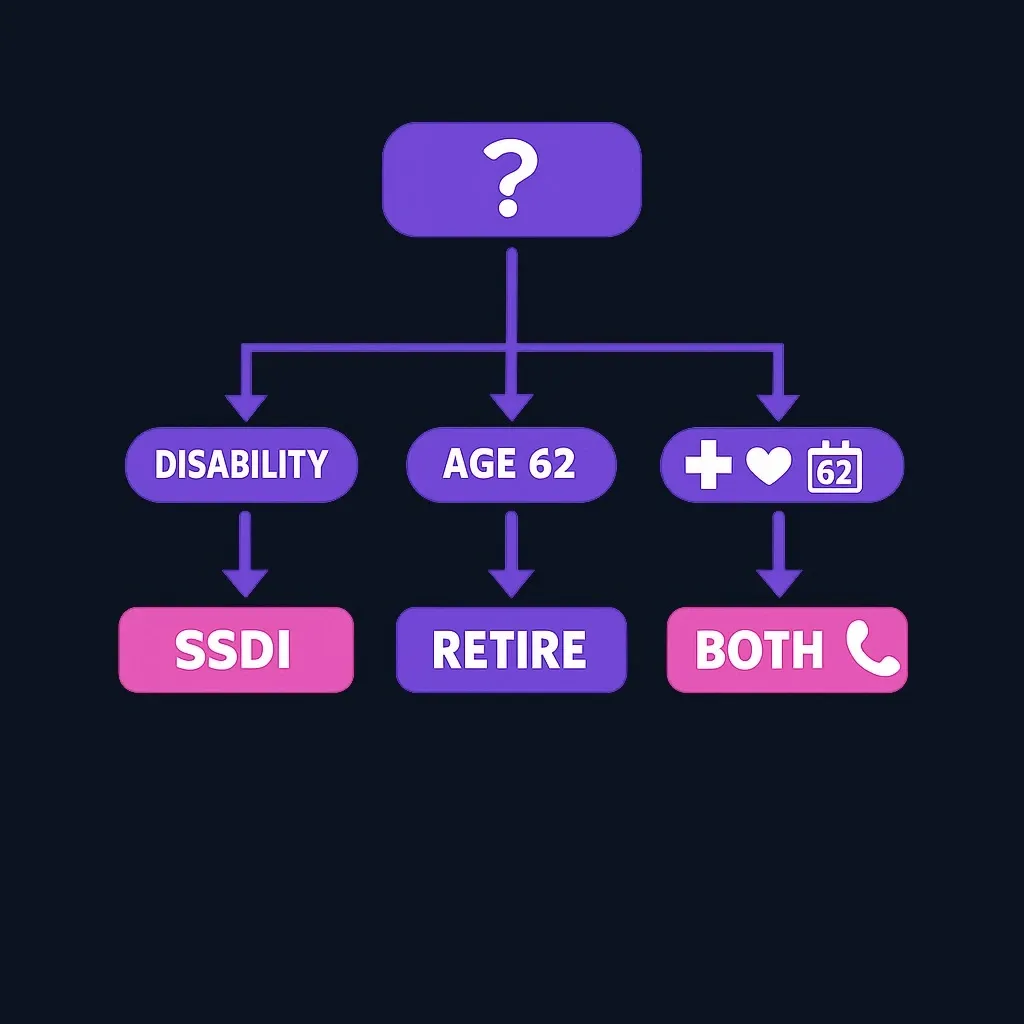
Practical decision framework (quick map)
- If a medical condition prevents you from working now and for the foreseeable future → evaluate SSDI application and assemble medical evidence.
- If you can no longer or choose not to work and want benefits now, and you are age-eligible (earliest retirement age is 62) → consider early retirement while weighing permanent reduction in monthly benefit.
- If both possibilities apply (medical problems before retirement age), contact SSA promptly about both claims and gather medical evidence in parallel. Ask about the effect of each entitlement date before choosing a retirement start month.
When to choose each option
When SSDI may be the better fit
- You may meet SSA’s standard for inability to perform substantial gainful activity because of a medically determinable condition expected to last at least 12 months or result in death, considering past and other work.
- You have a work history that supports a disability entitlement and you can wait for the SSDI decision process (or arrange interim income).
When early retirement may be the better fit
- You are near or at the earliest retirement age and prefer stable, immediate retirement income even if monthly checks are smaller.
- Your health or family situation makes continued full-time work impractical. But you do not expect to meet SSDI medical thresholds or prefer the simplicity of a retirement claim.
Combined situations and switching
- Some people apply for both pathways when timing and eligibility overlap. Filing early for retirement does not automatically prevent later SSDI claims, but processes and offsets can be complex. Before changing filings, inventory documentation, expected timelines, and how each path affects dependents and future recalculation at full retirement age.
Tradeoffs and caveats (includes common misconceptions and mistakes)
Common pitfalls and how to avoid them
- Delaying while gathering every record: Provide the evidence you have and identify your treatment providers. SSA says not to delay applying while collecting medical evidence; it can help obtain missing information.
- Assuming early retirement is reversible: Early retirement reduces monthly benefits permanently in many cases; verify how starting benefits early affects survivor and spousal benefits you may value.
- Overlooking work rules: Both SSDI and retirement benefits have work-related rules that can affect eligibility and payment size. Confirm the consequences of returning to paid work before deciding.
- Treating SSDI and retirement as identical: They are separate programs with different triggers. Choose based on medical capacity and timing, not convenience alone.
Appeals and documentation (practical tips)
- Keep a single, ordered folder (electronic or paper) of all medical records. Provider names and dates, medication lists, and functional-impact notes from clinicians and employers.
- Document daily function: short, dated notes about how the condition affects specific tasks (standing, lifting, concentration) can help reviewers understand real-world impact.
- If denied, follow the administrative appeal steps promptly: denials commonly require a reconsideration or hearing to reverse. Getting representation or advice early can help focus evidence-gathering.
Can I receive both SSDI and early retirement benefits?
You cannot collect two full benefits on the same earnings record for the same month. You may apply for disability while receiving reduced retirement, but SSA must coordinate the awards, and earlier retirement months can affect the disability amount. Ask about your specific onset and entitlement dates.
How do I know if I qualify for SSDI?
Qualification depends on whether a medical condition prevents sustained work and on your work/earnings record; decisions rely on medical documentation and functional limitations. Gathering complete, current medical evidence is the first practical step.
What should I do if my SSDI application is denied?
There is an administrative appeals process after an initial denial. Common next steps include requesting reconsideration, preparing for a hearing, and strengthening medical documentation. Consider getting guidance from a qualified representative who understands the disability process.
What happens to benefits when I reach full retirement age?
SSDI automatically changes to retirement benefits at full retirement age; it is not a second payment added to SSDI. See SSA’s transition explanation. Ask SSA about adjustments if your record includes earlier reduced retirement or other benefits.
For a separate retirement-timing decision, consider Should you use savings to delay Social Security.
This guide covers U.S. rules. Finelo provides financial education, not personalized financial, investment, tax, or legal advice.
Financial LiteracyU.S. GuideFinancial Education
Practice trading with Finelo
Practice in a simulator, learn with bite-sized lessons, and build confidence before risking real money.
About the author
Finelo Team
The Finelo Team creates practical investing and trading education designed to help beginners learn faster with structured challenges, simulator practice, and bite-sized lessons.
Keep reading — Related articles
Financial Literacy
USDA vs. FHA loan
Compare location and income eligibility, down payments, credit conditions, and upfront and annual program charges for a home purchase.
Finelo Team
Financial Literacy
Term life vs. accidental death insurance
Compare broad term-life protection with accident-only coverage, including exclusions, underwriting, and the family income gap.
Finelo Team
Financial Literacy
Term life insurance laddering vs. one policy
Compare several term policies ending at different times with one policy, using coverage needs, costs, and future insurability.
Finelo Team