Margin interest is the interest your broker charges when you borrow money against your investment account to buy securities. Like any loan, the borrowed balance accrues interest until you repay it, and that cost directly reduces your investment returns. The SEC cautions that margin interest raises the amount your investment must earn just to break even, as explained in its Investor Bulletin on margin interest.
Understanding Margin Interest: What You Need to Know
Margin interest is the interest your broker charges when you borrow money against your investment account to buy securities. Like any loan, the borrowed balance accrues interest until you repay it, and that cost…
7 min read
Practice trading with Finelo
Practice in a simulator, learn with bite-sized lessons, and build confidence before risking real money.
Want to learn more?
Practice in a simulator, learn with bite-sized lessons, and build confidence before risking real money.
Explore FineloExplore Finelo's 28-day challenges
Turn learning into a daily habit with guided challenge paths.
This page is for investors who are considering a margin account or already have one and want to understand what the borrowing actually costs. You will find the mechanics, the math, the risks, and a decision framework. It is educational content, not financial advice.
What is margin interest?
When you open a margin account, your broker lets you borrow against the cash and securities you hold to buy more investments. The loan is convenient: there is no application for each trade, and the money is available instantly. But it is still a loan. The broker charges interest on the borrowed balance, typically quoted as an annual rate, and the securities in your account serve as collateral.
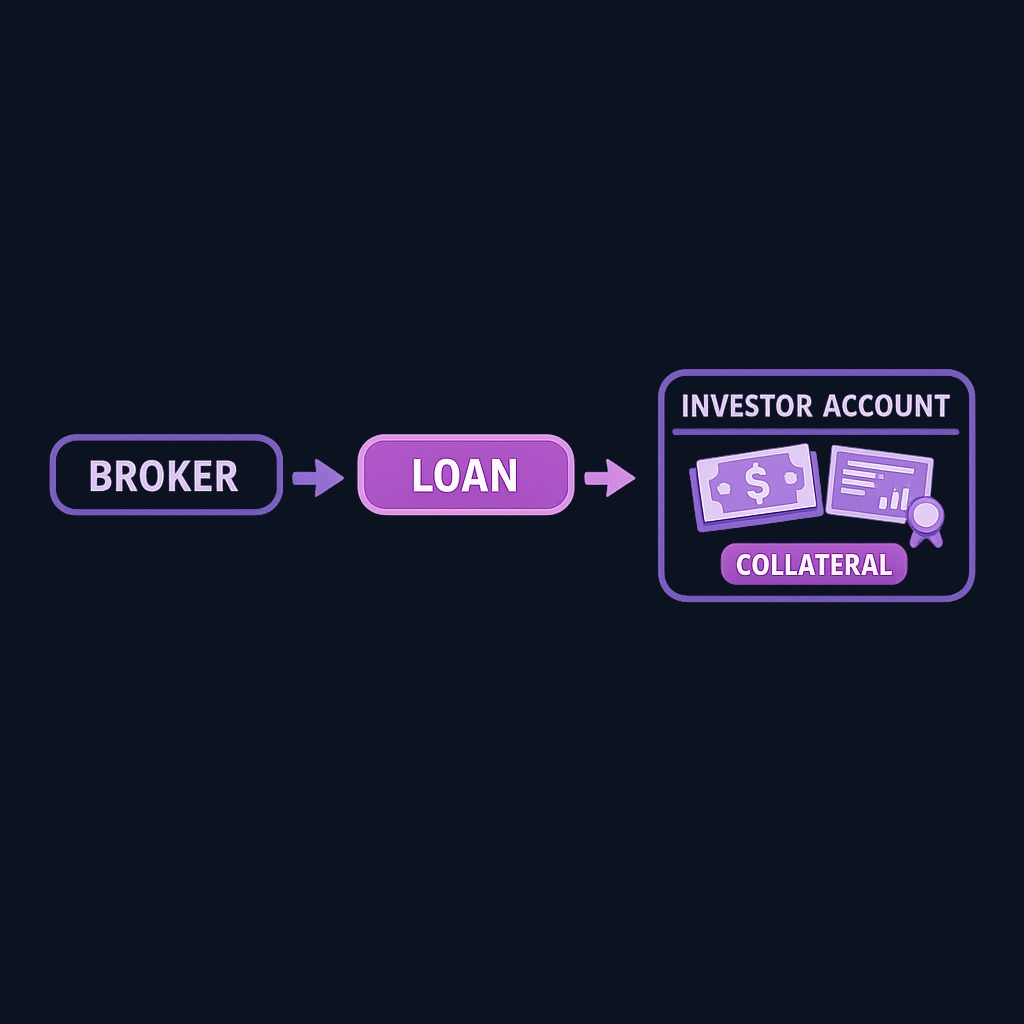
Margin interest differs from most consumer debt in two ways. First, there is usually no fixed repayment schedule; the balance can ride as long as your account meets maintenance requirements. Second, the rate is variable in most cases, moving with benchmark rates and with the size of your loan. Both features make margin debt easy to carry and easy to underestimate.
How margin interest is calculated
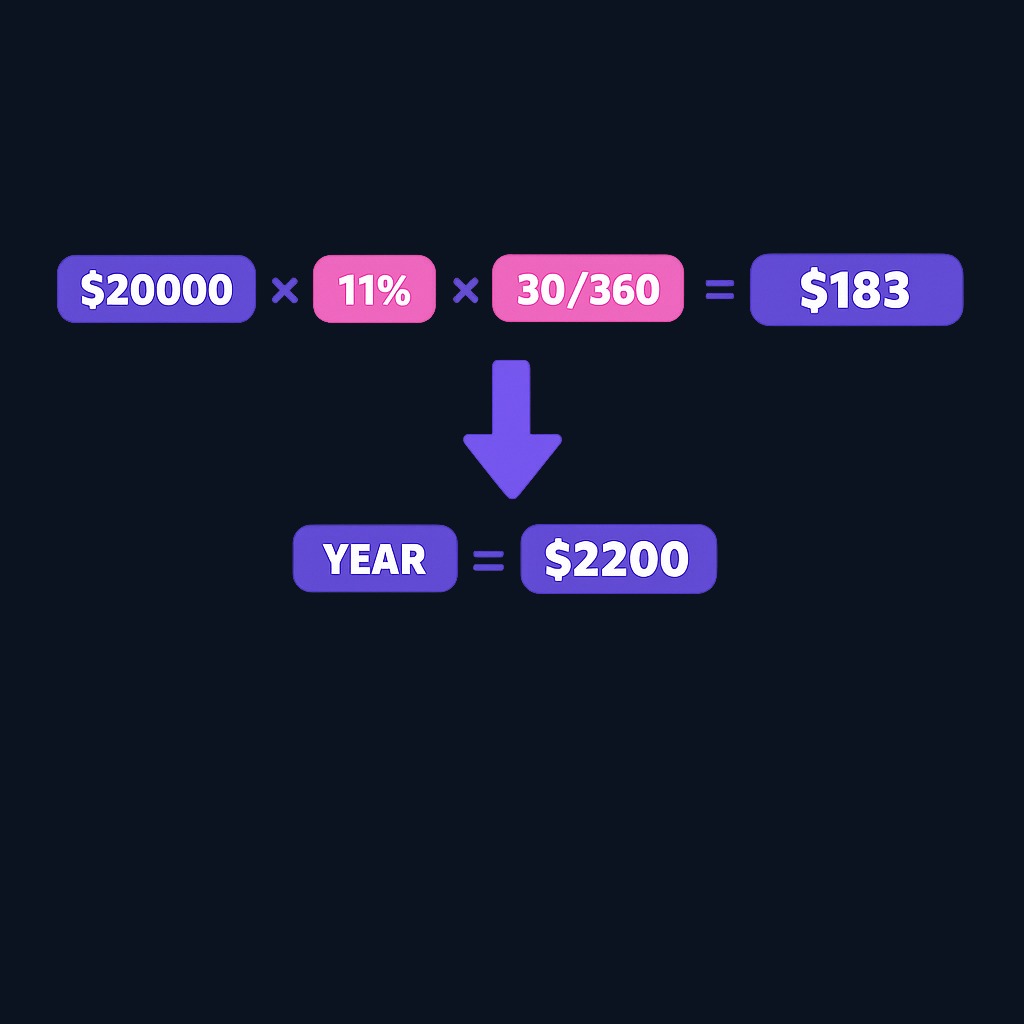
Most brokers accrue margin interest daily and post it to the account monthly. The daily charge is roughly the borrowed balance times the annual rate divided by 360 or 365, depending on the firm's convention. Because the balance changes as you trade, deposit, or withdraw, the interest meter adjusts continuously.
A worked example: borrow $20,000 at an 11% annual rate for 30 days. The interest is about 20,000 × 0.11 × 30/360, or roughly $183 for the month. Hold the loan for a year at that rate and the cost approaches $2,200, before compounding from monthly posting.
Details of account handling matter more than most investors expect. The SEC's bulletin describes how firms may net balances differently: some sweep cash from your cash account against the margin loan, others charge interest on the full loan while your idle cash sits unapplied. Its example involves an investor with a $50,000 margin loan and $50,000 in cash at the same firm, where the treatment of those balances determines what interest is actually owed. Reading your firm's margin agreement tells you which approach applies to you.
The real cost: break-even math
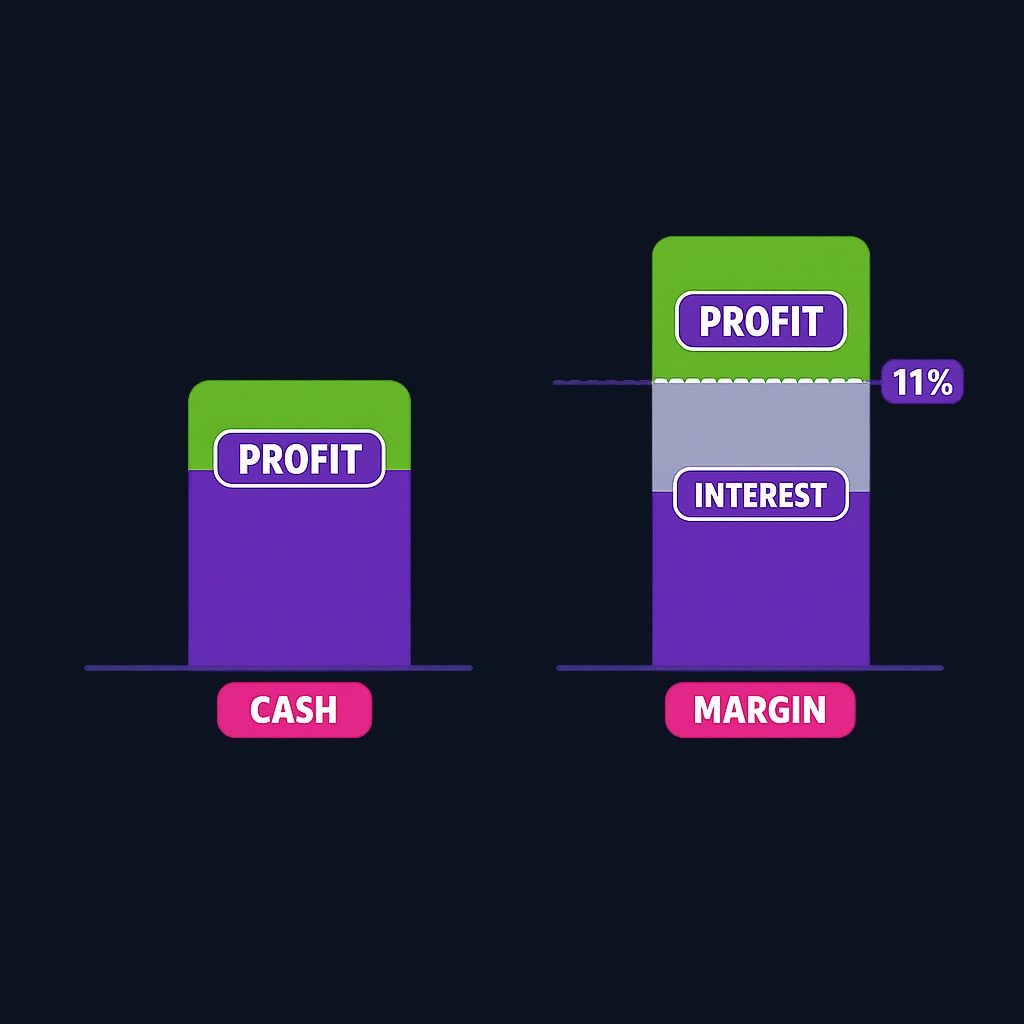
Margin interest moves your break-even point. Buy a stock with cash and you profit when it rises at all. Buy it with borrowed money at 11% annual interest and the position must gain about 11% in a year before you earn anything. The hurdle grows with time: the longer you hold the loan, the more return the interest consumes.
| Scenario (one year) | Stock return | Interest cost | Your outcome |
|---|---|---|---|
| Cash purchase | +8% | none | +8% |
| 50% on margin at 11% | +8% | on borrowed half | roughly +10.5% before other costs |
| 50% on margin at 11% | -8% | on borrowed half | roughly -21.5% before other costs |
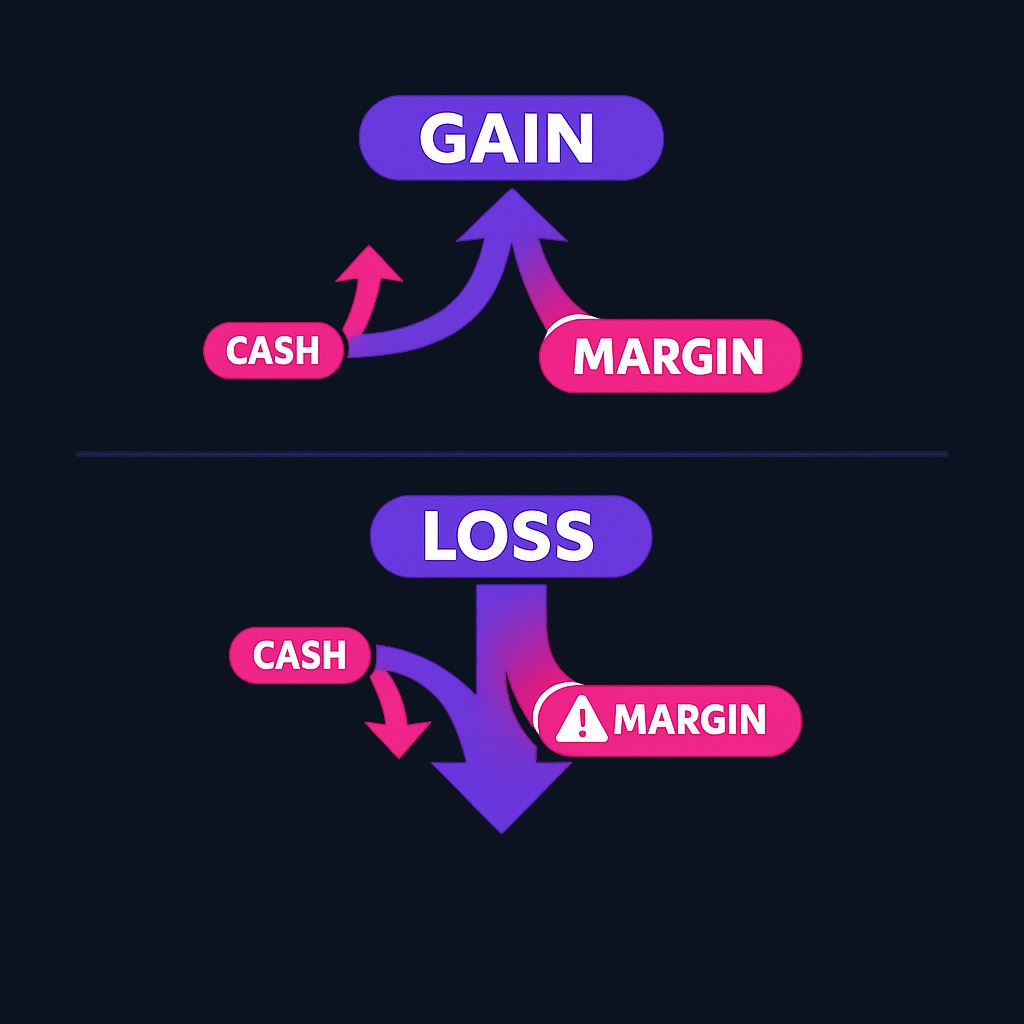
Leverage cuts both ways: it can amplify gains when returns beat the interest rate, and it deepens losses when they do not. The asymmetry in how losses feel, and how they trigger margin calls, is why the interest rate alone understates the risk.
The risks of margin interest
- Compounding drag. Unpaid interest is added to your balance, so you begin paying interest on interest.
- Variable rates. A loan that made sense at one rate can become expensive after benchmark rates rise; brokers can change margin rates without asking you.
- Margin calls. If your account equity falls below maintenance requirements, the broker can demand more cash or sell your securities, sometimes without prior notice, locking in losses at the worst moment.
- Slow leak in flat markets. Even when nothing dramatic happens, a market that moves sideways while interest accrues erodes your account quietly.
- Behavioral pressure. Debt shortens patience. Positions financed at a daily cost are harder to hold through normal volatility.
Practice trading with Finelo
Practice in a simulator, learn with bite-sized lessons, and build confidence before risking real money.
Comparing margin interest rates across brokerages
Margin rates differ widely between firms and usually follow a tiered schedule: the more you borrow, the lower the rate. Some brokers price aggressively as a customer-acquisition tool, while full-service firms often charge substantially more. Because rates change with the market, check each broker's current published schedule rather than relying on comparisons that may be stale.
The SEC's bulletin suggests questions worth asking before you borrow, which paraphrase to: what is the current rate, how often can it change and where is it published, how frequently does interest accrue, and how are cash balances applied against the loan. Add two of your own: at what account level do rate tiers improve, and does the firm negotiate rates for larger balances? Many do, but only when asked.
Best practices for managing margin interest
- Know your number. Track your exact borrowed balance and the annualized cost in dollars, not just the percentage.
- Keep leverage modest. Using a fraction of your available margin leaves room for volatility before a call.
- Pay interest promthly. Clearing accrued interest monthly prevents the balance from compounding.
- Match horizon to cost. Short, specific uses of margin are easier to justify than permanent leverage on long-term holdings.
- Watch the rate. Set a reminder to recheck your broker's schedule after central-bank rate changes.
- Have an exit plan. Decide in advance what you will sell or deposit if the market drops, so the choice is not made for you.
What to know before deciding
Before borrowing on margin, read your firm's margin agreement and current rate schedule, and confirm how interest accrues and how cash is netted. Then run the break-even math for your intended position and holding period. Finally, stress-test: assume the position falls meaningfully and check whether your account would face a maintenance call, and what you would do about it. If any of those steps feels uncomfortable, that discomfort is information.
Decision framework: should you use margin at all?
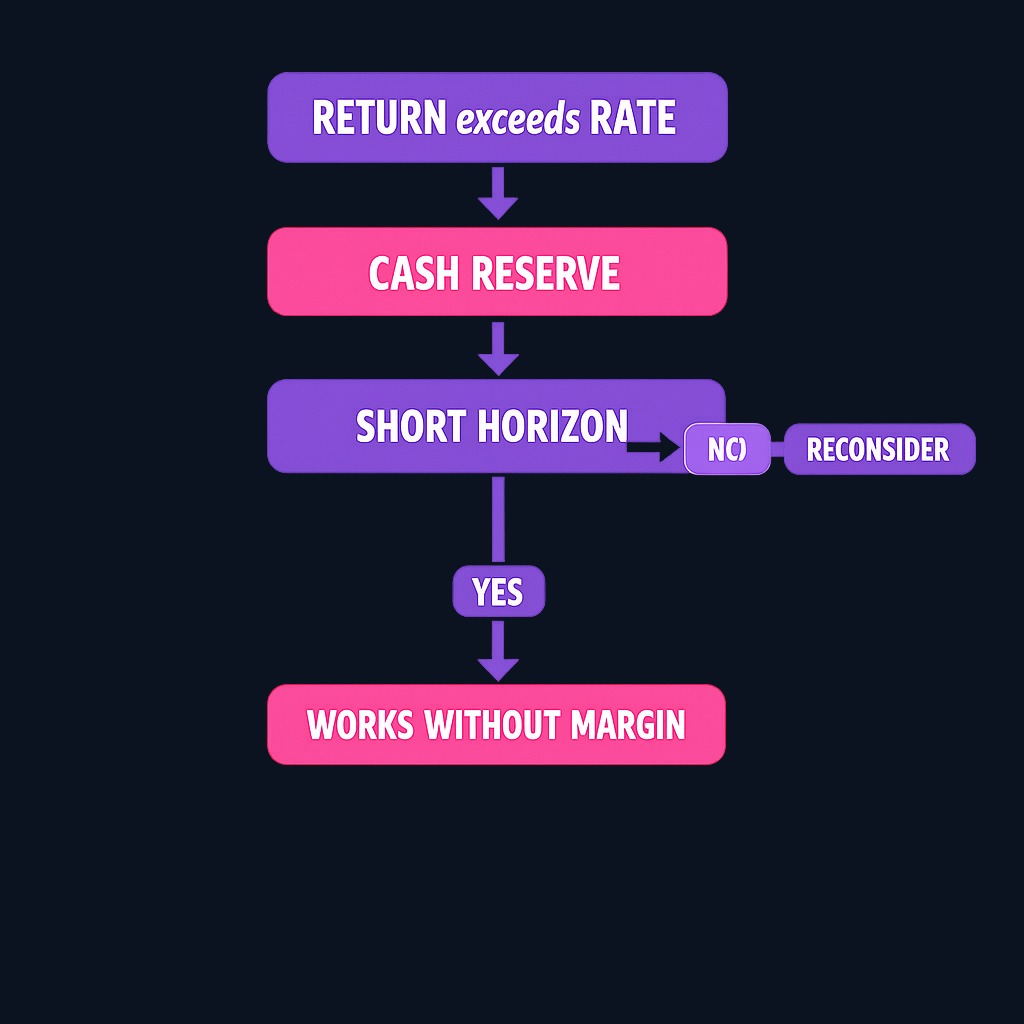
Ask four questions in order. First, does your expected return, conservatively estimated, clearly exceed the margin rate? If not, the loan starts underwater. Second, can you absorb the downside scenario without forced selling, meaning you have cash or unused equity in reserve? Third, is the holding period short enough that interest will not quietly consume the thesis? Fourth, would you make this same investment at this size with cash? If margin is the only way the idea works, the idea may not work. Borrowing that survives all four questions is at least deliberate; most margin trouble comes from leverage that was never examined this way.
Conclusion and next steps
Margin interest is the ongoing price of investing with borrowed money: accrued daily, compounding when unpaid, and raising the bar your investments must clear before you profit. Used sparingly, with modest leverage and a clear exit plan, it is a tool; used casually, it is a slow leak with a trapdoor. Next step: if you have a margin account, look up your current rate, compute last month's interest in dollars, and run the break-even math on any position you are financing. Numbers you have seen are much harder to ignore.
Frequently asked questions
How is margin interest charged?
Most brokers accrue it daily on your outstanding loan balance and post the total to your account monthly. The accrued interest becomes part of your balance if unpaid, so it compounds over time.
Is margin interest tax deductible?
In some jurisdictions, interest on money borrowed to invest can be deductible within limits, but the rules are technical and depend on your situation. Consult a qualified tax professional before counting on any deduction.
Why did my margin rate change without notice?
Margin rates are typically variable and tied to benchmark rates plus the firm's spread. Brokers generally reserve the right to adjust them, and changes apply to existing balances. The current schedule is published on your broker's site.
Can I avoid margin interest in a margin account?
Yes. Having margin capability does not require borrowing. If you settle purchases with cash in the account and keep your loan balance at zero, no interest accrues, while the account retains its flexibility for occasional use.
margininterestyou
Practice trading with Finelo
Practice in a simulator, learn with bite-sized lessons, and build confidence before risking real money.
About the author
Finelo Team
The Finelo Team creates practical investing and trading education designed to help beginners learn faster with structured challenges, simulator practice, and bite-sized lessons.
Keep reading — Related articles

Trading
Understanding Walk Forward Analysis in Trading
Brief educational note: this article is educational — not investment advice — and trading involves the risk of loss.
Finelo Team
Trading
VWAP vs Moving Average: Formulas, Uses, and Limits
VWAP weights price by recorded volume over a defined period, while a moving average summarizes a sequence of prices over a rolling lookback.
Finelo Team
Trading
Volume Profile vs Market Profile: What Each Chart Measures
Volume Profile groups traded volume by price level.
Finelo Team