Sequence of returns risk is the danger that the order of your investment returns, not just their average, damages your portfolio once you start withdrawing money. Two retirees can earn the same average return, yet the one who hits a market slump early in retirement can run out of money years sooner.
Understanding Sequence of Returns Risk and Its Impact on Retirement
Sequence of returns risk is the danger that the order of your investment returns, not just their average, damages your portfolio once you start withdrawing money. Two retirees can earn the same average return, yet the…
7 min read
Practice trading with Finelo
Practice in a simulator, learn with bite-sized lessons, and build confidence before risking real money.
Want to learn more?
Practice in a simulator, learn with bite-sized lessons, and build confidence before risking real money.
Explore FineloExplore Finelo's 28-day challenges
Turn learning into a daily habit with guided challenge paths.
This page is for people approaching retirement, recent retirees, and anyone building a withdrawal plan. You will see how the risk works with a worked example, why timing matters more than averages, and practical strategies to protect your income. The material is educational, not financial advice, so review your own numbers before acting.
What is sequence of returns risk?
While you are saving, the order of annual returns barely matters. A bad year followed by a good year lands you in roughly the same place as the reverse. The math changes the moment you begin withdrawing. Each withdrawal locks in losses during down years, leaving fewer shares invested for the recovery that follows.
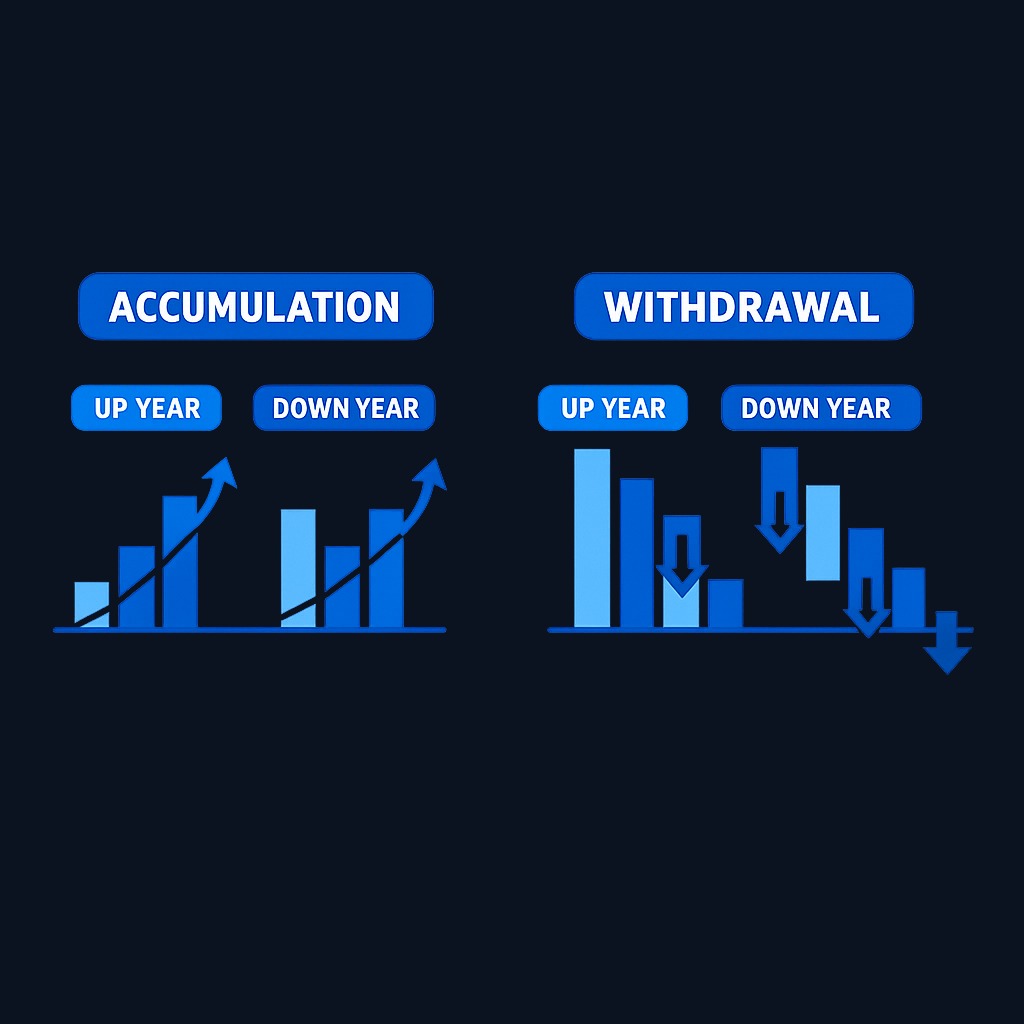
That is the essence of sequence of returns risk: the same set of yearly returns, shuffled into a different order, produces very different outcomes once money flows out of the portfolio. Charles Schwab's overview of sequence-of-returns risk makes the same point: timing matters, and early-retirement losses combined with withdrawals can do outsized, lasting damage.
Average return tells you almost nothing about this danger. A portfolio averaging 6% per year can fail if the worst years arrive first, while another with the same average survives comfortably because its losses came late.
Why sequence of returns risk matters for your retirement income
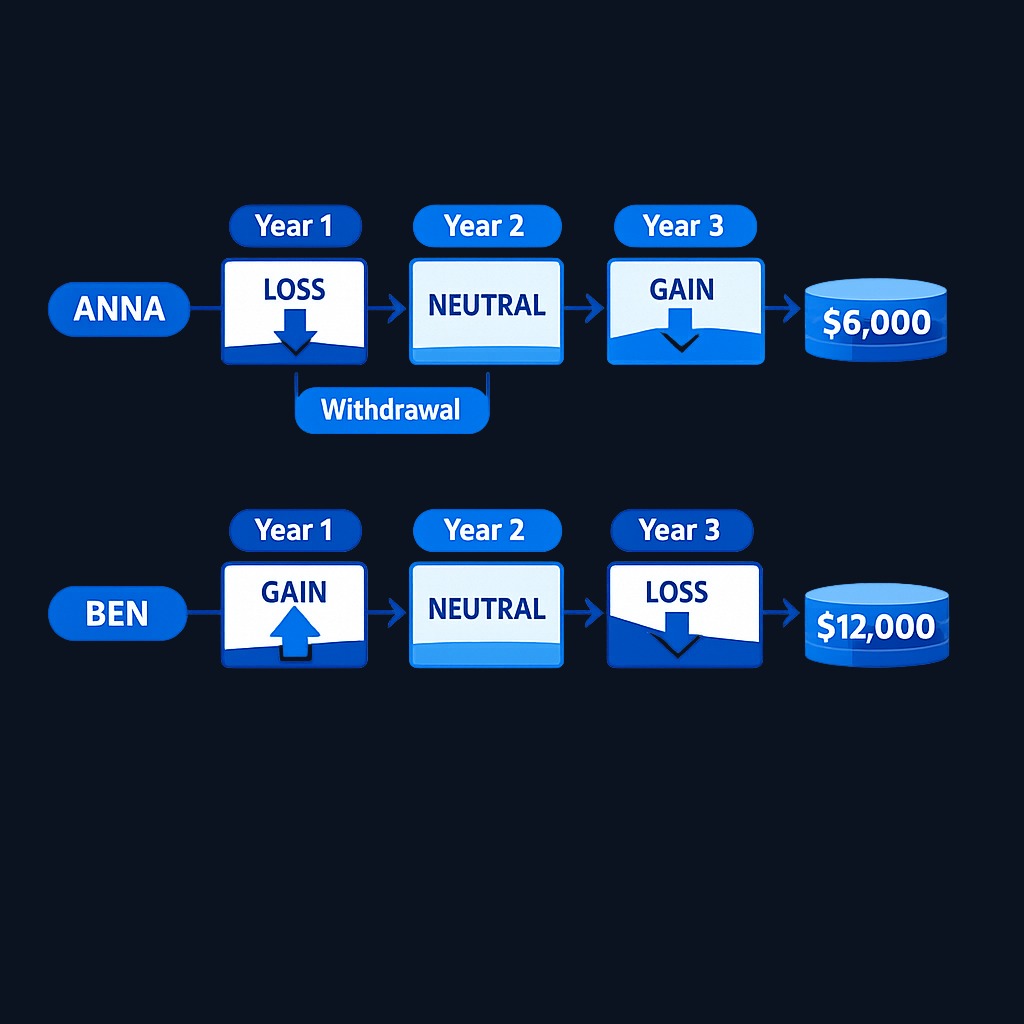
Consider two retirees, Anna and Ben. Each starts with $500,000, withdraws $25,000 per year, and earns the same three returns over three years, just in reverse order.
| Year | Anna's return | Anna's year-end balance | Ben's return | Ben's year-end balance |
|---|---|---|---|---|
| 1 | -20% | $380,000 | +20% | $570,000 |
| 2 | +5% | $372,750 | +5% | $572,250 |
| 3 | +20% | $417,300 | -20% | $432,800 |
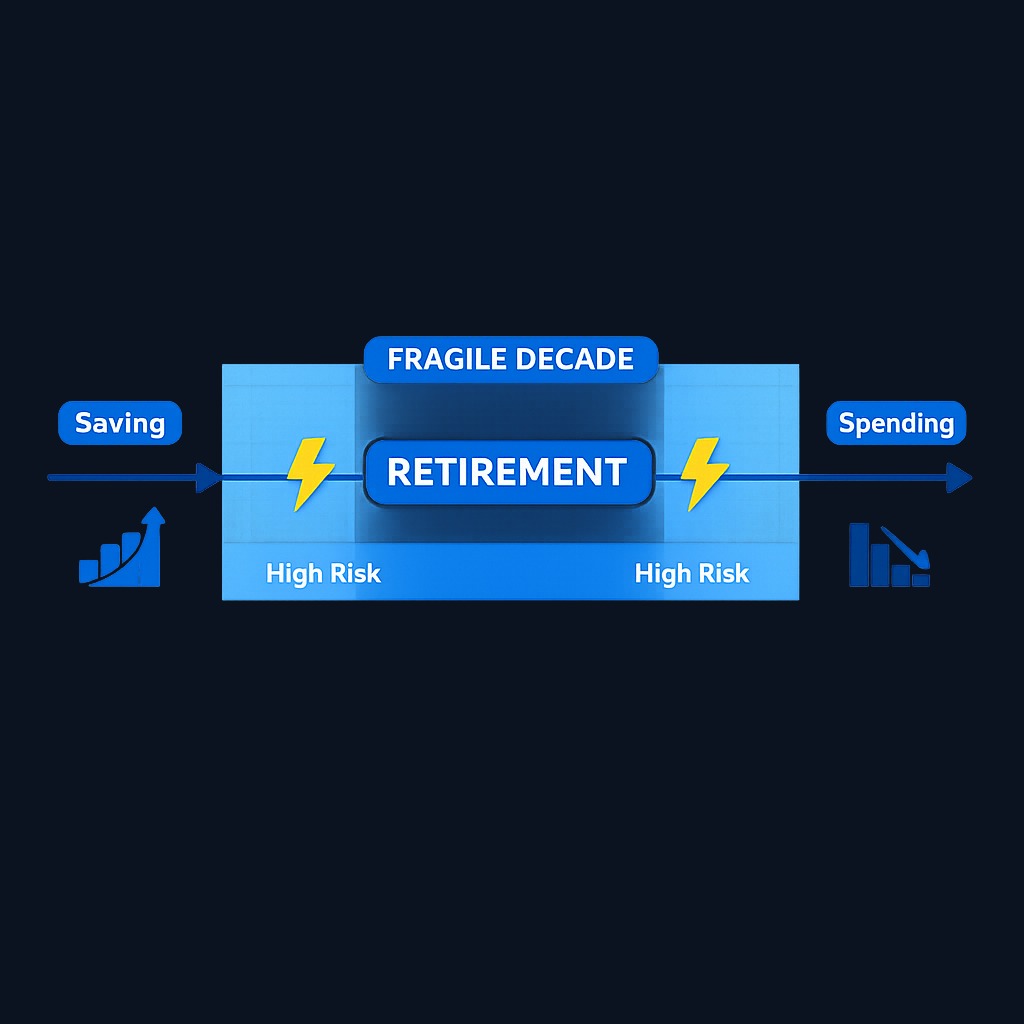
Same returns, same average, same withdrawals. Ben simply met his bear market later and finishes ahead of Anna. Stretch this gap over a 30-year retirement, with inflation-adjusted withdrawals, and the early-loss path can exhaust a portfolio a decade sooner. The risk concentrates in the years just before and just after your retirement date, a window often called the fragile decade. Strong returns in that window can set you up for life; deep losses there can force painful cuts even if markets later recover.
How sequence of returns risk can affect when you retire
Because the fragile decade dominates outcomes, your retirement date itself becomes a risk decision. Retiring into the teeth of a bear market means selling depressed assets to fund living costs from day one. Retiring after a long bull run means your balance looks fat, but valuations may be stretched and future returns thinner.
You cannot time markets, but you can build flexibility around the date. Options include working one or two more years if markets fall just before your target date, phasing into part-time work so withdrawals start smaller, or delaying large discretionary spending in the first years. Flexibility on timing and spending is itself a hedge: every year you avoid selling into a slump leaves more shares invested for the recovery.
Strategies to mitigate sequence of returns risk
No single tactic removes the risk, but combining several can blunt it:
- Hold a cash or short-term bond buffer. One to three years of planned withdrawals in stable assets lets you avoid selling stocks during a downturn.
- Use a flexible withdrawal rule. Trimming withdrawals after bad years, even modestly, dramatically improves survival odds compared with rigid inflation-adjusted spending.
- Rebalance on schedule. Rebalancing forces you to sell what held up and buy what fell, refilling the buffer and keeping risk in line.
- Diversify across assets. A mix of stocks, bonds, and cash smooths the path of returns, which matters more than maximizing the average once withdrawals begin.
- Segment your money by time horizon. A bucket approach dedicates near-term money to safe assets and long-term money to growth, matching each dollar to when you will need it.
- Consider guaranteed income for essentials. Covering fixed costs with predictable income sources reduces how much you must withdraw from volatile assets in any given year.
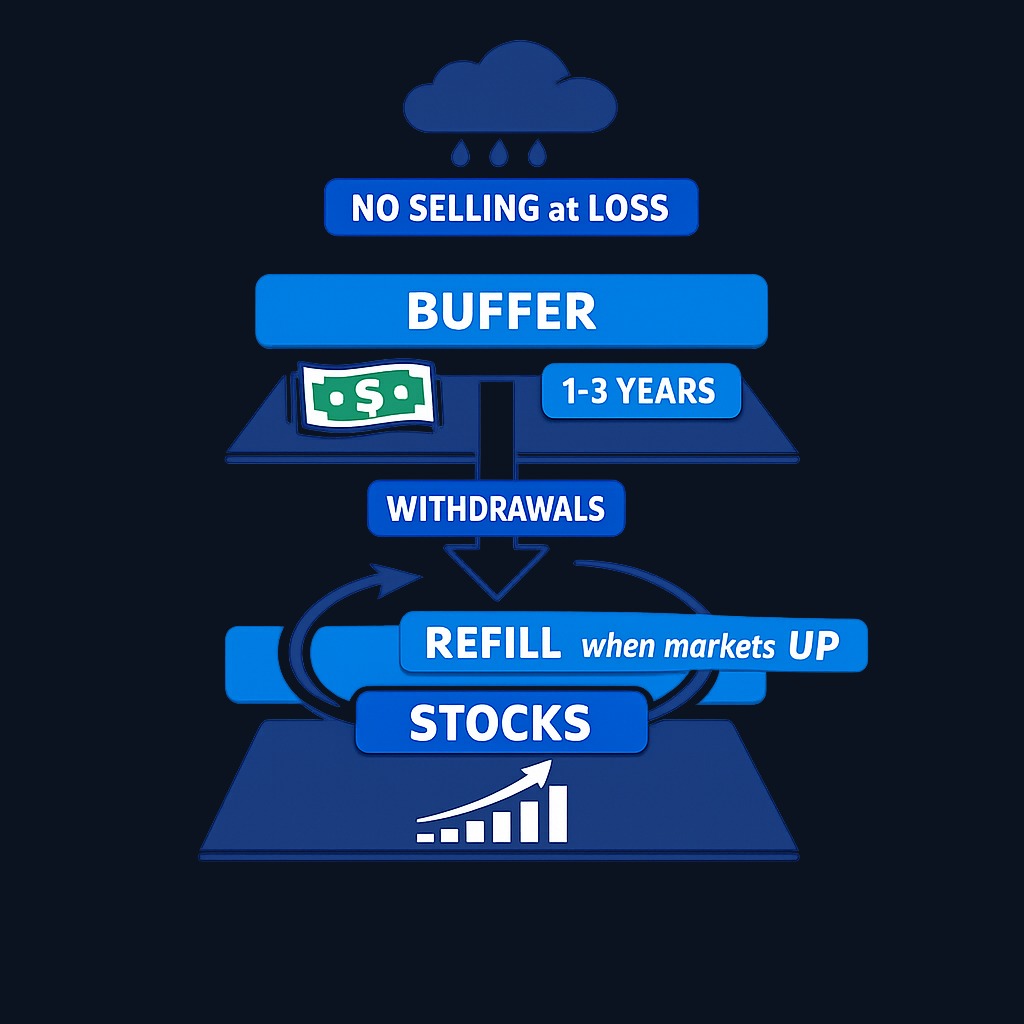
Each tactic has trade-offs. Buffers drag on returns in good times, spending rules require discipline, and guarantees carry costs and terms you should verify carefully before committing.
Practice trading with Finelo
Practice in a simulator, learn with bite-sized lessons, and build confidence before risking real money.
A tale of two decades: how the same average return diverges
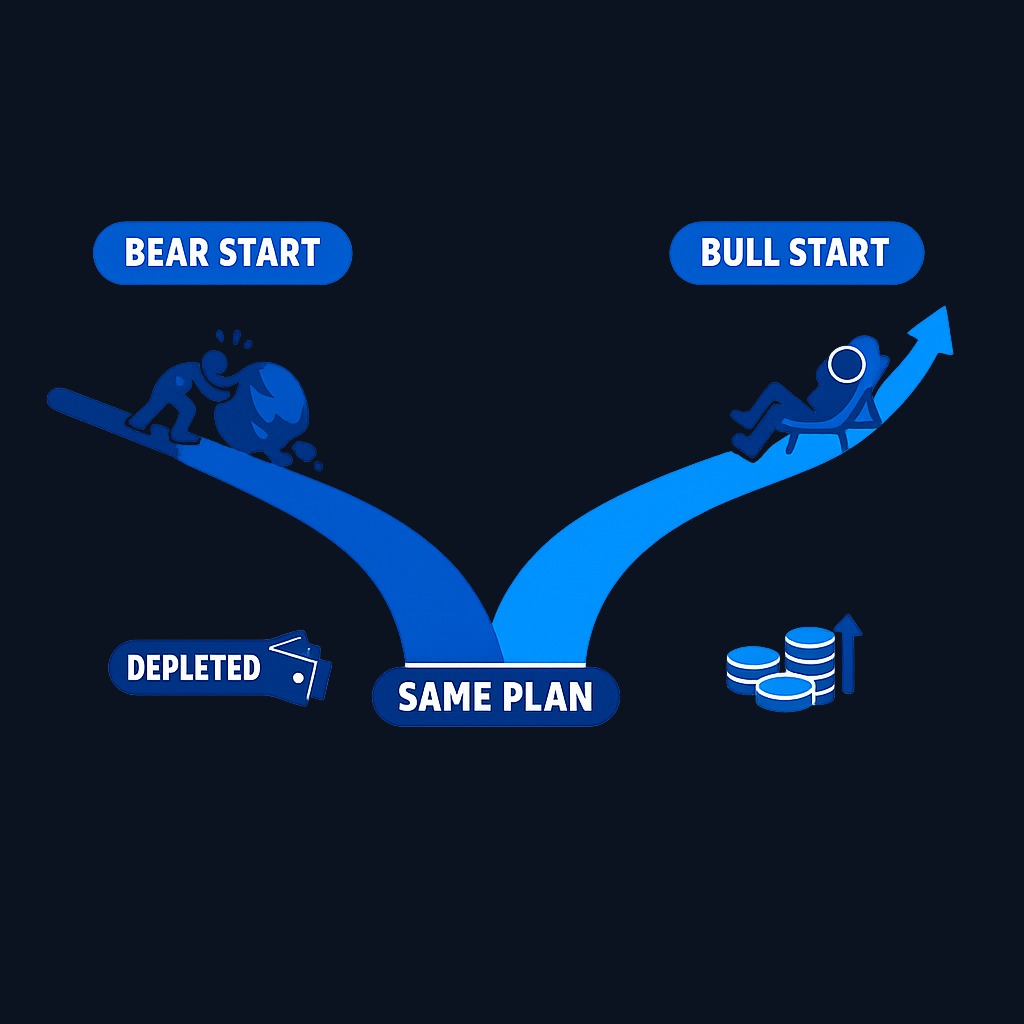
Case studies of historical retirees show the pattern clearly. Someone who retired into a deep bear market with high inflation faced brutal early losses, and rigid withdrawals from a shrinking portfolio compounded the damage for decades. Someone who retired at the start of a long bull market could overspend for years and still finish with more than they started with.
The lesson is not that one retiree was smarter. Both followed the same plan; the market simply dealt them different opening hands. Since you cannot choose your hand, the practical response is to plan for a poor opening sequence: keep early withdrawals moderate, hold a buffer, and revisit the plan every year. If the good sequence shows up instead, you can raise spending later, which is a far easier adjustment than cutting it.
What to know before deciding
Before you settle on a withdrawal plan, pressure-test the assumptions behind it. Check what happens to your plan if the first five years deliver below-average returns, how your spending would flex if your balance fell 25%, and how much of your budget is truly fixed versus discretionary. Tax treatment of withdrawals from different account types also shapes how long money lasts, so confirm the rules for your accounts and situation. Illustrations like the tables above are simplified for education; real results vary with fees, inflation, taxes, and your actual return sequence. When the stakes are high, model several scenarios rather than one average-case projection.
Decision framework: stress-testing your retirement plan
- Map your fragile decade. Note the five years before and after your planned retirement date; that window deserves the most conservative assumptions.
- Run a bad-first-years scenario. Model your plan with losses up front, not just an average return every year. If it fails, the plan needs adjusting, not hoping.
- Size your buffer. Decide how many years of withdrawals you want in stable assets and where they will sit.
- Write your cut rule in advance. Decide now what spending you would trim after a down year, so the decision is mechanical rather than emotional.
- Schedule an annual review. Recheck balance, spending, and allocation each year and after major market moves.
Conclusion and next steps
Sequence of returns risk is the reason two identical average returns can produce opposite retirement outcomes. The order of gains and losses interacts with withdrawals, and early losses cut deepest. You cannot control the sequence you get, but buffers, flexible spending, diversification, and a stress-tested plan let you absorb a bad opening without abandoning your goals.
Next steps: sketch your own fragile decade, run your numbers through a bad-first-years scenario with a retirement calculator, and write down the spending cuts you would make after a down year.
Frequently asked questions
What is sequence of returns risk in simple terms?
It is the risk that bad market years arrive early in your retirement, when withdrawals magnify their damage. The order of returns, not just the average, determines how long a portfolio lasts once money is being taken out.
How does it differ from regular market risk?
Market risk is the chance that investments fall in value. Sequence risk is about when those falls happen relative to your withdrawals. A crash at 40 is a setback; the same crash in your first retirement year can permanently shrink your income.
What strategies help mitigate sequence of returns risk?
Common approaches include holding one to three years of spending in cash or short-term bonds, using flexible withdrawal rules, rebalancing regularly, diversifying, and covering essential costs with predictable income. Combining several tactics works better than relying on one.
How can I assess my exposure to sequence of returns risk?
Look at how close you are to your withdrawal start date, how rigid your planned spending is, and how much of your portfolio sits in volatile assets. The closer the date, the stiffer the spending, and the heavier the stock allocation, the higher your exposure.
sequencereturnsriskitsimpactretirement
Practice trading with Finelo
Practice in a simulator, learn with bite-sized lessons, and build confidence before risking real money.
About the author
Finelo Team
The Finelo Team creates practical investing and trading education designed to help beginners learn faster with structured challenges, simulator practice, and bite-sized lessons.
Keep reading — Related articles

Trading
Understanding Walk Forward Analysis in Trading
Brief educational note: this article is educational — not investment advice — and trading involves the risk of loss.
Finelo Team
Trading
VWAP vs Moving Average: Formulas, Uses, and Limits
VWAP weights price by recorded volume over a defined period, while a moving average summarizes a sequence of prices over a rolling lookback.
Finelo Team

Trading
Volume Profile vs Market Profile: What Each Chart Measures
Volume Profile groups traded volume by price level.
Finelo Team