Stock market circuit breakers are automatic, market-wide trading halts. They trigger when the S&P 500 falls 7% (Level 1), 13% (Level 2), or 20% (Level 3) from the prior day's close, per the Investor.gov glossary. Level 1 and 2 halts pause trading for 15 minutes when they occur before 3:25 p.m. Eastern; Level 3 closes the market for the day. The key distinctions are the trigger levels, halt lengths, order behavior, and the separate LULD system for individual securities.
What Are Stock Market Circuit Breakers and How Do They Work?

Stock market circuit breakers are automatic, market-wide trading halts. They trigger when the S&P 500 falls 7% (Level 1), 13% (Level 2), or 20% (Level 3) from the prior day's close, per the Investor.gov glossary. Level 1…
7 min read
Practice trading with Finelo
Practice in a simulator, learn with bite-sized lessons, and build confidence before risking real money.
Want to learn more?
Practice in a simulator, learn with bite-sized lessons, and build confidence before risking real money.
Explore FineloExplore Finelo's 28-day challenges
Turn learning into a daily habit with guided challenge paths.
How circuit breakers function
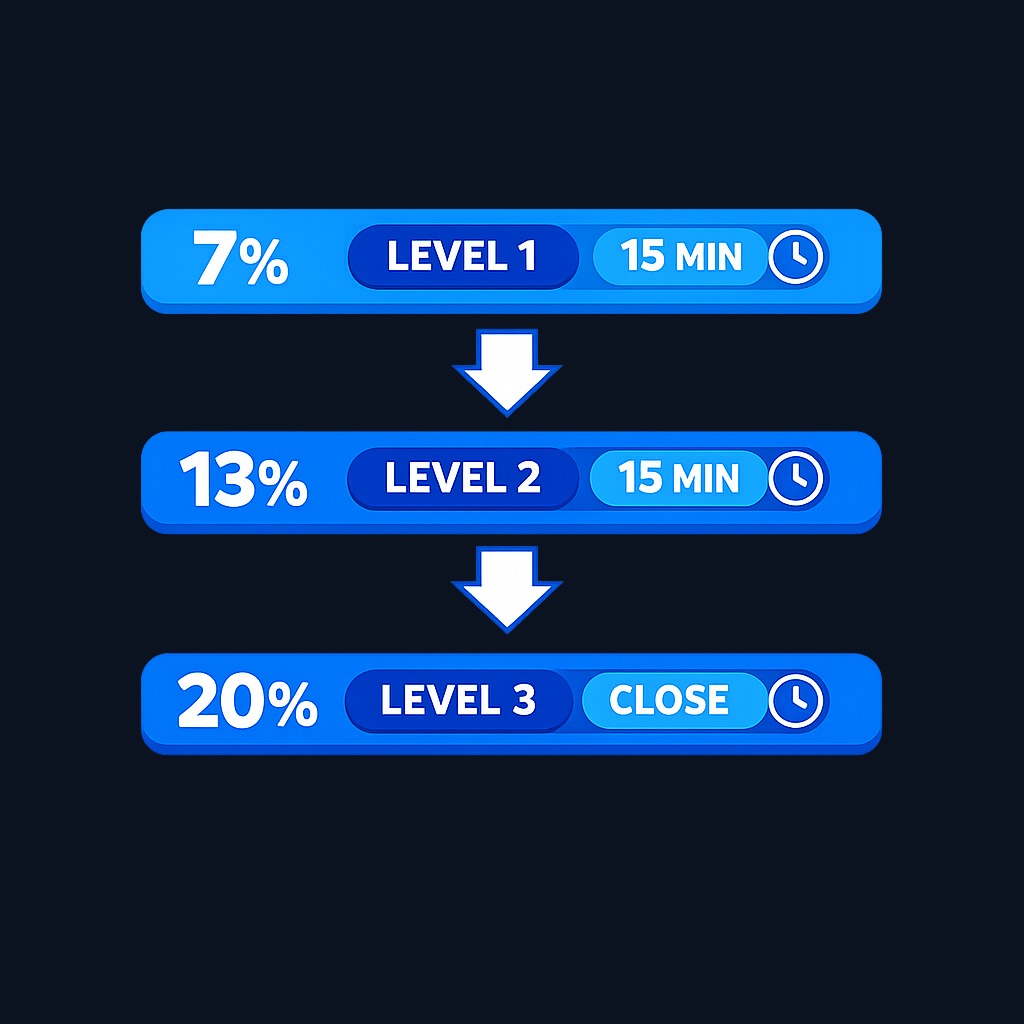
The system works on three escalating thresholds, recalculated every day from the prior close of the S&P 500:
| Level | S&P 500 decline | What happens |
|---|---|---|
| Level 1 | 7% | 15-minute halt if triggered before 3:25 p.m. ET; no halt after that |
| Level 2 | 13% | Another 15-minute halt if before 3:25 p.m. ET; each level can fire only once per day |
| Level 3 | 20% | Trading closes for the remainder of the day, whenever it occurs |
The halts are coordinated across securities and futures exchanges, so the pause is genuinely market-wide rather than venue-by-venue. The purpose is to give participants time to absorb information and restore liquidity. The pause interrupts the feedback loop where falling prices force selling that causes further falls.
Single-stock protections: limit up-limit down
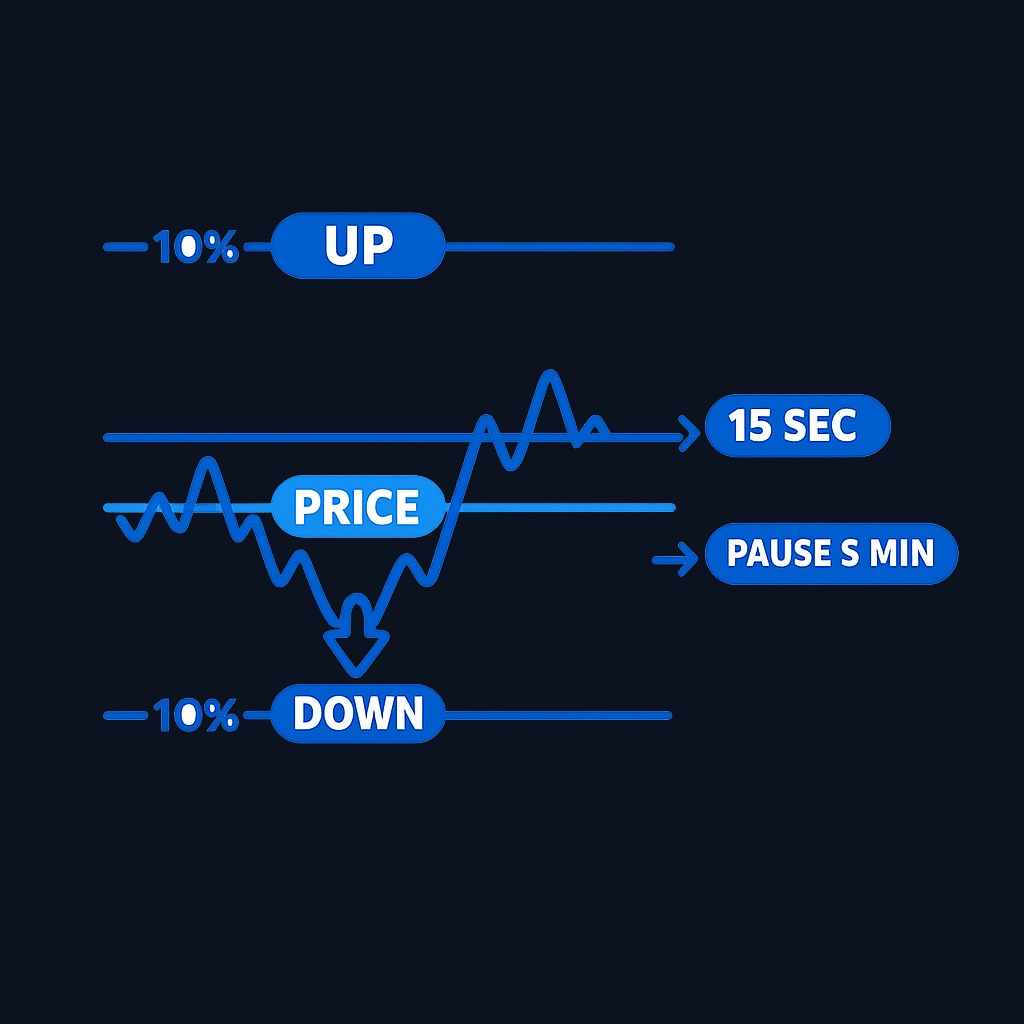
Alongside the market-wide system, individual stocks trade inside "limit up-limit down" (LULD) price bands. Bands are generally 5% for large liquid names and 10% or wider for smaller ones. They are measured against a rolling five-minute average price. If a stock presses the band and cannot trade back inside it within 15 seconds, that single security pauses for five minutes. Most trading halts you see on ordinary days are these single-stock pauses, not the market-wide breakers.
A hypothetical worked example
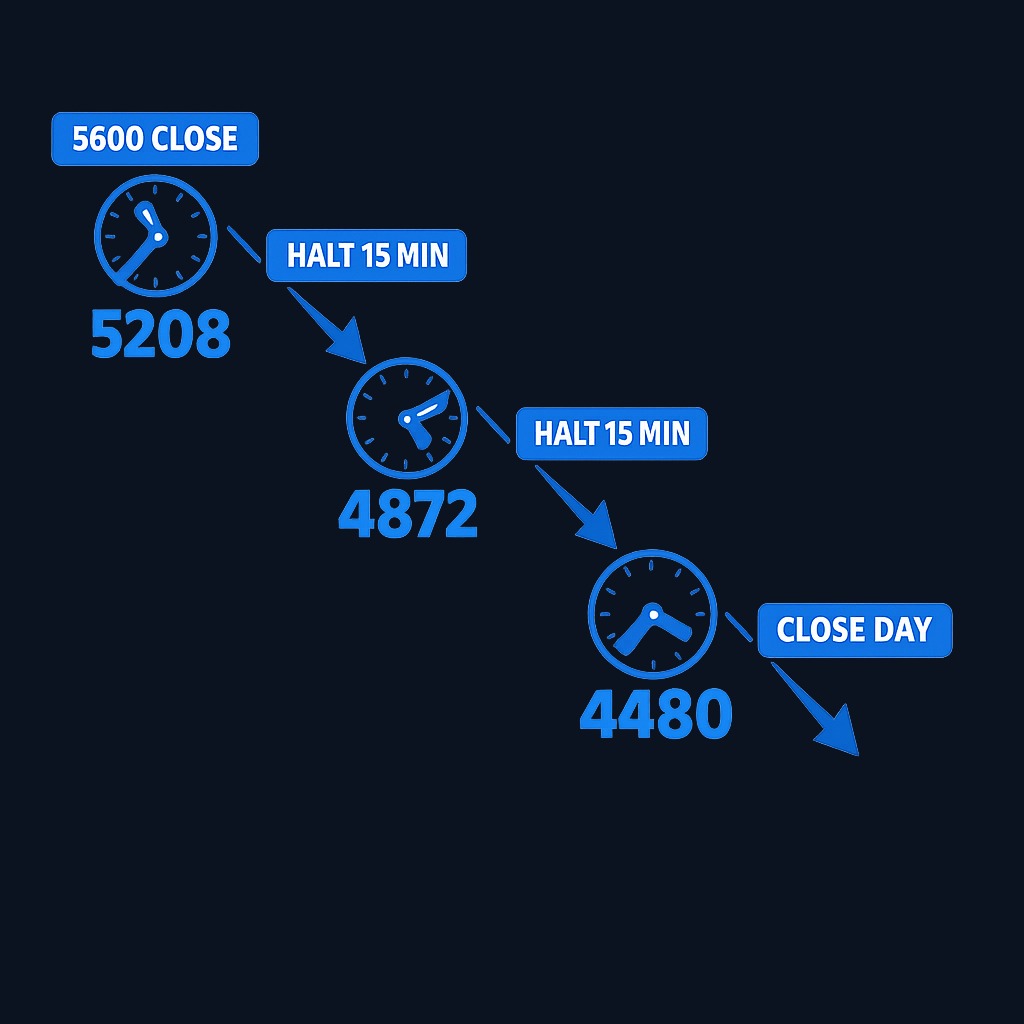
Suppose the S&P 500 closed yesterday at 5,600. Today's breaker levels would be:
- Level 1 at 5,208 - a 392-point drop (7%)
- Level 2 at 4,872 - a 728-point drop (13%)
- Level 3 at 4,480 - a 1,120-point drop (20%)
If the index hits 5,208 at 11:40 a.m., all stock trading halts for 15 minutes and reopens through an auction process. If selling resumes and the index reaches 4,872 at 2:10 p.m., a second 15-minute halt fires. Only a further slide to 4,480 would end the session early. Each threshold resets the next morning based on the new closing price.
Where the system came from
Circuit breakers were created after the crash of October 19, 1987. That day the Dow fell 22.6% in a single session with no mechanism to pause the cascade. The original design used point-based Dow thresholds. The framework was overhauled in 2013 to the current percentage-based S&P 500 system with the 7/13/20 levels. The market-wide breakers have triggered rarely. They fired once in October 1997 under the old rules. Then pandemic-driven selling tripped Level 1 halts four times in March 2020, on March 9, 12, 16, and 18. In each 2020 case, trading resumed after 15 minutes and the session completed without reaching Level 2.
What halts mean for your orders and your plan
Practical effects investors should understand before the next volatile day:
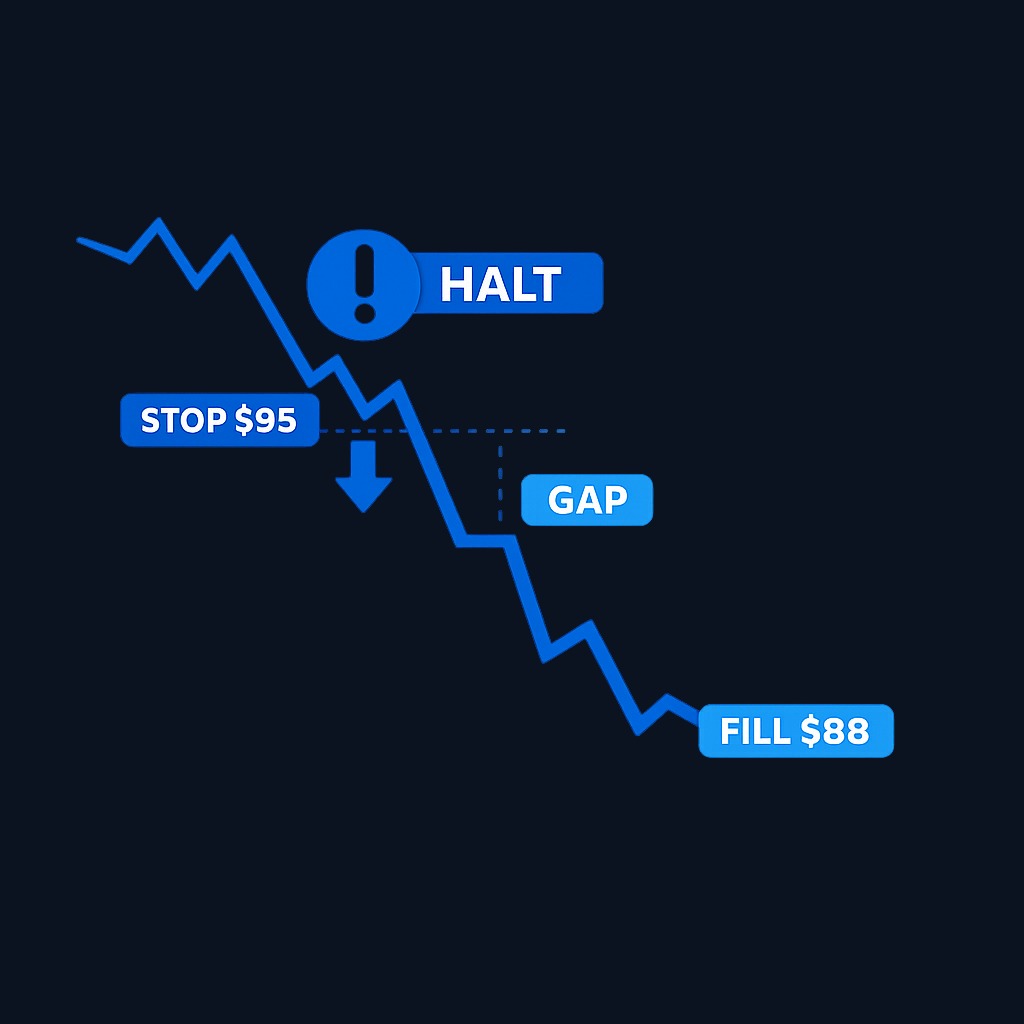
- Orders do not execute during a halt. Market orders queue and fill at the reopening auction price, which can differ sharply from the last trade before the pause. That reopening gap is a real risk of panicking into a halt.
- Stop-losses can fill far below the stop level. A stop triggered into a halted, gapping market becomes a market order at whatever the reopen provides.
- Futures hit their own limits overnight. Equity index futures have separate down-limit rules outside regular hours, so headlines about "futures limit down" describe a related but distinct mechanism.
- Halts are information windows. The 15 minutes exist to let you read, breathe, and check your plan - using them to queue impulsive orders defeats the purpose.
- Aggressive short-term trading around halts is high-risk. The SEC's plain-language warnings on day trading risk apply doubly in breaker conditions, when spreads widen and liquidity thins.
Do circuit breakers actually work?
Evidence and opinion are mixed, and honest coverage should say so. Supporters credit the 2020 halts with orderly reopens: each pause ended, auctions cleared, and the market finished the sessions functioning. Critics point to two effects. The "magnet effect" hypothesis argues that traders rush to sell as the index approaches a known threshold. That rush can accelerate the very decline the breaker is meant to slow. And halts do not change fundamentals; the March 2020 sessions that opened with Level 1 halts still closed deeply red. The consensus position among regulators after 2020 reviews was that the framework functioned as designed - slowing the mechanics of panic, not preventing losses.
Practice trading with Finelo
Practice in a simulator, learn with bite-sized lessons, and build confidence before risking real money.
What to know before deciding how to react
A halt is not a signal to buy or sell. Know the day's 7%, 13%, and 20% levels, understand how resting orders and margin requirements can behave through a pause and reopening auction, and size positions so a gap does not force an unplanned decision. Reopening prices can be volatile, but there is no basis for claiming forced sellers routinely receive the day's worst price.
Decision framework: responding to a market-wide halt
| Your situation | Sensible response |
|---|---|
| Long-term investor, diversified portfolio | Do nothing during the halt; review allocation on your normal schedule |
| Holding positions on margin | Check requirements immediately; arrange cash rather than waiting for forced liquidation |
| Active trader with open positions | Reassess stops and sizing during the pause; expect wide spreads at reopen |
| Tempted to buy the dip | Wait for the reopening auction to clear before judging real prices |
| Using market orders near 3:25 p.m. | Switch to limit orders; late-day breaker rules change and gaps get violent |
FAQ
What triggers a stock market circuit breaker?
A single-day decline in the S&P 500 of 7%, 13%, or 20% from the prior close triggers Level 1, 2, or 3 respectively. The point values are recalculated daily, as described in the investor.gov glossary.
How long do the halts last?
Level 1 and Level 2 halts last 15 minutes when triggered before 3:25 p.m. ET. After 3:25 p.m., Levels 1 and 2 no longer halt trading. A Level 3 breach closes the market for the rest of the day at any time.
How often have market-wide circuit breakers been triggered?
Rarely. Under the modern framework, the market-wide breakers fired four times during March 2020, all at Level 1. They also fired once in 1997 under the earlier point-based rules. Single-stock LULD pauses, by contrast, happen routinely.
Do circuit breakers apply to individual stocks?
Individual securities are governed by the separate limit up-limit down mechanism. It pauses a single stock for five minutes when its price presses outside its allowed band. Market-wide breakers halt everything at once.
Conclusion and next steps
Market-wide circuit breakers pause trading at 7% and 13% declines when triggered before 3:25 p.m. ET and close the market after a 20% decline. They cannot stop losses or guarantee calmer prices; they create a standardized pause for order handling and information processing. Individual NMS securities use the separate Limit Up-Limit Down Plan, which uses price bands and trading pauses rather than the market-wide thresholds.
TradingMarketsBeginner
Practice trading with Finelo
Practice in a simulator, learn with bite-sized lessons, and build confidence before risking real money.
About the author
Finelo Team
The Finelo Team creates practical investing and trading education designed to help beginners learn faster with structured challenges, simulator practice, and bite-sized lessons.
Keep reading — Related articles

Trading
Understanding Walk Forward Analysis in Trading
Brief educational note: this article is educational — not investment advice — and trading involves the risk of loss.
Finelo Team
Trading
VWAP vs Moving Average: Formulas, Uses, and Limits
VWAP weights price by recorded volume over a defined period, while a moving average summarizes a sequence of prices over a rolling lookback.
Finelo Team

Trading
Volume Profile vs Market Profile: What Each Chart Measures
Volume Profile groups traded volume by price level.
Finelo Team