A fill or kill order (FOK) is a trade instruction that must be executed immediately and completely, or not at all. If the market cannot fill the entire order right away, the whole order is cancelled, with no partial fills, as defined in the SEC's investor glossary.
What is a Fill or Kill Order?
A fill or kill order (FOK) is a trade instruction that must be executed immediately and completely, or not at all. If the market cannot fill the entire order right away, the whole order is cancelled, with no partial…
5 min read
Practice trading with Finelo
Practice in a simulator, learn with bite-sized lessons, and build confidence before risking real money.
Want to learn more?
Practice in a simulator, learn with bite-sized lessons, and build confidence before risking real money.
Explore FineloExplore Finelo's 28-day challenges
Turn learning into a daily habit with guided challenge paths.
If you are learning order types, this page gives you the practical picture: how a fill or kill order works, when traders reach for it, and how it compares with similar instructions. As with everything in investing education, this is informational, not financial advice.
Who this is for and how it works
This page is for beginners who already know what a buy or sell order is and want to understand execution qualifiers, plus anyone who trades position sizes large enough that partial fills hurt.
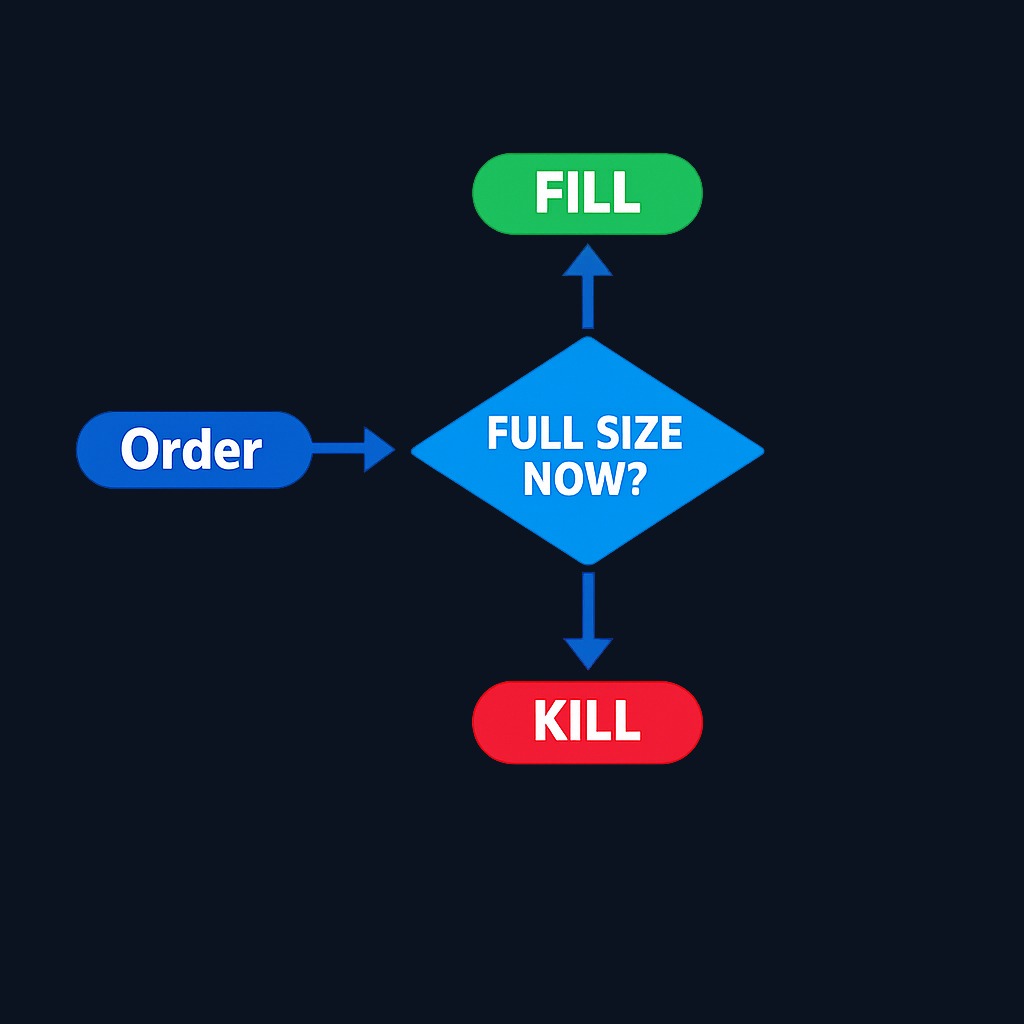
When you send a FOK order, your broker checks whether the full quantity can be executed immediately, usually at your specified limit price or better. Two outcomes are possible:
- Fill: the entire order executes at once, at your price or better.
- Kill: any part of the order cannot be filled immediately, so the exchange cancels all of it.
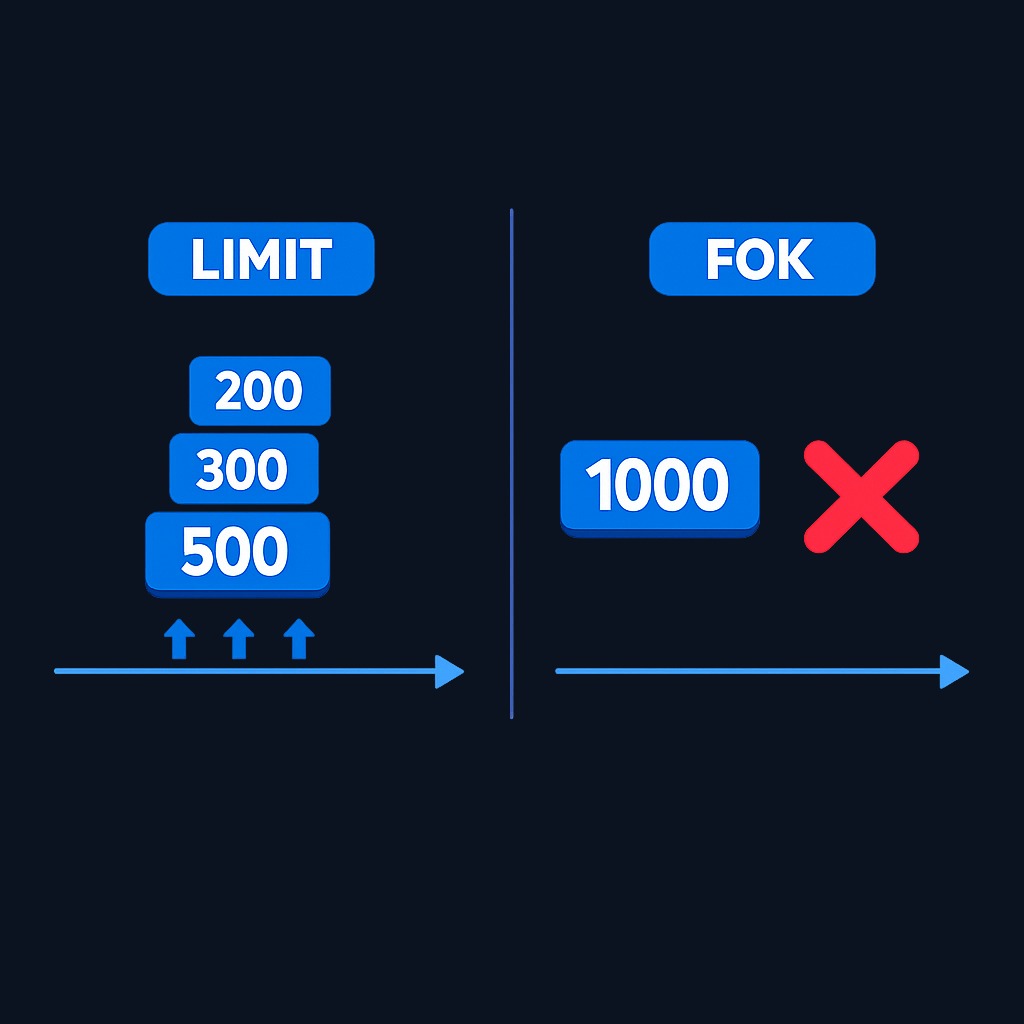
There is no middle ground and no waiting around on the order book. That all-or-nothing, right-now behavior is the entire point. Compare that with a plain limit order, which can sit open for hours and fill in pieces: 200 shares now, 300 later, and so on.
Key benefits
The advantages are focused:
- No partial positions. You either get the full size or stay flat, which keeps position management clean.
- No stale orders. Nothing lingers on the book to execute later at a moment you no longer want.
- Price control. Combined with a limit price, you cap what you pay or floor what you receive.
- Clean strategy execution. Trades that only work as a complete block, such as hedges, arrive whole or not at all.
Proof, examples, and objections
Why would anyone demand this strictness? Partial fills can be a real problem for large trades. Schwab's overview of order types and conditions notes that an all-quantity qualifier can prevent, say, a 100-share execution on a 5,000-share order - but the same strictness means the order may not execute at all. Getting a tiny slice of a big position leaves a trader exposed: they hold an awkward partial position and may move the price against themselves while finishing the job.
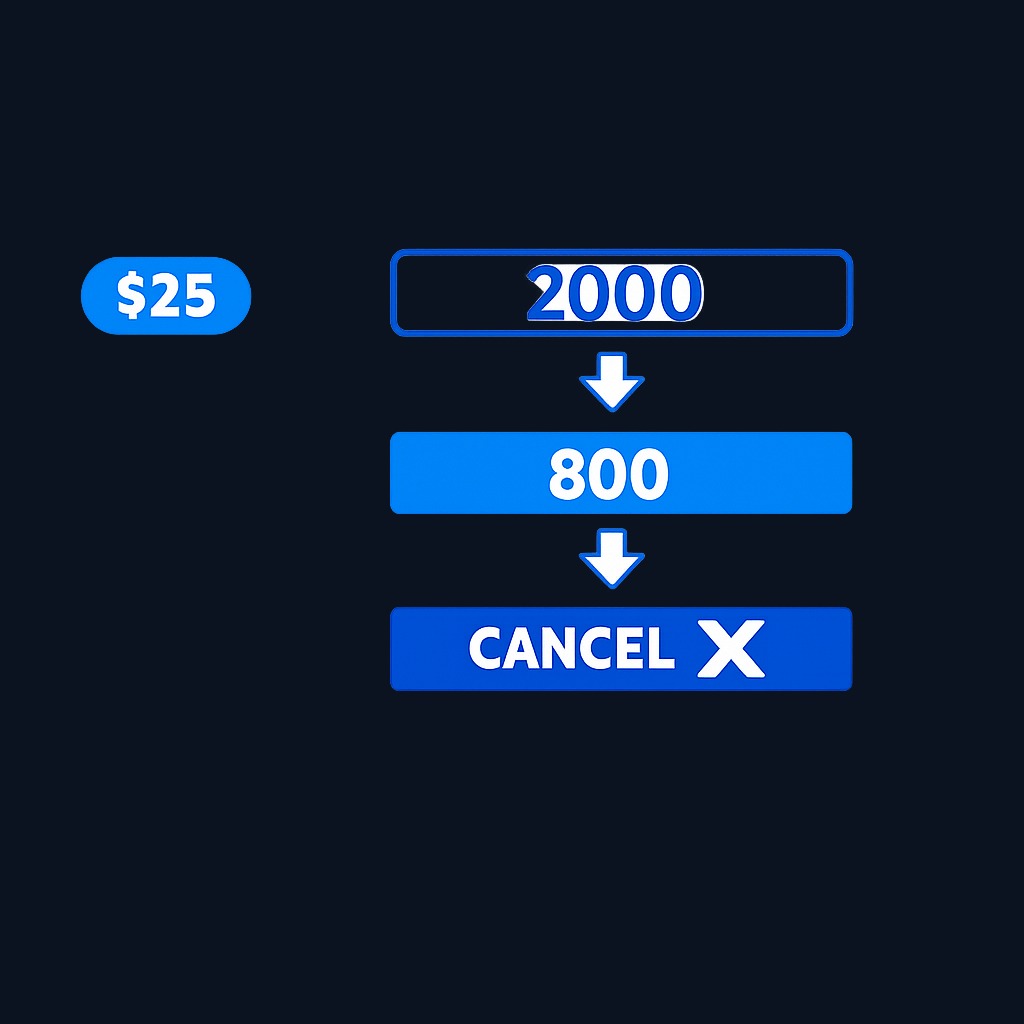
A concrete example: suppose you want 2,000 shares of a mid-cap stock at $25.00, and only 800 shares are available at that price right now. A limit order buys 800 and waits. An FOK order cancels entirely, and you keep your cash.
The honest objections mirror the benefits:
- Low fill probability. Demanding full size immediately means many FOK orders simply die, especially in thinly traded stocks.
- Missed moves. While your order gets killed repeatedly, the market can run away from your price.
- Limited retail need. For small orders in liquid stocks, partial fills are rare anyway, so the qualifier adds little.
- Availability varies. Not every broker or market supports FOK on every product, and some venues prohibit these qualifiers on certain order flows, so check your broker's rules first.
Practice trading with Finelo
Practice in a simulator, learn with bite-sized lessons, and build confidence before risking real money.
Fill or kill vs other order types
| Order type | Executes immediately? | Partial fills allowed? | Can rest on the book? |
|---|---|---|---|
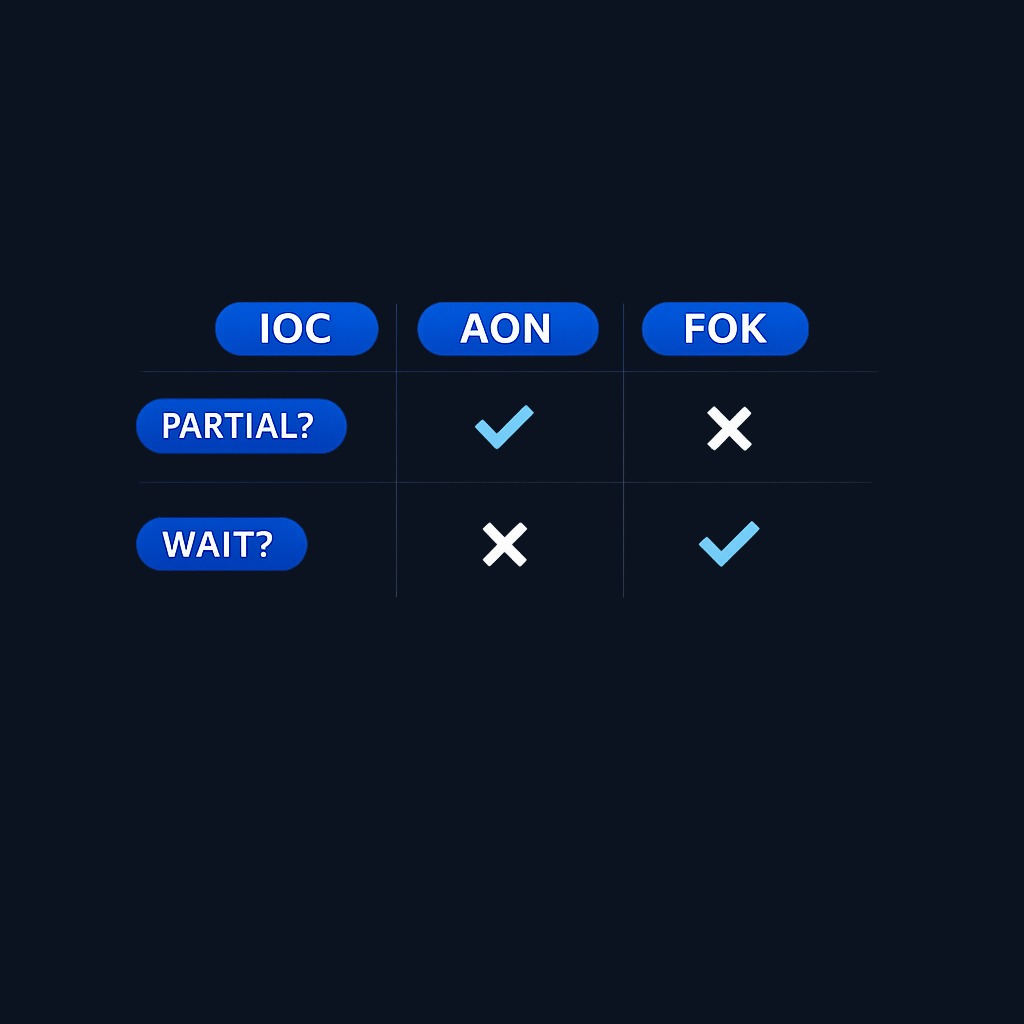
| Fill or kill (FOK) | Yes, required | No | No |
| Immediate or cancel (IOC) | Yes, required | Yes, remainder cancelled | No |
| All or none (AON) | No, can wait | No | Yes |
| Limit order | Only if price allows | Yes | Yes |
| Market order | Yes | Yes | No |
The two closest cousins are worth separating. An immediate or cancel order also demands instant execution but accepts a partial fill and cancels the rest. An all or none order refuses partial fills but is willing to wait on the order book until full size is available. A fill or kill order is the strictest of the three: full size, right now, or nothing.
Decision framework: when a fill or kill order makes sense
Run through three questions before using one. First, is the order large relative to typical trading volume? If yes, a partial fill is a genuine risk and FOK earns its keep; if you are trading 20 shares of a mega-cap stock, it probably changes nothing. Second, does your strategy depend on getting the full size at one price, for example a hedge that only works as a complete block? Third, can you tolerate not trading at all? A killed order means no position; if missing the trade is worse than a partial fill, use a limit or IOC order instead. In short: FOK suits size-sensitive, price-sensitive trades in liquid markets, and frustrates almost everything else.
Conclusion and next steps
A fill or kill order buys certainty of size and price at the cost of certainty of execution: the whole trade happens instantly or none of it does. It shines for large, price-sensitive trades and adds little for small orders in liquid names. Next step: open your broker's order ticket, find the time-in-force and qualifier options, and identify which of FOK, IOC, and AON it actually supports before you ever need one in a live trade.
Frequently asked questions
How do fill or kill orders differ from immediate or cancel orders?
Both demand immediate execution. An IOC order accepts whatever portion fills instantly and cancels the remainder, while a FOK order cancels everything unless the full quantity executes. FOK is stricter; IOC trades completeness for a higher chance of getting at least something done.
Can fill or kill orders be used for options trading?
Many platforms support FOK on options and other derivatives, where all-or-nothing execution matters for multi-leg strategies. Support differs by broker and market, so confirm in your platform's order-type documentation before relying on it.
Are there restrictions on fill or kill orders?
Yes, availability depends on the broker, exchange, and security. Some venues prohibit this qualifier on certain orders or route them differently. Check your broker's order-type rules so a killed or rejected order does not surprise you.
Do fill or kill orders cost more?
Brokers generally charge standard commissions regardless of qualifier, and a killed order that never executes typically costs nothing. The real cost is opportunity: repeated kills can leave you out of a move you wanted to catch.
fillkillorder
Practice trading with Finelo
Practice in a simulator, learn with bite-sized lessons, and build confidence before risking real money.
About the author
Finelo Team
The Finelo Team creates practical investing and trading education designed to help beginners learn faster with structured challenges, simulator practice, and bite-sized lessons.
Keep reading — Related articles
Trading
Understanding Walk Forward Analysis in Trading
Brief educational note: this article is educational — not investment advice — and trading involves the risk of loss.
Finelo Team

Trading
VWAP vs Moving Average: Formulas, Uses, and Limits
VWAP weights price by recorded volume over a defined period, while a moving average summarizes a sequence of prices over a rolling lookback.
Finelo Team

Trading
Volume Profile vs Market Profile: What Each Chart Measures
Volume Profile groups traded volume by price level.
Finelo Team