Slippage in trading is the difference between the price you expected when you placed an order and the price at which the order actually executed. It happens because markets move in the instant between your click and the fill, and because there may not be enough shares available at the quoted price. Slippage can work against you or, less often, in your favor.
What is Slippage Trading and How Can You Manage It?
Slippage in trading is the difference between the price you expected when you placed an order and the price at which the order actually executed. It happens because markets move in the instant between your click and…
7 min read
Practice trading with Finelo
Practice in a simulator, learn with bite-sized lessons, and build confidence before risking real money.
Want to learn more?
Practice in a simulator, learn with bite-sized lessons, and build confidence before risking real money.
Explore FineloExplore Finelo's 28-day challenges
Turn learning into a daily habit with guided challenge paths.
This page is for traders and investors who keep seeing fills that do not match the quote on their screen and want to know why, how much it matters, and what to do about it. We will cover the causes, the types, the performance impact, and practical controls like limit orders. As always, this is educational content, not financial advice.
Understanding the causes of slippage
Slippage traces back to three market mechanics. First, prices move continuously. The quote you saw is a snapshot; by the time your order reaches the market, buyers and sellers may have repriced, especially around news, earnings, and volatile openings. Second, quoted prices carry limited size. The best bid or ask covers only a certain number of shares, so a larger market order eats through multiple price levels, filling each chunk at a progressively worse price. Third, the bid-ask spread itself: a market buy executes at the ask and a market sell at the bid, so crossing the spread is a built-in cost even when nothing else changes.
The common thread is liquidity. Heavily traded large-cap stocks during regular market hours offer deep order books and tight spreads, so slippage is usually pennies. Thinly traded small caps, after-hours sessions, and fast markets offer the opposite: wide spreads, shallow depth, and fills you may not recognize.
Types of slippage: negative and positive
Slippage is usually a cost, but not always:
| Type | What happens | Typical situation |
|---|---|---|
| Negative slippage | Fill at a worse price than expected | Fast or thin markets, market orders |
| Positive slippage | Fill at a better price than expected | Market ticks your way; broker price improvement |
| Spread cost | Buy at ask, sell at bid | Every market order, even in calm conditions |
The SEC's guide to trade execution makes the underlying point plainly: in fast-moving markets, the price of the stock can change between the time you place an order and the time it executes, so the quote you clicked is not a guarantee.
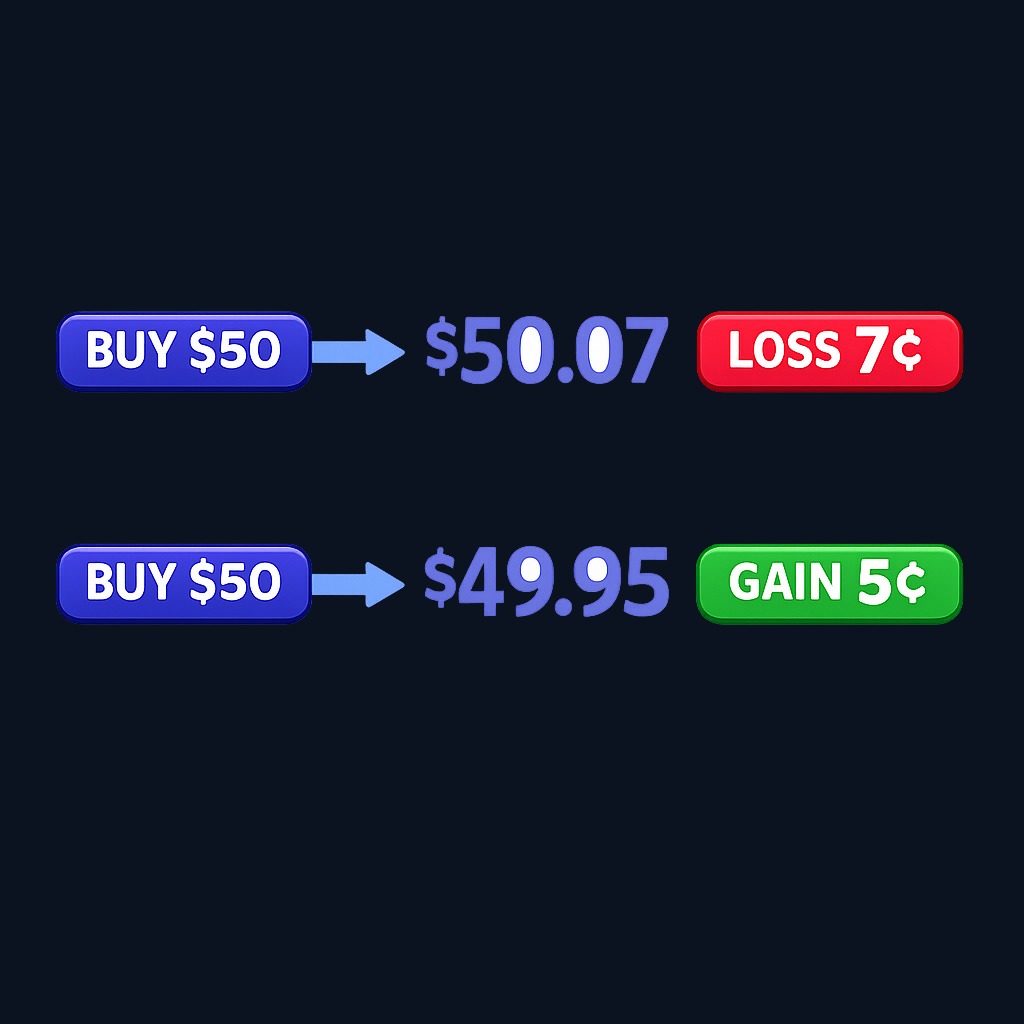
Direction depends on which way the market moves against your order flow in that fraction of a second. Over many trades, most active traders find slippage nets out as a real cost, which is why managing it matters more than hoping for lucky fills.
How slippage affects trading performance
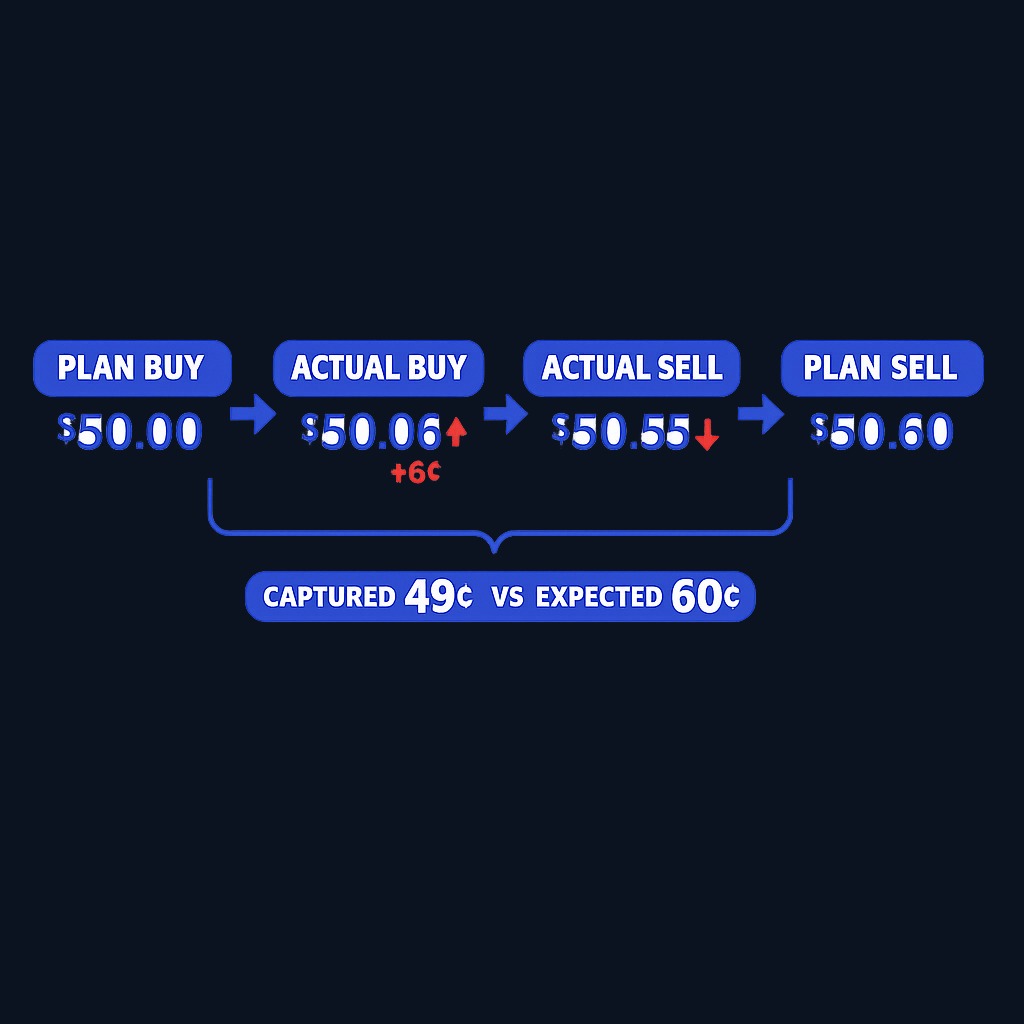
Slippage is an invisible line item in your results. A strategy that looks profitable on paper can lose money live once every entry and exit gives up a small edge to execution. Consider a simple example: you plan to buy at $50.00 and sell at $50.60, a 60-cent expected gain. If your buy slips to $50.06 and your sell fills at $50.55, you captured 49 cents instead, roughly a fifth of the edge gone before commissions.
Three factors scale the damage. Frequency: the more often you trade, the more times you pay the toll, so high-turnover strategies feel slippage most. Size: bigger orders relative to available volume walk deeper into the order book. Urgency: strategies that demand instant execution, such as momentum entries and stop-loss exits in fast markets, accept whatever price is there. Long-term investors making occasional trades in liquid stocks experience slippage as noise; short-term traders should treat it as a core cost of doing business and measure it explicitly.
Strategies to minimize slippage
You cannot eliminate slippage, but you can control your exposure to it:
- Use limit orders. A limit order caps your price: it fills at your limit or better, or not at all. You trade execution certainty for price certainty, which is exactly the right trade when slippage risk is high.
- Trade liquid markets. Tight spreads and deep books in widely traded stocks leave less room for surprises.
- Avoid volatile moments. The minutes around the market open, the close, and scheduled news are when quotes move fastest and fills wander most.
- Size orders to the market. Keep individual orders small relative to typical volume; break large positions into pieces rather than sweeping the book in one shot.
- Use stop-limit rather than plain stop orders where appropriate. A stop order becomes a market order when triggered and can fill far from the stop price in a gap; a stop-limit bounds the damage but may not execute at all. Each choice is a different risk, so pick deliberately.
- Check fills. Compare your execution prices with the quotes you targeted. Persistent, unexplained gaps are worth a conversation with your broker or a change in order habits.
Practice trading with Finelo
Practice in a simulator, learn with bite-sized lessons, and build confidence before risking real money.
A worked example: the same trade, three ways
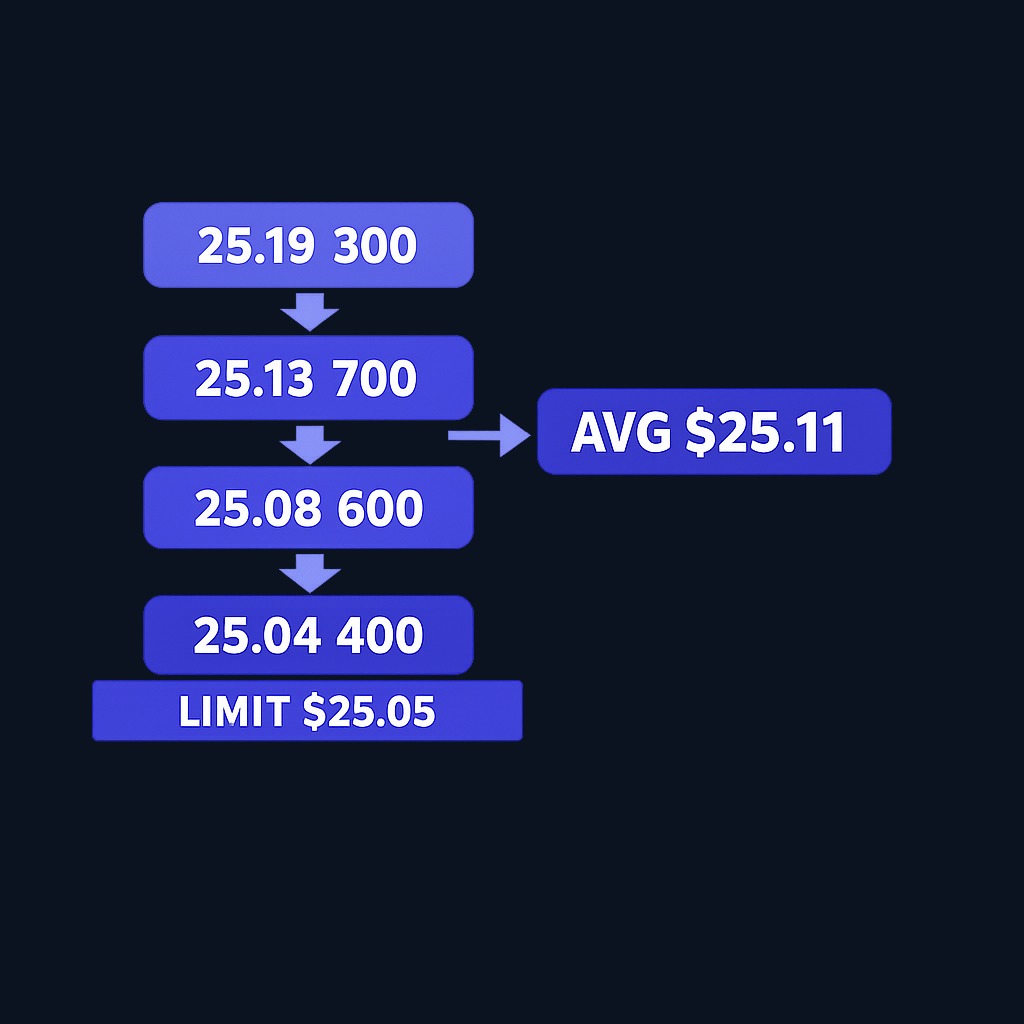
Imagine you want 2,000 shares of a mid-cap stock quoted at $25.00 bid, $25.04 ask, with 400 shares displayed at the ask. A market order takes the 400 at $25.04, then climbs: 600 more at $25.08, 700 at $25.13, and the last 300 at $25.19, for an average near $25.11, about 7 cents of slippage per share versus the quote. A limit order at $25.05 fills 400 immediately and waits; you avoid overpaying but risk chasing the stock if it runs. Splitting the order into five 400-share pieces spread over the session usually lands between the two, capturing available liquidity without pushing the price. None of these is universally right; each allocates the risk between price and execution differently, and that allocation is a real decision every time size meets a thin book.
What to know before deciding how to trade
Before choosing an order type, know three numbers for the stock you trade: the typical bid-ask spread, the average daily volume, and the size you intend to trade relative to both. Then match the tool to the situation: liquid stock, small order, calm market favors simple orders; thin stock, large order, or fast market favors limits and patience. Finally, measure your own history: your broker's confirmations contain every fill price, and comparing them against your intended prices over a month tells you what slippage actually costs you, in your account, rather than in theory.
Decision framework: managing slippage systematically
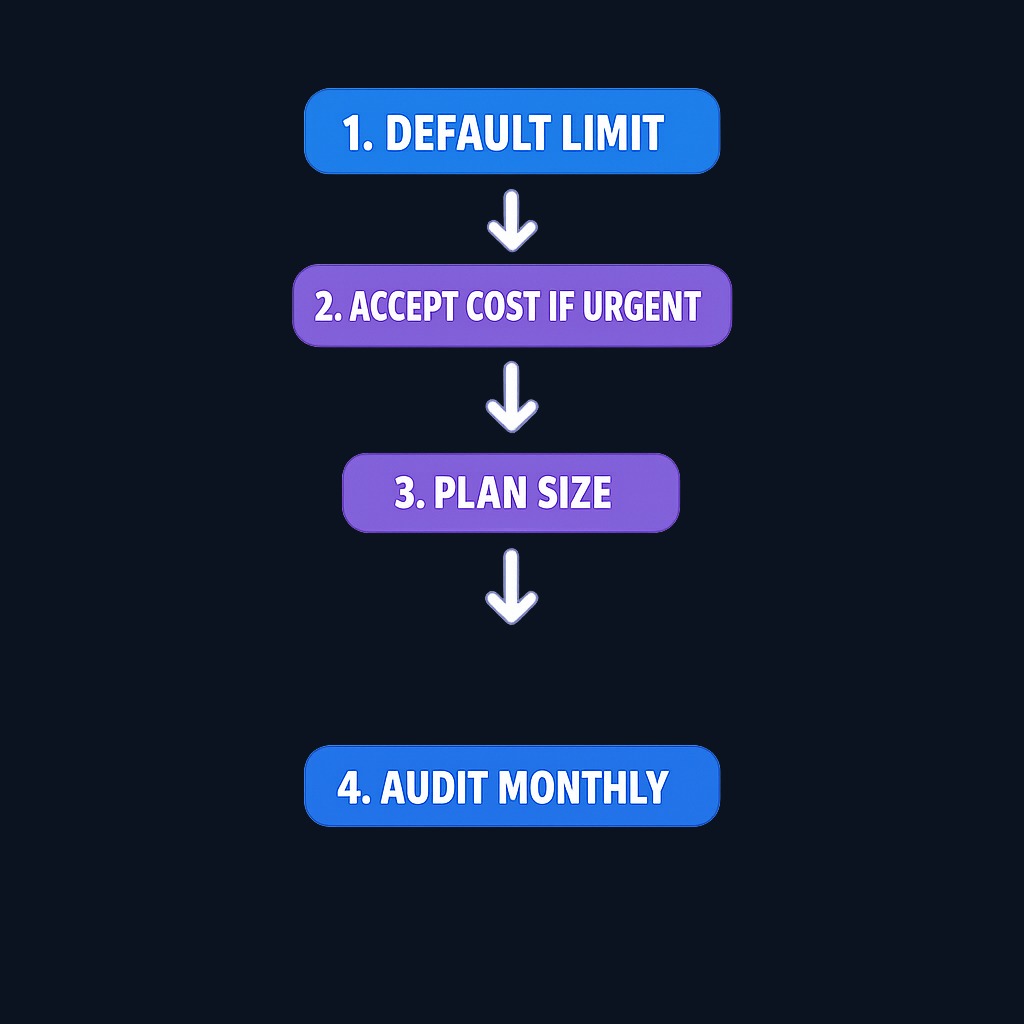
Apply four rules in order. First, default to limit orders unless you have a specific reason to demand immediate execution. Second, when immediacy matters, such as exiting a losing position, accept slippage consciously as the price of certainty and size the position beforehand so that cost is survivable. Third, never place size into an illiquid market without a plan: split the order, spread it over time, or accept that your own trading will move the price. Fourth, audit monthly: total the gap between intended and executed prices, and if the number rivals your commissions or your edge, change your execution habits before changing your strategy. Traders who follow this loop turn slippage from a mystery into a managed, measured cost.
Conclusion and next steps
Slippage is the execution tax markets charge for immediacy: usually small in liquid stocks, punishing in thin or fast ones, and cumulative for active traders. Limit orders, liquidity awareness, sensible sizing, and a monthly fill audit put most of it under your control. Next step: pull your last ten trade confirmations, compare each fill against the price you intended, and total the difference. That one number tells you whether slippage is a rounding error in your trading or a leak worth fixing.
Frequently asked questions
What is slippage in trading in simple terms?
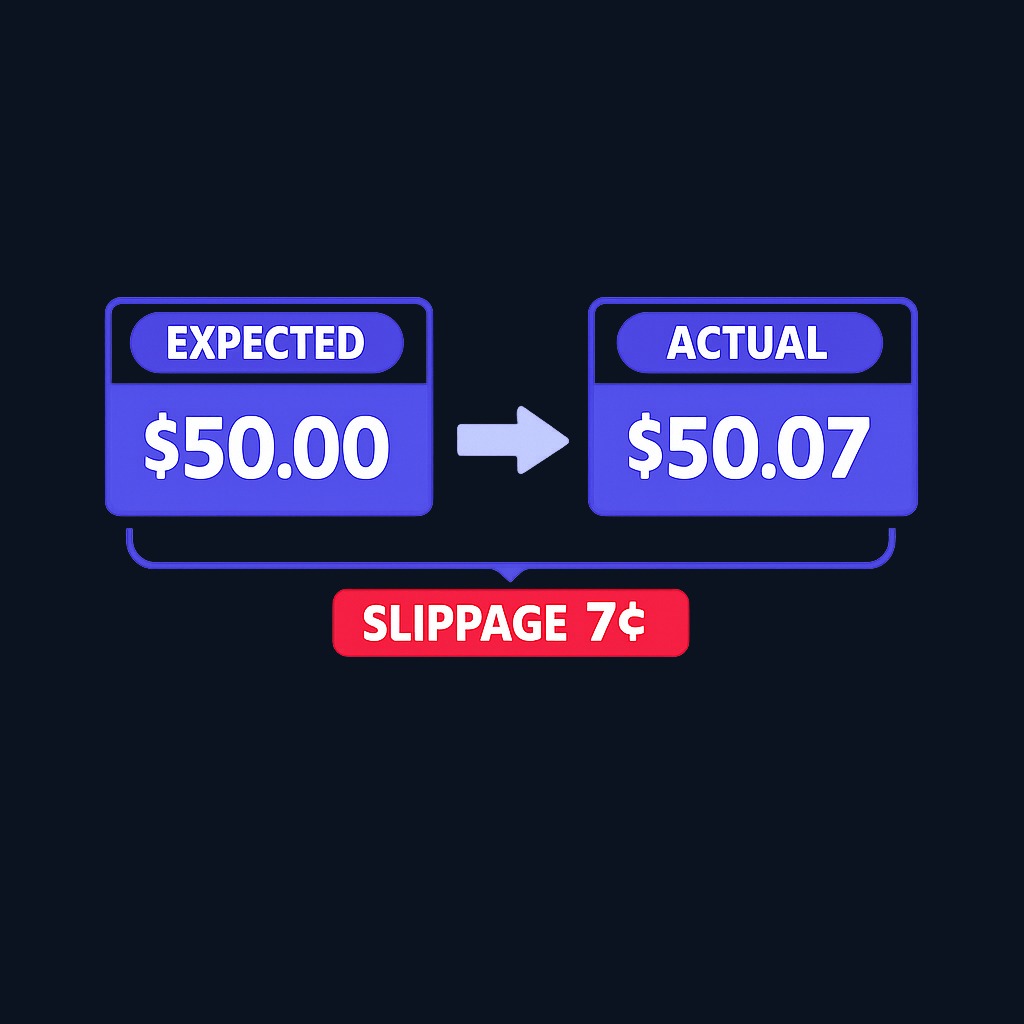
It is the gap between the price you expected and the price you got. You click buy at $50.00, the order fills at $50.07, and the 7 cents is slippage, caused by market movement and limited shares at the quoted price.
Is slippage always bad?
No. Positive slippage, filling at a better price than expected, does happen, particularly with brokers that offer price improvement. Across many trades, though, slippage typically nets out as a cost, so it is safer to manage it than to count on favorable fills.
Do limit orders prevent slippage?
They prevent price slippage: a limit order cannot fill worse than your stated price. The trade-off is execution risk, meaning the order may fill partially or not at all if the market never reaches your limit.
When is slippage the worst?
In fast markets and thin markets: around news releases and earnings, at the open and close, in after-hours sessions, and in low-volume stocks where the order book is shallow and spreads are wide. Large orders relative to volume amplify all of it.
slippagetradingyoumanage
Practice trading with Finelo
Practice in a simulator, learn with bite-sized lessons, and build confidence before risking real money.
About the author
Finelo Team
The Finelo Team creates practical investing and trading education designed to help beginners learn faster with structured challenges, simulator practice, and bite-sized lessons.
Keep reading — Related articles

Trading
Understanding Walk Forward Analysis in Trading
Brief educational note: this article is educational — not investment advice — and trading involves the risk of loss.
Finelo Team
Trading
VWAP vs Moving Average: Formulas, Uses, and Limits
VWAP weights price by recorded volume over a defined period, while a moving average summarizes a sequence of prices over a rolling lookback.
Finelo Team

Trading
Volume Profile vs Market Profile: What Each Chart Measures
Volume Profile groups traded volume by price level.
Finelo Team