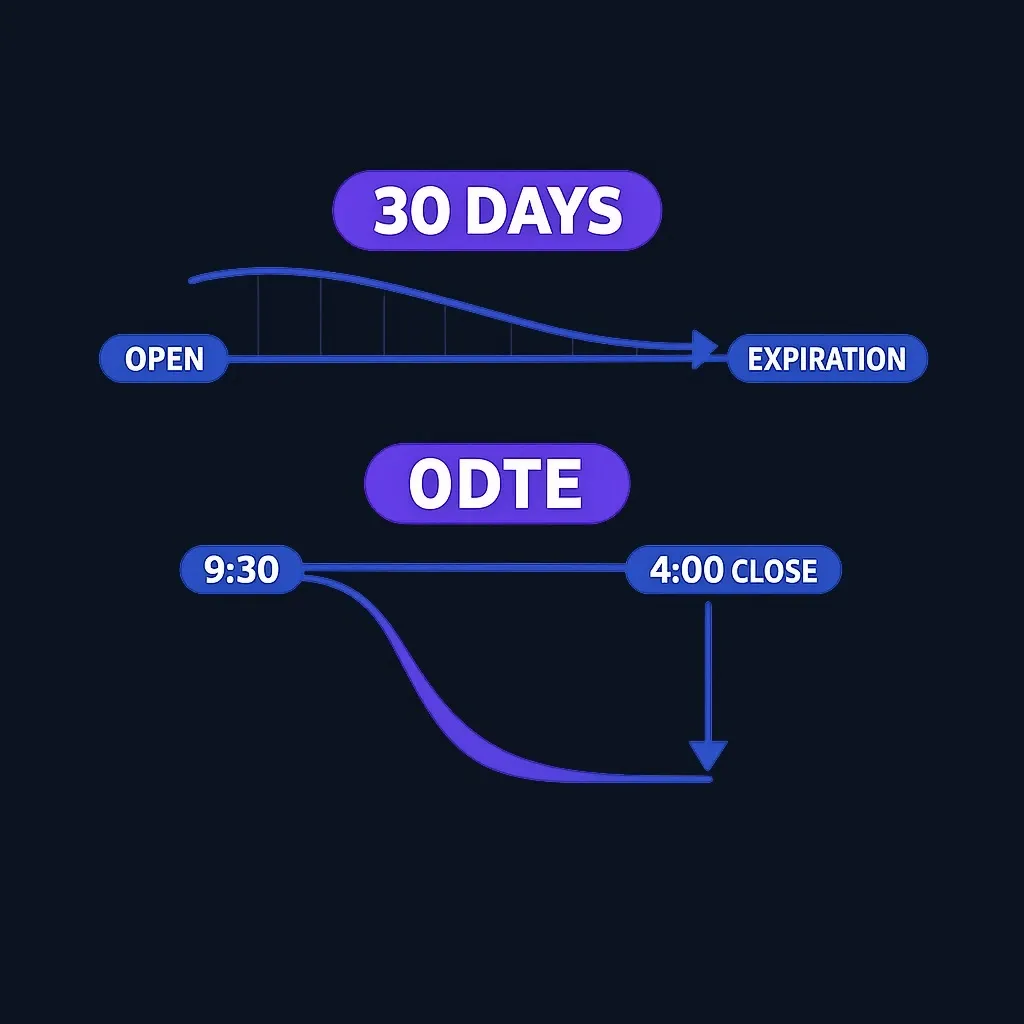
0DTE options, short for "zero days to expiration," are options contracts that expire at the end of the current trading day. Everything that normally unfolds over the weeks of an option's life is compressed into a few hours: the remaining time value drains to zero by the close, the price can swing violently on small moves in the market, and there is no next day to recover from a wrong call.
0DTE Options: Zero Days to Expiration Explained
0DTE options expire on the day they are traded. Learn how time decay, gamma, settlement, and assignment affect these contracts, including the possibility of losing an entire premium within hours.
9 min read
Practice trading with Finelo
Practice in a simulator, learn with bite-sized lessons, and build confidence before risking real money.
Want to learn more?
Practice in a simulator, learn with bite-sized lessons, and build confidence before risking real money.
Explore FineloExplore Finelo's 28-day challenges
Turn learning into a daily habit with guided challenge paths.
They grew after exchanges added expirations for every trading day. Cboe reported that 0DTE contracts represented 59% of SPX options volume during 2025 in its January 2026 industry review. Buyers can lose the entire premium within hours, while some short positions can lose much more than the premium received. These contracts require experience and close attention to expiration mechanics.
This guide explains what 0DTE options are, why they took over so much of the options market, how they behave on expiration day, and, most importantly, what can go wrong. It is written to help you understand the headlines, not to encourage you to trade them.
A 0DTE option compresses an option's entire remaining life, and every risk that comes with it, into a single trading session.
What "zero days to expiration" means
DTE stands for days to expiration, the time an options contract has left before it expires. A 45-DTE option expires in 45 days; a 0DTE option expires today, at the end of the current session.
There are two senses of the term, and both matter. Technically, every option becomes a 0DTE option on its final day, whether it was listed six months ago or last week. What changed is that traders no longer have to wait for that day to arrive: exchanges now list index and ETF options that expire every trading day, so there is always a fresh contract in its final hours.
"0DTE trading" means deliberately opening positions in these same-day contracts, buying or selling options whose entire remaining life is measured in hours rather than weeks. If calls, puts, and premium are still new to you, start with options trading for beginners before reading further here.
Why 0DTE options exploded
Cboe listed the first weekly S&P 500 (SPX) options in 2005, expiring on Fridays. Monday and Wednesday expirations arrived in 2016. Then, in 2022, Cboe added Tuesday and Thursday expirations, and from May of that year SPX had a contract expiring on every trading day of the week. Once every day was an expiration day, same-day trading stopped being a Friday-only event.
The growth since has been steep (figures move, so treat these as of 2026):
- Same-day contracts were a small corner of the market as recently as 2020, when they were roughly a sixth of SPX options volume.
- Cboe reported an average 2.3 million SPX 0DTE contracts per day in 2025, representing 59% of total SPX options volume. This is a dated annual statistic, not a fixed share for every trading day.
- Retail traders drove much of the surge, helped by commission-free brokers and mobile apps, and short-dated contracts now make up a large and growing share of the options they trade.
Short remaining maturity can make premiums appear inexpensive, and heavily traded contracts can have tight spreads. Neither is guaranteed, particularly around news or away from actively traded strikes. An option’s expiration also does not necessarily eliminate overnight exposure: exercise or assignment of a physically settled ETF option can create a stock position.
How they work: SPX vs SPY
Most 0DTE activity happens in S&P 500 products, but the two main vehicles work differently, and the difference matters most at expiration.
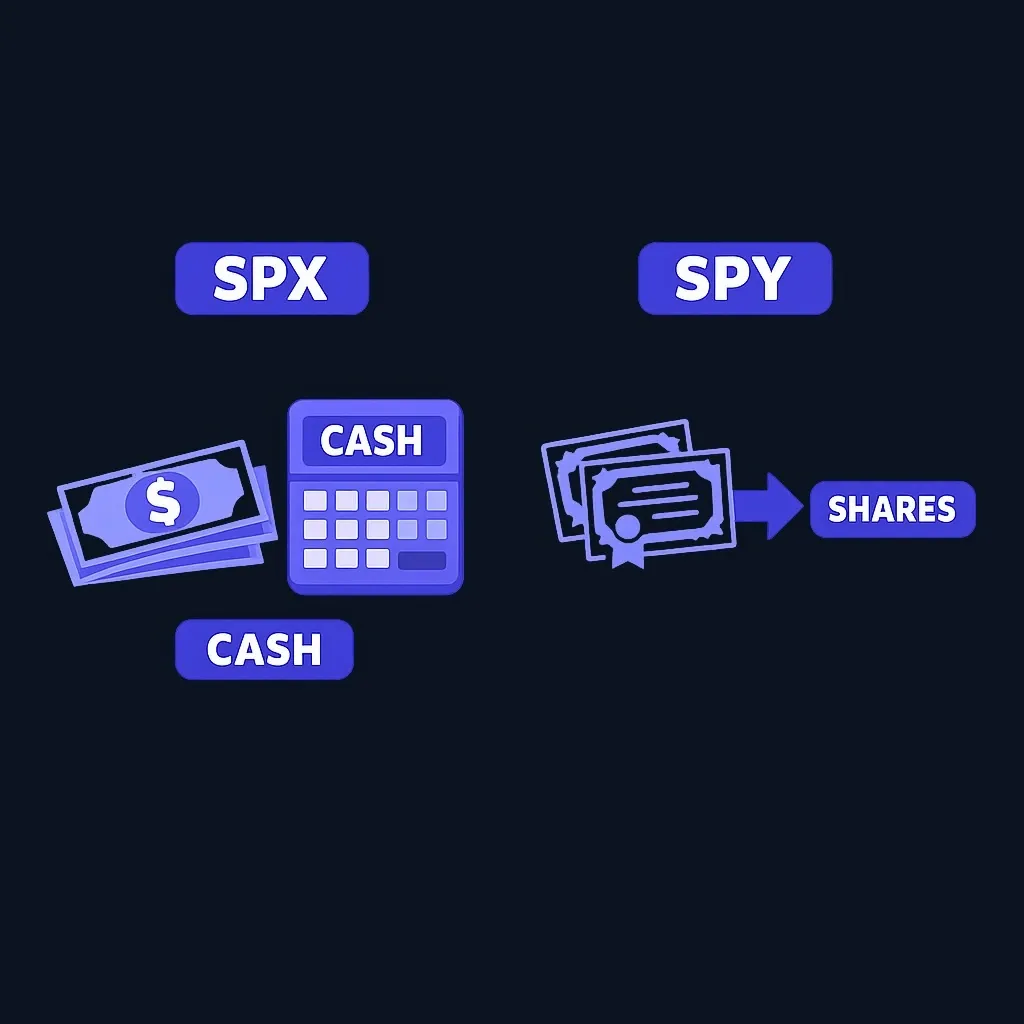
| SPX and XSP (index options) | SPY and QQQ (ETF options) | |
|---|---|---|
| Settlement | Cash: profit or loss settles in dollars | Physical: shares change hands |
| Exercise style | European: only at expiration | American: any time before expiration |
| Assignment risk for sellers | No early assignment or delivery of shares; cash settlement obligations remain | Real: sellers can be assigned shares |
| Contract size | SPX is about 10x SPY; XSP is about SPY-sized | Standard 100-share contracts |
European-style SPX and XSP options settle in cash without delivery of shares. Settlement timing varies by series: standard SPX contracts can be AM-settled, while SPXW weekly expirations are generally PM-settled. American-style ETF options can create stock positions through exercise or assignment. Broker deadlines and post-close price changes matter, so the closing quote alone may not determine a trader’s final exposure.
The Greeks on expiration day
If you know the option Greeks, 0DTE is those Greeks at maximum intensity.
Theta estimates the effect of time passing while other inputs are held constant. Near expiration, remaining time value can erode quickly, especially near the money, but there is no universal intraday decay curve. Changes in the underlying price and implied volatility can overwhelm the isolated time effect.
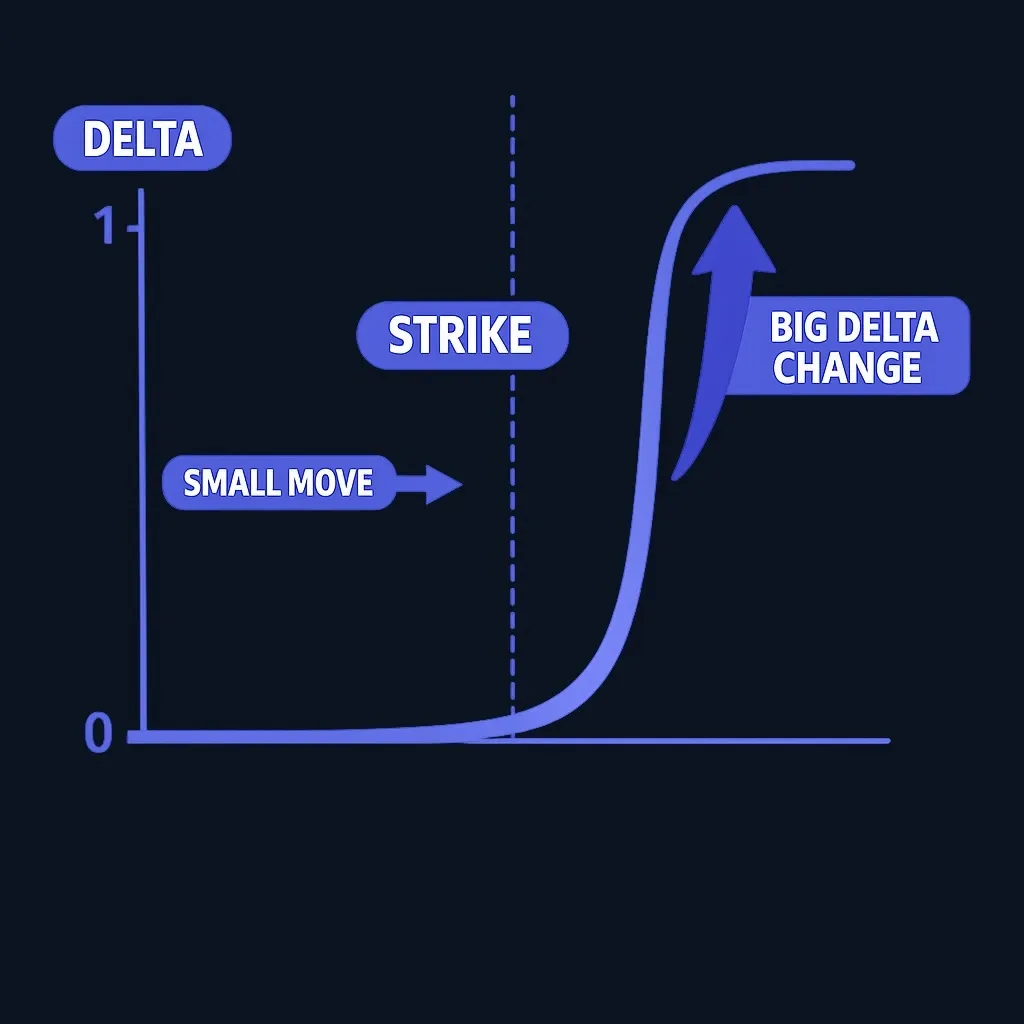
Gamma, which measures how fast an option's directional exposure changes, is at its most extreme. Near the strike on expiration day, an option's delta can snap between almost zero and almost one on a small move in the underlying.
In practice, a modest index move can swing an option's price by a large percentage within minutes. The same gamma that produces a sudden windfall produces a sudden wipeout, and on expiration day it is dialed to maximum. That is what makes 0DTE feel like a lottery ticket to buyers and a minefield to sellers.
Scheduled events magnify all of it. Fed announcements, inflation releases, and major earnings land hard in a market where every contract expires the same evening, inflating premiums beforehand and collapsing or exploding them afterward.
Who trades 0DTE, and why
This is descriptive, not an endorsement. Event traders take short-term directional positions around scheduled news, accepting the possibility of a full premium loss. Premium sellers sell 0DTE spreads and iron condors to collect the day's rapid decay, betting the index stays within a range. Hedgers, including institutions, buy same-day protection around specific events and treat the premium as a one-day insurance cost. The common thread is that every one of these participants is making a same-day, high-precision bet, usually while watching the market full-time. That is the honest job description, and it looks nothing like beginner investing.
Practice trading with Finelo
Practice in a simulator, learn with bite-sized lessons, and build confidence before risking real money.
The risks: read this section twice
For a 0DTE buyer, loss of the entire premium is possible. An option that remains out of the money at expiration normally expires worthless. Being right about direction is insufficient if the move is too small or too late. Do not infer a universal loss rate from this payoff structure: results differ by strike, premium, exit timing, strategy, and costs.
Consider one illustrative example, close to a scenario FINRA itself walks through: you pay $2,000 for 0DTE call options, betting the index closes above your strike. If it finishes even slightly below, the calls expire worthless and the full $2,000 is gone at the bell. Cheap premiums also tempt bigger positions, and repeated small total losses add up fast.
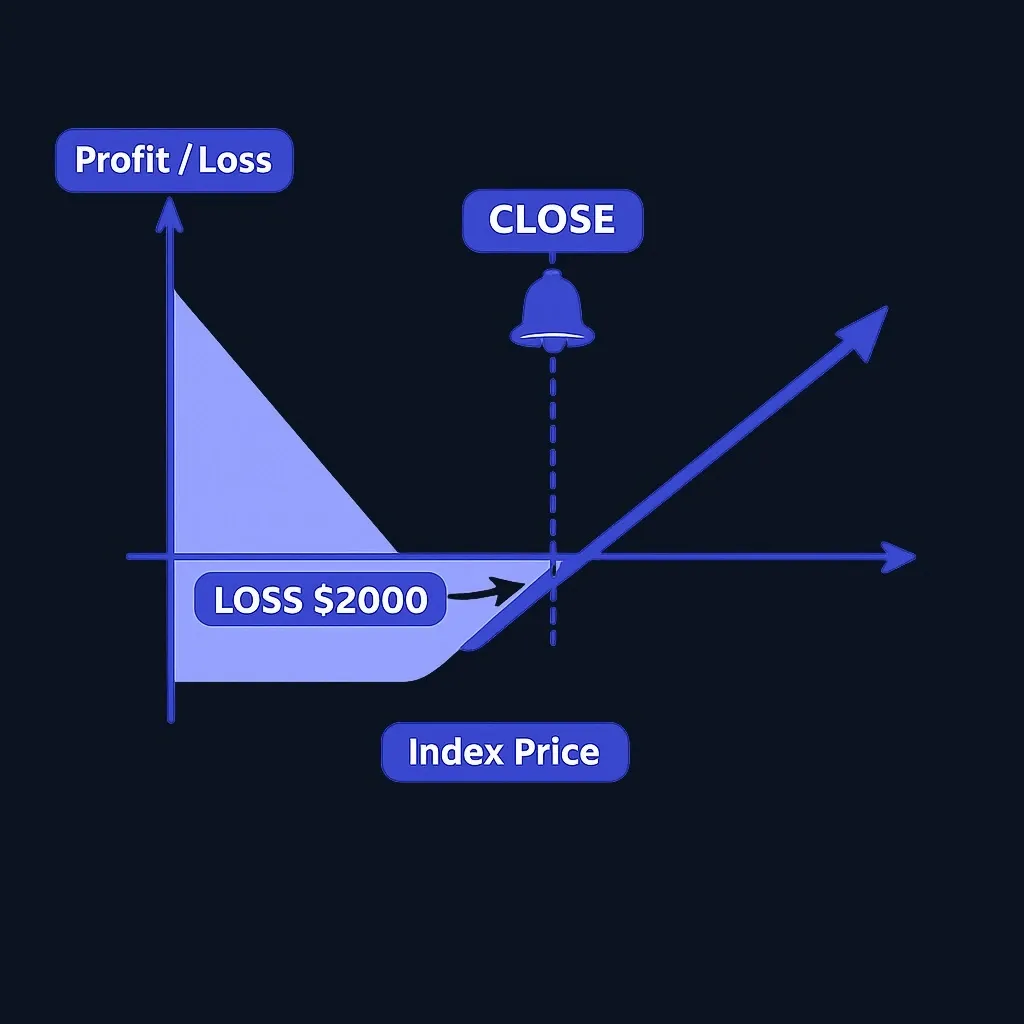
Sellers face a different risk profile. Expiration-day gamma can quickly turn a manageable position into a large loss. An uncovered short call has theoretically unlimited upside loss; an uncovered short put has substantial but bounded downside loss if the underlying falls to zero. Defined-risk spreads have different limits, although exercise, assignment, and execution can complicate their realized outcome.
On the ETF side, in-the-money short options can be assigned, turning an options trade into an unwanted overnight share position, and pin risk makes the final minutes near the strike genuinely unpredictable.
At the account level, FINRA warns that a firm may liquidate an expiring position before the close, which can limit a profit or lock in a loss at a moment you did not choose, and that intraday margin requirements can apply. Trading 0DTE requires options approval from your broker, and firms differ in what they permit. This is not fine print; it is the actual experience of trading these contracts, which is why any serious discussion of risk management around 0DTE sounds so severe.
What regulators and research say
FINRA has published an investor insight specifically on 0DTE, laying out loss scenarios in plain terms and reminding investors that options trading requires firm approval and a reading of the official options disclosure document. Cboe, which lists the products, describes near-the-money 0DTE contracts as extremely sensitive and frames them as suitable only for sophisticated market participants.
Schwab’s education describes 0DTE as a high-risk approach requiring experience and active monitoring. Profitability depends on strategy, execution, costs, and the sample studied; neither the possibility of a large gain nor a claim about average trader results makes a specific position suitable for a beginner.
Who should not trade 0DTE options
Beginners, first and above all. This page exists so you can understand what you keep seeing in the headlines, not so you can join the people posting them. Beyond beginners: anyone who cannot watch positions continuously through the trading day, anyone who would be genuinely hurt by losing the full amount at stake in a single afternoon, and anyone drawn in by screenshots of overnight riches, because for every posted windfall there is a silent stack of tickets that expired worthless. Understanding 0DTE is worth your time; trading it is a different decision entirely, and a far riskier one.
Practice before you go near real money
Begin with contract specifications and paper examples. Track how the underlying price, remaining time, and implied volatility affect a hypothetical position, and record the exercise and settlement rules separately. Finelo offers financial education and practice with virtual funds; do not assume a general simulator reproduces live 0DTE execution, margin, or assignment mechanics.
Where to learn more
The durable skill is understanding options well enough to see through the hype, which comes from fundamentals. Build the base in order: the option Greeks, theta decay, and what happens to options at expiration, with risk management alongside them. You can also learn more about Finelo, read Finelo reviews, see the About Finelo page, or visit the Finelo support center.
Educational note: This article is for educational purposes only and does not constitute financial, investment, legal, or tax advice. Finelo is an educational product, not a brokerage or adviser. Simulator practice uses virtual funds. Investing and trading involve risk, including possible loss of principal; verify account-specific requirements with your broker.
Sources and Further Verification
Frequently asked questions
Are 0DTE options profitable?
Some trades are profitable and others lose the full premium or more. There is no universal win rate: the strategy, strike, price paid, exit timing, and costs all matter. An option finishing out of the money normally expires worthless. Treat 0DTE as high-risk speculation, not reliable income.
Are 0DTE options good for beginners?
No. Brokers, FINRA, and Cboe all frame 0DTE as an instrument for experienced traders. The speed, the gamma sensitivity, and how often positions go to a total loss leave no room for the learning curve a beginner needs. Learn the mechanics here, then practice in a simulator rather than with real money.
What is the difference between SPX and SPY 0DTE options?
SPX and its mini-sized cousin XSP are cash-settled and European-style, so they settle in dollars at expiration with no shares assigned. SPY options are American-style and physically settled, so an in-the-money short can be assigned actual shares, adding assignment and pin risk on top of ordinary price risk.
What happens to a 0DTE option at the close?
The result depends on the contract’s settlement and exercise rules. Cash-settled index contracts use their specified settlement value; ETF options can result in a stock position. Exercise deadlines, after-hours moves, and broker procedures can matter after the closing bell. Check the exact series instead of assuming every option ends the same way.
Why do people trade 0DTE options at all?
Traders may seek short-term exposure, event hedges, or a position with a small initial premium. Liquidity and spreads vary. Expiration can still leave settlement obligations or an overnight stock position after exercise or assignment, and the possibility of a large same-day loss remains.
0DTE OptionsTradingBeginner
Practice trading with Finelo
Practice in a simulator, learn with bite-sized lessons, and build confidence before risking real money.
About the author
Finelo Team
The Finelo Team creates practical investing and trading education designed to help beginners learn faster with structured challenges, simulator practice, and bite-sized lessons.
Keep reading — Related articles

Trading
Understanding Walk Forward Analysis in Trading
Brief educational note: this article is educational — not investment advice — and trading involves the risk of loss.
Finelo Team
Trading
VWAP vs Moving Average: Formulas, Uses, and Limits
VWAP weights price by recorded volume over a defined period, while a moving average summarizes a sequence of prices over a rolling lookback.
Finelo Team

Trading
Volume Profile vs Market Profile: What Each Chart Measures
Volume Profile groups traded volume by price level.
Finelo Team