On the same day South Korea's stock market was halted mid-crash and chip stocks sold off from Seoul to Amsterdam, one giant went the other way. On Tuesday, Apple briefly touched a $5 trillion market value — only the second company in history to reach the milestone, after Nvidia crossed it in October 2025.
Apple Market Cap Hits $5 Trillion: How It Happened and What It Means for Investors
Apple briefly touched a $5 trillion market value during an AI chip selloff — only the second company ever to reach the milestone. Here's why money rotated into the toll collector.
4 min read
Practice trading with Finelo
Practice in a simulator, learn with bite-sized lessons, and build confidence before risking real money.
Want to learn more?
Practice in a simulator, learn with bite-sized lessons, and build confidence before risking real money.
Explore FineloExplore Finelo's 28-day challenges
Turn learning into a daily habit with guided challenge paths.
The timing is the story. In the middle of the worst AI-driven selloff in months, investors fleeing chipmakers didn't leave tech — many of them hid inside its biggest, calmest name.
This article is for information and education only and is not financial advice.
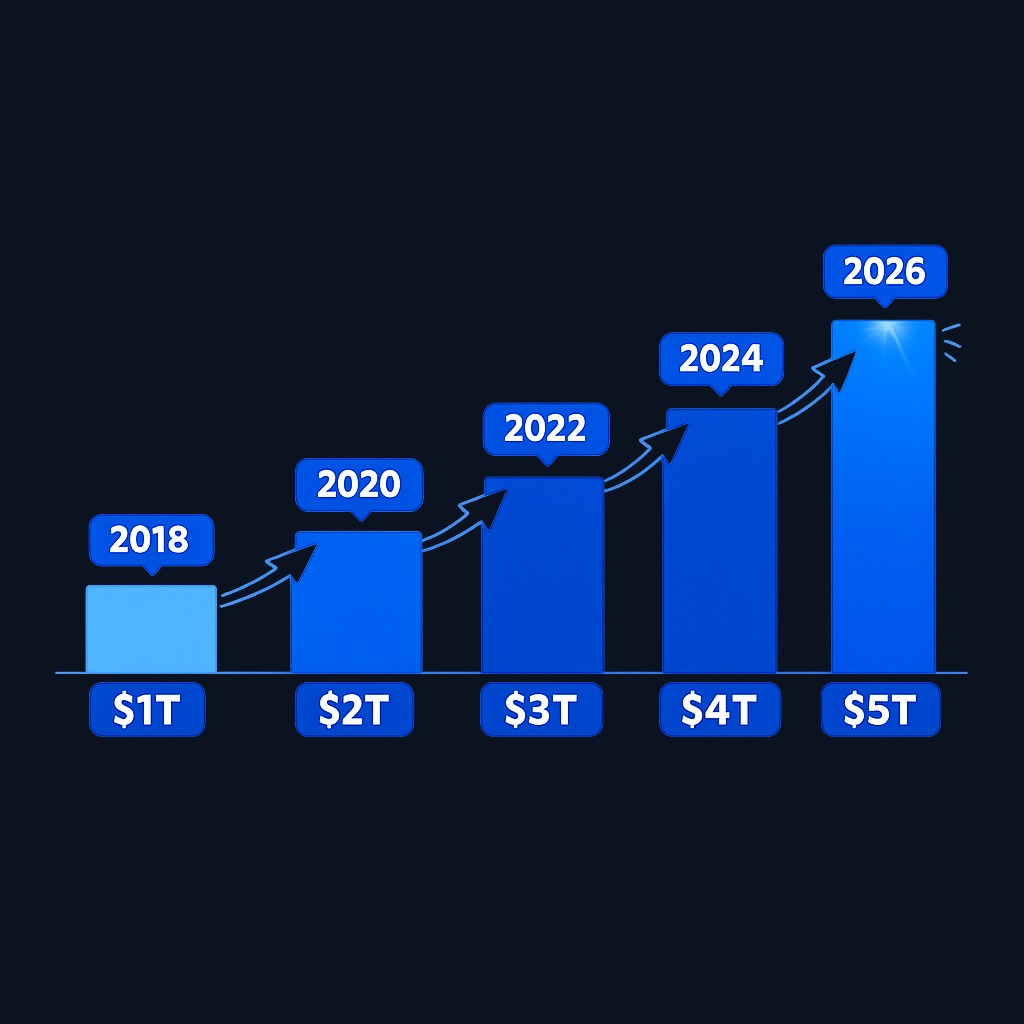
From $1 trillion to $5 trillion in eight years
Apple became the world's first trillion-dollar company in 2018. Five-fold growth in roughly eight years is remarkable for any business — staggering for one already the largest on Earth for much of that period. The milestone also lands at a symbolic moment for the company: a long-planned leadership transition takes effect September 1, and quarterly earnings arrive July 30 — which will test whether the $5 trillion price sticks or proves a brief touch.
Why Apple rises while chip stocks fall
The chip selloff is driven by two fears: that the AI buildout's spending is outrunning its financing, and that Chinese competition will erode future profits. Notice what both have in common — they punish companies whose valuations depend on massive capital outlays paying off years from now.
Apple is the mirror image. It spends comparatively little on AI infrastructure, buys rather than builds much of its AI capability, and monetizes the one asset the AI boom can't route around: more than a billion devices in people's pockets. Whoever wins the AI model wars, they'll likely pay to reach users through the screen Apple owns. Add the world's largest share-buyback program steadily shrinking the share count, and you get a stock investors treat as tech's bomb shelter — up on Monday and Tuesday while Nvidia fell 5% and the Nasdaq slid.
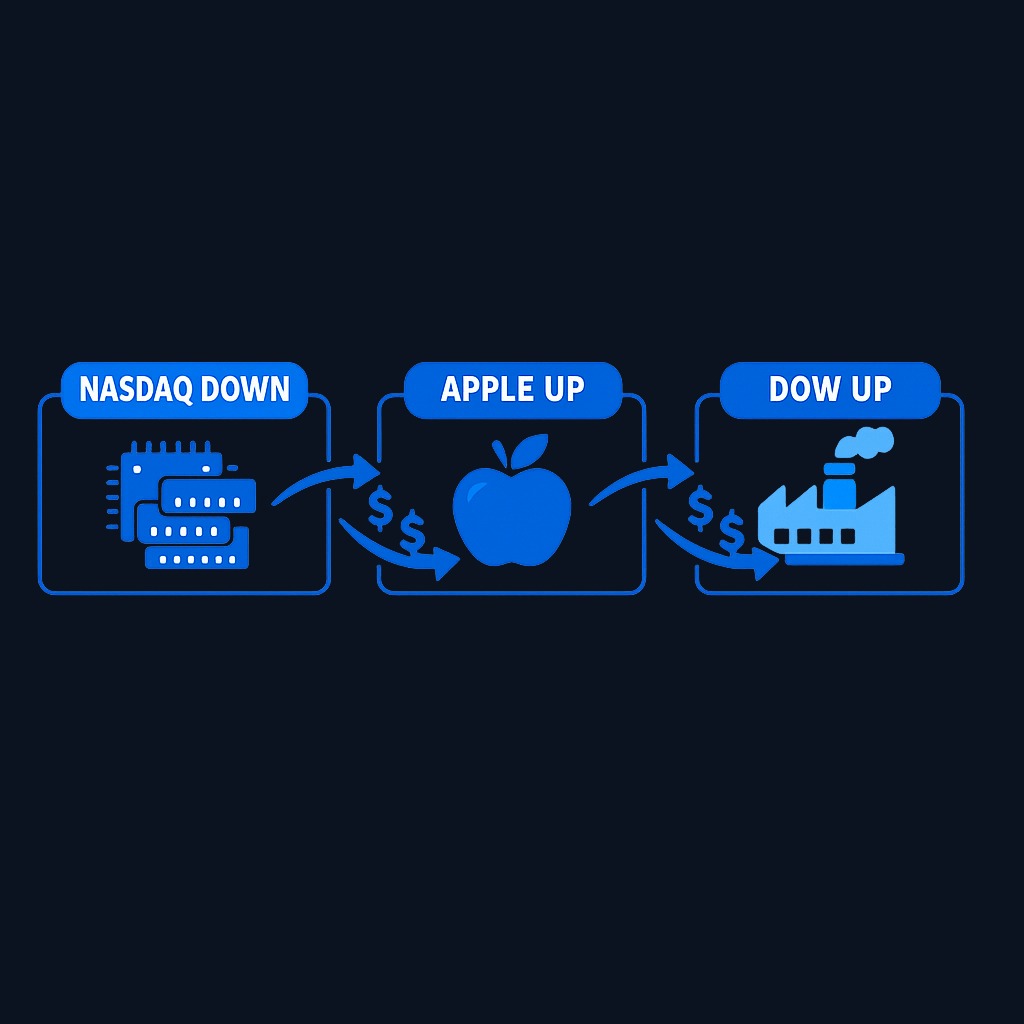
There's a name for this pattern. Within every boom, money rotates between the builders (who spend), the suppliers (who sell them equipment), and the toll collectors (who own distribution). This week repriced the builders and suppliers. The toll collector hit $5 trillion.

Practice trading with Finelo
Practice in a simulator, learn with bite-sized lessons, and build confidence before risking real money.
A milestone with an asterisk
Two honest cautions. First, "briefly touched" is doing real work — Apple crossed the line intraday and closed below it; milestones like this often take several attempts to hold. Second, $5 trillion is a price, not a verdict: Nvidia reached it first while being the AI trade, and Apple reached it while avoiding the AI trade's risks. The market rewarding both strategies within nine months tells you how much uncertainty is still being priced about how the AI era actually plays out.
Why this matters to YOU
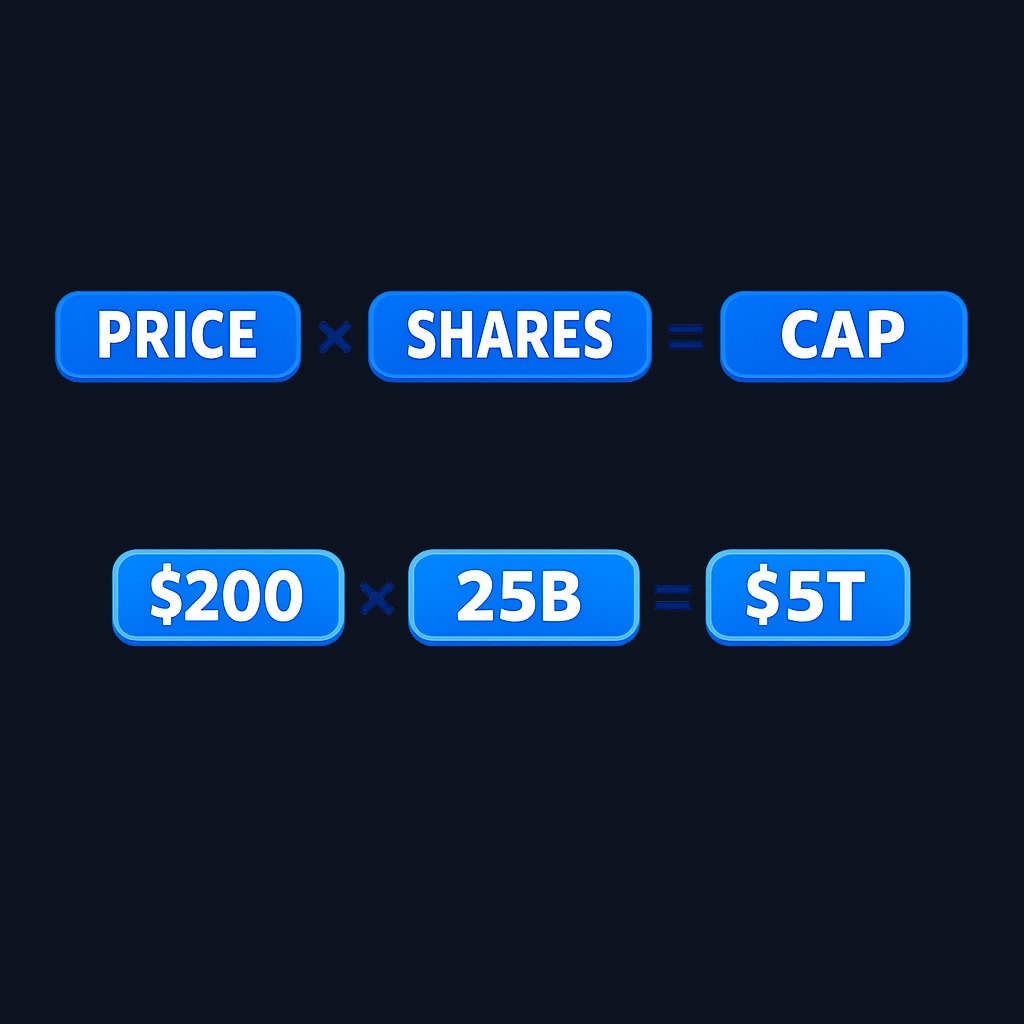
Market cap is just price × shares — a $5T label doesn't make a stock "expensive" or "cheap" by itself. What matters is what you pay per dollar of profit, and what those profits do next.
Rotation, not exit. This week's money didn't leave the market — it moved from risky tech to safe tech to old-economy names (the Dow rose while the Nasdaq fell). Understanding rotation explains market days that otherwise look contradictory.
Concentration cuts both ways. Apple and Nvidia together are a huge slice of every S&P 500 index fund. Their milestones are your milestones — and their stumbles are your stumbles. Know what you own.
Apple reports earnings Thursday July 30 — a day after the Fed decision and Meta's report. By Friday, we'll know whether tech's bomb shelter held. For the crash context that framed this week's rotation, see Kospi Index Drops 6%: Why South Korea's Stock Market Paused Trading Again.
Finelo does not provide investment advice. This article is for informational and educational purposes only.
Sources: CNBC — Apple touches $5 trillion, Bloomberg — second company to reach milestone, 9to5Mac — milestone details
Frequently asked questions
Did Apple really hit a $5 trillion market cap?
Yes — briefly. On Tuesday Apple touched $5 trillion intraday, becoming only the second company in history to reach the milestone after Nvidia in October 2025. It closed below the line, so "briefly touched" matters.
Why did Apple rise while chip stocks fell?
The chip selloff punished companies whose valuations depend on huge AI spending paying off years later. Apple spends comparatively little on AI infrastructure, monetizes a huge installed base of devices, and is often treated as tech's bomb shelter during rotation.
Does a $5 trillion market cap mean Apple is expensive?
Not by itself. Market cap is price × shares. What matters for valuation is what you pay per dollar of profit and what those profits do next — plus how concentrated your index funds are in mega-cap tech.
Applemarket caprotationAI selloffinvestingconcentration
Practice trading with Finelo
Practice in a simulator, learn with bite-sized lessons, and build confidence before risking real money.
About the author
Finelo Team
The Finelo Team creates practical investing and trading education designed to help beginners learn faster with structured challenges, simulator practice, and bite-sized lessons.
Keep reading — Related articles

News
U.S. Gas Prices Reach $4.46: What the Increase Means for Inflation and Household Costs
The EIA's U.S. all-grades gasoline average reached $4.455 per gallon. See what changed, why regions differ and how fuel prices affect inflation.
Finelo Team
News
China Sets a Stronger Yuan Fix at 6.7521: What It Means for USD/CNY
China set its September 18 yuan reference rate at 6.7521 per dollar. Learn how the official fixing differs from market rates and why the move matters.
Finelo Team
News
BOJ Raises Its Policy Rate to 1.25%: What the Decision Means for the Yen
The BOJ raised its overnight policy-rate target to around 1.25%. Learn why the yen can still weaken after a rate increase and what the decision says.
Finelo Team