Last editorial review: September 28, 2026
Enrolled agent vs. CPA: who fits your tax needs?
Compare tax credentials, IRS representation, experience, and scope of work to choose the right kind of help for your return.
8 min read
Practice trading with Finelo
Practice in a simulator, learn with bite-sized lessons, and build confidence before risking real money.
Want to learn more?
Practice in a simulator, learn with bite-sized lessons, and build confidence before risking real money.
Explore FineloExplore Finelo's 28-day challenges
Turn learning into a daily habit with guided challenge paths.
An enrolled agent, or EA, specializes in federal tax matters and is credentialed by the IRS. A certified public accountant, or CPA, holds a state-issued accounting license and may offer tax, accounting, or other services. Both can represent taxpayers before the IRS when their credentials are current.
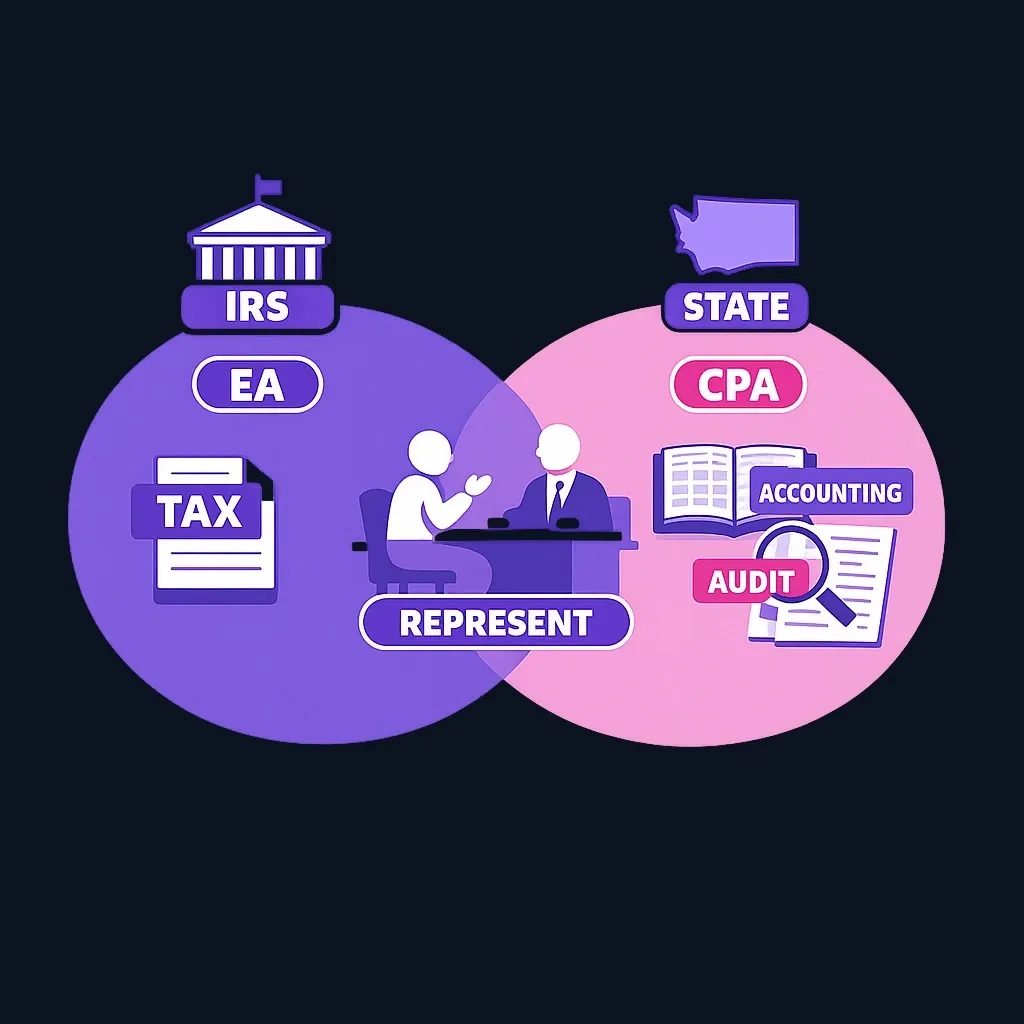
The best fit depends on the work you need and the professional's experience, not just the letters after their name.
Compare the scope
| Question | Enrolled agent | CPA |
|---|---|---|
| Credential authority | IRS | State accountancy board |
| Typical focus | Tax preparation, planning, and representation | Accounting services that may include tax |
| IRS representation | Broad representation rights | Broad representation rights |
| Experience to verify | Your particular tax issue | Your particular tax or accounting issue |
The IRS credential guide explains representation rights. The IRS EA overview explains the EA credential and continuing requirements.
Ask about the problem you actually have
A straightforward individual return calls for different experience from a multistate business, foreign income, or an IRS collection dispute. Some CPAs do little tax work; some EAs have extensive experience with complex tax cases.
If you also need financial statements or regulated audit and attest services, ask a CPA firm what it is licensed and equipped to provide. An EA credential alone does not authorize those accounting services.
Compare engagement terms
Request a written description of the work, fees, expected turnaround, and who will answer follow-up questions. Ask whether notice responses or audit representation are included or separately billed.
Verify credentials through the appropriate authority and confirm who will sign the return. A tax preparer should explain the return and let you review it before filing.
For a hypothetical freelancer with ordinary business expenses, relevant small-business tax experience may matter more than choosing EA or CPA in the abstract. For a business needing both tax work and audited statements, the scope of services becomes a larger part of the decision.
Match the engagement to the professional's actual experience
Describe the work before comparing credentials. Preparing a straightforward individual return, resolving an IRS notice, coordinating a multistate business return, and auditing financial statements are different engagements. A professional's license establishes qualifications and permitted scope, but it does not show how often they handle your particular problem.
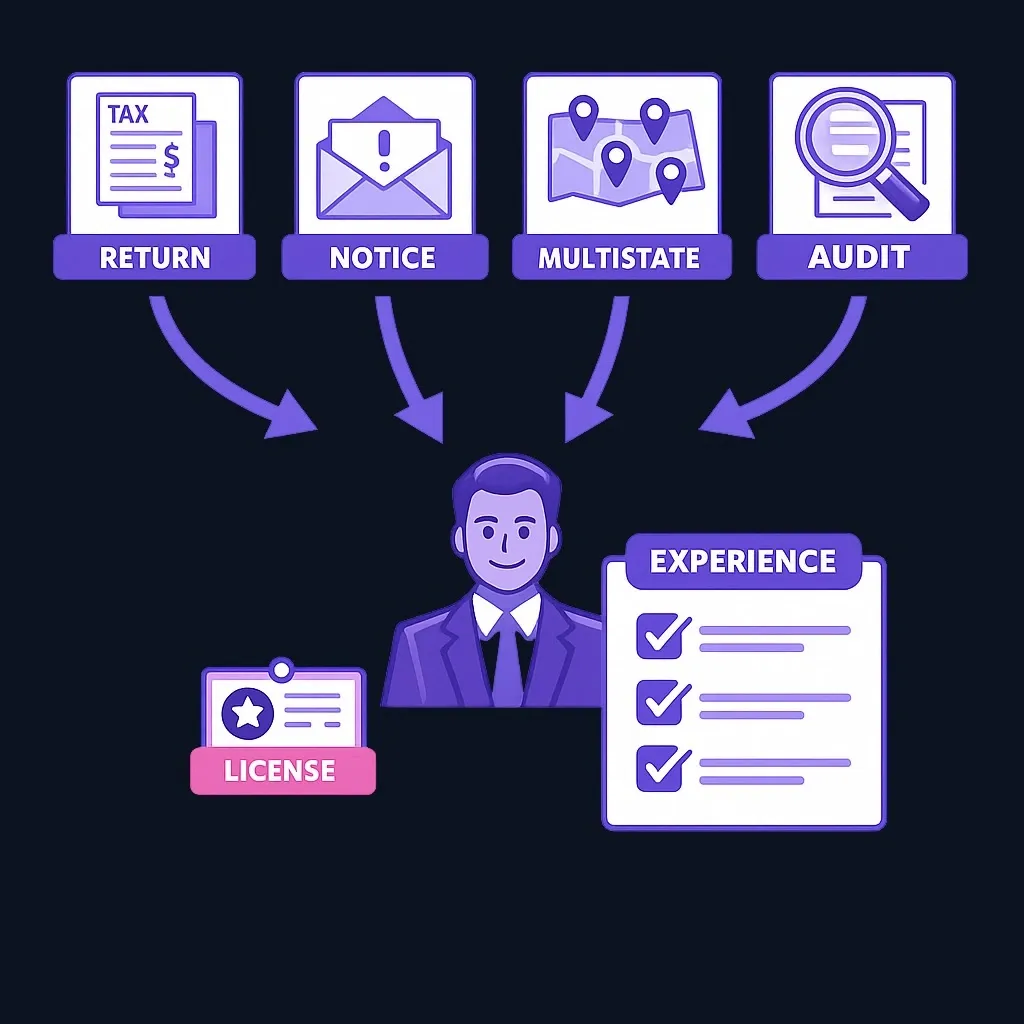
For a tax notice, ask about experience with that notice type and the stage of the case. Is the work a written response, an amended return, a collection alternative, or representation during an examination? For an ongoing business relationship, ask whether bookkeeping, payroll, tax preparation, and planning are included or separately billed.
Request an engagement letter that identifies the work, expected fees, responsibilities, and communication arrangements. Clarify who will actually prepare the return and who will review it. A large firm's brand and the credentials of one partner do not tell you who will handle routine questions or an urgent deadline.
Compare fees without rewarding an unrealistic promise
A low initial quote can become expensive if the scope is unclear. Ask how additional schedules, late records, amended filings, or notice responses are charged. For hourly work, request an estimate and an explanation of what could change it. For a fixed fee, identify what is excluded.
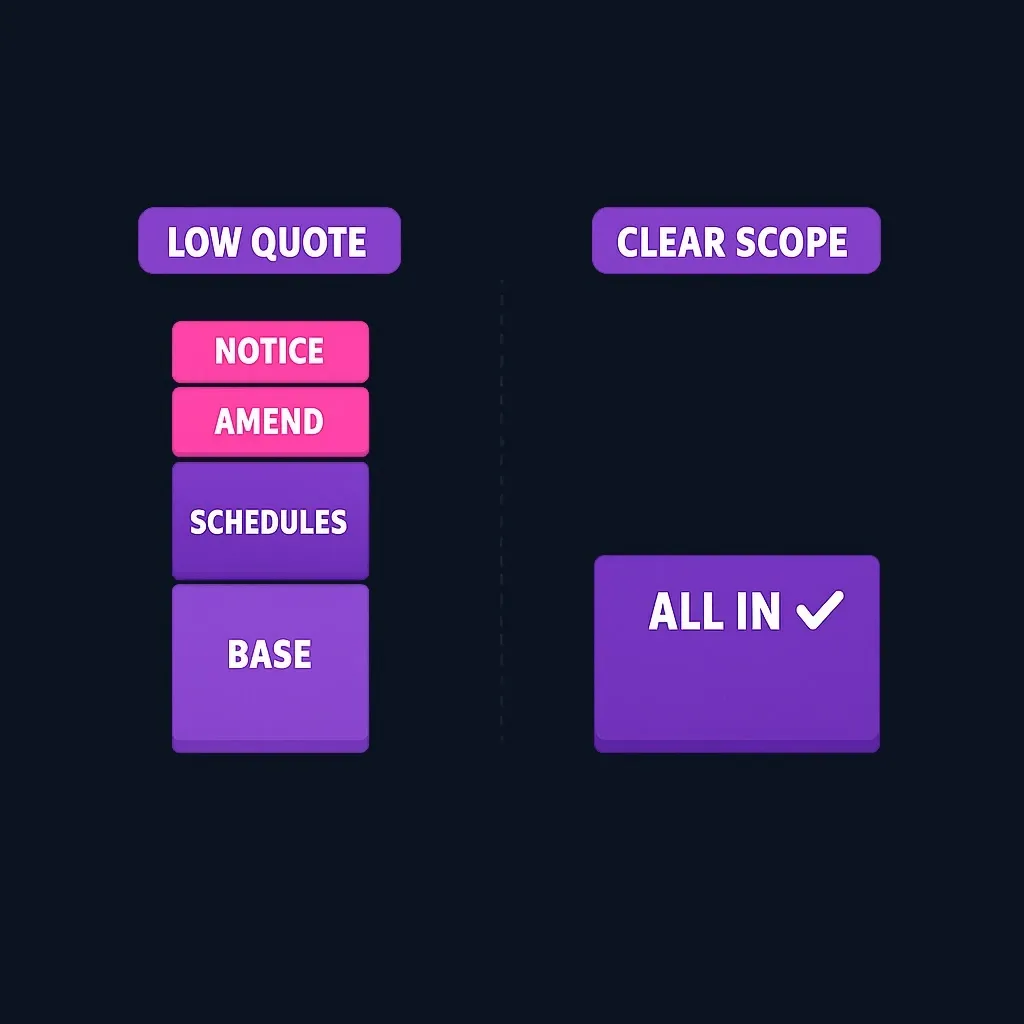
Be cautious about promises of a particular refund or guaranteed settlement before the preparer has reviewed the records. A good comparison centers on competent work and clear reasoning. You remain responsible for reviewing a return before signing, including the income, deductions, payment information, and bank details.
Bring organized prior returns, notices, and supporting records to the initial discussion. Explain known missing documents or disputed amounts rather than hiding them to get a cheaper quote. Clear information helps the professional assess whether they can handle the engagement and what needs to happen first.
Practice trading with Finelo
Practice in a simulator, learn with bite-sized lessons, and build confidence before risking real money.
What is an Enrolled Agent?
An Enrolled Agent is a tax practitioner federally authorized to represent taxpayers before the IRS. The IRS states that an enrolled agent earns that privilege either by passing a comprehensive, three-part IRS examination covering individual and business tax matters, or by qualifying through experience as a former IRS employee. Concrete example: if the IRS opens an audit on your individual or business return, an EA can speak and negotiate with IRS examiners on your behalf because the EA credential explicitly grants representation privileges. Caveat: the EA credential is specialized to federal tax work; state-level permissions or non-tax accounting tasks are outside that credential’s defining authority.
What is a Certified Public Accountant (CPA)?
A Certified Public Accountant (CPA) is a licensed accounting professional regulated at the state level; states set the education, examination, and experience requirements that lead to licensure. Check the issuing board for current status and authorized services.
Concrete example: businesses commonly turn to CPAs for bookkeeping reconciliation, tax preparation, and broader financial reporting tasks. Caveat: CPA rules, permitted services, and mobility between states vary because licensure is state-based. Confirm a CPA’s active license and standing with the issuing state board when geographic scope matters.
How to compare your options
Checklist (apply in order):
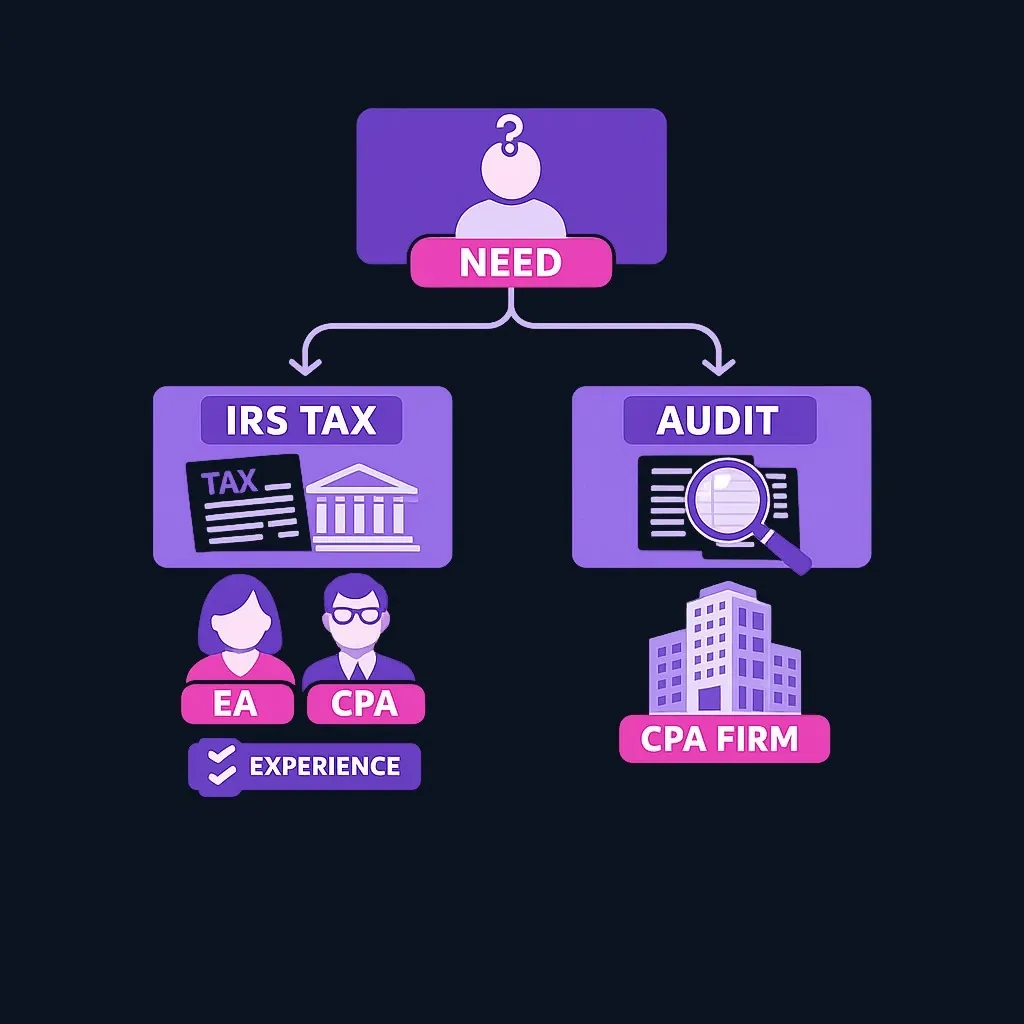
- Primary need: Is it IRS representation or a broader accounting engagement? (If IRS-focused, EA is designed for that.)
- Complexity: Does your situation involve audits, back taxes, collections, or appeals with the IRS? EAs specialize in those federal tax processes.
- State-level or attest needs: Do you need audited financial statements, state-only licensing, or services that require a state CPA license? If so, a CPA’s state-regulated credentials matter.
- Cost and scope: If you only need tax filing and representation, an EA often delivers specialized tax help. For integrated accounting and advisory across taxes and financial reporting, a CPA may be more appropriate. Worked example: A sole proprietor with a missed estimated-payment issue and an IRS collection notice — an EA can handle negotiation and representation with the IRS. A small company preparing financial statements for investors or a loan — a CPA whose practice includes the required accounting or assurance services may be appropriate. Concrete caveat: Always verify the practitioner’s active credential and standing with the issuing authority before engaging them.
When to choose an Enrolled Agent
Choose an EA when your core need is federal tax help, representation, or negotiation with the IRS. The IRS explicitly authorizes EAs to represent taxpayers before the agency after passing the three-part exam or qualifying via IRS experience. Practical scenario: If you receive an IRS audit notice, wage-garnishment threat, or are negotiating an Offer in Compromise, an EA’s certification is directly aligned with those federal tax interactions. If you also need regulated audit or attest services, identify a properly licensed CPA firm for that work. Business valuation is a separate specialty; neither title alone establishes valuation expertise.
When to choose a CPA
Consider a CPA when you need broader accounting services, state-regulated attest work, or integrated tax and financial reporting advice. CPAs are state-licensed accounting professionals whose practice parameters are set by state boards; they are commonly engaged for financial statement preparation, tax strategy plus accounting, and business advisory tasks.
Practical scenario: A small business seeking audited financial statements for lenders, or wanting ongoing CFO-level financial advice plus tax filing, typically hires a CPA. Caveat: confirm the CPA is authorized to provide the requested services in the relevant state and that the CPA offers the specific services (audit, compilation, advisory) you require.
Tradeoffs and caveats
- Specialization vs breadth: EA qualification centers on federal tax matters and IRS practice, although an EA may also handle state tax returns; CPA qualification covers broader accounting subjects but are governed by state licensure rules. Consider the credential that aligns with the dominant task.
- Verify credentials: For EAs, confirm enrollment with IRS resources; for CPAs, check the issuing state board. Always check active status and disciplinary history before hiring.
- Cost expectations: Pricing varies widely by complexity, geography, and practitioner experience. Avoid assuming one credential is always cheaper; compare hourly or flat fees directly with shortlisted practitioners.
- Scope gaps: Neither credential guarantees suitability for every problem — e.g. for legal tax disputes that also require courtroom or state-law expertise, a tax attorney may be necessary. When in doubt, ask the practitioner whether they will handle the entire engagement or partner with other specialists.
What is an Enrolled Agent?
An Enrolled Agent is a tax practitioner authorized by the IRS to represent taxpayers; the credential is earned by passing a three-part IRS test or through qualifying IRS employment.
What is a Certified Public Accountant (CPA)?
A CPA is a state-licensed accounting professional. State boards set the exam, education, and experience requirements that govern CPA licensure and practice. Confirm the license through the issuing board.
Can EAs and CPAs represent me before the IRS?
Both EAs and CPAs with current qualifying credentials have unlimited representation rights before the IRS, including examinations, collection matters, and appeals. Verify current standing and relevant experience; state licensing does not make a CPA’s federal IRS representation rights narrower than an EA’s.
How should I choose between an EA and a CPA?
Decide by primary need: consider the relevant experience of either credential for federal tax representation; consider a CPA with the necessary specialty if you also need accounting or assurance services, audited financials, or integrated tax and financial reporting across state-regulated contexts. Use the checklist in Decision criteria to validate fit and always verify credentials before hiring.
If you are seeking help with a filed return, start with Should you amend a tax return for a small amount.
This guide covers U.S. rules. Finelo provides financial education, not personalized financial, investment, tax, or legal advice.
Financial LiteracyU.S. GuideFinancial Education
Practice trading with Finelo
Practice in a simulator, learn with bite-sized lessons, and build confidence before risking real money.
About the author
Finelo Team
The Finelo Team creates practical investing and trading education designed to help beginners learn faster with structured challenges, simulator practice, and bite-sized lessons.
Keep reading — Related articles

Financial Literacy
USDA vs. FHA loan
Compare location and income eligibility, down payments, credit conditions, and upfront and annual program charges for a home purchase.
Finelo Team

Financial Literacy
Term life vs. accidental death insurance
Compare broad term-life protection with accident-only coverage, including exclusions, underwriting, and the family income gap.
Finelo Team

Financial Literacy
Term life insurance laddering vs. one policy
Compare several term policies ending at different times with one policy, using coverage needs, costs, and future insurability.
Finelo Team