Last editorial review: September 8, 2026
Inherited IRA Rules: Withdrawal Timelines, Taxes, and Beneficiary Options
Inherited IRA rules govern how beneficiaries must receive distributions after an account owner dies. Rules vary by your relationship to the decedent (spouse vs. non‑spouse), the IRA type…
11 min read
Practice investing with Finelo
Build practical investing skills with guided lessons, simulator practice, and structured challenges.
Want to learn more?
Build practical investing skills with guided lessons, simulator practice, and structured challenges.
Explore FineloExplore Finelo's 28-day challenges
Turn learning into a daily habit with guided challenge paths.
U.S. scope: This article discusses U.S. institutions, financial products, tax rules, and dollar examples unless stated otherwise. Rules and product terms may change; verify current official guidance for your situation.
Quick answer
Inherited IRA rules govern how beneficiaries must receive distributions after an account owner dies. Rules vary by beneficiary category, account type, date of death, and whether the owner died before or after the required beginning date. For many individual beneficiaries who are not “eligible designated beneficiaries,” the account must be emptied by December 31 of the year containing the 10th anniversary of the owner's death (IRS Publication 590-B). Annual distributions during that period may also apply when the owner died on or after the required beginning date, so do not assume “nothing is due until year 10.” Confirm the written schedule with the custodian and a tax professional before withdrawing or moving assets.
Introduction to Inherited IRAs
An inherited IRA is an IRA held by a beneficiary after the original owner dies. The account is no longer the owner’s; the beneficiary must follow distribution rules that affect taxes and future options. These rules depend on beneficiary type, the IRA type, and the account’s history, so early contact with the custodian is essential to preserve options Fidelity.
Who this page is for
- People who just inherited (or expect to inherit) an IRA and need practical next steps.
- Readers who want to compare basic tax and distribution tradeoffs before speaking with a custodian or tax pro.
What you’ll be able to do after reading
- Identify the decision points that affect timing and taxes.
- Follow a short checklist to preserve options and avoid common penalties.
- Use a compact decision framework to evaluate sensible next steps.
What to know before deciding
This content is educational and not tax or legal advice; check account-specific rules and tax consequences with the custodian and an appropriately qualified professional before taking action.
Core preparatory steps
- Confirm the named beneficiary and request the custodian’s inherited‑IRA forms and instructions promptly Fidelity.
- Identify the IRA type (traditional or Roth) and whether the original owner had already taken required distributions before death Fidelity.
- Ask whether the account must be split when multiple beneficiaries exist, and what paperwork that requires Fidelity.
Documents to gather from the custodian
- Beneficiary‑designation statement and required account retitling forms.
- Death certificate instructions and any custodian checklist.
- Account contribution and distribution history to confirm prior RMD status Fidelity.
Practical takeaway: treat the first weeks after a death as administrative triage. Prompt custodian contact preserves options and reduces the risk of missed deadlines Fidelity.
Current federal beneficiary framework
Current IRS guidance divides individual beneficiaries into two broad groups. An eligible designated beneficiary is the owner's surviving spouse, minor child, a disabled or chronically ill individual, or someone not more than 10 years younger than the owner. Other individual designated beneficiaries generally fall under the 10-year rule (IRS Publication 590-B). Trusts, estates, multiple beneficiaries, and deaths before 2020 can produce different results.
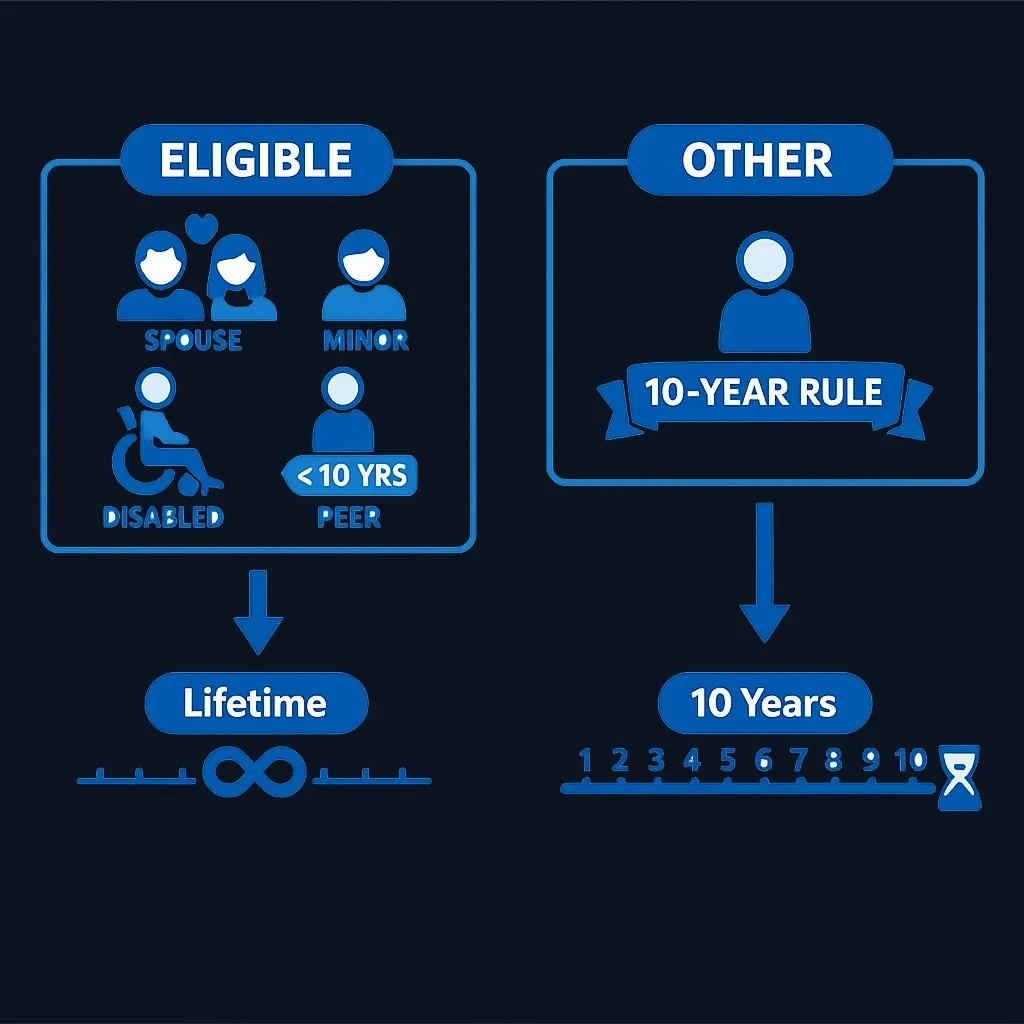
Under the 10-year rule, the entire account generally must be distributed by December 31 of the year containing the 10th anniversary of death. If the owner died before the required beginning date and the 10-year rule applies, Publication 590-B says no distribution is required before year 10. If the owner died on or after the required beginning date, post-death RMD mechanics can require distributions during the 10-year window. The beneficiary is also responsible for any remaining year-of-death RMD the owner did not take (IRS Publication 590-B).
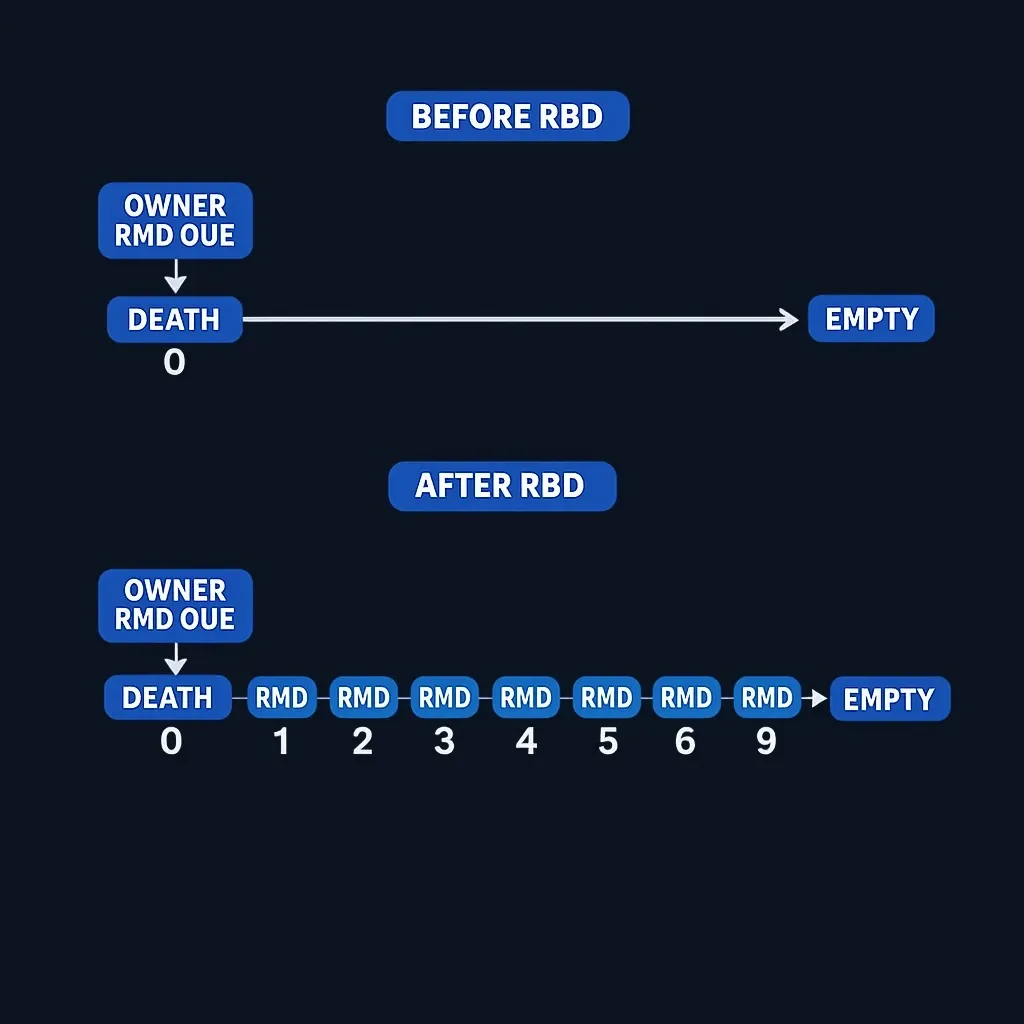
Practical note: use the year of death, beneficiary category, owner’s required-beginning-date status, and IRA type to obtain a written distribution schedule. Older “stretch IRA” explanations may not apply.
Distribution Rules for Inherited IRAs
Factors that determine the schedule
Distribution requirements for an inherited IRA depend on:
- The beneficiary category (spouse vs. non‑spouse vs. trust or multiple beneficiaries).
- The IRA type (traditional or Roth).
- Whether the original owner had already begun required distributions before death Fidelity.
First actions you should take
- Ask the custodian whether you must set up a retitled inherited‑IRA account and whether multiple beneficiaries require separate accounts Fidelity.
- Request a written distribution schedule and any required minimum distribution (RMD) calculations the custodian will use Fidelity.
- Confirm how each withdrawal will be reported for tax withholding and Form 1099 reporting Fidelity.
How to think about RMDs
- RMDs set minimum withdrawal amounts and timing for many inherited accounts. The exact calculation depends on beneficiary category and account history. Use the current IRS tables and rules, then have the custodian or a tax professional confirm the amount and deadline (IRS Publication 590-B).
- If you inherit multiple accounts, custodians commonly require separate inherited accounts so each beneficiary follows the applicable distribution rules Fidelity.
Worked example: process only
- Confirm the account balance date your custodian will use for RMD calculations (typically a specified prior date).
- Ask the custodian which beneficiary factor or schedule they will apply for your beneficiary type.
- Divide the balance by the factor to get the RMD for the period and confirm the deadline to withdraw. Confirm the result against current IRS guidance and the custodian's written calculation before taking distributions.

Traditional versus Roth inherited IRAs
| Feature | Traditional inherited IRA | Roth inherited IRA |
|---|---|---|
| Typical tax treatment of distributions | Generally taxable as ordinary income except for any recoverable basis (IRS Publication 590-B) | Qualified distributions are tax-free; a beneficiary distribution can include taxable earnings if the five-year requirement was not met (IRS Publication 590-B) |
| Custodian steps | Usually retitle to an inherited account; ask for written RMD schedule Fidelity | Same custodian process; tax treatment depends on the account’s qualifying status Fidelity |
| Practical consequence | Taxable portions increase income in the distribution year | Post-death distribution rules still apply even though qualified Roth distributions may be tax-free (IRS Publication 590-B) |
Practical takeaway: tax timing and account history matter. Use custodian calculations and tax professional modeling before large withdrawals Fidelity.
Tax Implications of Inherited IRAs
High‑level tax differences
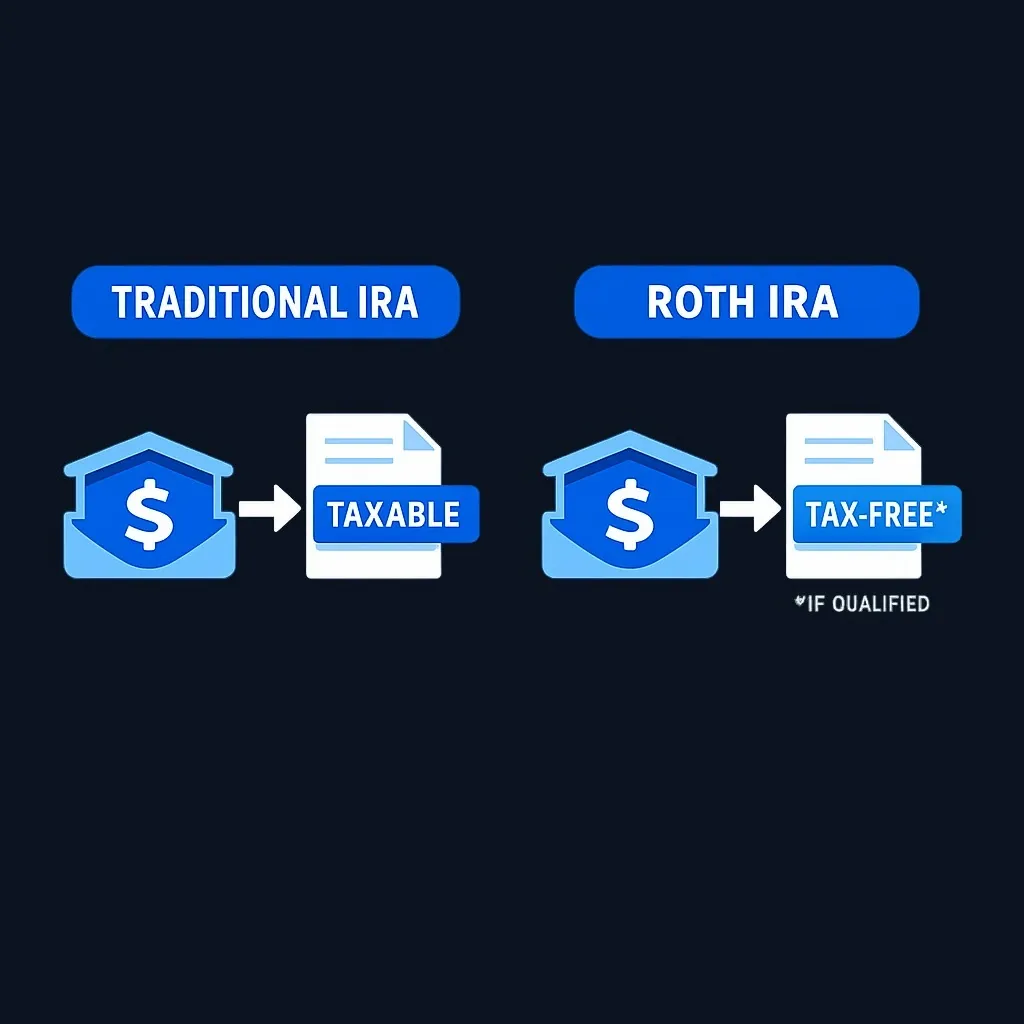
- Traditional inherited IRA distributions are generally taxable as ordinary income, except for any portion attributable to after-tax basis (IRS Publication 590-B).
- Roth inherited IRA distributions may be tax-free when the distribution is qualified. If the original Roth had not satisfied its five-year requirement, earnings can be taxable even though the death exception generally avoids the 10% early-distribution additional tax (IRS Publication 590-B).
Tax planning checklist
- Before taking a lump sum, ask the custodian how distributions will be reported and whether tax withholding is available Fidelity.
- Model the tax impact of withdrawals with a tax professional; large, single‑year withdrawals can materially increase taxable income and affect tax brackets Fidelity.
- Keep detailed records of contributions, conversions, and distributions for the account’s history and your tax return Fidelity.
Illustrative, real‑world scenarios (qualitative)
- Immediate cash need: a large withdrawal from a traditional inherited IRA creates taxable income in the year withdrawn; consider whether staged distributions are permitted and advisable Fidelity.
- Roth qualification: if the Roth meets the custodian’s holding/qualification rules, distributions to beneficiaries are more likely to be tax‑free; verify in writing Fidelity.
Practical takeaway: tax consequences depend on account type and history. Obtain custodian confirmation and tax advice before large moves Fidelity.
Special Considerations for Spousal Beneficiaries
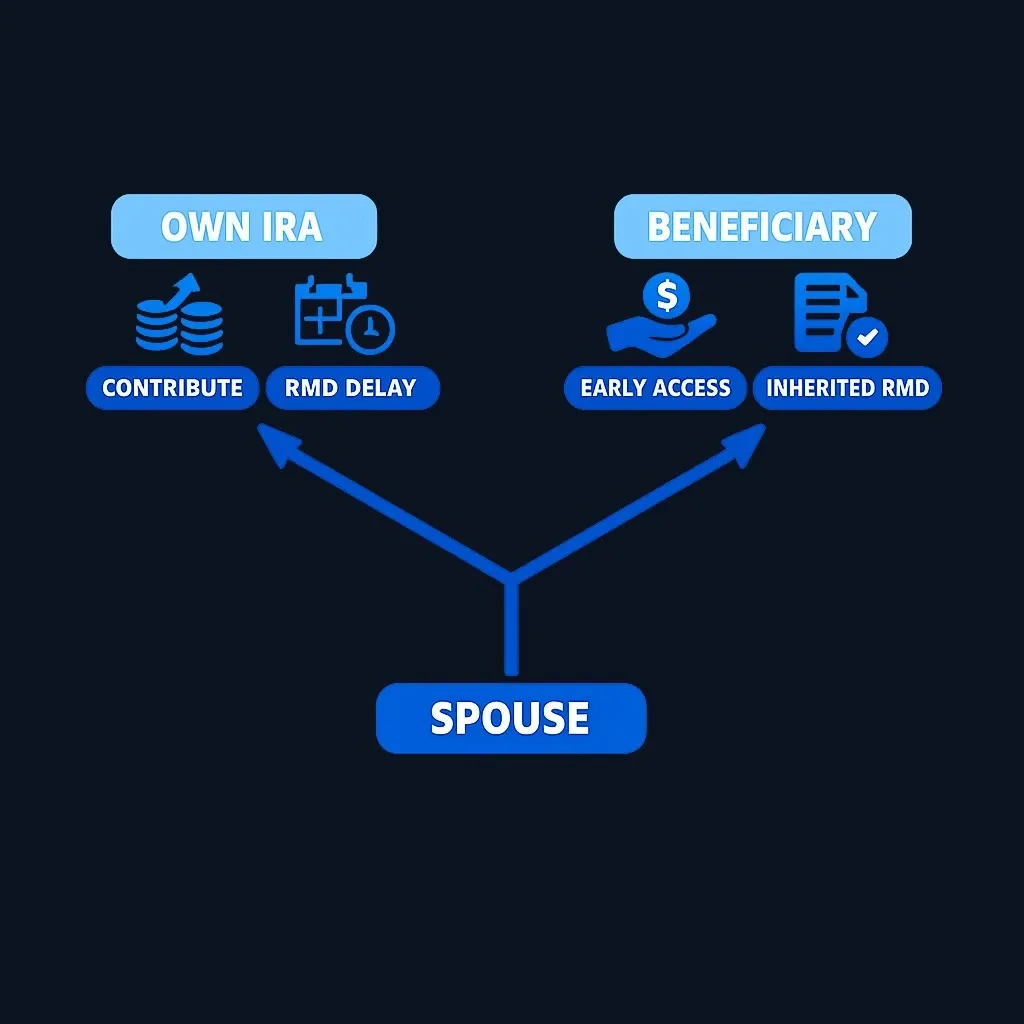
Surviving spouses generally have additional options that can change distribution timing and future contribution ability. A sole spouse beneficiary may be able to treat an inherited IRA as their own or remain a beneficiary, subject to the applicable rules (IRS Publication 590-B). The choice can affect RMD timing and access before age 59½, so confirm the custodian's elections and tax consequences before selecting one.
Decision factors for spouses
- Whether to treat the inherited account as your own or keep it as an inherited account.
- How the choice affects eligibility to make future contributions and the timing of required distributions.
- The spouse’s age and the original owner’s RMD status at death — those facts can change distribution mechanics Fidelity.
Practical takeaway: document spousal elections in writing with the custodian and get advisor confirmation of downstream tax and distribution effects Fidelity.
Practice investing with Finelo
Build practical investing skills with guided lessons, simulator practice, and structured challenges.
Common Mistakes to Avoid
This list highlights frequent beneficiary errors and how to prevent them.
- Waiting to contact the custodian
- Problem: Delays can limit administrative options, such as splitting accounts for multiple beneficiaries.
- Fix: Contact the custodian immediately and request required forms and a written distribution plan Fidelity.
- Assuming inherited funds can be rolled into your existing IRA
- Problem: Rollovers and contributions to inherited IRAs are generally restricted and depend on beneficiary type.
- Fix: Verify with the custodian whether rollovers or contributions are permitted for your situation Fidelity.
- Taking a large lump sum without tax modeling
- Problem: A lump sum can trigger a large tax bill in one year.
- Fix: Model scenarios with a tax professional and ask the custodian about staged withdrawals and withholding options Fidelity.
- Missing required distributions or deadlines
- Problem: Missed deadlines can cause tax complications and additional reporting.
- Fix: Request the custodian’s written RMD schedule and mark deadlines on your calendar Fidelity.
- Not splitting accounts for multiple beneficiaries
- Problem: A single pooled account complicates tax reporting and distribution rules.
- Fix: Ask the custodian about establishing separate inherited accounts for each beneficiary and complete paperwork early Fidelity.
Beneficiary quick checklist
- Contact custodian and request inherited‑IRA packet and written RMD calculations. Fidelity
- Gather death certificate, beneficiary forms, and account history. Fidelity
- Decide with tax advisor whether to take lump sums or staged distributions. Fidelity
- If multiple beneficiaries, request account split and confirm separate titling. Fidelity
- Keep written records of all custodian correspondence and distribution confirmations. Fidelity
Decision framework
Use this compact framework to evaluate inherited‑IRA options and choose a defensible path.
Step 1 — Identify facts (gather, don’t guess)
- Who is the beneficiary: spouse, non‑spouse individual, trust, or multiple beneficiaries?
- What is the IRA type: traditional or Roth?
- Had the owner begun RMDs before death? Confirm with custodian records Fidelity.
Step 2 — Collect custodian constraints
- Which inherited‑account types does the custodian offer?
- Are separate accounts required for multiple beneficiaries?
- What written deadlines or elections does the custodian require? Request all answers in writing Fidelity.
Step 3 — Model tax outcomes
- Using the custodian’s written RMDs and your tax‑bracket assumptions, model year‑by‑year taxable income for candidate distribution strategies.
- Evaluate whether staged withdrawals, taking only RMDs, or a lump sum best fits cash needs and tax impact. Get a tax professional to validate the model Fidelity.
Step 4 — Choose, document, and review
- Make the custodian election in writing and keep confirmations.
- Revisit the strategy annually if market, tax, or personal circumstances change Fidelity.
Practical note: if you feel unsure at any stage, pause distributions until you have the custodian’s written calculations and a tax advisor’s review. That reduces the chance of costly mistakes Fidelity.
FAQ
What is an inherited IRA?
An inherited IRA is an IRA that a beneficiary receives after the original owner dies. The beneficiary must follow specific distribution rules and custodian procedures that differ by beneficiary type and account history; contact the custodian promptly for required steps Fidelity.
What are the distribution rules for inherited IRAs?
Distribution rules depend on whether you are a spouse, another individual beneficiary, a trust, an estate, or one of multiple beneficiaries, and on whether the original owner had reached the required beginning date. Many non-eligible designated beneficiaries must empty the account by the end of the 10th year, and some must also take annual distributions during that window (IRS Publication 590-B).
How do I calculate RMDs for an inherited IRA?
Calculation methods vary by beneficiary type and account history. The practical steps are: obtain the balance date the custodian will use, request the beneficiary factor/schedule the custodian will apply, and have the custodian provide the written RMD amount and deadline — then verify with a tax professional Fidelity.
What are the tax implications of inherited IRAs?
Tax consequences depend on account type and history: traditional IRA distributions are generally taxable to beneficiaries as ordinary income, while Roth distributions may be tax‑free if the account qualifies. Confirm the account’s qualifying status and get tax advice before large withdrawals Fidelity.
Conclusion and Next Steps
Key takeaways
- Inherited‑IRA rules are fact‑sensitive: beneficiary type, IRA type, and the owner’s distribution history determine deadlines and taxes Fidelity.
- Contact the custodian immediately, get written RMD calculations, and consult a tax or legal professional before making withdrawals Fidelity.
Actionable next steps
- Call the custodian, request the inherited‑IRA packet, and ask for written RMD calculations. Fidelity
- Gather the death certificate and verify beneficiary designations. Fidelity
- Model tax outcomes with a tax professional before taking large distributions. Fidelity
Use the checklist above to organize the custodial forms and questions you need to verify with the IRA custodian and current official guidance.
Sources and Further Verification
- Fidelity
- IRS Publication 590-B: Distributions from Individual Retirement Arrangements
- IRS: Retirement topics—beneficiary
More from Finelo
- Inherited Brokerage Accounts: Taxes, Cost Basis, and Next Steps
- SIMPLE IRA vs. 401(k): Limits, Costs, and Which Plan Fits a Small Business
- Solo 401(k) vs. SEP IRA: Limits, Costs, and Which Plan Fits Your Business
Disclaimer
This article is provided by Finelo for educational and informational purposes only. Finelo does not provide financial, investment, tax, legal, or insurance advice. Consider your circumstances and consult an appropriately qualified professional before making financial decisions.
InvestingBeginner GuideFinancial Education
Practice investing with Finelo
Build practical investing skills with guided lessons, simulator practice, and structured challenges.
About the author
Finelo Team
The Finelo Team creates practical investing and trading education designed to help beginners learn faster with structured challenges, simulator practice, and bite-sized lessons.
Keep reading — Related articles

Investing
Yield to Call vs Yield to Maturity: Assumptions and Bond Risks
Yield to call (YTC) estimates a bond's yield if the issuer redeems it on an eligible call date; yield to maturity (YTM) estimates yield if it remains outstanding to final maturity.
Finelo Team

Investing
Will My Employer Know If I Take a 401(k) Loan?
Who this page is for: readers new to 401(k) loans who want a practical, privacy‑focused explanation — what your employer can see, how to limit visibility, and the financial tradeoffs to weigh.
Finelo Team

Investing
What Medical Expenses Qualify for a 401(k) Hardship Withdrawal?
Before you decide, confirm three things with your plan administrator:
Finelo Team