Last editorial review: September 28, 2026
Personal loan with an origination fee vs. no origination fee
See how an origination fee changes usable proceeds and borrowing cost, and compare offers for the same cash need and term.
9 min read
Practice trading with Finelo
Practice in a simulator, learn with bite-sized lessons, and build confidence before risking real money.
Want to learn more?
Practice in a simulator, learn with bite-sized lessons, and build confidence before risking real money.
Explore FineloExplore Finelo's 28-day challenges
Turn learning into a daily habit with guided challenge paths.
An origination fee is a charge for making a loan. A loan without that fee can still cost more if its rate or other charges are higher. Compare the amount of cash you receive and the full repayment cost, not just whether the offer says “no fee.”
Follow the money
Suppose a lender deducts a 3% fee from a $10,000 loan. You receive $9,700 but repay according to the $10,000 loan agreement. If you need exactly $10,000 in usable cash, that offer does not yet meet the need.
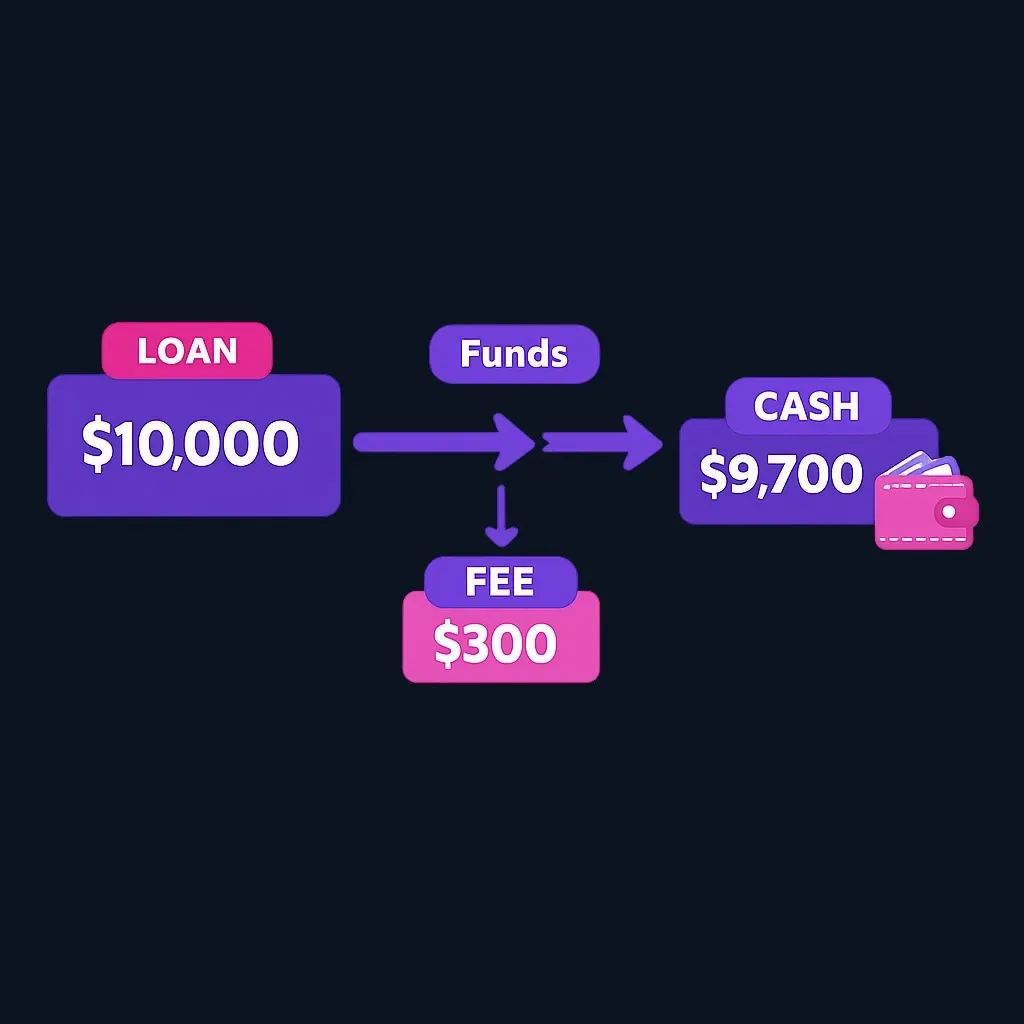
This is a hypothetical calculation, not a typical fee quote. Some fees are paid separately or financed differently. The CFPB's personal-loan fee guide explains why the full agreement matters.
Compare the same cash and term
| Item | What it tells you |
|---|---|
| Net proceeds | Money actually available after deductions |
| APR | Annualized borrowing cost including applicable charges |
| Finance charge | Dollar cost under the disclosed schedule |
| Total payments | Amount repaid if payments follow the schedule |
| Early-payoff terms | Whether shortening the loan changes the comparison |
Dividing the fee by the cash received does not calculate APR. APR also reflects interest and the timing of payments.
Think about early repayment
An upfront fee may not be refunded when you repay early. A lower-rate loan with a fee can therefore look less attractive if you expect to clear the balance quickly. Ask for a payoff comparison using your likely repayment date.
Likewise, “no origination fee” does not mean no late fees, optional products, or other costs. Review the final disclosures rather than the advertisement.
Request two offers for the same usable amount and repayment period. Choose the one with a payment you can maintain and the lower relevant total cost, while keeping enough cash for essential expenses.
Start with equal cash received
If you need a specific amount for a bill, compare loans that deliver that amount after any deducted fee. Two offers showing the same loan principal can provide different usable cash. Choosing the smaller payment without noticing a funding shortfall can lead to additional borrowing immediately afterward.
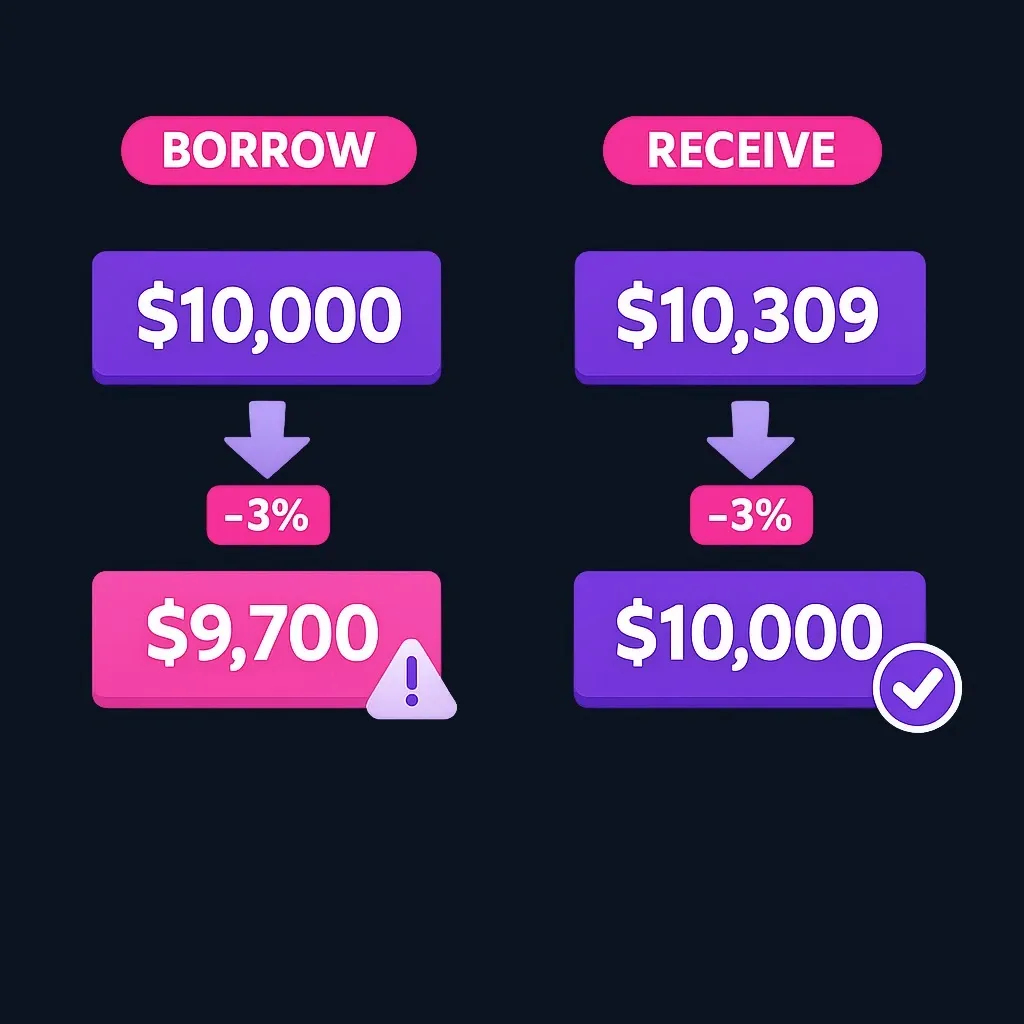
For a hypothetical 3% deducted fee, receiving $10,000 requires a principal of about $10,309.28: $10,000 divided by 0.97. The fee is about $309.28. That is different from borrowing $10,000 and receiving $9,700. Use the lender's actual rounding and disclosures when comparing a real offer.
Then examine the payment schedule and total of payments on the equal-proceeds offers. A fee-free loan with a higher rate may or may not cost more. The answer depends on the rates, terms, fees, and how long you actually keep the loan. APR is useful, but it should be read alongside the cash received and total dollar obligation.
Test an early-payoff scenario separately
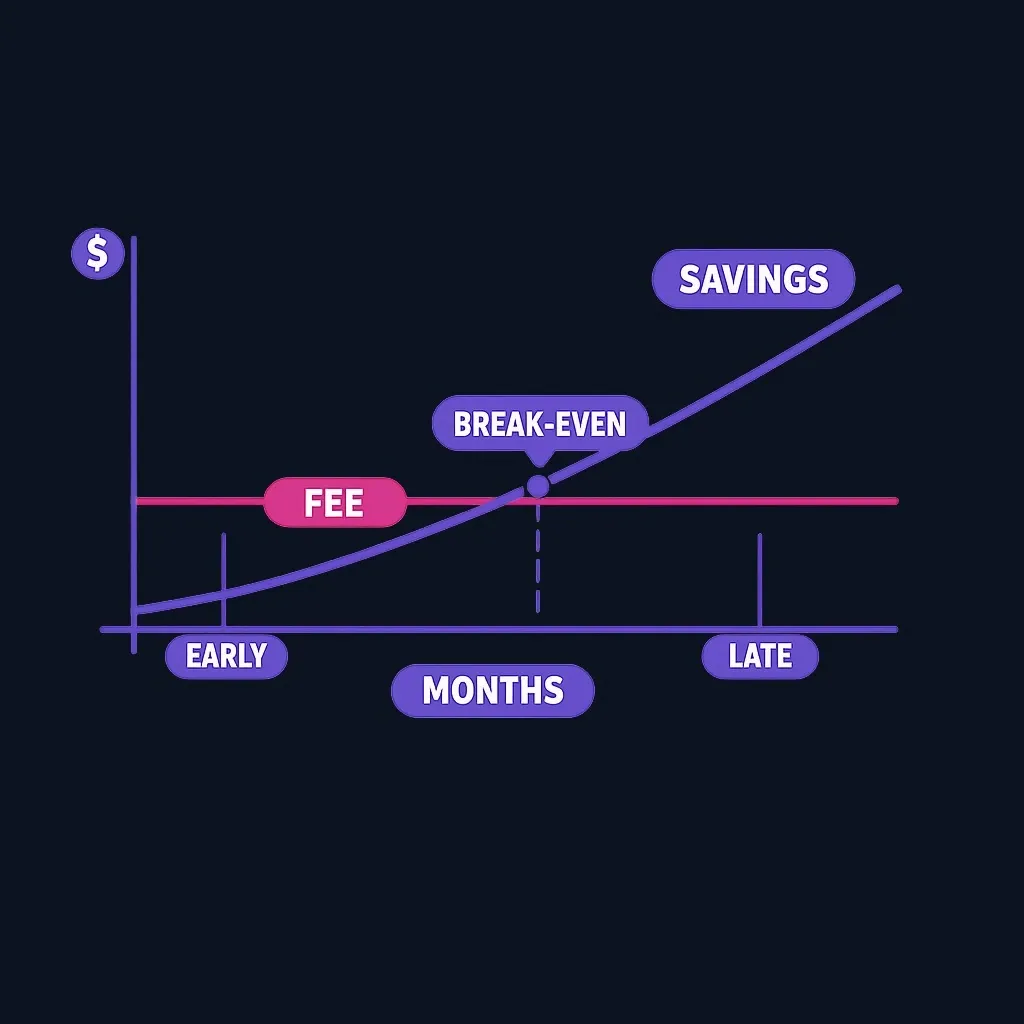
An upfront fee can matter more when a loan is repaid quickly because you have less time to benefit from a lower interest rate. Ask whether any fee is refundable and whether early repayment has a charge. Do not assume the scheduled lifetime comparison still applies if you expect to pay the balance off in a few months.
Keep the purpose and borrowing amount fixed while comparing. Approval for a larger loan is not a reason to take more cash than needed. A clear comparison asks what it costs to obtain the required funds and repay them on a manageable schedule, rather than which offer has the most appealing fee label.
Practice trading with Finelo
Practice in a simulator, learn with bite-sized lessons, and build confidence before risking real money.
How Origination Fees Work
Origination fees affect both the cash you receive and the effective cost of borrowing.
How they’re calculated and applied
- Percentage model: Lender multiplies the fee rate by the loan amount (e.g. 3% × $10,000 = $300) and may deduct it from proceeds, finance it, or require separate payment.
- Flat fee model: The agreement specifies a fixed dollar charge; check how it is collected rather than assuming it is deducted.
Net proceeds vs nominal principal
- Nominal principal: the amount shown in your loan agreement (e.g. $10,000).
- Net proceeds: the actual cash you receive after fees (e.g. $9,700 with a $300 fee).
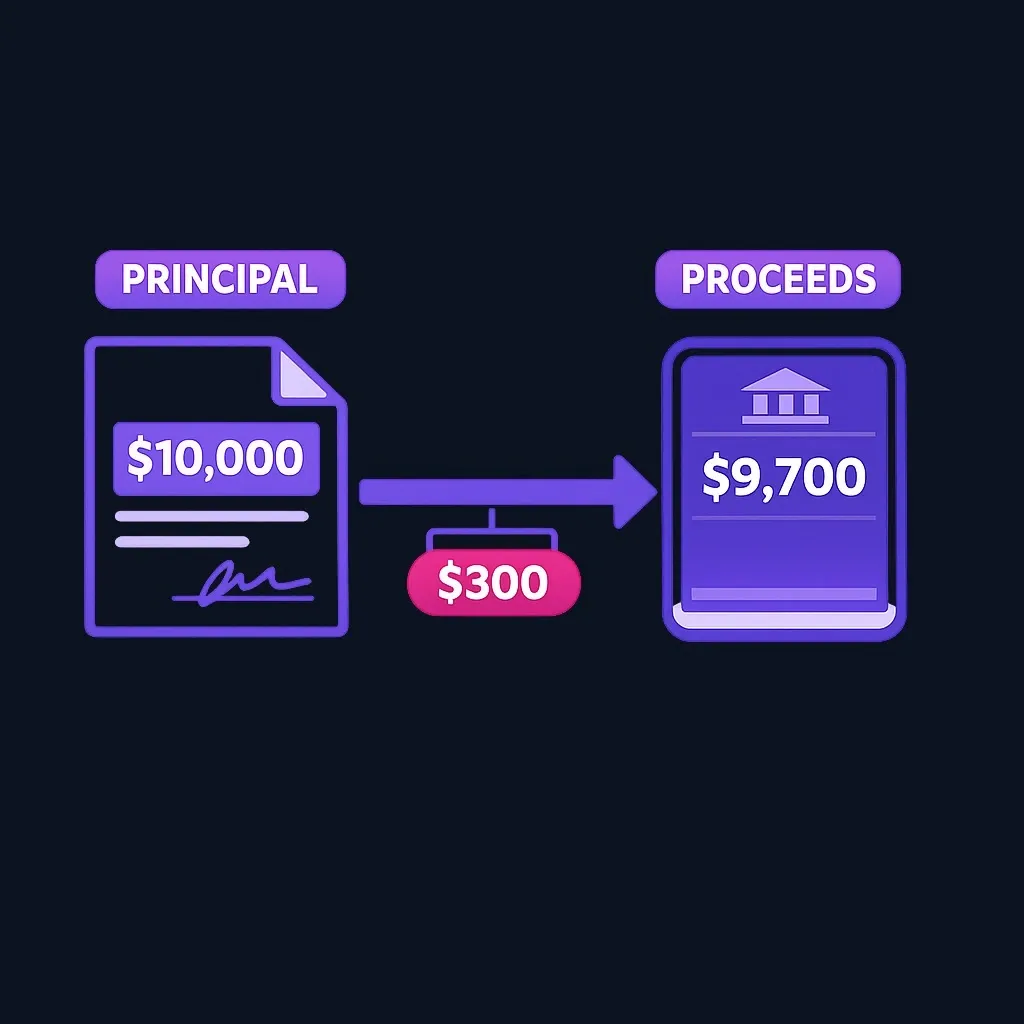
Simple effective-cost illustration
- Fee portion of received funds: fee ÷ net proceeds. For a $10,000 loan with 3% fee, fee = $300 and net proceeds = $9,700; 300 ÷ 9,700 ≈ 3.09%. That is a fee-to-proceeds ratio, not APR, and shows the fee’s size on the cash you get.
How APR and disclosures handle fees
- APR (annual percentage rate) is designed to bundle interest and required fees into a single rate for easier comparison. Compare APRs to see which offer is cheaper overall; APR includes many lender fees where required by law.
Regulatory and lender practices
- A fee should be identifiable in the loan’s required disclosures and cash-flow calculation. If the cash arriving in your account differs from the quoted principal, ask the lender to explain every deduction before accepting the offer.
How to compare your options
Use these criteria to choose between a loan with an origination fee and a no-fee loan.
Checklist to compare offers
- APR: Compare the APR each lender discloses; APR typically reflects interest plus many required fees.
- Net proceeds: Subtract any origination fee from principal to find the cash you’ll actually receive.
- Total repayment amount: Add the scheduled payments and only separately paid costs not already included. Subtract the usable cash received to estimate borrowing cost. Do not add a deducted or financed origination fee again if it is already reflected in the cash received and repayment schedule.
- Loan term and monthly payment: A longer term can reduce payments but raise total interest. Include fees in your math.
- Pricing: The fee and rate depend on the actual offer and borrower profile. Compare approved terms rather than assuming a no-fee label makes an offer cheaper.
- Funding speed and convenience: Check the promised funding date separately from the price. An origination fee does not by itself establish faster funding or better service.
- Refundability and contingencies: Confirm whether a fee is refundable if you pay off early or the loan is rescinded — check the promissory note.
Obtain offers showing the same cash received and term. Compare the disclosed repayment schedules and any separately paid costs. Then model an early payoff if that is your realistic plan, checking whether the upfront fee is refundable.
When to choose each option
Concrete scenarios and decision points
When a loan with an origination fee may make sense
- The equal-proceeds offer has a lower total borrowing cost after including the fee, and its payment is affordable. A lower interest rate alone does not establish this result.
- You expect to hold the loan for a long term and the accumulated interest savings exceed the one-time fee. Run the total-cost calculation above.
When a no-origination-fee loan may be better
- You need the full principal in hand immediately (fees reduce net proceeds).
- You plan to repay quickly or refinance soon. A fee paid upfront is harder to recover in short holding periods.
- You prefer simple pricing and certainty about monthly cash flows.
Worked example focused on fee impact (fee only)
- Scenario: $10,000 nominal loan, 3% origination fee. Fee = $300; net proceeds = $9,700.
- Effective fee as percent of received cash = 300 ÷ 9,700 ≈ 3.09%. This shows the fee’s real economic bite on funds you receive. (Use APR and payment data from offers to compare total repayment before deciding.)
Common mistakes borrowers make
- Comparing interest rates but ignoring fees. Always compare APR or total repayment to include fees.
- Forgetting net proceeds—assuming the loan principal equals cash in hand.
- Overlooking refundability and prepayment rules—some fees may not be refundable.
Alternatives to Loans with Origination Fees
If you want to avoid origination fees altogether, consider these options. Verify each option’s terms with the provider.
No-fee personal loans from lenders
- Request a no-origination-fee offer from an eligible lender and compare it with the fee-bearing offer at equal net proceeds and term.
Credit union loans
- Request an actual quote from a credit union for which you qualify. Membership alone does not establish a lower rate or a waived origination fee; compare its disclosures with the other offers.
Balance transfer or low-rate credit cards
- Other borrowing products have different fee, rate, and repayment structures. Compare them only if their permitted use and actual terms fit the expense; a promotional headline alone does not establish a lower cost.
Secured borrowing
- A collateral-backed offer needs its own cost and risk comparison. Home-equity borrowing can put the home at risk, and vehicle-title products should not be assumed to be a low-cost substitute. Avoid pledging an essential asset merely to obtain a no-origination-fee label.
Tradeoffs and caveats
Practical caveats to keep in mind
Disclosure and enforcement
- Lenders must disclose fees in loan documents. Regulators pursue enforcement when fees are hidden or misrepresented. Read the promissory note carefully.
APR and comparisons
- APR rules aim to standardize comparisons, but some fees may not be reflected depending on loan structure and applicable disclosure rules. Use APR as your first check and verify total payments.
Credit profile effects
- Offers vary by borrower. If prequalification is available, confirm whether it uses a soft inquiry and which terms remain conditional before submitting a full application.
Speed vs price
- If speed matters, obtain a specific funding timeline. Compare it separately from fees, and do not assume a higher charge purchases faster service.
Negotiation and shop-around
- Not all fees are non-negotiable. Ask lenders if they can waive or reduce the fee, and get written confirmation. When comparing, request full disclosures and run the total-cost math.
Verify current pricing on official lender sites before deciding. Loan terms and market offers change frequently.
What is a personal loan origination fee?
An origination fee is an upfront charge a lender may deduct from the loan principal to cover underwriting and processing. Lenders often deduct the fee from the loan before funding, so your net proceeds are reduced.
How is an origination fee calculated?
The contract may state the fee as a percentage or a flat amount. Use the fee in the actual offer and check whether it is deducted from proceeds, financed, or paid separately.
Are there personal loans without origination fees?
Some lenders offer loans without origination fees. Check the complete terms; a higher rate or a longer repayment period can still make the no-fee offer more expensive.
How should I compare a loan with a fee to one without?
Compare equal net proceeds and repayment periods using APR, disclosed finance charges, and the total of payments. Add only costs not already included in that total so an origination fee is not counted twice.
Before accepting collateral requirements, also compare Secured vs. unsecured personal loans.
This guide covers U.S. rules. Finelo provides financial education, not personalized financial, investment, tax, or legal advice.
Financial LiteracyU.S. GuideFinancial Education
Practice trading with Finelo
Practice in a simulator, learn with bite-sized lessons, and build confidence before risking real money.
About the author
Finelo Team
The Finelo Team creates practical investing and trading education designed to help beginners learn faster with structured challenges, simulator practice, and bite-sized lessons.
Keep reading — Related articles
Financial Literacy
USDA vs. FHA loan
Compare location and income eligibility, down payments, credit conditions, and upfront and annual program charges for a home purchase.
Finelo Team

Financial Literacy
Term life vs. accidental death insurance
Compare broad term-life protection with accident-only coverage, including exclusions, underwriting, and the family income gap.
Finelo Team
Financial Literacy
Term life insurance laddering vs. one policy
Compare several term policies ending at different times with one policy, using coverage needs, costs, and future insurability.
Finelo Team


