Last editorial review: September 8, 2026
Social Security at 62 vs. 67: Benefit Trade-Offs and Break-Even Factors

This social security at 62 vs 67 comparison focuses on the rules, costs, risks, and practical trade-offs a reader should verify before deciding.
13 min read
Practice investing with Finelo
Build practical investing skills with guided lessons, simulator practice, and structured challenges.
Want to learn more?
Build practical investing skills with guided lessons, simulator practice, and structured challenges.
Explore FineloExplore Finelo's 28-day challenges
Turn learning into a daily habit with guided challenge paths.
U.S. scope: This article discusses U.S. institutions, financial products, tax rules, and dollar examples unless stated otherwise. Rules and product terms may change; verify current official guidance for your situation.
This social security at 62 vs 67 comparison focuses on the rules, costs, risks, and practical trade-offs a reader should verify before deciding.
Quick comparison answer
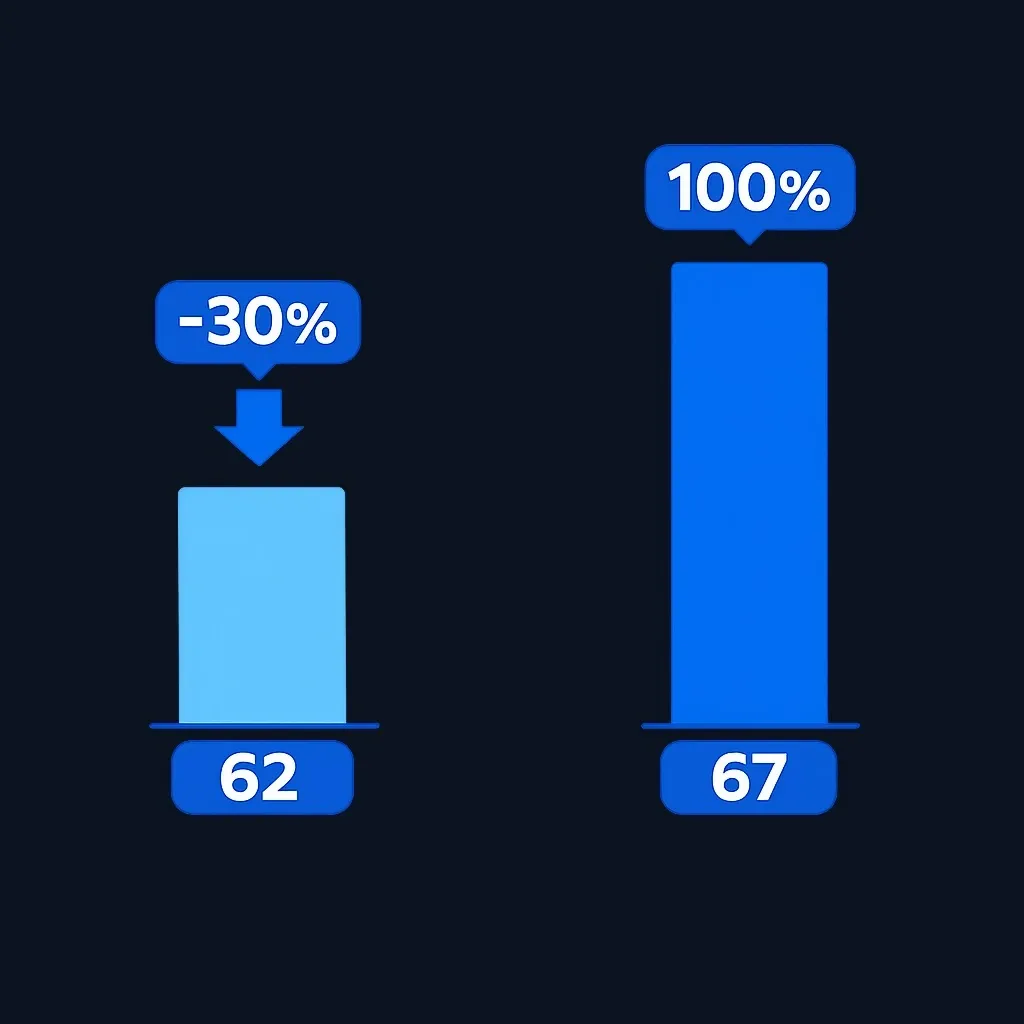
Claiming Social Security retirement benefits at 62 can provide income sooner, but the monthly amount is permanently reduced relative to claiming at full retirement age. Full retirement age depends on birth year; it is 67 for people born in 1960 or later, including people who turn 62 in 2026 (Social Security Administration). When full retirement age is 67, starting at 62 can reduce the worker's retirement benefit by as much as 30% (SSA retirement-benefits guide).
Educational note: This page is for financial education, not financial or investment advice. Retirement-income decisions involve uncertainty, and investing or drawing from savings can involve loss.
Understanding Social Security benefits
Social Security claiming age is a timing decision. The earlier-income choice is not just “more years of checks.” It is a trade-off between getting payments sooner and accepting a lower monthly benefit. Retirement benefits can generally start at 62, and delaying beyond full retirement age can increase the worker's benefit until age 70 (Social Security Administration).
Age 67 matters because it is full retirement age for people born in 1960 or later. People born earlier may have a full retirement age between 66 and 67, so “62 versus 67” is not the correct comparison for every reader (SSA full-retirement-age table). Use the estimates in your own Social Security account rather than a generic dollar example.
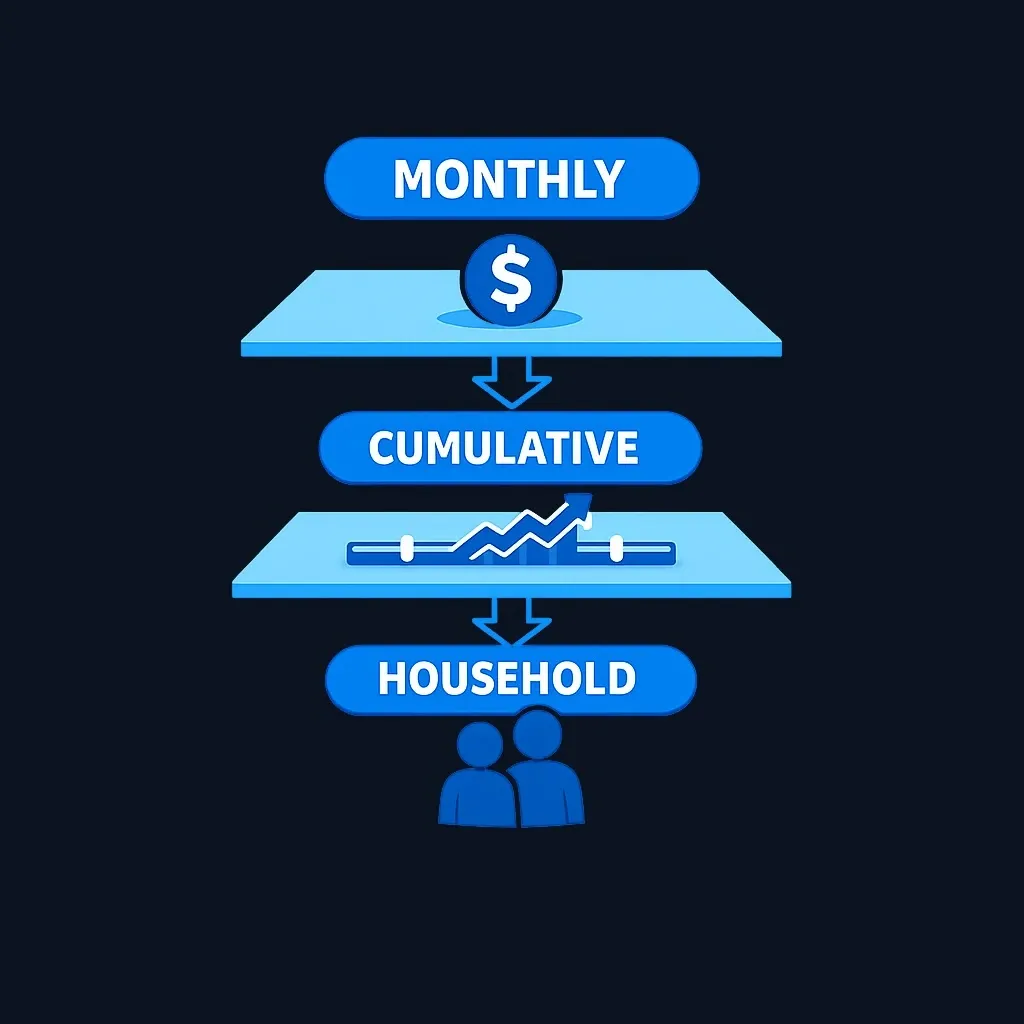
Think of the decision in three layers:
- Monthly income: How much arrives each month once payments begin?
- Cumulative income: How long would you need to live for the larger later check to overtake the smaller earlier checks?
- Household resilience: Would your decision make life easier or harder for a spouse, partner, or dependent if household income changes later?
That last layer is where many simple calculators feel incomplete. A single person with urgent cash needs may see the decision differently than a married couple where one person’s benefit supports most of the household budget.
Claiming Social Security at age 62
Claiming at 62 is mainly about access to income sooner. SSA permits retirement benefits to begin as early as 62, subject to eligibility rules (Social Security Administration). Some people may need income sooner to help pay bills, or may not expect to live long enough to benefit from delaying (Fidelity).
When early claiming can make sense
Age 62 can be a practical choice when Social Security fills an immediate income gap. That might be the case if you left work earlier than planned, have limited liquid savings, or face health issues that change your time horizon. In that situation, the value of income now may outweigh the appeal of a larger future payment.
Health is especially important because break-even math depends on how long payments continue. Fidelity explicitly identifies shorter life expectancy as one reason some people may claim sooner rather than wait (Fidelity). That does not make early claiming automatically right. It means the decision should reflect more than the largest monthly number.
What you give up by claiming early
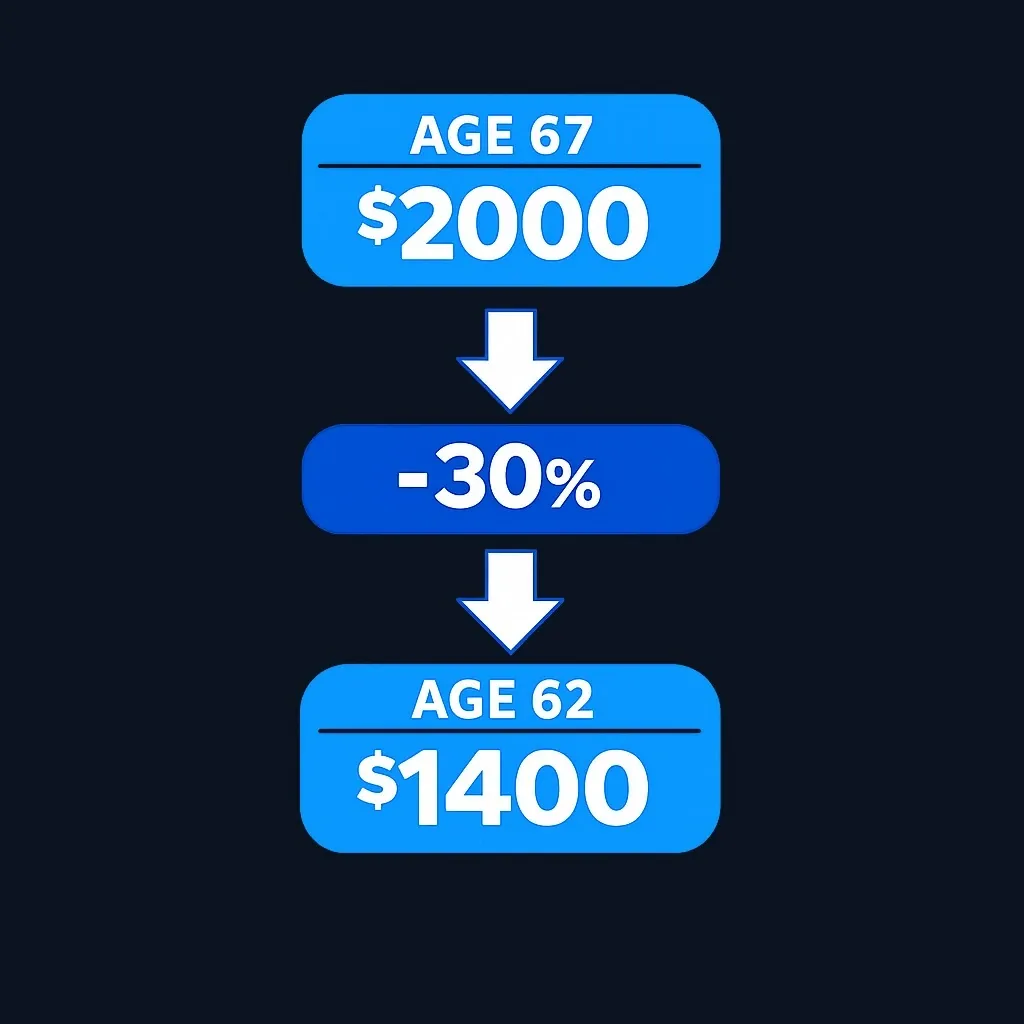
The trade-off is a permanently smaller monthly benefit. If full retirement age is 67, SSA's current guide shows that starting at 62 can reduce the worker's retirement benefit by as much as 30%; the exact reduction depends on the number of months before full retirement age (SSA retirement-benefits guide). A smaller check can matter more over time if retirement expenses rise, savings fall, or another household income source disappears.
A common mistake is comparing only the first few years. Early claiming may feel clearly better at first because checks begin sooner. The later-claiming option often looks stronger only after enough years have passed for the larger monthly payment to catch up.
Claiming Social Security at age 67
For someone whose full retirement age is 67, claiming then means accepting a waiting period in exchange for the unreduced full-retirement-age amount. For someone with an earlier full retirement age, age 67 may already include delayed-retirement credits; verify the applicable birth-year rule and personal estimate with SSA (SSA full-retirement-age table).
Why waiting can help
Waiting can improve monthly retirement cash flow once benefits begin. That can be valuable if you expect Social Security to cover a meaningful share of essential spending. A larger monthly check may also reduce pressure on private savings later in retirement.
Waiting can also act like a longevity hedge. If you live well past the break-even point, the larger monthly amount may produce more cumulative income. Schwab’s broader framing supports that idea by noting that waiting until 70 yields greater benefits for most people (Charles Schwab).
What waiting can cost
The cost of waiting is the income you do not receive between 62 and 67. That gap has to be covered somehow. Common bridge sources include wages, cash savings, retirement accounts, pensions, or reduced spending.
This is where Social Security and private savings interact. If waiting forces you to sell investments during a weak market, the higher future benefit may come with near-term portfolio risk. If you have stable cash reserves or part-time income, waiting may be easier to sustain.
Side-by-side comparison table
Use this table as a decision lens, not a universal answer. It assumes age 67 is the reader's full retirement age; check the SSA birth-year table before using the comparison.
| Decision point | Claim at 62 | Claim at 67 |
|---|---|---|
| Main appeal | Income starts sooner; SSA permits eligible workers to begin retirement benefits at 62 (Social Security Administration) | The unreduced full-retirement-age amount when 67 is your full retirement age (SSA full-retirement-age table) |
| Main drawback | A permanent reduction; as much as 30% when full retirement age is 67 (SSA retirement-benefits guide) | You must cover the waiting period before payments begin |
| Better fit when | You need income sooner or have a shorter expected time horizon | You can fund the gap and value higher later monthly income |
| Cash-flow profile | More income earlier, smaller monthly amount later | No benefit income during the wait, then a larger monthly amount |
| Break-even effect | Leads early in cumulative dollars at first | Can catch up later if the larger payment continues long enough |
| Household planning lens | May help near-term bills but can leave less monthly income later | May support a stronger later-life budget if you can wait |
The key is not which column looks better in isolation. The key is whether the waiting period is affordable and whether the larger later payment is likely to matter for long enough.
Decision criteria
A good 62-versus-67 decision starts with your own numbers, then adds personal context. Avoid using a friend’s benefit, an online average, or a sample number as your answer. Your earnings record, household needs, savings, health, and work plans can change the conclusion.
1. Immediate cash need
If Social Security is needed to pay essential expenses, claiming at 62 may be a practical necessity. Fidelity recognizes that some people need income sooner to help pay bills (Fidelity). In that case, the question becomes how to manage the smaller payment, not how to maximize a theoretical future amount.
If you can cover expenses without Social Security, waiting becomes easier to evaluate. You can compare the cost of using savings or earnings for the bridge period against the value of the higher monthly benefit later.
2. Health and longevity expectations
Health does not provide certainty, but it changes the break-even conversation. Fidelity notes that some people may claim sooner because they do not expect to live long enough to benefit from delaying (Fidelity). A shorter expected time horizon can make earlier income more attractive.
A longer expected time horizon can make waiting more compelling. The larger check has more time to catch up and then continue paying. This is why two people with the same benefit estimates can reasonably reach different decisions.
3. Household and survivor resilience
If someone else depends on your retirement income, run the decision as a household. Ask what the budget looks like if one income source stops, one spouse needs care, or one person lives much longer than the other. The “best” claiming age for one person may not be the best claiming age for the household.
This is the gap many simple comparisons miss. A single retiree may focus on personal break-even age. A couple may care more about stable income for the surviving household member.
4. Private savings and investment risk
Waiting until 67 often requires a bridge. That bridge may come from cash, part-time work, retirement accounts, or taxable investments. Each option has trade-offs.
Using savings can preserve the chance of a higher Social Security payment later, but it also reduces assets. Selling investments can add market-timing risk. Working longer may reduce withdrawals, but it depends on health, job availability, and personal goals.
5. Flexibility and stress
The mathematically stronger option may still be hard to live with. If delaying creates anxiety or forces you into unstable withdrawals, the higher future check may not feel worth the pressure. If claiming early creates long-term budget stress, the near-term relief may fade.
A practical decision balances numbers with resilience. The goal is not to “win” a spreadsheet. The goal is to choose a claiming age that fits your cash flow, risk tolerance, and household needs.
Practice investing with Finelo
Build practical investing skills with guided lessons, simulator practice, and structured challenges.
When to choose each option
There is no single best answer for everyone. A useful answer is conditional: claim earlier when income now matters more; wait when you can fund the gap and the larger later benefit supports your plan.
Consider claiming at 62 if…
You may lean toward 62 if you need income to cover essential spending. Fidelity specifically mentions people who need payments sooner to help pay bills (Fidelity). This can be especially relevant after job loss, caregiving, illness, or an early retirement that was not fully planned.
Age 62 may also fit if health changes your expected time horizon. Fidelity notes that some people may not expect to live long enough to benefit from delaying (Fidelity). In that case, receiving benefits sooner may carry more value than waiting for a larger check.
Consider waiting until 67 if…
You may lean toward 67 if you can pay expenses without Social Security during the waiting period. Waiting can produce a larger monthly benefit in the 62-versus-67 comparison. Fidelity’s hypothetical illustrates that a filer waiting until 67 could receive approximately $2,000 per month in that scenario (Fidelity).
Waiting may also fit if you expect retirement to last a long time. The larger payment has more years to offset the checks you skipped earlier. It may also reduce pressure on savings later, when returning to work could be harder.
A simple break-even framework
Use your own benefit estimates and this simplified formula:
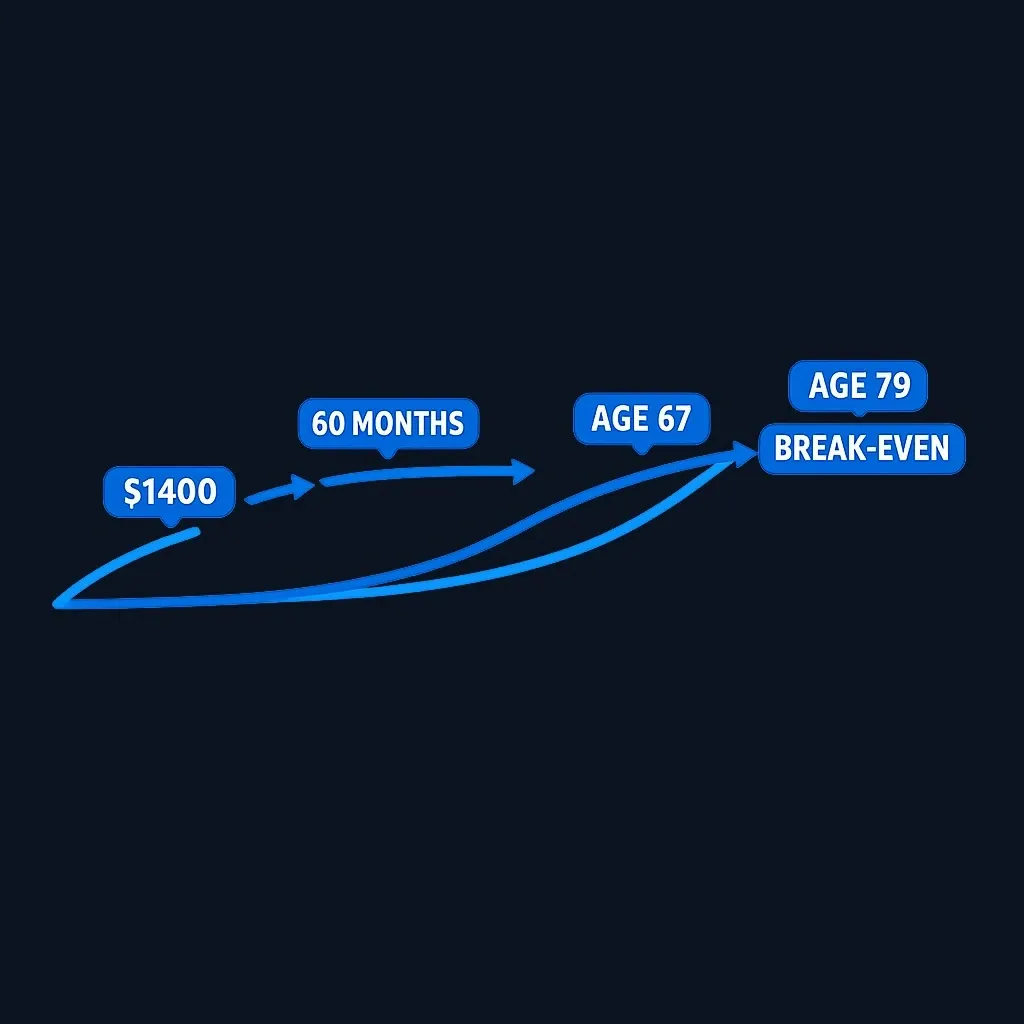
Break-even years after 67 = age-62 monthly benefit × months waited ÷ monthly difference between age 67 and age 62
For a 62-versus-67 comparison, the waiting period is the time between those two ages. The age-62 amount starts earlier, while the age-67 amount starts later but is larger. The break-even point is when the cumulative total from waiting catches up.
Here is the workflow:
- Write down your estimated monthly benefit at 62.
- Write down your estimated monthly benefit at 67.
- Subtract the age-62 amount from the age-67 amount.
- Multiply the age-62 amount by the number of months you would wait.
- Divide the result by the monthly difference.
Then ask a planning question: “Do I expect the larger check to matter for enough years after the break-even point?” This arithmetic is only a rough comparison. It does not model cost-of-living adjustments, taxes, earnings-test effects while working, the time value of money, or spouse and survivor benefits.
Tradeoffs and caveats
The biggest caveat is that Social Security claiming is personal. A sample benefit is useful for learning the mechanics, but it is not a decision number. Fidelity’s $2,000-per-month figure is tied to its own hypothetical example, not a universal estimate (Fidelity).
Common mistakes to avoid
Mistake 1: Choosing based only on the highest monthly payment. A higher monthly payment may look best, but it requires surviving the waiting period financially. If delaying forces damaging withdrawals or unpaid bills, the larger future check may not solve the real problem.
Mistake 2: Choosing based only on “getting money sooner.” Early income can help, but Fidelity identifies reduced benefits as the downside of claiming early (Fidelity). If your retirement may last a long time, the smaller monthly amount can become more painful later.
Mistake 3: Ignoring the household. A claiming decision can affect more than one person’s budget. Couples should compare income while both people are alive, then stress-test the budget if only one person remains.
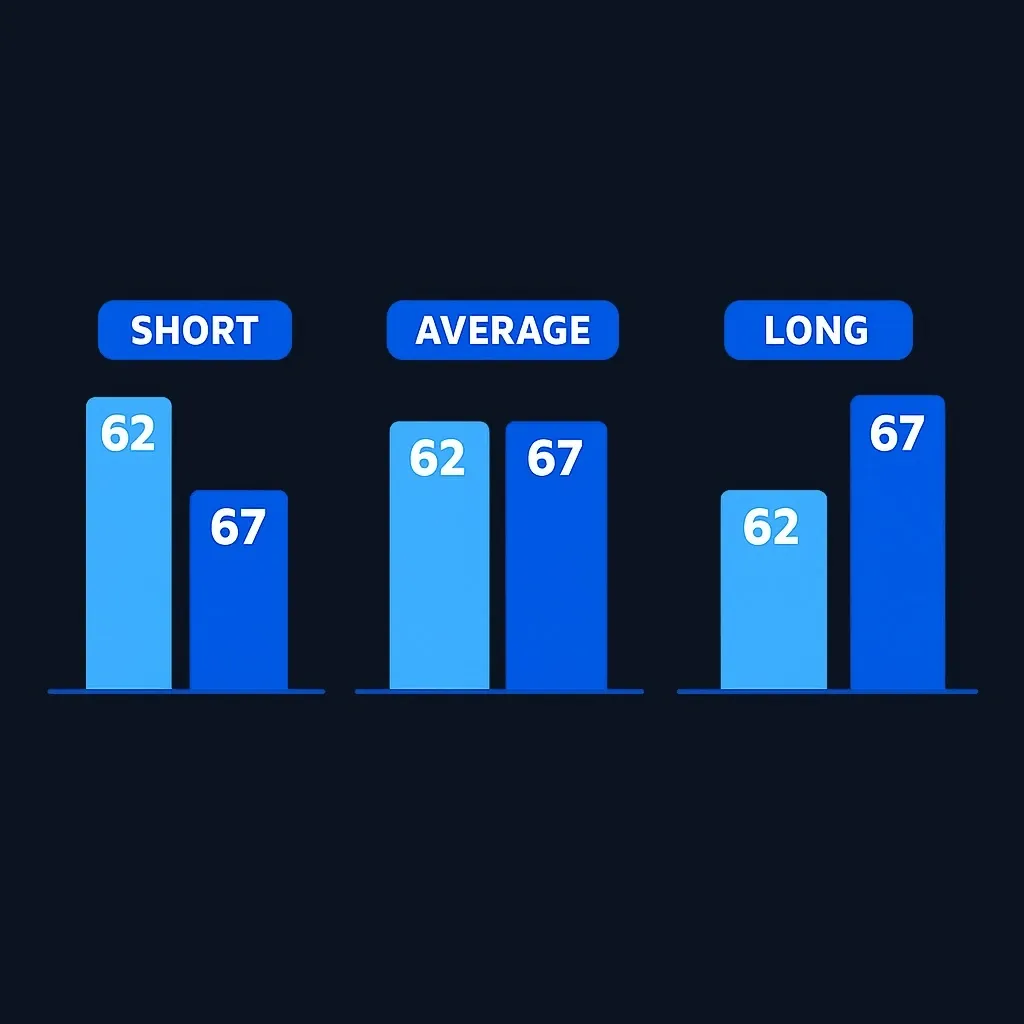
Mistake 4: Treating health as certain. Health is important, but it is still uncertain. Instead of trying to predict the exact future, test several scenarios: shorter life, average-feeling life, and long life. A decision that works across more scenarios may be easier to live with.
Source checks before deciding
Before filing, verify your own current benefit estimates through official channels and confirm the rules that apply to your situation. Also check how continued work, taxes, pensions, and household benefits may affect your plan. Those details can change the practical answer even when the 62-versus-67 comparison looks simple.
FAQ
What are the benefits of claiming Social Security at 62?
The main benefit is earlier income. Schwab notes that you may be eligible to collect Social Security as early as 62 (Charles Schwab). Fidelity adds that some people need income sooner to pay bills or may not expect to benefit from delaying (Fidelity).
How does claiming at 67 differ from claiming at 62?
Claiming at 62 starts income sooner but permanently reduces the monthly amount. Claiming at 67 provides the full-retirement-age amount only when 67 is your applicable full retirement age; check the SSA birth-year table and your personal estimate (Social Security Administration).
How do I calculate my Social Security break-even age?
Compare cumulative benefits. Add up the payments you would receive by starting at 62, then compare them with the larger monthly payments that begin at 67. The break-even point is the age when the age-67 path catches up.
What factors matter most when deciding between 62 and 67?
Focus on cash needs, health, expected longevity, household dependence, and available savings. Fidelity specifically points to near-term income needs and shorter life expectancy as reasons some people claim sooner (Fidelity). If you can fund the waiting period, the larger later payment may be worth evaluating.
Conclusion and next steps
The best answer to “Social Security at 62 vs. 67” depends on your assumptions. Claiming at 62 can solve an immediate income need, but Fidelity identifies reduced benefits as the downside of claiming early (Fidelity). Waiting until 67 can provide a larger monthly benefit, as shown in Fidelity’s full-retirement-age example (Fidelity).
Your next step is to gather your own age-62 and age-67 estimates, run the break-even formula, and stress-test the decision against health, savings, and household needs. The stronger choice is the one that fits both the math and your real retirement constraints.
Sources and Further Verification
- Fidelity
- Charles Schwab
- Social Security Administration: full retirement age
- Social Security Administration: retirement benefits
- Social Security Administration: 2026 retirement-benefits guide
More from Finelo
- Social Security Spousal Benefits: Eligibility, Calculations, and Claiming Rules
- 1031 Exchange vs. Opportunity Zone: Key Differences
- 83(b) Election: Deadlines, Tax Risks, and When Early Filing May Fit
Disclaimer
This article is provided by Finelo for educational and informational purposes only. Finelo does not provide financial, investment, tax, legal, or insurance advice. Consider your circumstances and consult an appropriately qualified professional before making financial decisions.
InvestingBeginner GuideFinancial Education
Practice investing with Finelo
Build practical investing skills with guided lessons, simulator practice, and structured challenges.
About the author
Finelo Team
The Finelo Team creates practical investing and trading education designed to help beginners learn faster with structured challenges, simulator practice, and bite-sized lessons.
Keep reading — Related articles

Investing
Yield to Call vs Yield to Maturity: Assumptions and Bond Risks
Yield to call (YTC) estimates a bond's yield if the issuer redeems it on an eligible call date; yield to maturity (YTM) estimates yield if it remains outstanding to final maturity.
Finelo Team
Investing
Will My Employer Know If I Take a 401(k) Loan?
Who this page is for: readers new to 401(k) loans who want a practical, privacy‑focused explanation — what your employer can see, how to limit visibility, and the financial tradeoffs to weigh.
Finelo Team

Investing
What Medical Expenses Qualify for a 401(k) Hardship Withdrawal?
Before you decide, confirm three things with your plan administrator:
Finelo Team