Last editorial review: September 28, 2026
Standard mileage vs. actual vehicle expenses
Compare business-vehicle deduction methods, records, switching restrictions, and the two mileage rates applicable during 2026.
9 min read
Practice trading with Finelo
Practice in a simulator, learn with bite-sized lessons, and build confidence before risking real money.
Want to learn more?
Practice in a simulator, learn with bite-sized lessons, and build confidence before risking real money.
Explore FineloExplore Finelo's 28-day challenges
Turn learning into a daily habit with guided challenge paths.
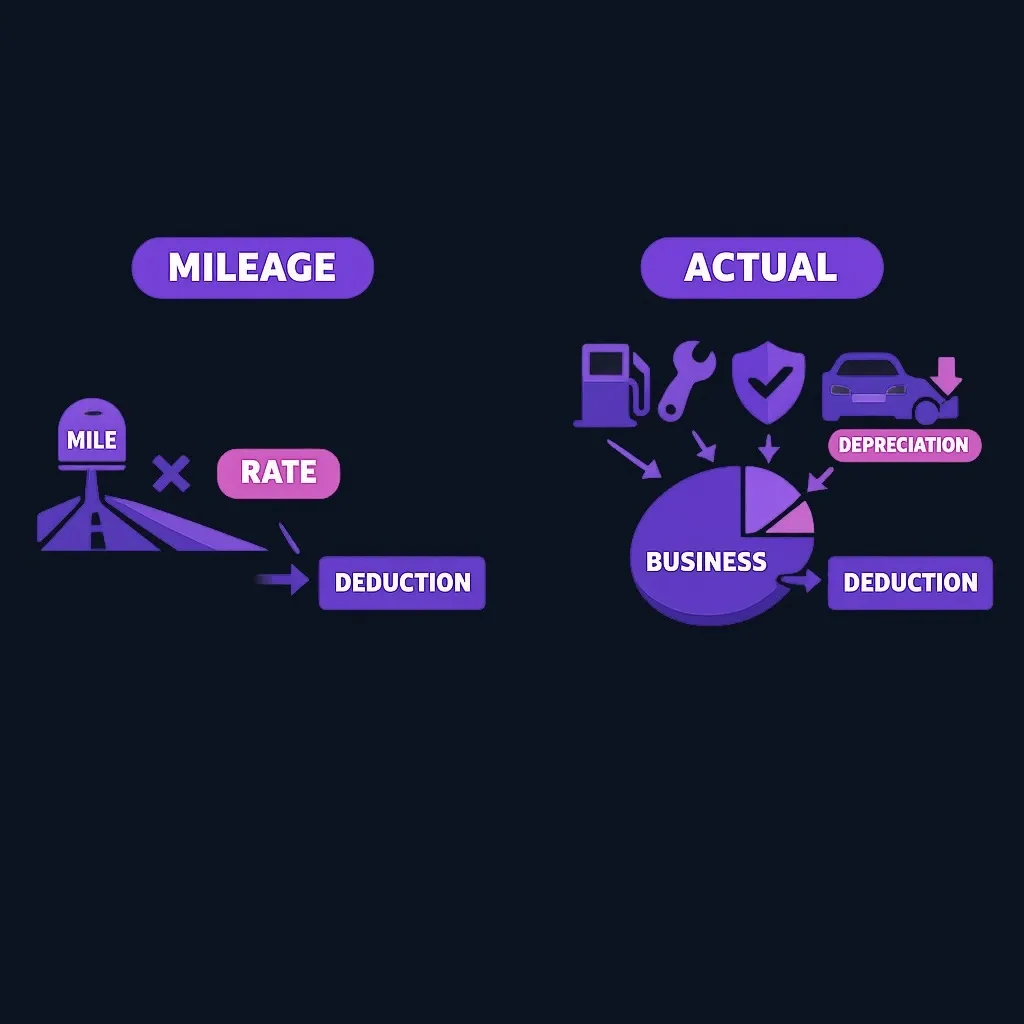
The standard mileage method multiplies eligible business miles by the applicable IRS rate. The actual-expense method uses the business share of eligible vehicle costs, including allowable depreciation. Compare both if you qualify, while checking restrictions on choosing or changing methods.
Neither method turns ordinary commuting into deductible business travel. This comparison is primarily for self-employed business use; ordinary employees generally cannot deduct unreimbursed vehicle expenses on their federal return, with exceptions for specified categories.
Use the rate for the date driven
As checked on September 28, 2026, the IRS mileage table lists two business rates for 2026:
| Period | Business rate per mile |
|---|---|
| January 1–June 30 | 72.5 cents |
| July 1–December 31 | 76 cents |
If a hypothetical driver records 4,000 eligible miles in the first period and 6,000 in the second, the calculation is $2,900 plus $4,560, or $7,460. Applying 76 cents to all 10,000 miles would be incorrect for that mileage pattern.

Compare with allowable actual costs
Under the actual method, determine the business share of eligible fuel, repairs, insurance, registration, lease costs or depreciation, and other permitted costs. Separate personal use. Do not automatically deduct every car-related payment, and do not add expenses already covered by the mileage method a second time.
The IRS vehicle-expense guidance explains recordkeeping and method restrictions. The first year of business use matters, and rules differ for owned and leased vehicles. Prior depreciation elections can limit your options.
Keep records under either method
Record dates, destinations, business purposes, miles, and total annual mileage. Keep receipts needed for actual expenses or separately deductible items. A rate table does not prove that a trip qualifies.
Calculate the allowable deduction under each available method for the same year. Then consider recordkeeping, later-year flexibility, and depreciation consequences. Check the official table again when preparing the return, especially in a year with a midyear rate change.
Build one mileage record that supports either method
Track total miles as well as business miles. The standard-mileage calculation needs eligible business mileage, while actual expenses generally require a supported business-use allocation. A record containing only selected client trips may be insufficient to establish the denominator for that allocation.

Record dates, distance, destination, and business purpose while the details are fresh. Distinguish personal trips and ordinary commuting from qualifying business travel. A car used mainly for work-related life is not automatically used entirely for deductible business driving.
Compare a dated mileage calculation with allowable actual costs
For a hypothetical 2026 example, assume 5,000 qualifying business miles in January–June and 5,000 in July–December. At the respective IRS rates of $0.725 and $0.76, the mileage amounts are $3,625 and $3,800, totaling $7,425 before separately allowable items. Applying the second-half rate to every mile would overstate this example by $175.
For actual expenses, gather eligible fuel, maintenance, insurance, registration, and other relevant records, and determine depreciation or lease treatment under the applicable rules. Allocate shared costs appropriately and handle business-only items as required. Do not compare the mileage result with the full cost of a partly personal vehicle. For self-employed taxpayers, a qualifying business share of loan interest can be separately deductible even with standard mileage. Business parking and tolls can also be separate; compare like-for-like totals without counting an item twice.
Practice trading with Finelo
Practice in a simulator, learn with bite-sized lessons, and build confidence before risking real money.
Check method eligibility before choosing the larger result
To preserve the standard-mileage option for an owned car, choose it in the first year the car is available for business use. For a leased car, choosing mileage generally commits you to that method for the lease period, including renewals. Depreciation elections and leased-vehicle rules can also limit switching. A spreadsheet showing a larger deduction does not make an otherwise unavailable method permissible.
Keep the vehicle's history: purchase or lease documents, first business-use date, prior methods, depreciation claimed, and annual business-use percentages. Those records make next year's decision easier and support the eventual sale or disposal calculation. The goal is a correct, documented deduction for actual business use, not whichever estimate happens to be largest.
How to compare your options
Use these practical criteria to pick a method. Each criterion includes a short worked takeaway.
Annual business miles
- Compare eligible business mileage using the rate for each applicable period with allowable actual expenses. More miles can increase the mileage-method amount, but that alone does not establish which eligible method produces the larger deduction.
Vehicle operating and ownership costs
- If your annual combined costs (fuel, repairs, insurance, registration, and allowable depreciation) are high, the actual-expense method often yields a larger deduction. See the IRS list of deductible car expenses in Publication 463 and compare totals to the standard-mileage calculation.
Recordkeeping tolerance
- Standard mileage requires a mileage log (date, miles, business purpose) and is simpler. Actual expenses require organized receipts and prorating when the vehicle is mixed-use. If you dislike bookkeeping, standard mileage is usually easier.
Depreciation and special rules
- Using actual expenses lets you claim depreciation (including potential first-year or Section 179 treatment where eligible), which can be decisive for expensive vehicles. The IRS rules on qualified vehicles and depreciation appear in Publication 463 and related guidance — check those before applying claimed depreciation.
Switching flexibility
- Tax rules limit switching between methods in certain cases; always confirm IRS instructions before changing methods for the same vehicle in later years.
Practical takeaway: estimate both methods once with your real numbers (or realistic estimates) using the current IRS rate. Then choose the method that yields the larger deduction and matches your recordkeeping bandwidth.
What is Standard Mileage?
The standard-mileage method applies the IRS business rate for the relevant travel period to qualifying business miles. Keep dates and business purposes, especially when the rate changes during a year. This article compares business-use methods; medical, charitable, and eligible moving mileage have separate rules. For a year with more than one rate, split the mileage by travel date before multiplying. Compare the result with the allowable business portion of actual costs, not all costs of a partly personal car.
What are Actual Expenses?
Actual expenses let you deduct the portion of your car's costs that apply to business use: fuel, oil, repairs, insurance, registration fees, licenses, lease payments or depreciation, and other operating costs, allocated by business-use percentage. The IRS describes these allowable expenses and allocation rules in Publication 463. Advantages: can exceed standard mileage when depreciation or high operating costs apply. Drawbacks: requires detailed receipts, prorating for personal use, and stronger documentation. (Example takeaway: total all eligible expenses for the year, multiply by the business-use percentage, and compare that value to the standard-mileage calculation before filing.)
When to choose each option
Use these scenario-driven rules-of-thumb and a small worked comparison to decide. Scenario A — high business mileage, low costs:
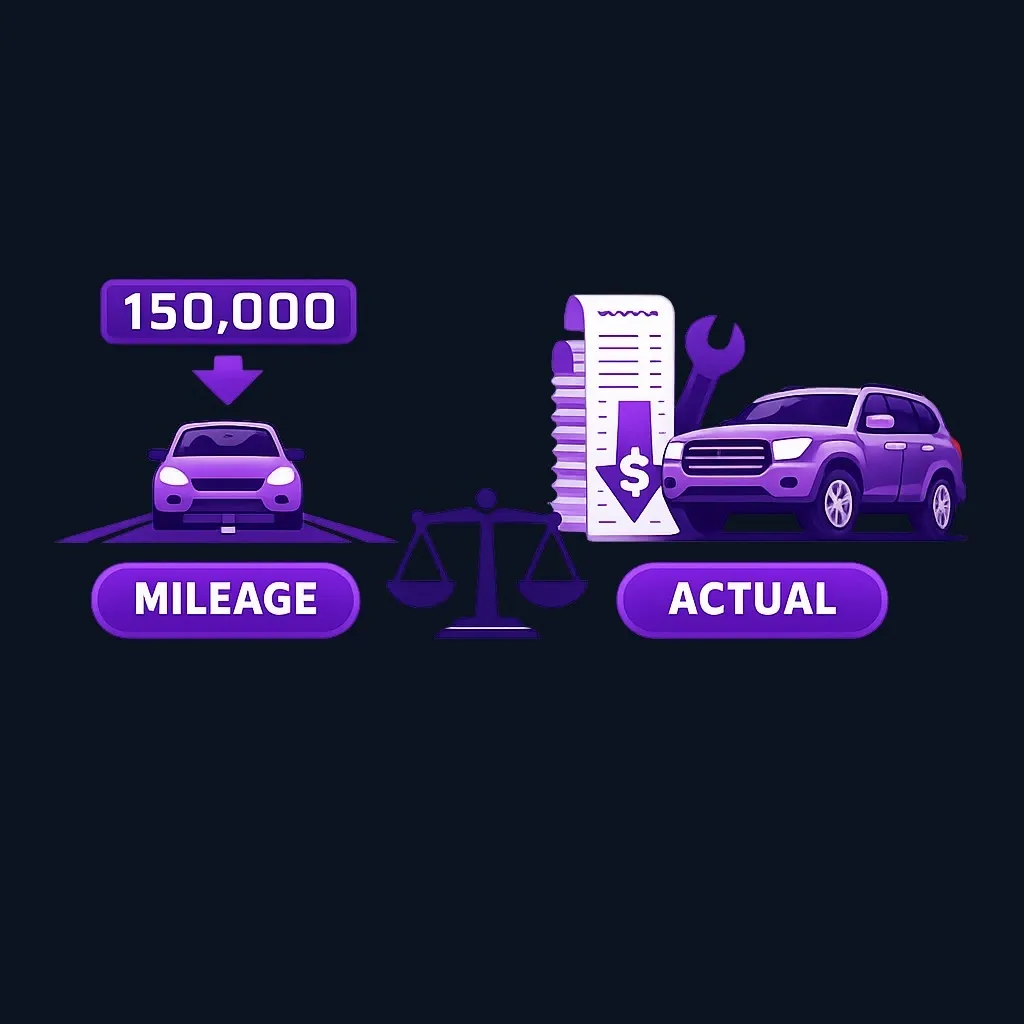
- You drive lots of business miles in a fuel-efficient, low-maintenance car. The standard-mileage method often wins because the applicable rate is multiplied by eligible miles and keeps bookkeeping light. Calculate each period’s miles at its applicable rate, then add the amounts.
Scenario B — expensive vehicle or heavy depreciation:
-
You have high annual depreciation or large eligible costs, such as expensive repairs. Actual expenses often yield a larger deduction because depreciation and fixed costs are included. Totals come from receipts and depreciation schedules; see IRS guidance for qualified vehicles.
-
When a vehicle is used for both business and personal driving, allocate expenses by business percentage. Keep mileage logs to substantiate the business-use fraction; IRS rules and examples are in Publication 463.
State-level variation:
- State tax treatment can differ. This page focuses on federal IRS guidance; check your state tax authority for any divergence.
Tradeoffs and caveats
Understand these common pitfalls and rules before you choose.
Common mistakes to avoid
- Incomplete logs: failing to record date, miles, and business purpose can lead to disallowed claims — keep contemporaneous entries.
- Mixing methods without checking rules: switching from standard mileage to actual expenses (or vice versa) can trigger limits — verify IRS switching rules in Publication 463 before changing.
- Forgetting depreciation: if you start with standard mileage, you may be limited in later years for claiming depreciation; check tax guidance on how prior choices affect depreciation eligibility.
- Poor receipt organization: actual-expense claims require receipts for verification; missing receipts can reduce or eliminate legitimate deductions.
Practical fix: maintain a simple mileage log app or spreadsheet for daily entries and scan receipts into a single folder monthly. Compare both methods at year-end using your real totals.
Which rate applies when it changes during the year?
Use the rate for the date of the qualifying travel. The 2026 business calculation separates January–June miles from July–December miles; keep the periods identifiable in the log.
What records do I need to keep for mileage deductions?
Keep a contemporaneous mileage log with date, starting and ending odometer or miles driven, and business purpose. For actual expenses, retain receipts, invoices, and records showing business vs. personal use. The IRS outlines required records and examples in Publication 463.
Can I use both methods for different vehicles?
Yes, you can use different methods for different vehicles, but IRS rules govern switching methods for the same vehicle and how depreciation is handled — consult Publication 463 before changing methods for a specific vehicle.
How often does the IRS update mileage rates?
The IRS updates mileage rates periodically (annually and sometimes midyear) and publishes the current and historical rates on its standard-mileage rates page.
A separate business deduction with two methods is Home office deduction: simplified method vs. actual expenses.
This guide covers U.S. rules. Finelo provides financial education, not personalized financial, investment, tax, or legal advice.
Financial LiteracyU.S. GuideFinancial Education
Practice trading with Finelo
Practice in a simulator, learn with bite-sized lessons, and build confidence before risking real money.
About the author
Finelo Team
The Finelo Team creates practical investing and trading education designed to help beginners learn faster with structured challenges, simulator practice, and bite-sized lessons.
Keep reading — Related articles

Financial Literacy
USDA vs. FHA loan
Compare location and income eligibility, down payments, credit conditions, and upfront and annual program charges for a home purchase.
Finelo Team

Financial Literacy
Term life vs. accidental death insurance
Compare broad term-life protection with accident-only coverage, including exclusions, underwriting, and the family income gap.
Finelo Team

Financial Literacy
Term life insurance laddering vs. one policy
Compare several term policies ending at different times with one policy, using coverage needs, costs, and future insurability.
Finelo Team


