Last editorial review: September 28, 2026
Student loan consolidation vs. refinancing
Compare a new federal consolidation loan with private refinancing, including the rate calculation and September 2026 repayment consequences.
11 min read
Practice trading with Finelo
Practice in a simulator, learn with bite-sized lessons, and build confidence before risking real money.
Want to learn more?
Practice in a simulator, learn with bite-sized lessons, and build confidence before risking real money.
Explore FineloExplore Finelo's 28-day challenges
Turn learning into a daily habit with guided challenge paths.
Federal Direct Consolidation combines eligible federal loans into a new federal loan. Private refinancing replaces loans with a new private loan. That difference determines whether federal repayment and forgiveness protections remain available.
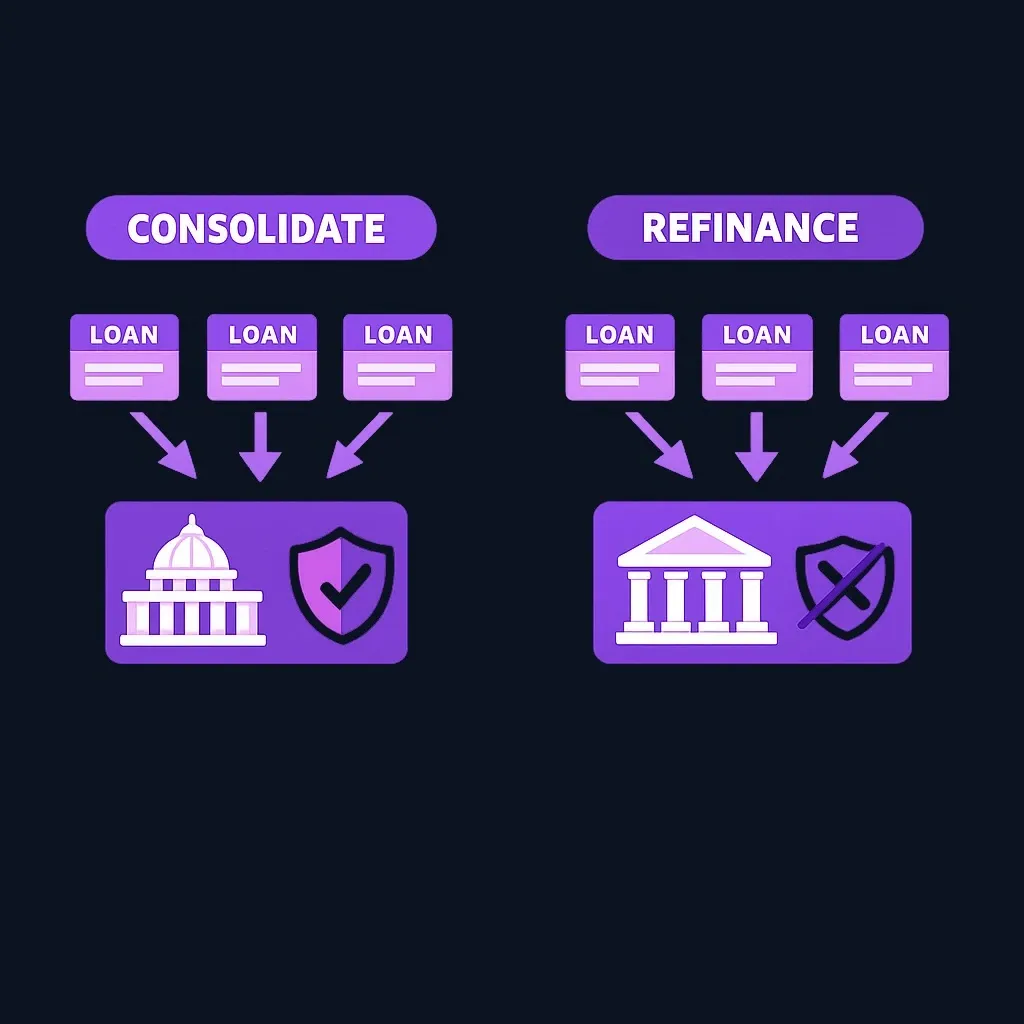
Start by identifying each loan's type, interest rate, disbursement date, and repayment status.
Compare the effect
| Feature | Federal consolidation | Private refinancing |
|---|---|---|
| New loan | Federal Direct Consolidation Loan | Private lender's loan |
| Rate | Weighted average of existing rates, rounded up to the nearest one-eighth percentage point | Based on lender pricing and qualification |
| Federal protections | Eligibility depends on the new loan and current rules | Lost for federal loans paid off through refinancing |
| Main purpose | Combine loans or change federal program eligibility | Seek different private pricing or terms |
The CFPB consolidation and refinancing guide explains the distinction. Federal consolidation is not usually a way to obtain a lower market rate.
How the consolidation rate is calculated
Federal Student Aid explains the weighted-average and rounding method. The balance of each loan determines its weight; this is not simply the average of the listed rates.
For example, $10,000 at 5% plus $20,000 at 6% gives a weighted average of about 5.6667%. Rounding upward to the nearest 0.125 percentage point produces a 5.75% consolidation rate. These are hypothetical balances and rates. Combining the loans simplifies the account structure; it does not reduce that weighted borrowing rate.
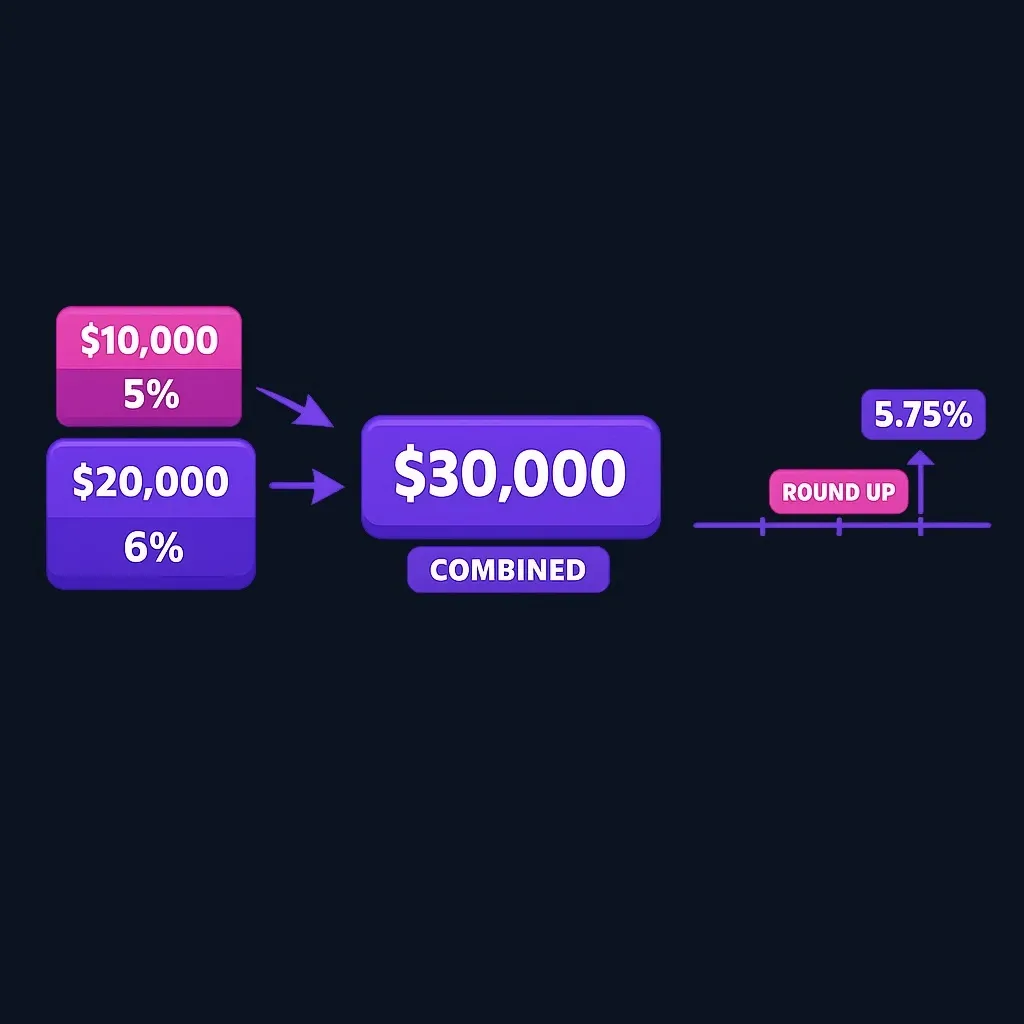
Any unpaid interest added to principal also affects the amount being financed. Compare the new balance and total repayment cost, not only the monthly payment.
Check the current program consequences
Under the rules in effect in September 2026, a new consolidation loan can change access to older repayment plans and to the Repayment Assistance Plan (RAP) or Tiered Standard plan. Parent PLUS loans and consolidation loans that repaid them have separate restrictions. Federal Student Aid’s August 2026 repayment-calculator guidance explains comparing consolidation on and off.
The disbursement date matters. MOHELA’s federal-loan FAQ explains that borrowers consolidating to access IBR, ICR, or PAYE needed the consolidation disbursed before July 1, 2026. An old loan does not automatically preserve its old options when replaced by a new consolidation loan. Do not rely on a pre-July checklist for an application now.
Ask specifically about income-driven repayment, forgiveness progress, Parent PLUS restrictions, and any interest added to the balance. A longer term can lower the payment while increasing total interest.
Separate federal and private decisions
Refinancing existing private loans can be a useful cost comparison. Refinancing federal loans is also a decision to surrender federal features, often irreversibly. Price that loss before focusing on the rate difference.
Request a written new-loan comparison showing payment, term, total cost, and benefits lost or gained. Use your current StudentAid.gov record and servicer information rather than an old generic consolidation checklist.
Inventory the loans before choosing a transaction
List each loan's federal or private status, balance, rate, disbursement date, repayment arrangement, and any forgiveness or cancellation progress. The servicer's name alone may not tell you every loan's program. Confirm the details in the official account records.
Then state the goal. Combining bills, gaining access to an available federal repayment option, obtaining a lower private rate, and removing a cosigner are different objectives. A transaction that solves one may make another less attainable. Ask how each existing loan will be treated after the change rather than assuming one result applies to the entire balance.
Practice trading with Finelo
Practice in a simulator, learn with bite-sized lessons, and build confidence before risking real money.
Price convenience separately from savings
A single payment can simplify administration without reducing interest. For a federal consolidation, the applicable weighted-rate and rounding rules matter. For private refinancing, compare the actual approved rate and term, including whether the rate is fixed or variable. A longer term can reduce monthly payments while increasing the total paid.
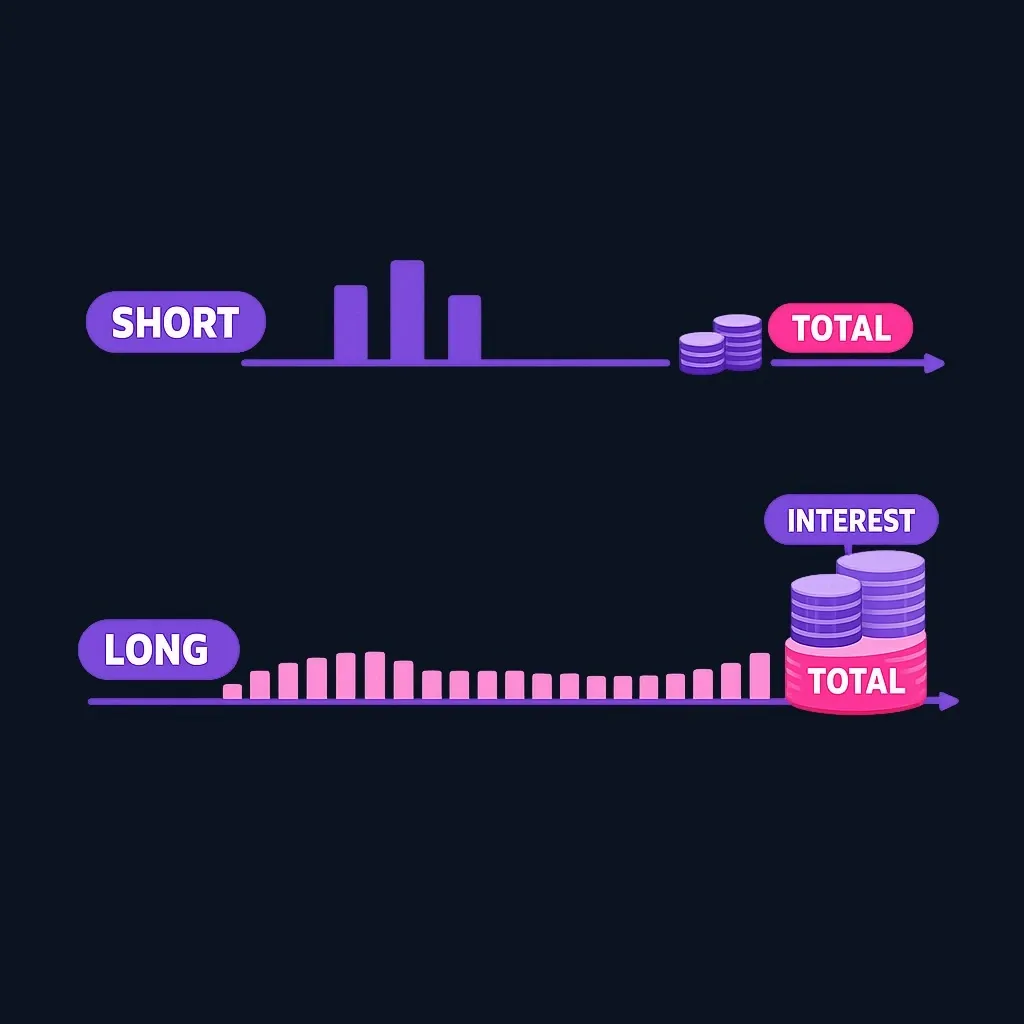
Keep the federal-protection decision separate from the rate comparison. Refinancing federal debt into a private loan gives up federal program features on that debt. The ability to reverse that decision should not be assumed. Evaluate possible future income disruption, not only today's comfortable salary.
Before signing, ask how current disbursement-date rules and program changes affect the specific loans. Save the written terms and verify that the old balances are paid after funding. Continue making required payments until the responsible servicer confirms otherwise; an application is not itself a payment pause.
What is Student Loan Consolidation?
Federal Direct Consolidation replaces eligible federal loans with a new federal loan. Private lenders sometimes use “consolidation” to describe refinancing several private loans together; check which transaction is actually being offered.
How consolidation works (high level)
- Federal consolidation: Eligible federal debt is replaced by a new Direct Consolidation Loan. This changes the loan itself, not merely the company sending the bill.
- Private consolidation: Private lenders may offer products that combine private student loans into a single loan. Availability and terms vary by lender.
Benefits
- One payment to manage: consolidation reduces multiple servicers and due dates to a single payment schedule.
- Simpler repayment tracking: having one account can make budgeting and autopay easier.
Drawbacks and pitfalls
- Not always a lower cost: consolidation does not guarantee a lower interest rate; program terms determine the new loan’s interest and schedule.
- Potential loss of features depending on the loan type and program (see Tradeoffs and caveats).
- Federal consolidation applications are free. Processing time, unpaid interest added to principal, and servicing changes still deserve attention.
What is Student Loan Refinancing?
Refinancing replaces one or more existing loans with a new loan under new terms offered by a lender. The new lender sets the interest rate, repayment term, and qualification criteria.
How refinancing works (high level)
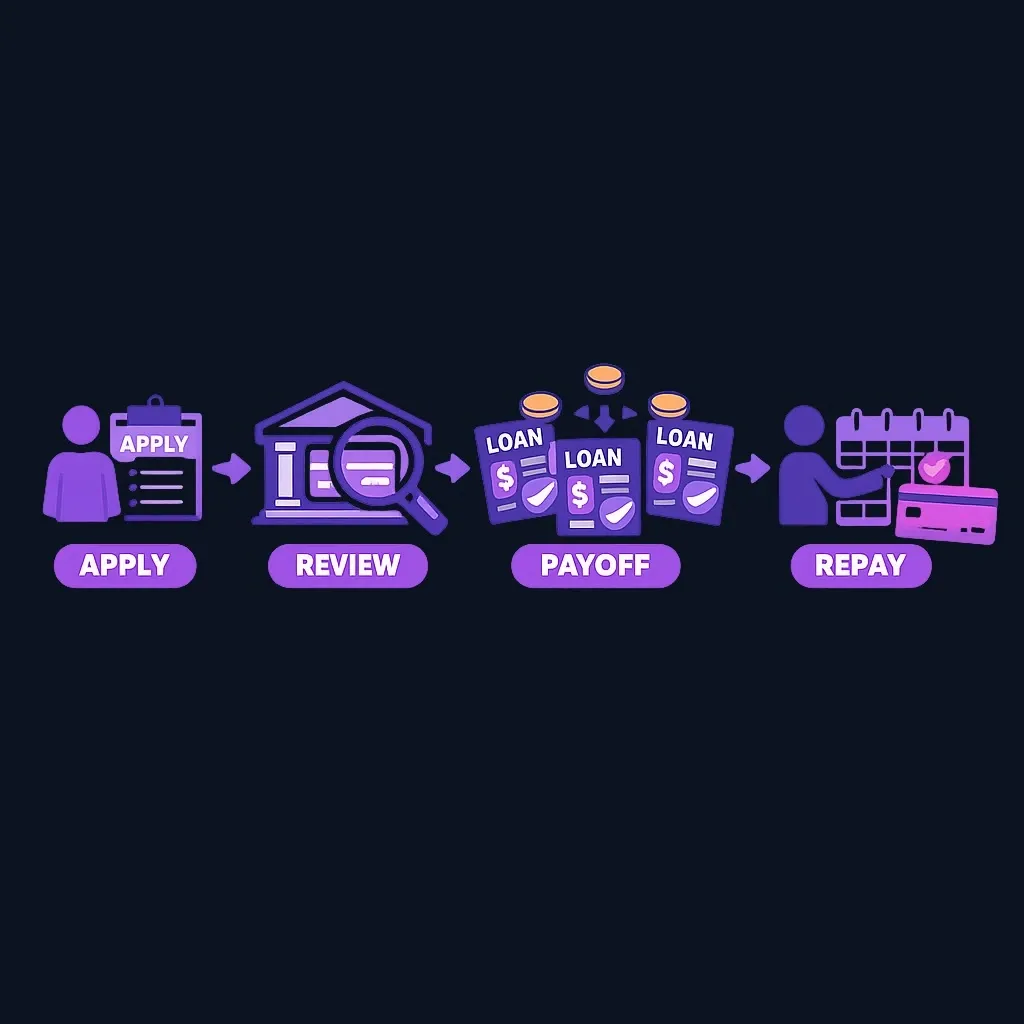
- You apply to a lender (often a private bank or credit union) who evaluates your credit, income, and debt to offer a loan with new terms.
- If approved and you accept, the lender pays off your old loans and you repay the new loan under its schedule and conditions.
Benefits
- Potential to lower your interest rate or monthly payment if you qualify for better terms from the new lender.
- Possible simplification — multiple loans rolled into one private loan.
Drawbacks and pitfalls
- Refinancing may remove access to federal loan programs and protections for loans that are converted into a private loan — confirm consequences with your servicer and lender.
- You must qualify under the new lender’s credit and income rules; approval is not automatic.
Use the CFPB guide linked above to compare the federal protections surrendered through private refinancing.
How to compare your options
Use these concrete criteria to decide whether to pursue consolidation or refinancing. Treat them as gates: if a criterion is essential to you, eliminate options that fail it.
1) Loan type and federal protections (non-negotiable check)
- If you have federal loans and rely on federal programs (income-driven repayment, certain forgiveness programs, or federal deferment/forbearance), preserving federal status is usually critical. Confirm what protections you currently use or anticipate needing.
2) Monthly payment versus total cost
- If your goal is a lower monthly payment, a longer term (via consolidation or refinancing) may help but increases total interest.
- If your goal is lower total interest, seek a lower rate or a shorter term — refinancing may achieve this for borrowers with strong credit.
3) Credit qualification and lender requirements
- Refinancing requires approval by the new lender based on credit, income, and debt-to-income ratio. If you cannot qualify, consolidation (especially federal programs for federal loans) may be the available path.
4) Simplicity and servicer management
- Consolidation can reduce multiple servicers into a single federal payment path when applicable.
- Refinancing reduces accounts to a new private servicer and may offer borrower-friendly features like autopay discounts; check the lender’s stated features.
5) Timing and future plans
- If you expect to pursue loan forgiveness (public service, teacher forgiveness, etc.), avoid actions that make you ineligible.
- If your income is likely to increase and you can qualify for better terms later, refinancing now or later should be timed to maximize benefit.
Consider federal consolidation after checking eligibility:
- The new consolidation loan provides the specific federal option you need under current rules. Keeping existing loans can be better when consolidation would remove a repayment option or affect forgiveness progress.
- You primarily want to simplify payments across multiple federal loans without changing loan status.
- You cannot qualify for private refinancing based on current credit or income.
Choose refinancing if:
- You have private loans, or you have federal loans but are confident you do not need federal protections and you qualify for a better rate from a private lender.
- Your credit score and income are strong enough that private lenders would offer materially lower rates or better loan terms.
- You prefer the private lender’s repayment features and are comfortable giving up federal loan status (if applicable).
Hypothetical borrower examples
These invented scenarios illustrate the decision process; they are not borrower case histories. Case A — The public-service borrower:
- Profile: Works in qualifying public service, uses income-driven repayment, plans long-term public service career.
- Decision logic: Preserving federal eligibility matters most. Before consolidating, the borrower checks the new repayment-plan eligibility and treatment of earlier qualifying payments. Simpler record-keeping alone is not enough to justify the change. Refinancing that converts loans to private status would jeopardize forgiveness eligibility.
Case B — The high-earning borrower with private loans:
- Profile: Stable high income, strong credit. Holds only private student loans with high rates.
- Decision logic: Refinancing to a new private loan could reduce rate and shorten term, potentially lowering total interest. A shorter term can increase the monthly payment even when the rate falls. Consolidation through a private lender could also simplify payments but offers similar tradeoffs; compare multiple lenders.
Case C — The mixed-loan borrower unsure about future needs:
- Profile: Holds both federal and private loans. Uncertain about future need for federal protections.
- Decision logic: Evaluate federal loans separately, including leaving them unchanged, and compare refinancing offers for private loans if that could lower cost. Avoid refinancing federal loans unless you’re confident you won’t need federal options.
Common mistakes and fixes
- Mistake: Refinancing federal loans without checking forgiveness eligibility. Fix: Verify eligibility for any federal programs you might use and ask your servicer how refinancing would change status.
- Mistake: Focusing only on monthly payment without calculating total interest. Fix: Use the full repayment schedule. For a fully repaid fixed-rate loan, scheduled payments minus the amount financed show interest; include any separately paid fees when comparing total cost.
- Mistake: Assuming consolidation always reduces paperwork and cost. Fix: Check program terms, capitalization, and servicing transitions. Federal consolidation does not require an application fee.
Tradeoffs and caveats
Make these tradeoffs explicit before you change loan status or servicers.
Impact on federal benefits (what to watch for)
- The options available to you differ by whether your loans are federal or private. For details on how consolidation and refinancing interact with federal/private loan types, see CFPB guidance on what consolidation and refinancing mean for different loan categories.
- Before refinancing federal loans with a private lender, confirm the consequences for any federal programs you rely on — doing so can change eligibility, timing, or availability of protections.
Timing, fees, and servicer changes
- Contact your current servicer(s) to understand timing, whether interest continues to accrue during processing, and any required documentation.
- Compare APR, any permitted fees, rate structure, borrower benefits, and total payments. Private education loans do not impose a prepayment penalty; read the offer rather than treating it as a generic personal loan.
Market considerations
- Refinancing offers depend on market rates and your credit profile. Compare written quotes obtained close together, with the same balance and term, rather than relying on advertised minimum rates.
What is the difference between consolidation and refinancing?
Consolidation groups multiple loans into one repayment arrangement; the specific program depends on whether loans are federal or private. Refinancing replaces your existing loans with a new loan issued by a lender that sets new terms and eligibility requirements.
How does refinancing affect my federal loan benefits?
Federal loans paid off by a private refinance lose federal loan protections and repayment programs. Confirm the effect for your specific loans with your servicer and lender before refinancing; the CFPB recommends reviewing available options based on loan type.
When should I consider consolidating my loans?
Consider consolidation when you need to simplify payments across multiple loans, especially if those loans are in the same loan system (federal or private). If you depend on federal repayment plans or forgiveness, verify the new loan’s eligibility and treatment of payment counts before consolidating. Retaining the existing loans is also an option.
What are the potential savings from refinancing?
Potential savings come from a lower interest rate or finding a shorter term that reduces total interest. Savings depend on the new rate, the term you choose, any fees, and your original loan terms. Compare total interest over the life of the loan (not just monthly payments) before deciding.
If the federal loan is already in default, start with Student loan rehabilitation vs. consolidation.
This guide covers U.S. rules. Finelo provides financial education, not personalized financial, investment, tax, or legal advice.
Financial LiteracyU.S. GuideFinancial Education
Practice trading with Finelo
Practice in a simulator, learn with bite-sized lessons, and build confidence before risking real money.
About the author
Finelo Team
The Finelo Team creates practical investing and trading education designed to help beginners learn faster with structured challenges, simulator practice, and bite-sized lessons.
Keep reading — Related articles
Financial Literacy
USDA vs. FHA loan
Compare location and income eligibility, down payments, credit conditions, and upfront and annual program charges for a home purchase.
Finelo Team
Financial Literacy
Term life vs. accidental death insurance
Compare broad term-life protection with accident-only coverage, including exclusions, underwriting, and the family income gap.
Finelo Team
Financial Literacy
Term life insurance laddering vs. one policy
Compare several term policies ending at different times with one policy, using coverage needs, costs, and future insurability.
Finelo Team