Last editorial review: September 28, 2026
Student loan rehabilitation vs. consolidation
Compare routes out of federal student-loan default, including qualifying payments, credit records, and current versus 2027 rules.
10 min read
Practice trading with Finelo
Practice in a simulator, learn with bite-sized lessons, and build confidence before risking real money.
Want to learn more?
Practice in a simulator, learn with bite-sized lessons, and build confidence before risking real money.
Explore FineloExplore Finelo's 28-day challenges
Turn learning into a daily habit with guided challenge paths.
If a federal student loan is in default, rehabilitation and consolidation can be routes back to repayment. Rehabilitation requires a qualifying payment process. Consolidation creates a new federal loan if you meet the conditions for consolidating defaulted debt.
Compare eligibility, timing, credit reporting, and the repayment options available afterward.
The main differences
| Feature | Rehabilitation | Consolidation |
|---|---|---|
| Process | Complete the required rehabilitation payments | Meet defaulted-loan consolidation conditions and obtain the new loan |
| Credit history | Default notation is removed after successful rehabilitation; earlier late payments can remain | Does not remove the default record in the same way |
| Timing | Requires completion of the payment process | May resolve default sooner, depending on eligibility and processing |
| Future payments | Based on the repayment options you then qualify for | Based on the new loan and current program rules |
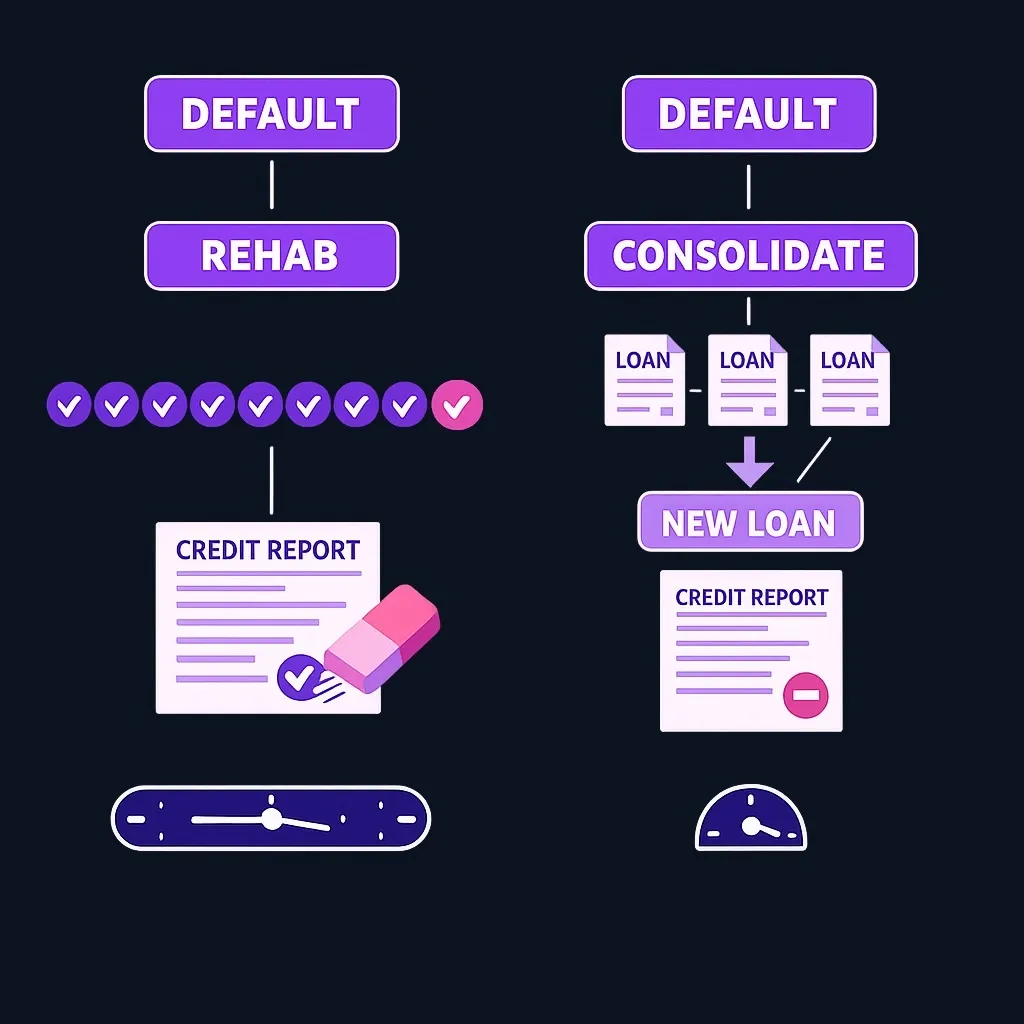
Federal Student Aid's rehabilitation FAQ explains the process. Direct and FFEL rehabilitation generally requires nine qualifying voluntary payments within ten consecutive months; Perkins rehabilitation generally requires nine consecutive qualifying monthly payments. An involuntary collection is not automatically a qualifying rehabilitation payment.

What consolidation requires when a loan is in default
One route is to make three consecutive, voluntary, on-time, full monthly payments under the required repayment arrangement before consolidation. Another is to agree to repay the new consolidation loan under an eligible income-driven plan. The federal definition of a satisfactory repayment arrangement explains both routes; eligibility for a particular plan still depends on the new loan and current rules.
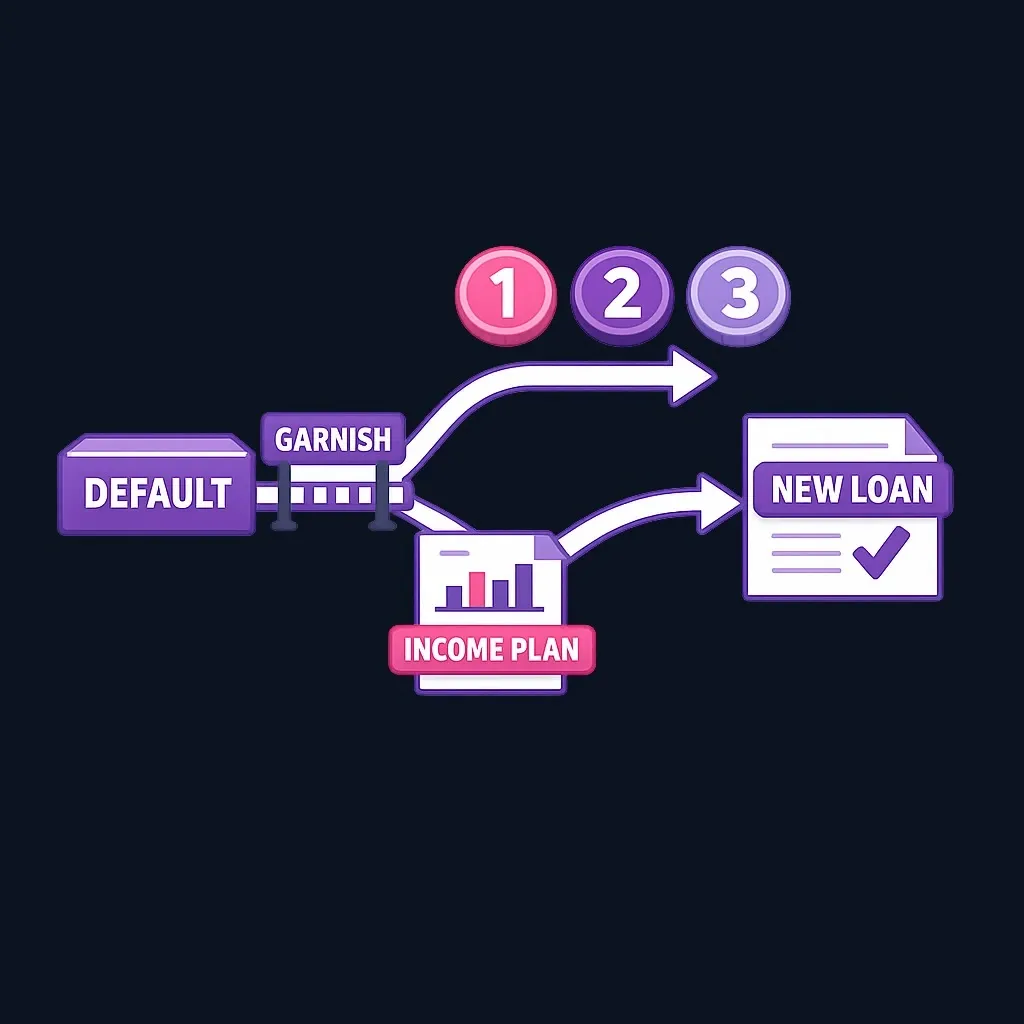
A judgment or an active administrative wage-garnishment order can also restrict consolidation unless the relevant condition is resolved. The consolidation regulation sets out those restrictions. Three payments are not a universal promise that every defaulted loan can immediately consolidate.
Prior rehabilitation and the 2027 change
As of September 28, 2026, a Direct Loan successfully rehabilitated on or after August 14, 2008 generally cannot be rehabilitated again if it returns to default. The Direct Loan regulation provides for a second opportunity beginning July 1, 2027. That future expansion should not be treated as an option already available in September 2026. FFEL and Perkins borrowers should establish their own program’s eligibility with the loan holder.
For a borrower who has never rehabilitated the loan and can sustain the required payment process, removing the default notation may be valuable. Someone needing another route must first establish consolidation eligibility and the payment due afterward. Neither route erases every earlier late-payment entry or guarantees a particular credit-score increase.
Do not stop at getting out of default
Ask what your payment will be afterward. Consolidation can change repayment-plan eligibility, especially under rules tied to new loans and 2026 disbursement dates. Use Federal Student Aid's repayment comparison guidance to check the new arrangement.
Also ask how current collection activity will be handled. Starting an application does not by itself establish that collections have stopped. Program rules, administrative pauses, and your account status can affect the answer.
Request an account-specific comparison
Identify the loan type and holder, prior rehabilitation history, payment requirements, projected completion date, and resulting repayment plan. Use the current rule for your loan type and application date.
Keep the written agreement and payment records. A successful exit from default should lead to an affordable continuing payment, not another default a few months later. Use official loan-holder and Federal Student Aid guidance rather than forum anecdotes about someone else's account.
Confirm the default status and the available route
Start with official records identifying the loan type, current holder or servicer, balance, and collection status. Different federal loan types can have different rehabilitation details. A prior rehabilitation, an existing consolidation, or legal collection restrictions can affect what is available now.
Ask for the exact requirements in writing. For rehabilitation, understand the payment amount, due dates, qualifying-payment rules, and what happens if a payment is missed. For consolidation, confirm the requirements for including a defaulted loan and the repayment arrangement that would apply afterward. An application submitted without satisfying those conditions may not resolve the default.
Practice trading with Finelo
Practice in a simulator, learn with bite-sized lessons, and build confidence before risking real money.
Compare the outcome after default is resolved
Rehabilitation and consolidation can have different credit-reporting consequences. Removing the default record does not mean every earlier late payment disappears or that a particular credit-score increase is guaranteed. Ask how the completed transaction will be reported and check the reports after processing.
Also compare the payment required on the resulting loan. A temporary rehabilitation payment and the later regular repayment amount need not be identical. The route is only sustainable if the borrower can manage the ongoing arrangement or qualifies for an available plan that makes it workable.
Keep the timeline tied to current rules
Federal student-loan rules are changing, and a future effective date should not be treated as a right available today. Use the rules for the date of the request and the actual loan. If a later change may affect eligibility, confirm how the servicer will apply it rather than relying on a general announcement.
Save the agreement, payment confirmations, and completion notice. Continue checking the account through any transfer to a new servicer. A default-resolution plan should end with a confirmed status and a clear next payment, not merely a completed application.
What a consolidation loan changes
A Direct Consolidation Loan replaces eligible federal debt with a new federal loan. It can sometimes include just one eligible loan; the number of bills is not the only reason to consider it. Special restrictions apply when an existing consolidation loan is being consolidated again.
For someone in default, the distinction is between resolving the current default and removing its historical record. An eligible, completed consolidation can resolve default. It does not provide rehabilitation’s removal of the default notation. A borrower should not reject consolidation on the mistaken belief that it only combines current loans, or select it expecting a clean credit history.
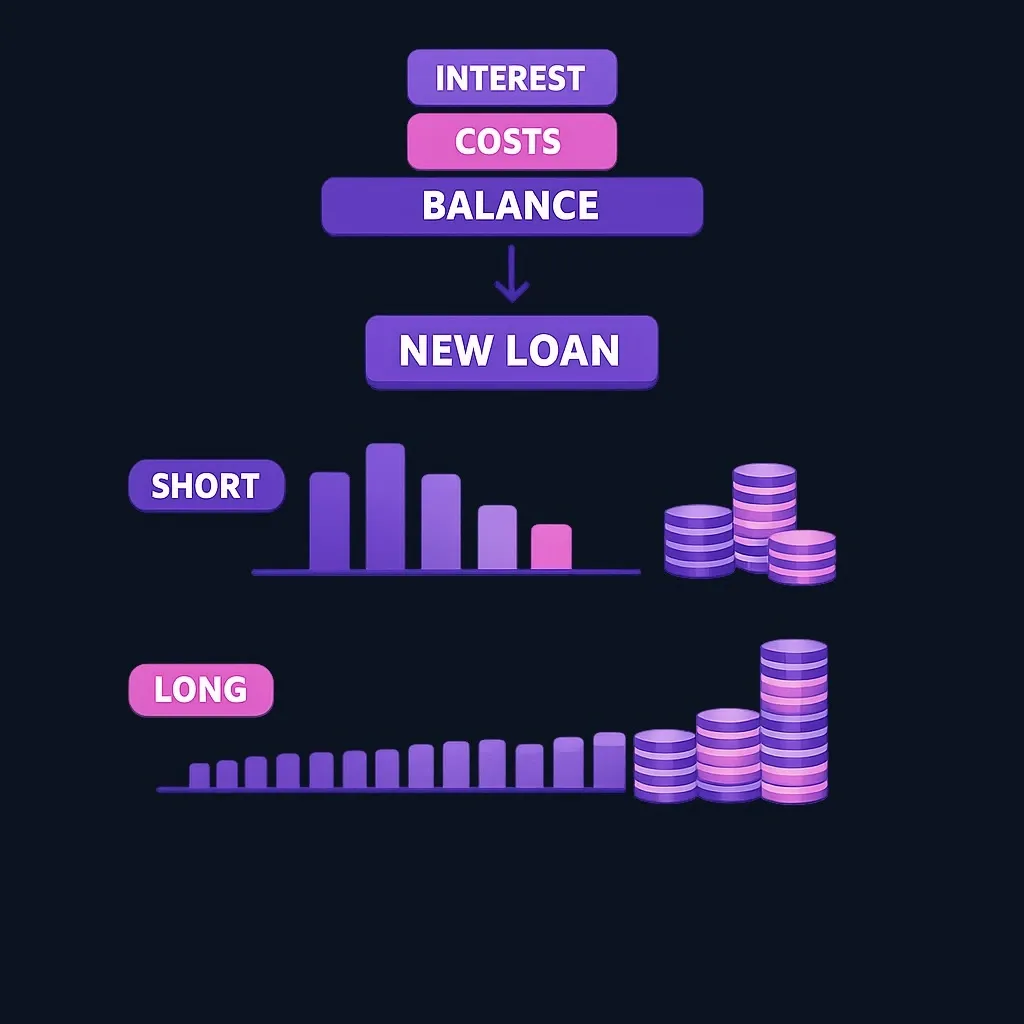
Ask for a breakdown of the proposed new balance. Unpaid interest and applicable collection costs can affect the amount owed. Then compare the monthly payment and estimated total repayment under the available plan. A smaller payment created by a longer schedule is useful breathing room, but it does not by itself establish that the debt is cheaper.
Compare the temporary payment with the continuing payment
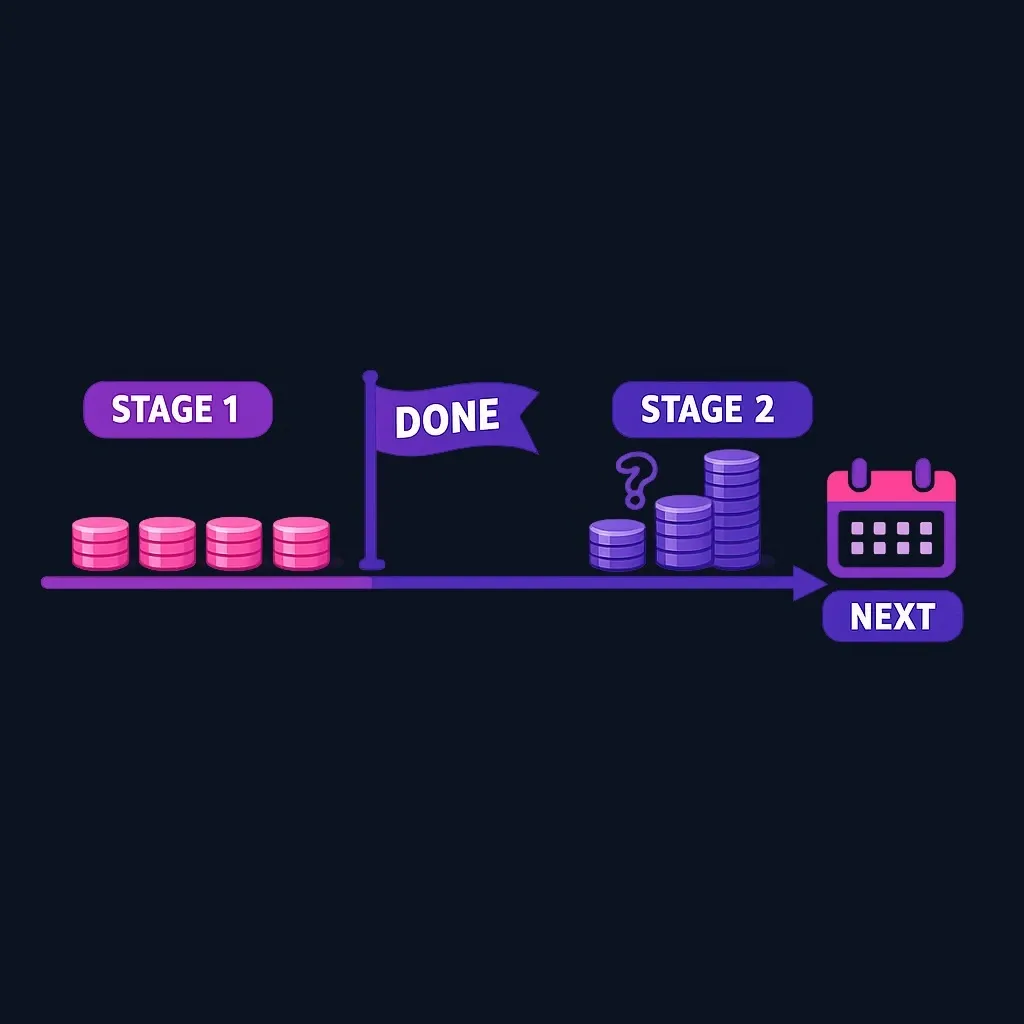
A rehabilitation agreement has its own payment calculation. That amount is not a quote for every payment after rehabilitation. Ask the loan holder to explain both stages: what must be paid to complete the agreement, and what regular repayment options may be available afterward.
Build the comparison around money left after essential household expenses. Include irregular bills such as vehicle repairs or annual insurance. An agreement that works only in a perfect month may be hard to sustain. If the proposed rehabilitation payment is unaffordable, tell the loan holder and ask about the process for reviewing income and expenses before assuming the quoted amount is your only option.
For consolidation, request the same practical information for the resulting loan. An application or online estimate is not proof that a plan has been approved. Keep the payment-plan confirmation and check the first statement against it. If the figures differ, contact the responsible servicer promptly.
A hypothetical borrower comparison
Imagine a borrower who has never rehabilitated the defaulted loan. Their employment has stabilized, but savings are limited. The borrower values removing the default notation and believes they can maintain the qualifying payment series. Rehabilitation may fit those priorities, provided the loan holder confirms eligibility and the continuing repayment options.
Now imagine another borrower facing a time-sensitive financial decision. They want to compare a potentially faster consolidation with rehabilitation. The appropriate comparison includes eligibility, processing time, the resulting balance, and credit reporting. Consolidation may address the current default without removing its history. A lender evaluating that history can still make its own credit decision.
These are illustrations, not promises about approval or timing. Neither borrower should infer that a particular credit score, future mortgage approval, or immediate end to collections follows from submitting paperwork. Written account-specific answers matter more than a story about someone else’s experience.
Questions to resolve before committing
Use one document to record answers for each loan. A borrower with different loan programs may need more than one conversation.
- Which loan identifiers and balances are covered by the agreement?
- Has this loan been rehabilitated before, and does that affect eligibility now?
- What payment amount, due date, and payment method will count?
- How does an existing garnishment or other collection action affect the route?
- What happens if a payment arrives late or is less than the required amount?
- How will completion be confirmed, and who will service the loan afterward?
- Which repayment plans will be available after completion under current rules?
- What will be reported to credit bureaus, and when should the borrower check it?
A useful answer names the loan, the action required, and the relevant date. “You should be fine” does not explain whether the next payment is due or whether a collection order remains active. Ask for clarification while the agreement can still be adjusted or the choice reconsidered.
Follow through after the final step
Keep payment confirmations throughout rehabilitation, then obtain the completion notice. If the loan transfers, save both the old and new account details. Verify the next due date, the approved repayment arrangement, and the status of automatic payments. Do not assume an existing automatic-payment instruction follows the loan to another servicer.
After consolidation, confirm which old balances were paid and which loans remain outside the new loan. Check the new statement against the approved terms. A remaining loan still needs attention even if the consolidated account now has one convenient payment.
Review credit reports after the change has been processed. If reporting does not match the confirmed outcome, use the reporting company’s and servicer’s dispute processes with supporting records. An accurate earlier late payment is different from an incorrect statement that the loan is still in default.
Does consolidation get a defaulted loan back into repayment?
It can, if the borrower and loans satisfy the conditions and the consolidation is completed. It does not remove the prior default record in the same way as successful rehabilitation. Federal Student Aid’s default-resolution comparison separates these outcomes.
How long does rehabilitation take?
For Direct and FFEL loans, the qualifying series is generally nine payments within ten consecutive months. Perkins loans generally require nine consecutive monthly payments. Processing and transfer can add time, so ask for the expected completion date rather than treating the last payment date as the entire timeline.
Can I rehabilitate and then consolidate?
That sequence may be possible, but it is not automatically beneficial. After rehabilitation, reassess whether a new consolidation loan would improve the available options or instead change repayment-plan eligibility and other benefits. Getting out of default is a reason to review the next step, not an instruction to take another loan transaction.
Before accepting a private replacement loan, distinguish Student loan consolidation vs. refinancing.
This guide covers U.S. rules. Finelo provides financial education, not personalized financial, investment, tax, or legal advice.
Financial LiteracyU.S. GuideFinancial Education
Practice trading with Finelo
Practice in a simulator, learn with bite-sized lessons, and build confidence before risking real money.
About the author
Finelo Team
The Finelo Team creates practical investing and trading education designed to help beginners learn faster with structured challenges, simulator practice, and bite-sized lessons.
Keep reading — Related articles

Financial Literacy
USDA vs. FHA loan
Compare location and income eligibility, down payments, credit conditions, and upfront and annual program charges for a home purchase.
Finelo Team

Financial Literacy
Term life vs. accidental death insurance
Compare broad term-life protection with accident-only coverage, including exclusions, underwriting, and the family income gap.
Finelo Team
Financial Literacy
Term life insurance laddering vs. one policy
Compare several term policies ending at different times with one policy, using coverage needs, costs, and future insurability.
Finelo Team