Last editorial review: September 8, 2026
Stock Options vs. RSUs: Key Differences
For most employees, stock options vs RSUs comes down to certainty versus upside. RSUs are usually easier to model because they deliver equity value after vesting. Stock options can offer…
12 min read
Practice investing with Finelo
Build practical investing skills with guided lessons, simulator practice, and structured challenges.
Want to learn more?
Build practical investing skills with guided lessons, simulator practice, and structured challenges.
Explore FineloExplore Finelo's 28-day challenges
Turn learning into a daily habit with guided challenge paths.
U.S. scope: This article discusses U.S. institutions, financial products, tax rules, and dollar examples unless stated otherwise. Rules and product terms may change; verify current official guidance for your situation.
Quick comparison answer
For most employees, stock options vs RSUs comes down to certainty versus upside. RSUs are usually easier to model because they deliver equity value after vesting. Stock options can offer more upside if the company’s share price rises above the exercise price, but they add exercise-cost, timing, tax, and expiration risk.
Both employee stock option plans and restricted stock units are common forms of equity compensation, according to FINRA’s employee stock award guidance (FINRA). This page is for employees comparing an offer, refresh grant, or liquidity decision.
Finelo is a financial education resource, so this comparison focuses on how to ask better questions before relying on equity compensation in a financial plan through Finelo’s learning hub.
What are Stock Options?
Stock options are equity awards that can give an employee the right to purchase company shares under the terms of a grant. The key word is “option.” The award may become valuable if the company’s share value rises enough above the exercise price.
That structure creates leverage. A small increase in company value can produce a larger percentage gain for the option holder. The reverse is also true. If the share value does not rise enough, the option may be worth little in practice.
The most important term is the exercise price, often called the strike price. This is the price used to calculate whether exercising the option makes economic sense. If the market value is far above that price, the option may have meaningful spread value. If it is below that price, exercising may not be attractive.

Options also create timing decisions. You may need to decide whether to exercise before you can sell shares. That can be difficult at a private company, where liquidity may depend on future company events or internal rules.
Tax complexity is another reason to slow down. The IRS identifies stock options as an area with potential issues, which is a useful warning before acting on a grant casually (IRS Publication 5992).
Stock option benefits and drawbacks
The main benefit is upside. Options can be powerful when the exercise price is low and the company later grows meaningfully. They can align employees with future appreciation rather than current share value.
The drawbacks are cash need, complexity, and uncertainty. You may need money to exercise. You may also need to understand taxes, liquidity, and departure rules before acting. Read the grant agreement, plan document, and equity portal materials before treating headline option counts as value.
What are RSUs?
Restricted Stock Units, or RSUs, are equity awards that are usually easier for employees to understand than options. Instead of asking whether a share price is above an exercise price, the central question is simpler: what are the vested shares worth?
That simplicity makes RSUs easier to compare with salary or bonus compensation. You can model several share-price outcomes and estimate a range of possible value. The estimate is still uncertain, but the payoff structure is easier to explain.
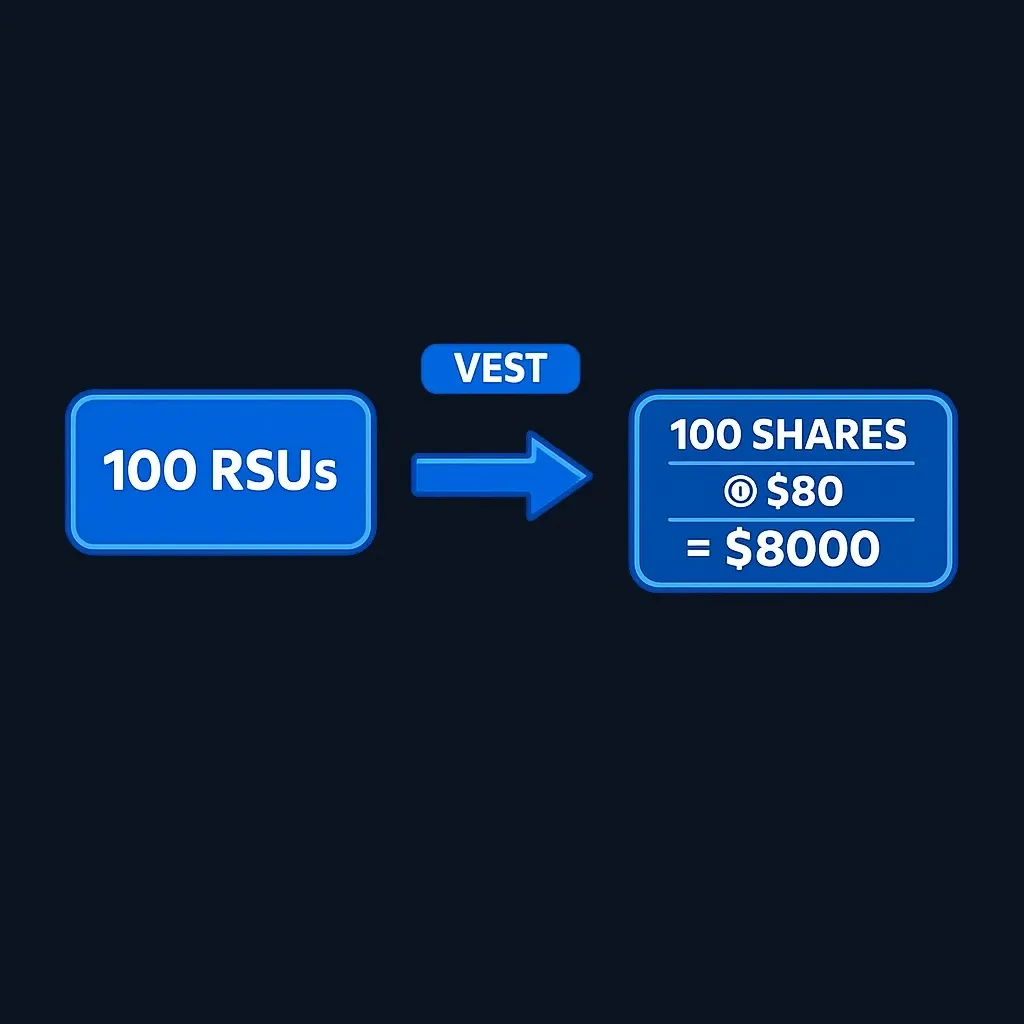
RSUs are not cash. Their value depends on the company’s share value when they vest and when you sell. If the company’s value falls, the award can be worth less than expected. If the company’s value rises, the award can become a larger part of your total compensation.
FINRA lists RSUs among common equity compensation types, which is why employees should ask detailed questions before relying on stock awards (FINRA). The label “RSU” is only the start. Vesting terms, settlement details, tax withholding, trading rules, and departure provisions can all affect the result.
RSU benefits and drawbacks
The biggest benefit is planning clarity. RSUs can still be volatile, but they do not require the same exercise decision as options. That can make them easier to include in a personal compensation review.
The drawback is concentration risk. RSUs can increase your exposure to one company. Your job, salary, bonus, and equity may all depend on the same employer. That can feel normal while you are employed, but it is still a real financial risk.
Side-by-side comparison table
| Criterion | Stock options | RSUs |
|---|---|---|
| Core payoff logic | Value depends heavily on appreciation above the exercise price. | Value depends mainly on share value after vesting. |
| Main employee question | “Will future appreciation justify the cost, timing, and risk?” | “How much company stock exposure am I comfortable holding?” |
| Cash need | May require cash to exercise. | Usually does not start with a purchase decision. |
| Complexity | Higher, because exercise timing, taxes, and liquidity matter. | Lower, though taxes, settlement, and selling rules still matter. |
| Downside experience | May have little practical value if appreciation is not enough. | Can lose value if company shares fall. |
| Best-fit situation | Higher-upside, higher-uncertainty compensation. | More straightforward equity planning. |
| Documents to review | Grant agreement, plan rules, exercise process, departure rules, tax materials. | Grant agreement, vesting schedule, settlement rules, trading policy, tax materials. |
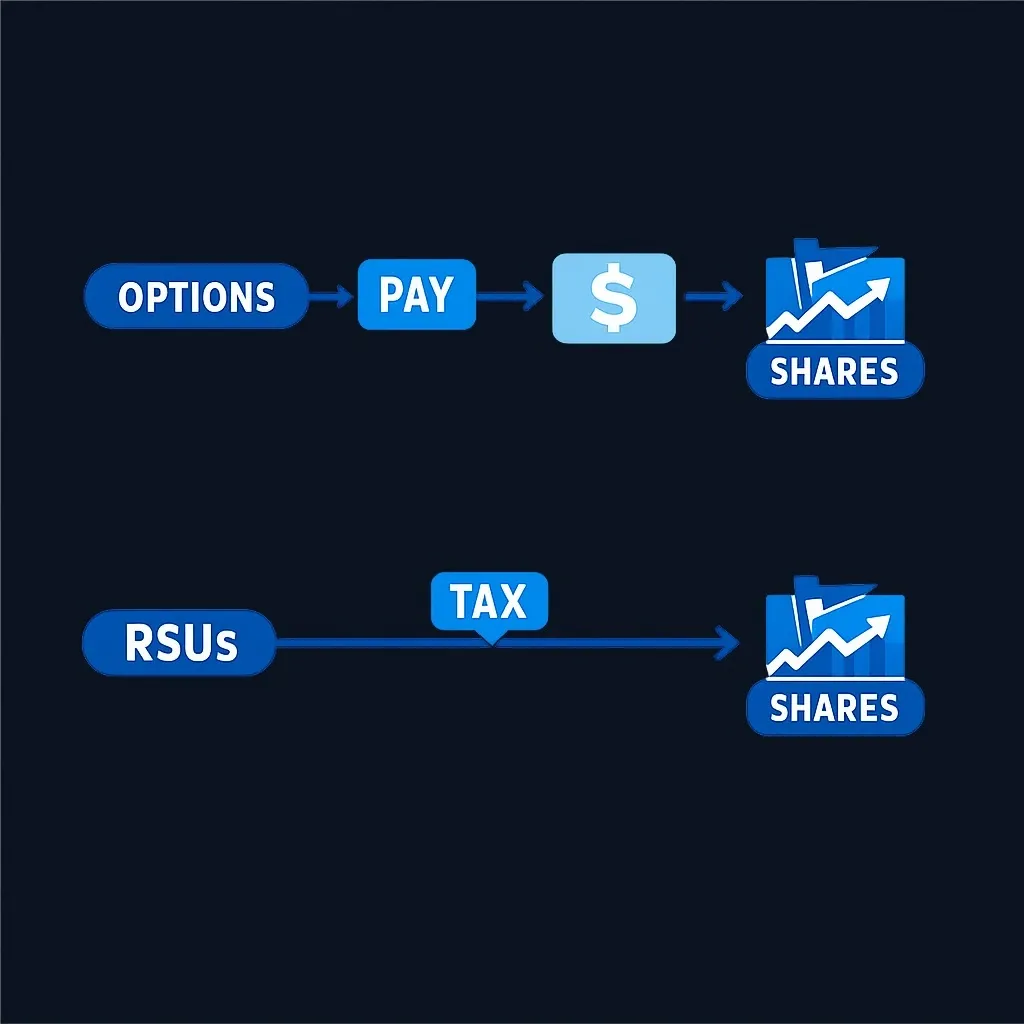
The practical difference is sequencing. With options, the hard question often comes before liquidity: should you exercise, and can you afford that risk? With RSUs, the hard question often comes after vesting: should you hold, sell, or diversify?
A useful shortcut is to separate “earning the equity” from “owning the stock.” Vesting answers the first question. Your financial plan answers the second. A vested award can still be risky if too much of your net worth depends on one employer.

Decision criteria
1. How much certainty do you need?
If you want compensation that is easier to model, RSUs may be simpler. You can build low, middle, and high share-price scenarios. The estimate may still move, but the structure is easier to follow.
Options require more assumptions. You need to think about future share value, exercise price, timing, tax treatment, liquidity, and departure rules. That does not make them bad. It means the headline grant size can be misleading.
2. How much cash can you commit?
Options can require cash before the outcome is clear. That is one of the biggest practical differences. If exercising would require emergency savings or borrowed money, the risk deserves extra attention.
RSUs can still create cash-flow questions, especially around taxes and withholding. But the decision usually does not begin with “Can I afford to purchase the shares?” That makes RSUs easier for employees who want less operational complexity.
3. How concentrated are you already?
Both awards can increase company-stock concentration. This risk is easy to miss because equity compensation arrives through work, not through a normal brokerage decision.
Use a simple exposure check. List your salary from the company, unvested equity, vested company shares, and other savings. If the employer dominates that list, the type of award matters less than total exposure.
4. What is the company stage?
At an early private company, options may be attractive because future appreciation is the main story. The upside can be meaningful, but liquidity is less predictable. Exercise windows, valuation changes, and tax treatment become important.
At a later-stage or public company, RSUs may feel more like recurring compensation. Employees may have clearer pricing and more direct liquidity paths. The decision often shifts toward taxes, diversification, and career risk.
5. What happens if you leave?
Leaving can change the practical value of an award. Vesting, exercise timing, settlement, and access to company information may all matter. The exact answer depends on the plan documents.
Before accepting an offer or resigning, ask for the documents that govern your award. FINRA’s guidance emphasizes asking questions about stock awards before relying on assumptions (FINRA).
When to choose each option
Stock options may fit when upside is the priority
Options may deserve more attention when you believe the company has meaningful growth potential. They may also be more appealing if the exercise price is low relative to plausible future value. In that situation, the structure can amplify appreciation.
Consider a realistic startup offer. One company offers more salary and fewer options. Another offers lower salary and a larger option grant. The second offer may suit someone with savings, patience, and higher risk tolerance. It may not suit someone who needs predictable cash pay.
The key question is not whether options are better. The better question is whether the possible upside compensates for lower certainty, exercise cost, tax complexity, and liquidity risk.

RSUs may fit when planning value matters
RSUs may fit better when you want equity that is easier to include in a compensation plan. They can be useful when comparing job offers because you can model vested value more directly.
Consider a public-company employee receiving annual RSU refresh grants. Each vesting date becomes a planning checkpoint. The employee can review taxes, selling restrictions, concentration, and whether holding more company stock still fits their goals.
RSUs can be especially useful for employees who do not want exercise decisions. The tradeoff is that they may offer less leveraged upside than options in a major growth outcome.
A simple four-part framework
Use this filter before comparing headline grant sizes:
- Value path: Does the award need major appreciation to matter?
- Cash need: Will you need to pay money before realizing value?
- Liquidity: Can you sell shares when value appears?
- Concentration: How much of your financial life depends on one company?
If the first two answers create stress, RSUs may be easier to manage. If you can absorb uncertainty and want asymmetric upside, options may be worth closer review. Either way, the documents control the actual outcome.
Practice investing with Finelo
Build practical investing skills with guided lessons, simulator practice, and structured challenges.
Tax Implications of Stock Options and RSUs
Taxes are one of the easiest places to make a costly mistake. The IRS specifically flags stock options as an area with potential issues, so employees should not treat exercise decisions as purely mechanical (IRS Publication 5992).
The cleanest approach is to turn tax uncertainty into questions before you act. Ask when taxable income may be recognized, how withholding works, and whether selling later could create a separate tax event. Also ask what records you need to keep.
For options, the key tax questions often involve exercise timing, share value, holding period, and sale timing. For RSUs, the questions often involve vesting, settlement, withholding, and later sale. The exact treatment can depend on the award type, employer plan, and your location.
A practical mistake is waiting until a deadline to ask tax questions. That creates pressure and reduces your ability to compare choices. Build a checklist before vesting, exercising, selling, or leaving the company.
Tradeoffs and caveats
Headline grant size can mislead
A large option grant can look more impressive than a smaller RSU grant. That comparison may be flawed because the payoff structures differ. Options depend on appreciation above an exercise price. RSUs depend more directly on share value after vesting.
When reviewing an offer, avoid comparing only the number of units. Instead, compare possible outcomes under conservative, moderate, and optimistic scenarios. Then subtract the friction: cash needs, taxes, liquidity, and risk.

Private-company equity needs extra caution
Private-company equity can be difficult to value from the employee’s perspective. A dashboard estimate may not equal spendable money. Liquidity can depend on company events, tender offers, acquisition terms, or public-market access.
This does not mean private-company equity is bad. It means you should discount uncertainty. If you need money for near-term goals, private equity value may not be a reliable substitute for cash compensation.
Employer incentives matter too
Companies use equity to attract, motivate, and retain employees. A vesting schedule can encourage employees to stay, but it does not remove business risk. Employees still need to understand what they are receiving.
Employers can also help by educating employees clearly. Useful education includes plain-language grant summaries, tax reminders, scenario examples, and clear explanations of departure rules. Avoiding jargon helps employees make better decisions.
FAQ
What is the difference between RSUs and stock options?
RSUs are generally easier to model because value is tied to vested share value. Stock options depend more on whether company shares appreciate above the exercise price. Both are common equity compensation types, according to FINRA (FINRA).
How are RSUs taxed?
The exact tax treatment depends on the award terms, employer process, and your situation. Ask when income may be recognized, how withholding works, and what happens if you sell shares later. Do this before vesting dates, not after.
What happens to unvested RSUs if I leave the company?
Departure rules depend on the grant agreement and plan documents. Ask how leaving affects unvested awards, settlement timing, and any access to equity information. Do not rely only on a recruiter summary.
What are the advantages of stock options?
The main advantage is upside if the company’s value rises meaningfully above the exercise price. The tradeoff is higher complexity. Exercise cost, taxes, liquidity, and timing can all affect the final result.
Conclusion
RSUs are usually easier to understand and plan around. Stock options can offer more upside, but they demand more judgment about exercise cost, taxes, liquidity, and future appreciation.
Before valuing either award, collect the grant agreement, vesting schedule, plan rules, tax materials, and departure terms. Then model several outcomes rather than one optimistic case. If the decision affects a large part of your compensation or net worth, consider speaking with a qualified tax or financial professional before acting.
Sources and Further Verification
More from Finelo
- Cashless Exercise of Stock Options: Costs, Taxes, Risks, and Alternatives
- Early Exercise of Stock Options: Taxes, Costs, Risks, and When It May Fit
- Best Stock Market Movies for Beginners in 2026
Disclaimer
This article is provided by Finelo for educational and informational purposes only. Finelo does not provide financial, investment, tax, legal, or insurance advice. Consider your circumstances and consult an appropriately qualified professional before making financial decisions.
InvestingBeginner GuideFinancial Education
Practice investing with Finelo
Build practical investing skills with guided lessons, simulator practice, and structured challenges.
About the author
Finelo Team
The Finelo Team creates practical investing and trading education designed to help beginners learn faster with structured challenges, simulator practice, and bite-sized lessons.
Keep reading — Related articles

Investing
Yield to Call vs Yield to Maturity: Assumptions and Bond Risks
Yield to call (YTC) estimates a bond's yield if the issuer redeems it on an eligible call date; yield to maturity (YTM) estimates yield if it remains outstanding to final maturity.
Finelo Team

Investing
Will My Employer Know If I Take a 401(k) Loan?
Who this page is for: readers new to 401(k) loans who want a practical, privacy‑focused explanation — what your employer can see, how to limit visibility, and the financial tradeoffs to weigh.
Finelo Team

Investing
What Medical Expenses Qualify for a 401(k) Hardship Withdrawal?
Before you decide, confirm three things with your plan administrator:
Finelo Team